Dungeon Master Assistance

Where anyone over 18 can share thoughts and ideas on RPGs.

Tag Archives: player character

D&D – Player Character Image Gallery


These are the images I used for all of the different character sketches for the ready-to-play character sheets. If you are trying to decide which character type to play in your next Dungeons and Dragons game, these images may give you a little inspiration.

D&D 3.5 – Animal Companion / Familiar Character Sheets

Animal-Sheet

Animal-Sheet

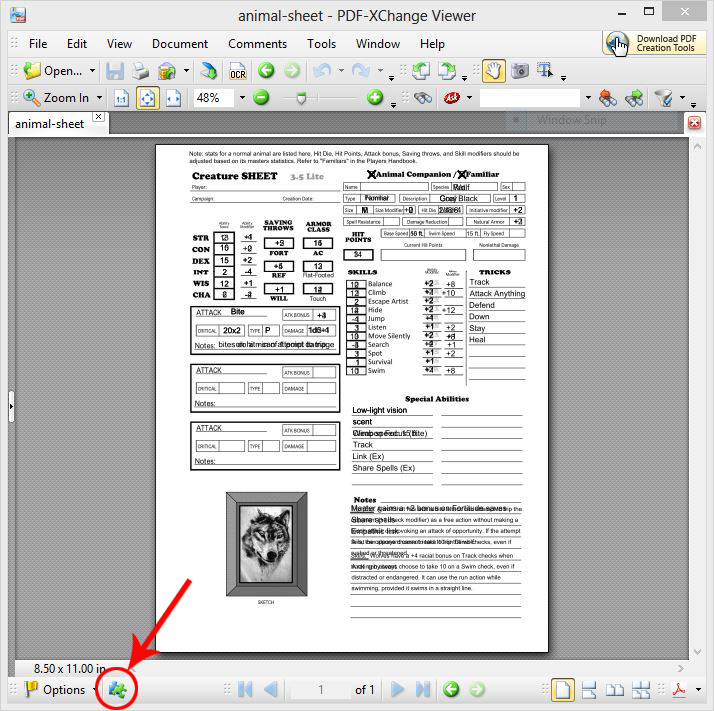
This is a character sheet for animal companions and familiars for Dungeons and Dragons Lite.

This is a multi-layer PDF file. When you open it, it will be unreadable until you turn off some of the layers. To use it simply turn off all of the layers except for those that contain the information you desire.

1) For a blank sheet – turn off all of the layers except for the “Sheet” layer.

2) Turn on the layer “Animal Companion – Wolf”  for a ready-to-play wolf animal companion.

-or-

2) Turn on the layer “Familiar-Rat” for an almost ready-to-play rat familiar. It has the information filled in for a normal rat, but you will need to adjust its statistics based on your player character’s as explained in the 3.5 Players’ Handbook.pdf-xchange_1

pdf-xchange_2

Please let me know if you discover any mistakes, or if you think I should have created these differently.

UPDATE: There is now a fillable version of this popular file – Find it on this post: Animal Companion / Familiar Character Sheets – Fillable

UPDTATE 2: By request – you can now download a completely blank version (no layers) for those of you who prefer to print out a bloak sheet and fill it in by hand. Click on this link  animal-sheet-blank

D&D 3.5 – Fast-Play Character Sheets

Character-Sheet

Human-Sheet-Front                   Human-Sheet-Back

Half-orc-Sheet-Front                 Half-orc-Sheet-Back

Halfling-Sheet-Front                  Halfling-Sheet-Back

Half-elf-Sheet-Front                  Half-elf-Sheet-Back

Gnome-Sheet-Front                  Gnome-Sheet-Back

Elf-Sheet-Front                          Elf-Sheet-Back

Dwarf-Sheet-Front                  Dwarf-Sheet-Back


These are fast-play first level character sheets for Dungeons and Dragons Lite.

They are multi-layer PDF files. When you open them they will be unreadable until you turn off some of the layers. To use them simply turn off all of the layers except for those that contain the information you desire.

1) Download the front and back sheet for your character’s race.

2) For a blank sheet – turn off all of the layers except for the “Sheet” layer.

3) Turn on the “Class” layer for the class you are going to play to get all of the standard information, including the default equipment, for your character. You can print this out and it will be ready for you to add a background skill and to roll your ability scores. Everything for a first level character will be filled in that is not dependent on your ability scores.

4) Turn on the “Abilities” layer for the class you are going to play to get a ready-to-play character sheet. Everything except the character’s name, sex and description will be filled in and ready to use. The “Abilities” layer and the “Class” layer must both be for the same class or the numbers won’t add up correctly.

5) Optionally – on the Back sheet – you can turn on a “Sketch” layer for your character class. This will give you a drawing of your character. (These were all found on the internet, converted to black and white and scaled to fit on the sheet. They are all male characters.)

EXAMPLE: If you want a ready-to-play first level Half-orc Monk character. Download the files “Half-orc-Sheet-Front.pdf” and “Half-orc-Sheet-Back.pdf”. Open both of them using Acrobat Reader. On the Layers menu turn off (by clicking on the little eye beside the layer name) all of the layers except for these: “Sheet”, “Race_Half-orc”, “Class-Monk”, and “Abilities-Monk”. On the Back sheet, you can turn on the layer “Sketch-Monk” for a drawing of the character. Print both sheets (they are designed to print on the front and back side of a single sheet). Now all you have to do is fill in the name and sex and you are ready to play. The character’s description on the back side has been left blank for you to describe him as you see fit.


BEHIND THE DOUNGEON MASTER’S SCREEN

(For those of you that are interested in what I did and why I did it this way.)

For abilities I used this default ability array: 18, 16, 14, 12, 10, 8

This makes for interesting characters with everyone having some ability that they excel at and one that they are very bad at. With most of the abilities above average this makes for heroic characters.

I then assigned the abilities (highest to lowest) based on the character’s class.

Barbarian, Fighter, Monk: STR/DEX/CON/WIS/CHA/INT

Bard, Sorcerer: CHA/DEX/CON/INT/STR/WIS

Cleric, Druid: WIS/CHA/INT/STR/ DEX/CON

Paladin:  CHA/STR/DEX/ INT/WIS/CON

Ranger, Rogue:  DEX/STR/WIS/INT/CON/CHA

Wizard: INT/DEX/CON/WIS/CHA/STR


I tried my best to make the abilities work well for each class. I am sure others might have assigned them differently.

On a side note – I originally intended to have at least one class have an ability score of 8 (a -1 ability modifier) for each of the abilities, but I decided not to give anyone a score of 8 in Dexterity. Strictly interpreting the rules, if your character’s dexterity score is very low he is easier to hit if he is aware of the attack than if he isn’t! This is the result of a negative DEX modifier on his armor class. This reminds me of Jar Jar Binks leaning into the punches, but I think that even his flat-footed AC would be lower than his normal or touch AC.

Next I applied the standard ability score modifiers for each race.

Then, based on their ability modifiers, I modified or calculated:

– Saving throws

– Initiative (Dex)

– Armor class (Dex) [and (Wis) for monks]

– Hit points (Con)

– Melee weapon attack (Str)

– Ranged weapon attack (Dex)

– All of the skills [I selected a skill that I thought would be useful for a background skill]

– Loads (Str)

I also gave the classes these default Alignments:

Barbarian, Chaotic Neutral / Bard, Chaotic Good / Cleric, Matches his Deity / Druid, True Neutral / Fighter, Lawful Neutral /Monk, Lawful Neutral / Paladin, Lawful Good / Ranger, Neutral Good / Rogue, Chaotic Neutral / Sorcerer, Chaotic Neutral/ Wizard, Lawful Neutral


A lot of people are not familiar with multi-layer PDF files, but if you have any trouble turning layers on and off just let me know.

This gives you a total of 77 different ready-to-play characters.

Please let me know if you discover any mistakes, or if you think I should have created these differently.

D&D 3.5 – Iconic Rogue

Thinking of playing a Rogue? Here is an excellent article regarding the pros and cons of playing a Rogue: Rogues  with Class By Skip Williams.

Here is the information for playing an iconic Rogue character. Start with my post on Iconic Characters, then add this specific information.

Hit Die: d6

Class Skills: Climb, Decipher Script, Disable Device, Hide, Listen, Move Silently, Open Lock, Search, Sleight of Hand, Use Magic Device

Class Knowledge: Local

Special abilities:
The following are the special abilities available to Rogues. The abilities are listed under the level that they are acquired. Where an ability is described as (ref PHB), you should refer to that ability’s description in the players handbook.

1st Level
Deceitful: You get a +2 bonus on all Disguise checks and Forgery checks.
Sneak Attack: +1d6 damage when flanking target. (ref. PHB)
Trapfinding: Can use search to find traps with DC20 or higher and can use Disable Device to disarm magic traps. Beat a traps DC by 10 or more to bypass it without disarming it.
2nd Level
Evasion:  Take no damage on a successful Ref saving throw against an attack that normally deals half damage on a save.
3rd Level
Deft Hands: You get a +2 bonus on all Sleight of Hand checks and Use Rope checks.
Sneak Attack: Like Sneak Attack above, but now you get +2d6 damage
Trap Sense: +1 on Ref saves made to avoid traps and +1 dodge bonus to AC against attacks made by traps.
4th Level
Ability Score Adjustment: Add 1 to any ability score.
Uncanny Dodge: Retain Dexterity bonus to AC (if any) even if flat-footed or struck by an invisible attacker.
5th Level
Sneak Attack: Like Sneak Attack above, but now you get +3d6 damage
6th Level
Diligent: You get a +2 bonus on all Appraise checks and Decipher Script checks.
Trap Sense: Like Trap Sense above, but your bonuses become +2.
7th Level
Sneak Attack: Like Sneak Attack above, but now you get +4d6 damage
8th Level
Ability Score Adjustment: Add 1 to any ability score.
Improved Uncanny Dodge: Can no longer be flanked, unless by another rogue at least 4 levels higher.
9th Level
Improved Initiative: You get a +4 bonus on initiative checks.
Sneak Attack: Like Sneak Attack above, but now you get +5d6 damage
Trap Sense: Like Trap Sense above, but your bonuses become +3.
10th Level
Special  Ability (Crippling Strike): Sneak attack deals an additional 2 points Strength damage.
11th Level
Sneak Attack: Like Sneak Attack above, but now you get +6d6 damage
12th Level
Ability Score Adjustment: Add 1 to any ability score.
Nimble Fingers: You get a +2 bonus on all Disable Device checks and Open Lock checks.
Trap Sense: Like Trap Sense above, but your bonuses become +4.
13th Level
Sneak Attack: Like Sneak Attack above, but now you get +7d6 damage
Special  Ability (Improved Evasion): Like Evasion above, but now you also take only half damage on a failed save.
14th Level
No special abilities added at this level.
15th Level
Quick Draw: You can draw a weapon as a free action instead of as a move action. You can draw a hidden weapon (see the Sleight of Hand skill) as a move action. You may throw weapons at your full normal rate of attacks (much like a character with a bow).
Sneak Attack: Like Sneak Attack above, but now you get +8d6 damage
Trap Sense: Like Trap Sense above, but your bonuses become +5.
16th Level
Ability Score Adjustment: Add 1 to any ability score.
Special  Ability (Defensive Roll): Once a day, when damage from combat would reduce you to 0 or fewer HP, you can attempt to roll with the damage to get half damage. (ref. PHB)
17th Level
Sneak Attack: Like Sneak Attack above, but now you get +9d6 damage
18th Level
Stealthy: You get a +2 bonus on all Hide checks and Move Silently checks.
Trap Sense: Like Trap Sense above, but your bonuses become +6.
19th Level
Sneak Attack: Like Sneak Attack above, but now you get +10d6 damage
Special  Ability (Slippery Mind): ref PHB
20th Level
Ability Score Adjustment: Add 1 to any ability score.

D&D 3.5 – Iconic Ranger

Thinking of playing a Ranger? Here is an excellent article regarding the pros and cons of playing a Ranger: Rangers with Class By Skip Williams.

Here is the information for playing an iconic Ranger character. Start with my post on Iconic Characters, then add this specific information.

Hit Die: d8

Class Skills: Climb, Handle  Animal, Move Silently, Track, Search, Spot and Survival

Class Knowledge: Geography

Special abilities: The following are the special abilities available to Rangers.  The abilities are listed under the level that they are acquired. By the time your character reaches second level he must specialize in one of two different combat styles.  He can choose between the archery combat style and the two-weapon combat style. As indicated in the table below – some of the special abilities he receives as he advances in level will depend on the combat style he pursues. Where an ability is described as (ref PHB), you should refer to that ability’s description in the players handbook.

1st Level
Skill Focus (Survival): You get a +3 bonus on all Survival checks.
Favored Enemy: Select a type of creature from Table 3–14: Ranger Favored Enemies. You get a +2 bonus on Bluff, Listen, Sense Motive, Spot, and Survival checks against creatures of this type, and a +2 bonus on weapon damage
Wild  Empathy:  Can improve the attitude of an animal with a successful Cha check.
2nd Level
Combat Style: Select one of two combat styles to pursue: archery or two-weapon combat. You lose all benefits of your combat style when wearing medium or heavy armor.
Rapid Shot:  [If you are pursuing the archery combat style] You can get one extra attack per round with a ranged weapon. The attack is at your highest base attack bonus, but each attack you make in that round (the extra one and the normal ones) takes a -2 penalty. You must use the full attack action to use this ability.
-or-
Two-Weapon Fighting: [If you are pursuing the two-weapon combat style] Your penalties on attack rolls for fighting with two weapons are reduced. The penalty for your primary hand lessens by 2 and the one for your off hand lessens by 6. See the Two-Weapon Fighting special attack.
3rd Level
Endurance: You gain a +4 bonus on the following checks and saves: Swim checks made to resist damage, Constitution checks made to continue running, Constitution checks made to avoid damage from a forced march, Constitution checks made to hold your breath, Constitution checks made to avoid damage from starvation or thirst, Fortitude saves made to avoid damage from hot or cold environments, and Fortitude saves made to resist damage from suffocation. Also, you may sleep in light or medium armor without becoming fatigued.
Point Blank Shot: [If you are pursuing the archery combat style] You get a +1 bonus on attack and damage rolls with ranged weapons at ranges of up to 30 feet.
-or-
Two-Weapon Defense: [If you are pursuing the two-weapon combat style] When wielding a double weapon or two weapons (not including natural weapons or unarmed strikes), you gain a +1 shield bonus to your AC. See the Two-Weapon Fighting special attack. When you are fighting defensively or using the total defense action, this shield bonus increases to +2.
4th Level
Ability Score Adjustment: Add 1 to any ability score.
Animal Companion: (ref PHB)
Spells: You gain the ability to cast a small number of divine spells (ref PHB)
5th Level
Favored Enemy: Like Favored Enemy above but now you can select a second creature type from the table and the bonus against one of your favored enemies is increased by 2.
6th Level
Far Shot: [If you are pursuing the archery combat style] When you use a projectile weapon, such as a bow, its range increment increases by one-half (multiply by 1½). When you use a thrown weapon, its range increment is doubled.
-or-
Animal Affinity:  [If you are pursuing the two-weapon combat style] You get a +2 bonus on all Handle Animal checks and Ride checks.
Manyshot:  [If you are pursuing the archery combat style] As a standard action, you may fire two arrows at a single opponent within 30 feet. Both arrows use the same attack roll (with a -4 penalty) to determine success and deal damage normally (but see Special). For every five points of base attack bonus you have above +6, you may add one additional arrow to this attack, to a maximum of four arrows at a base attack bonus of +16. However, each arrow after the second adds a cumulative -2 penalty on the attack roll (for a total penalty of -6 for three arrows and -8 for four). Damage reduction and other resistances apply separately against each arrow fired. Special –  Regardless of the number of arrows you fire, you apply precision-based damage only once. If you score a critical hit, only the first arrow fired deals critical damage; all others deal regular damage.
-or-
Improved TwoWeapon Fighting: [If you are pursuing the two-weapon combat style] In addition to the standard single extra attack you get with an off-hand weapon, you get a second attack with it, albeit at a -5 penalty. See the Two-Weapon Fighting special attack.
7th Level
Woodland Stride: Can move through any normal undergrowth at normal speed and without taking damage.
8th Level
Ability Score Adjustment: Add 1 to any ability score.
Swift Tracker: Can move at normal speed while following tracks without the normal –5 penalty. Take only a –10 penalty when moving at up to twice normal speed while tracking.
9th Level
Precise Shot: [If you are pursuing the archery combat style] You can shoot or throw ranged weapons at an opponent engaged in melee without taking the standard -4 penalty on your attack roll.
-or-
Lightning Reflexes:  [If you are pursuing the two-weapon combat style] You get a +2 bonus on all Reflex saving throws.
Evasion:  Take no damage on a successful Ref saving throw against an attack that normally deals half damage on a save, only if wearing light or no armor.
10th Level
Favored Enemy: Like Favored Enemy above but now you can select a second creature type from the table and the bonus against one of your favored enemies is increased by 2.
11th Level
Improved Precise Shot: [If you are pursuing the archery combat style] Your ranged attacks ignore the AC bonus granted to targets by anything less than total cover, and the miss chance granted to targets by anything less than total concealment. Total cover and total concealment provide their normal benefits against your ranged attacks. In addition, when you shoot or throw ranged weapons at a grappling opponent, you automatically strike at the opponent you have chosen.
-or-
Greater TwoWeapon Fighting: [If you are pursuing the two-weapon combat style] You get a third attack with your off-hand weapon, albeit at a -10 penalty. See the Two-Weapon Fighting special attack.
12th Level
Ability Score Adjustment: Add 1 to any ability score.
Skill Focus (Hide): You get a +3 bonus on all Hide checks.
13th Level
Camouflage: Can use the Hide skill in any sort of natural terrain.
14th Level
No special abilities added at this level.
15th Level
Favored Enemy: Like Favored Enemy above but now you can select a second creature type from the table and the bonus against one of your favored enemies is increased by 2.
Skill Focus (Listen): You get a +3 bonus on all Listen checks.
16th Level
Ability Score Adjustment: Add 1 to any ability score.
17th Level
Hide in Plain Sight: Can use the Hide skill even while being observed – while in any natural terrain
18th Level
Skill Focus (Spot): You get a +3 bonus on all Spot checks.
19th Level
No special abilities added at this level.
20th Level
Ability Score Adjustment: Add 1 to any ability score.
Favored Enemy: Like Favored Enemy above but now you can select a second creature type from the table and the bonus against one of your favored enemies is increased by 2.

D&D 3.5 – Iconic Paladin

Thinking of playing a Paladin? Here is an excellent article regarding the pros and cons of playing a Paladin: Paladins with Class By Skip Williams.

Here is the information for playing an iconic Paladin character. Start with my post on Iconic Characters, then add this specific information.

Hit Die: d10

Class Skills: Ride, Heal

Class Knowledge: Nobility and royalty

Deity: Heironeous (recommended)

Alignment: must be Lawful Good

Code of Conduct: A paladin loses all class abilities if she ever willingly commits an evil act. Additionally, a paladin’s code requires that she respect legitimate authority, act with honor (not lying, not cheating, not using poison, and so forth), help those in need (provided they do not use the help for evil or chaotic ends), and punish those who harm or threaten innocents.

Associates: A paladin will never knowingly associate with evil characters, nor will he continue an association with someone who consistently offends his moral code.

[Paladins “detect evil” becomes “detect unholy”.  (Refer to  Turn Unholy ) This means that they can detect un-dead, demons, and devils. Some Paladins may be able to detect other kinds of creatures as well if they are defined in their faith’s holy scriptures as unholy. This means that a Paladin can not detect someone who has an evil alignment, evil thoughts, of is simply an all-around evil dude unless he is defined as unholy to his faith in his faith’s holy writings.]

Special abilities:

The following are the special abilities available to Paladins. The abilities are listed under the level that they are acquired. Where an ability is described as (ref PHB), you should refer to that ability’s description in the players handbook.

1st Level
Toughness: You gain +3 hit points.
Aura: same as for a Cleric
Detect Unholy: Can use detect unholy, as the spell, once per day.
Smite Unholy: Can attempt to smite unholy with one normal melee attack, once per day. Add your Charisma bonus (if any) to your attack roll and deal 1 extra point of damage per paladin level.
2nd Level
Divine Grace: Bonus equal to your Charisma bonus (if any) on all saving throws.
Lay on Hands: Can heal wounds, or deal damage to unholy, by touch. (ref. PHB)
3rd Level
Weapon Specialization: You gain a +2 bonus on all damage rolls you make using the selected weapon.
Aura of Courage: Immune to fear (magical or otherwise). Each ally within 10 feet of you gains a +4 morale bonus on saving throws against fear effects.
Divine Health : You gain immunity to all diseases, including supernatural and magical diseases (such as mummy rot and lycanthropy).
4th Level
Ability Score Adjustment: Add 1 to any ability score.
Turn Unholy: Can turn unholy. You may use this ability a number of times per day equal to 3 + your Charisma modifier. You turn unholy as a cleric of three levels lower would.
Spells: You can cast spells. You cast spells on the Paladin spell list. Refer to the cleric for information on preparing and casting spells. You cast spells as a cleric, but you don’t get domain spells and you don’t get to lose a prepared spell to spontaneously cast a cure spell in its place. Your caster level is one-half of your paladin level.
5th Level
Smite Unholy 2: Like smite unholy above, but now you can do it 2 times per day.
Special Mount: You gain the service of an unusually intelligent, strong, and loyal steed to serve you in your crusade against the unholy. This mount is usually a heavy warhorse. (ref. PHB)
6th Level
Negotiator: You get a +2 bonus on all Diplomacy checks and Sense Motive checks.
Remove Disease: Can produce a remove disease effect, as the spell, once per week.
7th Level
No special abilities added at this level.
8th Level
Ability Score Adjustment: Add 1 to any ability score.
9th Level
Magical Aptitude: You get a +2 bonus on all Spellcraft checks and Use Magic Device checks.
Remove Disease 2: Like remove disease above, but now you can do it 2 times per week.
10th Level
Smite Unholy 3: Like smite unholy above, but now you can do it 3 times per day.
11th Level
No special abilities added at this level.
12th Level
Ability Score Adjustment: Add 1 to any ability score.
Leadership: Having this ability enables the character to attract loyal companions and devoted followers, subordinates who assist him. See the table in the PHB for what sort of cohort and how many followers the character can recruit.
Remove Disease 3: Like remove disease above, but now you can do it 3 times per week.
13th Level
No special abilities added at this level.
14th Level
No special abilities added at this level.
15th Level
Greater Weapon Focus: You gain an additional +1 bonus on all attack rolls you make using the selected weapon.
Smite Unholy 4: Like smite unholy above, but now you can do it 4 times per day.
Remove Disease 4: Like remove disease above, but now you can do it 4 times per week.
16th Level
Ability Score Adjustment: Add 1 to any ability score.
17th Level
No special abilities added at this level.
18th Level
Greater Weapon Specialization: You gain an additional +2 bonus on all damage rolls you make using the selected weapon.
Remove Disease 5: Like remove disease above, but now you can do it 5 times per week.
19th Level
No special abilities added at this level.
20th Level
Ability Score Adjustment: Add 1 to any ability score.
Smite Unholy 5: Like smite unholy above, but now you can do it 5 times per day.

D&D 3.5 – Iconic Monk

Thinking of playing a Monk? Here is an excellent article regarding the pros and cons of playing a Monk: Monks with Class By Skip Williams.

Here is the information for playing an iconic Monk character. Start with my post on Iconic Characters, then add this specific information.

Hit Die: d8

Class Skills: Balance, Climb, Jump, Tumble

Class Knowledge: Religion

Special abilities:

The following are the special abilities available to Monks. The abilities are listed under the level that they are acquired. Where an ability is described as (ref PHB), you should refer to that ability’s description in the players handbook.

1st Level
Blind-Fight: In melee, every time you miss because of concealment, you can reroll your miss chance percentile roll one time to see if you actually hit. An invisible attacker gets no advantages related to hitting you in melee. That is, you don’t lose your Dexterity bonus to Armor Class, and the attacker doesn’t get the usual +2 bonus for being invisible. The invisible attacker’s bonuses do still apply for ranged attacks, however.  You take only half the usual penalty to speed for being unable to see. Darkness and poor visibility in general reduces your speed to three-quarters normal, instead of one-half.
Improved Grapple: You also gain a +4 bonus on all grapple checks.
Improved Unarmed Strike: You are considered to be armed even when unarmed —that is, you are not required to attempt a heroic action to attack an armed opponent when you attack them while unarmed.
AC Bonus: When unarmored and unencumbered, add your Wisdom bonus (if any) to your AC
Flurry of Blows: When unarmored, a monk may strike with a flurry of blows at the expense of accuracy. (ref PHB)
2nd Level
Combat Reflexes: Add +2 to your dexterity bonus when attempting heroic actions.
Evasion:  Take no damage on a successful Ref saving throw against an attack that normally deals half damage on a save.
3rd Level
Acrobatic: You get a +2 bonus on all Balance checks and Escape Artist checks.
Fast Movement: When not wearing armor, your speed is increased (refer to table for speed).
Still Mind: +2 bonus on saving throws against spells and effects from the school of enchantment.
4th Level
Ability Score Adjustment: Add 1 to any ability score.
Ki Strike: Unarmed attacks are treated as magic weapons for the purpose of dealing damage to creatures with damage reduction.
Slow Fall: When within arm’s reach of a wall you can use it to slow your descent. Take damage as if the fall were 20 feet shorter than it actually is.
5th Level
AC Bonus: you gain +1 bonus to your AC
Purity of Body: You gain immunity to all diseases except for supernatural and magical.
6th Level
Improved Trip: You gain a +4 bonus on your Strength check when attempting a heroic action to trip your opponent. If you trip an opponent in melee combat, you immediately get a melee attack against that opponent as if you hadn’t used your attack for the trip attempt.
Lightning Reflexes: You get a +2 bonus on all Reflex saving throws.
Slow Fall: Like slow fall above, but you now take damage as if the fall were 30 feet shorter.
7th Level
Wholeness of Body: Can heal a number of hit points of damage equal to twice your current level each day, and can spread this healing out among several uses.
8th Level
Ability Score Adjustment: Add 1 to any ability score.
Slow Fall: Like slow fall above, but you now take damage as if the fall were 40 feet shorter.
9th Level
Deflect Arrows: You must have at least one hand free (holding nothing) to use this ability. Once per round when you would normally be hit with a ranged weapon, you may deflect it so that you take no damage from it. You must be aware of the attack and not flat-footed. Attempting to deflect a ranged weapon doesn’t count as an action. Unusually massive ranged weapons and ranged attacks generated by spell effects can’t be deflected.
Improved Evasion: Like evasion above, but now you take only half damage on a failed save.
10th Level
AC Bonus: Your AC bonus is increased by 1 (becoming +2 now).
Ki Strike: Unarmed attacks are treated as lawful weapons for the purpose of dealing damage to creatures with damage reduction.
Slow Fall: Like slow fall above, but you now take damage as if the fall were 50 feet shorter
11th Level
Diamond Body: Gain immunity to poisons of all kinds.
Flurry of Blows: Like Flurry of Blows above, but now you get a second extra attack at your full base attack bonus.
12th Level
Ability Score Adjustment: Add 1 to any ability score.
Snatch Arrows: When using the Deflect Arrows ability you may catch the weapon instead of just deflecting it. Thrown weapons can immediately be thrown back at the original attacker (even though it isn’t your turn) or kept for later use. You must have at least one hand free (holding nothing) to use this ability.
Slow Fall: Like slow fall above, but you now take damage as if the fall were 60 feet shorter
Abundant Step: Can slip magically between spaces, as if using the spell dimension door, once per day. Your caster level for this effect is one-half your monk level (rounded down).
13th Level
Diamond Soul: Spell resistance equal to your current monk level + 10.
14th Level
Slow Fall: Like slow fall above, but you now take damage as if the fall were 70 feet shorter
15th Level
Stunning Fist: You must declare that you are using this ability before you make your attack roll (thus, a failed attack roll ruins the attempt). Stunning Fist forces a foe damaged by your unarmed attack to make a Fortitude saving throw (DC 10 + ½ your character level + your Wis modifier), in addition to dealing damage normally. A defender who fails this saving throw is stunned for 1 round (until just before your next action). A stunned creature drops everything held, can’t take actions, takes a -2 penalty to AC, and loses his Dexterity bonus to AC. You may attempt a stunning attack once per day for every four levels you have attained (but see Special), and no more than once per round. Constructs, oozes, plants, undead, incorporeal creatures, and creatures immune to critical hits cannot be stunned.
AC Bonus: your AC bonus is increased by 1 (+3 now)
Quivering Palm: Can set up vibrations within the body of another creature that can thereafter be fatal if you so desire, once a week. (ref PHB)
16th Level
Ability Score Adjustment: Add 1 to any ability score.
Ki Strike: Unarmed attacks are treated as adamantine weapons for the purpose of dealing damage to creatures with damage reduction and bypassing hardness.
Slow Fall: Like slow fall above, but you now take damage as if the fall were 80 feet shorter
17th Level
Timeless Body: No penalties to ability scores for aging and cannot be magically aged.
Tongue of the Sun and Moon: Can speak with any living creature.
18th Level
Iron Will: You get a +2 bonus on all Will saving throws.
Slow Fall: Like slow fall above, but you now take damage as if the fall were 90 feet shorter
19th Level
Empty Body: Can assume an ethereal state for 1 round per monk level per day, as though using the spell etherealness.
20th Level
Ability Score Adjustment: Add 1 to any ability score.
AC Bonus: AC bonus is increased by 1 (+4 now)
Slow Fall: Like slow fall above, but you now can fall any distance without harm as long as you are within arms reach of a wall.
Perfect Self: Treated as an outsider rather than as a humanoid for the purpose of spells and magical effects. (ref PHB)

D&D 3.5 – Iconic Fighter

Thinking of playing a Fighter? Here is an excellent article regarding the pros and cons of playing a Fighter: Fighters with ClassBy Skip Williams.

Here is the information for playing an iconic Fighter character. Start with my post on Iconic Characters, then add this specific information.

Hit Die: d10

Class Skills: Climb, Jump

Class Knowledge: Dungeoneering

Special abilities:

The following are the special abilities available to fighters. The abilities are listed under the level that they are acquired.

1st Level
Dodge: During your action, you designate an opponent and receive a +1 dodge bonus to Armor Class against attacks from that opponent. You can select a new opponent on any action. A condition that makes you lose your Dexterity bonus to Armor Class (if any) also makes you lose dodge bonuses.
Weapon Finesse: With a light weapon, rapier, whip, or spiked chain made for a creature of your size category, you may use your Dexterity modifier instead of your Strength modifier on attack rolls.
2nd Level
Combat Expertise: When you use the attack action or the full attack action in melee, you can take a penalty of as much as -5 on your attack roll and add the same number (+5 or less) as a dodge bonus to your Armor Class. This number may not exceed your base attack bonus. The changes to attack rolls and Armor Class last until your next action.
3rd Level
Improved Feint: You can make a Bluff check to feint in combat as a move action rather than a standard action.
4th Level
Ability Score Adjustment: Add 1 to any ability score.
Weapon Specialization: You gain a +2 bonus on all damage rolls you make using the selected weapon.
5th Level
No special abilities added at this level.
6th Level
Mobility: You get a +4 dodge bonus to heroic actions attempting to pass through a threatened square.
Improved Critical: When using the weapon you selected, your threat range is doubled.
7th Level
No special abilities added at this level.
8th Level
Ability Score Adjustment: Add 1 to any ability score.
Greater Weapon Focus: You gain an additional +1 bonus on all attack rolls you make using the selected weapon.
9th Level
Spring Attack: When using the attack action with a melee weapon, you can move both before and after the attack, provided that your total distance moved is not greater than your speed. No heroic action is required to do this.
10th Level
Whirlwind Attack: When you use the full attack action, you can give up your regular attacks and instead make one melee attack at your full base attack bonus against each opponent within reach. When you use the Whirlwind Attack, you also forfeit any bonus or extra attacks granted by other spells, or abilities.
11th Level
No special abilities added at this level.
12th Level
Ability Score Adjustment: Add 1 to any ability score.
Power Attack: On your action, before making attack rolls for a round, you may choose to subtract a number from all melee attack rolls and add the same number to all melee damage rolls. This number may not exceed your base attack bonus. If you attack with a two-handed weapon, or with a one-handed weapon wielded in two hands, instead add twice the number subtracted from your attack rolls. The penalty on attacks and bonus on damage apply until your next turn.
Greater Weapon Specialization: You gain an additional +2 bonus on all damage rolls you make using the selected weapon.
13th Level
No special abilities added at this level.
14th Level
Cleave: If you deal a creature enough damage to make it drop (typically by dropping it to below 0 hit points or killing it), you get an immediate, extra melee attack against another creature within reach. You cannot take a 5-foot step before making this extra attack. The extra attack is with the same weapon and at the same bonus as the attack that dropped the previous creature. You can use this ability once per round.
15th Level
Great Cleave: This ability works like Cleave, except that there is no limit to the number of times you can use it per round.
16th Level
Ability Score Adjustment: Add 1 to any ability score.
Blind-Fight: In melee, every time you miss because of concealment, you can reroll your miss chance percentile roll one time to see if you actually hit. An invisible attacker gets no advantages related to hitting you in melee. That is, you don’t lose your Dexterity bonus to Armor Class, and the attacker doesn’t get the usual +2 bonus for being invisible. The invisible attacker’s bonuses do still apply for ranged attacks, however.  You take only half the usual penalty to speed for being unable to see. Darkness and poor visibility in general reduces your speed to three-quarters normal, instead of one-half.
17th Level
No special abilities added at this level.
18th Level
Improved Overrun or Bull Rush: When you attempt to use a heroic action to overrun or bull rush an opponent, you gain a +4 bonus on your Strength check to knock down or push back your opponent.
19th Level
No special abilities added at this level.
20th Level
Ability Score Adjustment: Add 1 to any ability score.
Improved Sunder: You gain a +4 bonus on any attack roll made to attack an object held or carried by another character.

D&D 3.5 – Iconic Druid

Thinking of playing a Druid? Here is an excellent article regarding the pros and cons of playing a Druid: Druids with Class By Skip Williams.

Here is the information for playing an iconic Druid character. Start with my post on Iconic Characters, then add this specific information.

Hit Die: d8

Class Skills: Handle Animal (Cha), Heal (Wis), Listen (Wis), Spot (Wis)

Class Knowledge: Nature

Spells: A druid casts spells drawn from the druid spell list. However, he can’t cast spells that contain the “Evil” descriptor.

Druid Spells Explained

As a Druid, to cast a spell you have to prepare it. The druid must choose 1 hour of the day, in which he will have to meditate, in order to have his God grant him the spells. Unlike wizards, it doesn’t matter if he has slept or not. This is when he chooses which spells he can cast that day.

To cast a spell, the druid needs a Wisdom of 10+the spells level. (Not the casters level, the spells level) which means that, for example, if he had a Wisdom of 16 he could cast no higher than 6th level spells.

The saving throw difficulty class (DC) of his spells is 10 + the level of the spell + the druid’s Wis modifier. For example, if a 5th level druid with a Wisdom score of 16 throws a Hold Person spell. That is a 2nd level spell and his Wis modifier is (based on his Wisdom score of 16) is +3. So the DC for that spell will be 10+2+3 for a total of 15. The creature that he cast that spell on will have to make a will save of 15 or higher to resist the spell.

Druids, know every spell on the druid spell list, of the maximum level of spells they can cast.

A druid also may get more spells according to his Wisdom, refer to Table 1–1: Ability Modifiers And Bonus Spells. For example, if he had 16 Wisdom he would get 1 additional 1st, 2nd and 3rd level spell.

To prepare your spells:

Simply choose your 0, 1st, 2nd, 3rd etc. level spells depending on your druid’s level. If you have a high Wis. Score select any additional spells you are allowed. For example, if your Wis is 16, you can select 1 additional 1st, 2nd and 3rd level spell.

Note: there is no need to choose any summon nature’s ally spells. That’s because you can transform any prepared spell into a summon nature’s ally spell of the same level. This is called Spontaneous Casting. For example, a druid who has prepared repel vermin (a 4th-level spell) may lose repel vermin in order to cast summon nature’s ally IV (also a 4th-level spell).

Special abilities:

The following are the special abilities available to druids. The abilities are listed under the level that they are acquired. Where an ability is described as (ref PHB), you should refer to that ability’s description in the players handbook.

1st Level
Skill Focus (Handle Animal): You get a +3 bonus on all Handle Animal checks
Animal  Companion: (refer PHB)
Nature Sense: +2 bonus on Knowledge (nature) and Survival checks.
Wild Empathy: Can improve the attitude of an animal. (refer PHB)
2nd Level
Woodland Stride: (ref PHB)
3rd Level
Skill Focus (Survival): You get a +3 bonus on all Survival checks
Trackless Step: Leave no trail in natural surroundings and cannot be tracked. You may choose to leave a trail if so desired.
4th Level
Ability Score Adjustment: Add 1 to any ability score.
Resist Nature’s Lure: +4 bonus on saving throws against the spell-like abilities of fey.
5th Level
Wild Shape (1/day): Can turn yourself into any Small or Medium animal and back again once per day. (ref PHB)
6th Level
Wild Shape (2/day): Like Wild Shape above, but now you can do this 2 times per day.
Natural Spell: You can complete the verbal and somatic components of spells while in a wild shape. You substitute various noises and gestures for the normal verbal and somatic components of a spell. You can also use any material components or focuses you possess, even if such items are melded within your current form. This does not permit you the use of magic items while you are in a form that could not ordinarily use them, and you do not gain the ability to speak while in a wild shape.
7th Level
Wild Shape (3/day): Like Wild Shape above, but now you can do this 3 times per day.
8th Level
Ability Score Adjustment: Add 1 to any ability score.
Wild Shape (Large): Like Wild Shape above, but now you can also change into a Large animal.
9th Level
Venom Immunity: Immune to all poisons.
Stealthy: You get a +2 bonus on all Hide checks and Move Silently checks.
10th Level
Wild Shape (4/day): Like Wild Shape above, but now you can do this 4 times per day.
11th Level
Wild Shape (Tiny): Like Wild Shape above, but now you can also change into a Tiny animal.
12th Level
Ability Score Adjustment: Add 1 to any ability score.
Acrobatic: You get a +2 bonus on all Jump checks and Tumble checks.
Wild Shape (Plant): Like Wild Shape above, but now you can also change into a plant creature with the same size restrictions as for animal forms. (A druid can’t use this ability to take the form of a plant that isn’t a creature.)
13th Level
A Thousand Faces: (ref PHB).
14th Level
Wild Shape (5/day): Like Wild Shape above, but now you can do this 5 times per day.
15th Level
Timeless Body: No ability score penalties for aging and cannot be magically aged.
Agile: You get a +2 bonus on all Balance checks and Escape Artist checks.
Wild Shape (Huge): Like Wild Shape above, but now you can also change into a Huge animal.
16th Level
Ability Score Adjustment: Add 1 to any ability score.
Wild Shape (Elemental 1/day): (ref PHB).
17th Level
You get no additional abilities at this level.
18th Level
Wild Shape (6/day elemental 2/day): Like Wild Shape above, but now you can do a normal change 6 times per day and change to an elemental 2 times per day.
Athletic: You get a +2 bonus on all Climb checks and Swim checks.
19th Level
You get no additional abilities at this level.
20th Level
Ability Score Adjustment: Add 1 to any ability score.

Wild Shape (Elemental 3/day, Huge elemental): Like Wild Shape above, but now you can change into an elemental 3 times a day and it can be a huge elemental.

D&D 3.5 – Iconic Cleric

Thinking of playing a Cleric? Here is an excellent article regarding the pros and cons of playing a Cleric:  Clerics with Class  By Skip Williams.

Here is the information for playing an iconic Cleric character. Start with my post on Iconic Characters, then add this specific information.

Hit Die: d8

Class Skills: Diplomacy (Cha) Heal (Wis) and Knowledge (Religion)

Deity: A cleric devotes his life to serving one particular deity. The deity for your cleric depends on his race as indicated on the following table.

Race Deity
Dwarf Moradin(LG)
Elf Corellon Larethian (CG)
Gnome Garl Glittergold (NG)
Half-elf Corellon Larethian (NG)
Halfling Yondalla(LG)
Human Pelor(NG)
Half-orc Pelor(NG)

Alignment: Your cleric’s alignment should be the same as his Deity’s alignment.

Spells: A cleric casts spells drawn from the cleric spell list. However, he can’t cast spells that contain the “Evil” descriptor.

Domain Spells: When you select a Deity, you also select two of that Deity’s Domains. For each of the two domains you are granted one special power. Also, for each of the two domains, you get one domain spell for each spell level.

If you chose choose Strength and Healing as your domains, your domain powers and spells are listed here:

Strength Domain

Granted  Power: You can perform a feat of strength as a supernatural ability. You gain an enhancement bonus to Strength equal to your cleric level. Activating the power is a free action, the power lasts 1 round, and it is usable once per day.

 Strength Domain Spells

1

Enlarge Person

Humanoid creature doubles in size.

2

Bull’s Strength

Subject gains +4 to Str for 1 min./level.

3

Magic Vestment

Armor or shield gains +1 enhancement per four levels.

4

Spell Immunity

Subject is immune to one spell per four levels.

5

Righteous Might

Your size increases, and you gain combat bonuses.

6

Stoneskin

Ignore 10 points of damage per attack.

7

Bigby’s Grasping Hand

Large hand provides cover, pushes, or grapples.

8

Bigby’s Clenched Fist

 Large hand provides cover, pushes,  or attacks your foes.

9

Bigby’s Crushing Hand

Large hand provides cover, pushes, or crushes your foes.

Healing Domain

Granted Power: You cast healing spells at +1 caster level.

Healing Domain Spells

1

Cure Light Wounds

Cures 1d8 damage +1/level (max +5).

2

Cure Moderate Wounds

Cures 2d8 damage +1/level (max +10).

3

Cure Serious Wounds

Cures 3d8 damage +1/level (max +15).

4

Cure Critical Wounds

Cures 4d8 damage +1/level (max +20).

5

Cure  Light Wounds, Mass

Cures 1d8 damage +1/level (max +25) for many creatures.

6

Heal

Cures 10 points/level of damage, all diseases and mental conditions.

7

Regenerate

Subject’s severed limbs grow back, cures 4d8 damage +1/level (max +35).

8

Cure Critical Wounds, Mass

Cures 4d8 damage +1/level (max +40) for many creatures.

9

Heal, Mass

 As heal, but with several subjects.

Cleric Spells Explained

As a Cleric, to cast a spell you have to prepare it. The Cleric must choose 1 hour of the day, in which he will have to pray, in order to have his God grant him the spells. For Clerics of Pelor, this will normally be at sunrise. Unlike wizards, it doesn’t matter if he has slept or not. This is when he chooses which spells he can cast that day.

To cast a spell, the cleric needs a Wisdom of 10+the spells level. (Not the casters level, the spells level) which means that, for example, if he had a Wisdom of 16 he could cast no higher than 6th level spells.

The saving throw difficulty class (DC) of his spells is 10 + the level of the spell + the Cleric’s Wis modifier. For example, if a 5th level Cleric with a Wisdom score of 16 throws a Hold Person spell. That is a 2nd level spell and his Wis modifier is (based on his Wisdom score of 16) is +3. So the DC for that spell will be 10+2+3 for a total of 15. The creature that he cast that spell on will have to make a will save of 15 or higher to resist the spell.

Clerics, know every spell on the Cleric spell list, of the maximum level of spells they can cast.

A Cleric has 2 kinds of spells. The spells he gets from his class, and his Domain spells. For example, a level 5 Cleric gets 5 spells of 0 level, 3+1 spells of first level, 2+1 of second ,1+1 of third (1 is the normal spells, and +1 the domain). He also may get more spells according to his Wisdom, refer to Table 1–1: Ability Modifiers And Bonus Spells. For example, if he had 16 Wisdom he would get 1 additional 1st, 2nd and 3rd level spell.

To prepare your spells:

1) Choose your 0 level spells.

2) Choose your 1st, 2nd, 3rd etc. level spells depending on your cleric’s level. If you have a high Wis. Score select any additional spells you are allowed. For example, if your Wis is 16, you can select 1 additional 1st, 2nd and  3rd level spell.

3) Choose your domain spells (1 for each spell level). You have 2 domain spells to choose from for each level, but you can only choose one.

Note: there is no need to choose any non-domain healing spells. That’s because you can transform any non-domain spell into a healing spell of the same level. This is called Spontaneous Casting.

Special abilities:

The following are the special abilities available to clerics. The abilities are listed under the level that they are acquired.

1st Level
Combat Casting: You get a +4 bonus on Concentration checks made to cast a spell or use a spell-like ability while on the defensive or while you are grappling or pinned.
Aura: A cleric has a particularly powerful aura that identifies him as a devotee of his particular deity.  Certain magical spells can detect this aura.
Turn Unholy: [was Turn or Rebuke Undead] By boldly presenting his holy symbol and uttering holy words, a cleric can turn away or destroy the enemies of his faith. A cleric can attempt to turn away un-dead, demons, and devils. They can do this a number of times a day equal to 3 + their Cha modifier.
2nd Level
No additional abilities are added at this level.
3rd Level
Skill Focus (Heal): You get a +3 bonus on all Heal checks
4th Level
Ability Score Adjustment: Add 1 to any ability score.
5th Level
No additional abilities are added at this level.
6th Level
Magical Aptitude: You get a +2 bonus on all Spellcraft checks and Use Magic Device checks.
7th Level
No additional abilities are added at this level.
8th Level
Ability Score Adjustment: Add 1 to any ability score.
9th Level
Alertness: You get a +2 bonus on all Listen checks and Spot checks.
10th Level
No additional abilities are added at this level.
11th Level
No additional abilities are added at this level.
12th Level
Ability Score Adjustment: Add 1 to any ability score.
Investigator: You get a +2 bonus on all Gather Information checks and Search checks.
13th Level
No additional abilities are added at this level.
14th Level
No additional abilities are added at this level.
15th Level
Skill Focus (Use Magic Device): You get a +3 bonus on all Use Magic Device checks
16th Level
Ability Score Adjustment: Add 1 to any ability score.
17th Level
No additional abilities are added at this level.
18th Level
Agile: You get a +2 bonus on all Balance checks and Escape Artist checks.
19th Level
No additional abilities are added at this level.
20th Level
Ability Score Adjustment: Add 1 to any ability score.