Dungeon Master Assistance

Where anyone over 18 can share thoughts and ideas on RPGs.

Dragon Hunt – Chapter 2, Part 4 – The Gnome

The ranger walked away from the table with the elf and the gnome. Trevan said to the elf, “Aramil, this is Gimble. He is an old friend of mine.” and then to the gnome, “Gimble, you are the last person I expected to see here. Did you come to Rockport just for the dragon hunt?”

Gimble said, “When I heard about it, I knew you would be here so I came to help you kill Abraxas.”

Aramil excused himself and disappeared into the crowd. Gimble continued, “Where did you pick up the elf?”

“I just met him last night. We had to share a room”

“You must have done something to impress him. Elves don’t make friends easily.”

“Well, I guess I did save his life this morning.”

“Lets get out of here,” said Gimble. “There is something I have to tell you in private.”

“Don’t you need to stay here and get ready for tomorrow? What did you say, you are the cook?”

“Yeah, isn’t that great! I get a share of the treasure and don’t even have to fight. And I can ride in the food wagon. Really, it was the only position still open when I arrived. They don’t need my help today. We loaded everything a couple of days ago. The idea is that we will use the wagons and pack animals to haul our food and supplies to his lair and to haul the treasure back to Rockport after we kill him. I have a feeling that it won’t be quite that easy.”

Trevan said, “Why did you tell him that I could track dragons through the air? I do have a hawk that can help, but nobody can track anything that is flying.”

“That is what I need to talk to you about,” said Gimble. “So you have a hawk now? That’s great.”

They continued talking about the major events of their lives as they left the warehouse. They moved along the busy dock areas. When they came to a dark alleyway they ducked in and hid between a couple of crates that were along the wall. Gimble motioned for Trevan to be silent and waited for a couple of minutes before he carefully peaked around the crates. He said, “We should be able to talk here. We are alone.”

“What’s this all about?” said Trevan. “Why all the secrecy?”

“I have something that can lead us to Abraxas.”

“What is it? You mean you have a map to his lair?”

“No. No. Not a map, a magic item. With it we can find any dragon. All we have to do is get close and it will point the way.”

“How close?”

“We will only have to be within about two miles for it to start working. It will point in the direction to the closest dragon. You can tell what color the dragon is, about how far away it is and in which direction.”

“That’s amazing. Do you have it with you now? Can I see it?”

Gimble looked around the crates again and then pulled out a leather pouch. He carefully opened it and removed the silver pendent with the gem in it. It was glowing a little brighter than a candle. He handed it to Trevan who examined it closely. He could see a silver star that was pointing away from the sea and towards the heart of the town. “How does it work?”

“When it gets within range of a dragon it begins to shine in the color of the dragon. The star shows you which direction the dragon is from you. It shines brighter as you get closer.”

“But it is shining now.” said Trevan.

“That’s because there’s a dragon in town.” Trevan started to draw his crossbow, but Gimble stopped him. “It’s okay,” he said. “It’s a silver dragon. You can tell because of the color of the light. At first I thought it might be a white dragon, but looking at it closer, you can tell it is a silver light. If it was a red dragon, the light would be red. I found the dragon it is pointing to. She has taken human form and is posing as a barmaid at the inn near the front gate.”

“I think I may have met her,” said Trevan. “That is where I am staying. Are you sure? Why would a dragon want to live among humans?”

“Who knows,” said Gimble. “At least she’s a metallic dragon. Metallic dragons aren’t evil. The only problem is this gem only shows the closest dragon. As long as she is closer to us than Abraxas we can’t tell if he’s coming. It won’t be a problem after we leave the city.”

“He wouldn’t attack the city. Not with all of those towers with all of those ballistas.” Trevan thought for a second. “Where did you get it?”

“My uncle gave it to me before he died. I don’t know where he got it. He made me promise not to tell anyone about it, but I think he would approve of telling you. You won’t tell anyone will you?”

“Not if you don’t want me to.” Trevan thought some more, then something occurred to him. “Is it possible that your uncle took this from Abraxas? They say that he started this latest rampage when someone stole a magical gem from his hoard.”

“I don’t know. I was wandering that myself. I guess it is possible. I know he spent a lot of time in the Black Mountains. If this is from Abraxas’s hoard, then he knows that someone has it and can use it to find his lair,” said Gimble. “What do you think we should do with it?”

“Lets keep it a secret for now,” said Trevan as he handed it back to Gimble. “We can use it to help this group find his lair. Then we will see if I can help Sir Gleamheart defeat Abraxas. Where is Sir Gleamheart anyway? Was he there today?”

“I don’t think so,” said Gimble. “I think I saw him a couple of days ago, but I have never met him. He is going to be leading the quest, but the church is organizing it. He is going to be there tomorrow morning to lead the precession out of the city. There is a group of four that have been adventuring together for several years. The paladin Sir Gleamheart, the cleric you just met, his name is Pitchlight, a female wizard named Maylock and a rogue named Pickman forms the group that was originally planning to go up against Abraxas alone. Now they will be leading the quest. Everyone expects that when the dragon is confronted they will do most of the fighting.”

“How much do you know about them?” said Trevan.

“Not much. They are a local group of adventurers that have been abroad and just returned to fight the dragon. This is my first visit to Rockport. I’m sure I could find out a lot more if I asked around.”

“Why don’t you do that? Find out all you can about our fearless leaders and I will see you back at the warehouse tomorrow morning.”

“What are you going to do?”

Trevan said, “I am going to talk to a silver dragon.”

Gimble smilled broadly and started skipping off in the general direction of the warehouse. Trevan headed back to the inn. A bank of fog was coming in from the sea. By the time Trevan reached the inn the fog was so thick he couldn’t see across the square.

D&D 3.5 – Dying – Nonlethal Damage – Healing

Below are quotes from my house rules Dungeons and Dragons Lite [with notes to explain the reasoning behind the rules]:

 Dying

Characters die when their negative hit point total reaches -10 or one-third of their full normal hit points, whichever is a larger value. [This is to allow higher level characters, which tend to receive larger amounts of damage, a better change of survival.]

Opponents die when their hit points reach zero. [A monster at 0 hp is dead, and you don’t have to worry about wandering around the battlefield stabbing all your unconscious foes.] There are a few exceptions;

Exception 1 – When your opponent is a PC or major NPC (as designated by the DM). In this case your opponent dies when his hit points are reduced as indicated above for player characters. [The DM needs to allow certain powerful NPCs a chance of survival. The DM should let the PCs know if an opponent they thought they had slain is only unconscious.]

Exception 2 – When a monster’s description states that it doesn’t die when it runs out of hit points. [An example is a Vampire. If reduced to 0  hit points in combat, it automatically assumes gaseous form and attempts to escape.]

Exception 3 –When your character’s intent is to subdue and not to kill. [We are eliminating the nonlethal damage rules and substituting these rules that only apply to attacks with melee weapons or weapons that deal nonlethal damage.] You must declare your intent to subdue before making your attack roll. Subdual attacks do the normal amount of hit point damage until your opponent’s hit points reach zero.  Damage from a single subdual attack cannot reduce your opponent’s hit points below -9. Your opponent will be disabled at zero hit points, unconscious but stable at negative hit points. This unconscious character does not loose additional hit points while unconscious and can heal normally. He has a 10% chance per hour of regaining consciousness naturally. If his hit point total is reduced to -10 or below for any reason, he dies.


Magical Healing

If a character with negative hit points receives healing, he returns to 0 hp before any healing is applied. [In other words, he’ll wake up again with hit points equal to the healing provided by the effect—a cure light wounds spell for 7 hp will bring any dying character back to 7 hp, no matter what his negative hit point total had reached.]


Natural Healing

A character recovers all lost hit points with one evening of rest (8 hours of sleep). [The official rule of 1 hit point healing per character level for each full night’s rest (or twice his character level in hit points for a complete day of bed rest) is more realistic, but changing this allows for less down-time between adventuring days and makes it easier to “hold up” in a cleared out dungeon room for the night and continue the next day.]

D&D – Player Character Image Gallery


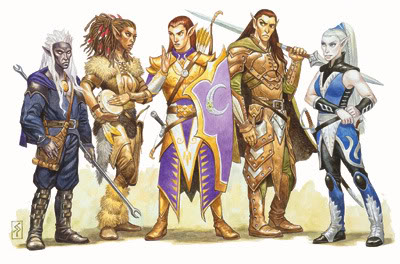
These are the images I used for all of the different character sketches for the ready-to-play character sheets. If you are trying to decide which character type to play in your next Dungeons and Dragons game, these images may give you a little inspiration.

D&D 3.5 – Animal Companion / Familiar Character Sheets

Animal-Sheet

Animal-Sheet

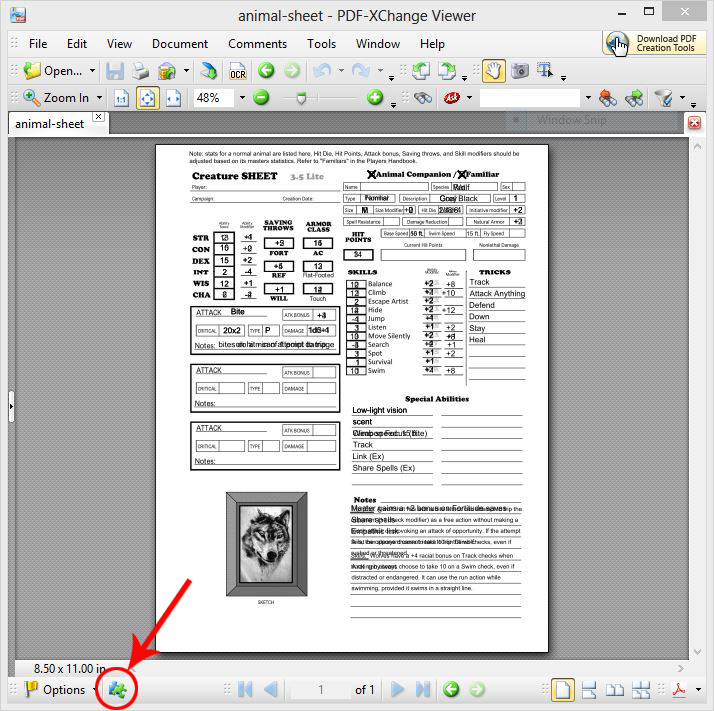
This is a character sheet for animal companions and familiars for Dungeons and Dragons Lite.

This is a multi-layer PDF file. When you open it, it will be unreadable until you turn off some of the layers. To use it simply turn off all of the layers except for those that contain the information you desire.

1) For a blank sheet – turn off all of the layers except for the “Sheet” layer.

2) Turn on the layer “Animal Companion – Wolf”  for a ready-to-play wolf animal companion.

-or-

2) Turn on the layer “Familiar-Rat” for an almost ready-to-play rat familiar. It has the information filled in for a normal rat, but you will need to adjust its statistics based on your player character’s as explained in the 3.5 Players’ Handbook.pdf-xchange_1

pdf-xchange_2

Please let me know if you discover any mistakes, or if you think I should have created these differently.

UPDATE: There is now a fillable version of this popular file – Find it on this post: Animal Companion / Familiar Character Sheets – Fillable

UPDTATE 2: By request – you can now download a completely blank version (no layers) for those of you who prefer to print out a bloak sheet and fill it in by hand. Click on this link  animal-sheet-blank

D&D 3.5 – Lite – Addendum

I will eventually update Dungeons and Dragons 3.5 Lite, but until then you should make these corrections and changes.

Words to be removed are shown with a strikethrough.

Words to be added are shown in red.

p.5       Under Gnomes: “Speed: 30 20 feet”

p.15     Under Ranger special abilities: “The following are the special abilities available to clerics rangers.”

p.17     Under Rogue: “Class Skills: Climb, Climb, Decipher Script, “

p.18     Under Sorcerer: Delete the sentence “A Sorcerer is the easiest class for a player to play.”

p.19     Under Wizard Spells Explained: “The saving throw difficulty class (DC) of his spells is 10 + the level of the spell + the druid’s wizard’s Int modifier.”

p.21     Insert this entire section before Special Knowledge Rules:

Skills that have changed:

The skills Craft, Perform and Profession have been omitted as they are not adventure related.

The Track skill has been added as a separate skill, a sub-skill to Survival. Survival is no longer considered a trained skill, but track is. Any ability that adds points to the Survival skill (such as Nature Sense) also adds the same number of points to the Track skill.

p.22     Under Acquiring languages beyond first level : “Unlike those selected at first level, the selected language must be one that he has been exposed to it long enough to have learned to speak and understand it.”

p.23     Under Dying : Your character dyes at zero minus 10 HP or zero minus (his Con modifier + his level), whichever is lower. Characters die when their negative hit point total reaches -10 or one-third of their full normal hit points, whichever is a larger value.

p.23     Insert this entire section before Natural Healing:

Magical Healing

If a character with negative hit points receives healing, he returns to 0 hp before any healing is applied.

p.30     Under Size  modifier: “Your size modifier is 0 unless your size is S, then it is -1  +1

p.31     Under Misc Modifier: Add

Hide (Gnomes and Halflings  +4)

Where there are differences between the posts on this site and the entries in the book, the posts take precedence.

D&D 3.5 – Fast-Play Character Sheets

Character-Sheet

Human-Sheet-Front                   Human-Sheet-Back

Half-orc-Sheet-Front                 Half-orc-Sheet-Back

Halfling-Sheet-Front                  Halfling-Sheet-Back

Half-elf-Sheet-Front                  Half-elf-Sheet-Back

Gnome-Sheet-Front                  Gnome-Sheet-Back

Elf-Sheet-Front                          Elf-Sheet-Back

Dwarf-Sheet-Front                  Dwarf-Sheet-Back


These are fast-play first level character sheets for Dungeons and Dragons Lite.

They are multi-layer PDF files. When you open them they will be unreadable until you turn off some of the layers. To use them simply turn off all of the layers except for those that contain the information you desire.

1) Download the front and back sheet for your character’s race.

2) For a blank sheet – turn off all of the layers except for the “Sheet” layer.

3) Turn on the “Class” layer for the class you are going to play to get all of the standard information, including the default equipment, for your character. You can print this out and it will be ready for you to add a background skill and to roll your ability scores. Everything for a first level character will be filled in that is not dependent on your ability scores.

4) Turn on the “Abilities” layer for the class you are going to play to get a ready-to-play character sheet. Everything except the character’s name, sex and description will be filled in and ready to use. The “Abilities” layer and the “Class” layer must both be for the same class or the numbers won’t add up correctly.

5) Optionally – on the Back sheet – you can turn on a “Sketch” layer for your character class. This will give you a drawing of your character. (These were all found on the internet, converted to black and white and scaled to fit on the sheet. They are all male characters.)

EXAMPLE: If you want a ready-to-play first level Half-orc Monk character. Download the files “Half-orc-Sheet-Front.pdf” and “Half-orc-Sheet-Back.pdf”. Open both of them using Acrobat Reader. On the Layers menu turn off (by clicking on the little eye beside the layer name) all of the layers except for these: “Sheet”, “Race_Half-orc”, “Class-Monk”, and “Abilities-Monk”. On the Back sheet, you can turn on the layer “Sketch-Monk” for a drawing of the character. Print both sheets (they are designed to print on the front and back side of a single sheet). Now all you have to do is fill in the name and sex and you are ready to play. The character’s description on the back side has been left blank for you to describe him as you see fit.


BEHIND THE DOUNGEON MASTER’S SCREEN

(For those of you that are interested in what I did and why I did it this way.)

For abilities I used this default ability array: 18, 16, 14, 12, 10, 8

This makes for interesting characters with everyone having some ability that they excel at and one that they are very bad at. With most of the abilities above average this makes for heroic characters.

I then assigned the abilities (highest to lowest) based on the character’s class.

Barbarian, Fighter, Monk: STR/DEX/CON/WIS/CHA/INT

Bard, Sorcerer: CHA/DEX/CON/INT/STR/WIS

Cleric, Druid: WIS/CHA/INT/STR/ DEX/CON

Paladin:  CHA/STR/DEX/ INT/WIS/CON

Ranger, Rogue:  DEX/STR/WIS/INT/CON/CHA

Wizard: INT/DEX/CON/WIS/CHA/STR


I tried my best to make the abilities work well for each class. I am sure others might have assigned them differently.

On a side note – I originally intended to have at least one class have an ability score of 8 (a -1 ability modifier) for each of the abilities, but I decided not to give anyone a score of 8 in Dexterity. Strictly interpreting the rules, if your character’s dexterity score is very low he is easier to hit if he is aware of the attack than if he isn’t! This is the result of a negative DEX modifier on his armor class. This reminds me of Jar Jar Binks leaning into the punches, but I think that even his flat-footed AC would be lower than his normal or touch AC.

Next I applied the standard ability score modifiers for each race.

Then, based on their ability modifiers, I modified or calculated:

– Saving throws

– Initiative (Dex)

– Armor class (Dex) [and (Wis) for monks]

– Hit points (Con)

– Melee weapon attack (Str)

– Ranged weapon attack (Dex)

– All of the skills [I selected a skill that I thought would be useful for a background skill]

– Loads (Str)

I also gave the classes these default Alignments:

Barbarian, Chaotic Neutral / Bard, Chaotic Good / Cleric, Matches his Deity / Druid, True Neutral / Fighter, Lawful Neutral /Monk, Lawful Neutral / Paladin, Lawful Good / Ranger, Neutral Good / Rogue, Chaotic Neutral / Sorcerer, Chaotic Neutral/ Wizard, Lawful Neutral


A lot of people are not familiar with multi-layer PDF files, but if you have any trouble turning layers on and off just let me know.

This gives you a total of 77 different ready-to-play characters.

Please let me know if you discover any mistakes, or if you think I should have created these differently.

D&D 3.5 – Wars: Mass Combat Rules

War_book_cover

D&D Wars – Front Cover

[There is an updated version of these rules available here: D&D Wars ]

Download these mass combat rules here (free): WAR

D&D Wars is a supplement to third edition Dungeons & Dragons that provides a set of mass combat rules for conducting battles with units as small as one to armies numbering in the thousands. D&D Wars are not simply armies making battle with each other. It is armies intermixed with monsters and NPCs. Added to this mix is a group of PC heroes doing what they can to change the tide of the war.

–My goals in creating these rules —

– The rules must be compatible with Dungeons and Dragons version 3.5.

– There must be rules for creating armies comprised of units of various sizes and compositions.

– It must have consistent rules for scaling the battle from a small group of villagers with torches and pitchforks all the way up to epic battles with thousands of soldiers on both sides.

– The rules must accommodate individual monsters wandering across the battlefield as well as other NPCs and PCs that are not part of the units.

– It must use standard combat rules without modification as far as possible.

– To this end:

  • It uses a standard 6 second combat round.
  • Creatures occupy the standard amount of space. The size represented by a 1” square is larger than the standard 5 ft (15 ft. being typical). Thus accommodating larger size armies.
  • Movement, Armor Class, Hit Points and Attacks/Damage for individual creatures that are not a part of a unit remain unchanged.
  • Movement, Armor Class, Hit Points and Attacks/Damage for one counter (representing several creatures that cover 1 square as part of a unit) will be the same as for a single standard creature. That way when counters of one unit attack counters of another unit, standard combat rules apply with very few exceptions.
  • Individual creatures that are not in a unit can attack, and be attacked by, the creatures in a unit. In either case it will be creatures attacking creatures. A simple conversion is done to calculate the amount of damage.
  • To speed up play, because of the potentially large number of units, monsters, NPCs, siege weapons, and PCs involved, each of them is restricted to only one action (move, attack or defense) each round. Also creatures with multiple attacks each round (except for PCs) will get only one attack action.
  • Then of course there must be special morale rules and rules for how to handle magic spells cast by or against units.
  • Throw in some rules for siege engines and I’m done.

Before creating these rules, I tried to find out if someone else had already done this, and I found several who had.

First, there are several excellent wargame systems. A mass combat system for an RPG and a wargame are not the same thing. Excellent wargames don’t necessarily deliver as RPG mass combat systems so I passed on them.

Second, I found several homebrew systems. Most of these are of the “treat a unit as a really large monster” variety. These all work for their games, of course, but most fall short of what I was looking for.

Third, there are a few serious, published attempts at creating RPG mass combat rules.

The best of these are described below in no particular order.

__________________________

Adamant Entertainment’s “Warpath

This is a Pathfinder supplement.

Even though it is not specifically for v3.5 it is close enough with only minor adjustments.

What I like:

It is an excellent, well thought out system. It uses a clever idea of making each 1” square represent 10 feet and each unit be represented by a 3”x6” index card.

It also contains information on the upkeep of an army, mustering armies, supplying an army and siege warfare. There is an alternate way to quickly resolve mass combat in only a few rolls of the dice.

It uses a standard 6 second combat round.

It is well presented and I got a lot of good information from here.

Why I didn’t use it:

It assumes that the PCs are commanders of the army, or at least unit leaders. There are no good rules to allow a PC to act independently from the unit (other than being a solo unit).

There are no rules to deal with units in combat against individual monsters or heroes.

It doesn’t scale well for different size battles. The rules for larger battles are unsatisfactory. It simply recommends that you use larger unit cards and to “be sure you have the space available” for all of the additional space it will take up on the battle matt.

_____________________________________________

Mongoose Publishing’s “Mass Combat

This is a supplement to Conan The Roleplaying Game which is v3.5 compatible.

What I like:

This is one of the best set of rules that I found. It does a good job of integrating v3.5 rules into a set of mass combat rules.

They have good rules for resolving magic use against units and for war machines.

It treats units as a group of counters, with each counter representing a number of individuals.

It uses a standard 6 second combat round.

Why I didn’t use it:

It relies heavily on unit formations, unit faces and a special “surge” attack. I wanted to avoid having facing rules. D&D 3.5 has no facing rules for creatures, so I didn’t want to introduce this into my mass combat system.

It is a little vague on how much space a counter covers.

Units do not make saving throws, but always take the average amount of damage they would have received if each individual had made a separate saving throw.

There are no rules to deal with units in combat against individual monsters or heroes.

__________________________________________________________

Wizards of the Coast’s “Complete Warrior

This official D&D accessory contains a chapter on Fantasy Warfare.

What I like:

It has a very good overview of how one can integrate warfare into a standard D&D campaign.

It has a good list of ways PCs can tern the tide of battle, with a table of possible missions and mission complications.

It would be good to use if the war is simply going on around the PCs.

Why I didn’t use it:

It doesn’t have any mass combat rules.

__________________________________________________________

Udo’s D20 Mass Combat

This is a small (5 pages) document that attempts to bring mass combat to d20 games.

What I like:

It scales up nicely. One 1 inch square can represent a 5, 25 or 100 ft. square.

It uses standard rules for the most part.

Why I didn’t use it:

It uses a 0-10 scale for health and attack damage, rather than standard hit points.

Any monster or character would have to be converted to the 0-10 FSP (Force Strength Points) system for both hit points and attack damage.

The system, although workable, is a little too rules light for my taste.

__________________________________________________________

Races of War’s Mass Combat Minigame

A 3.5e Sourcebook

“It’s a mini-game inside regular 3.5e that has been designed for simplicity and a minimum of bookkeeping.”

What I like:

It introduces a morale score (similar to Hit Points). When the unit’s morale score reaches 0, the unit flees form the battlefield.

Why I didn’t use it:

It uses squares that represent 50’ x 50’. This is workable, but I wanted more flexibility for larger or smaller armies.

It doesn’t use a simple initiative order, but each army acts in an order depending on its position and type of attack.

The rules for attacking a unit with spells (other than damage causing spells) are turned into damage causing spells or have no effect.

It has no rules for anything other than units or PCs (No rules for monsters or siege weapons for example).

D&D 3.5 – Iconic Rogue

Thinking of playing a Rogue? Here is an excellent article regarding the pros and cons of playing a Rogue: Rogues  with Class By Skip Williams.

Here is the information for playing an iconic Rogue character. Start with my post on Iconic Characters, then add this specific information.

Hit Die: d6

Class Skills: Climb, Decipher Script, Disable Device, Hide, Listen, Move Silently, Open Lock, Search, Sleight of Hand, Use Magic Device

Class Knowledge: Local

Special abilities:
The following are the special abilities available to Rogues. The abilities are listed under the level that they are acquired. Where an ability is described as (ref PHB), you should refer to that ability’s description in the players handbook.

1st Level
Deceitful: You get a +2 bonus on all Disguise checks and Forgery checks.
Sneak Attack: +1d6 damage when flanking target. (ref. PHB)
Trapfinding: Can use search to find traps with DC20 or higher and can use Disable Device to disarm magic traps. Beat a traps DC by 10 or more to bypass it without disarming it.
2nd Level
Evasion:  Take no damage on a successful Ref saving throw against an attack that normally deals half damage on a save.
3rd Level
Deft Hands: You get a +2 bonus on all Sleight of Hand checks and Use Rope checks.
Sneak Attack: Like Sneak Attack above, but now you get +2d6 damage
Trap Sense: +1 on Ref saves made to avoid traps and +1 dodge bonus to AC against attacks made by traps.
4th Level
Ability Score Adjustment: Add 1 to any ability score.
Uncanny Dodge: Retain Dexterity bonus to AC (if any) even if flat-footed or struck by an invisible attacker.
5th Level
Sneak Attack: Like Sneak Attack above, but now you get +3d6 damage
6th Level
Diligent: You get a +2 bonus on all Appraise checks and Decipher Script checks.
Trap Sense: Like Trap Sense above, but your bonuses become +2.
7th Level
Sneak Attack: Like Sneak Attack above, but now you get +4d6 damage
8th Level
Ability Score Adjustment: Add 1 to any ability score.
Improved Uncanny Dodge: Can no longer be flanked, unless by another rogue at least 4 levels higher.
9th Level
Improved Initiative: You get a +4 bonus on initiative checks.
Sneak Attack: Like Sneak Attack above, but now you get +5d6 damage
Trap Sense: Like Trap Sense above, but your bonuses become +3.
10th Level
Special  Ability (Crippling Strike): Sneak attack deals an additional 2 points Strength damage.
11th Level
Sneak Attack: Like Sneak Attack above, but now you get +6d6 damage
12th Level
Ability Score Adjustment: Add 1 to any ability score.
Nimble Fingers: You get a +2 bonus on all Disable Device checks and Open Lock checks.
Trap Sense: Like Trap Sense above, but your bonuses become +4.
13th Level
Sneak Attack: Like Sneak Attack above, but now you get +7d6 damage
Special  Ability (Improved Evasion): Like Evasion above, but now you also take only half damage on a failed save.
14th Level
No special abilities added at this level.
15th Level
Quick Draw: You can draw a weapon as a free action instead of as a move action. You can draw a hidden weapon (see the Sleight of Hand skill) as a move action. You may throw weapons at your full normal rate of attacks (much like a character with a bow).
Sneak Attack: Like Sneak Attack above, but now you get +8d6 damage
Trap Sense: Like Trap Sense above, but your bonuses become +5.
16th Level
Ability Score Adjustment: Add 1 to any ability score.
Special  Ability (Defensive Roll): Once a day, when damage from combat would reduce you to 0 or fewer HP, you can attempt to roll with the damage to get half damage. (ref. PHB)
17th Level
Sneak Attack: Like Sneak Attack above, but now you get +9d6 damage
18th Level
Stealthy: You get a +2 bonus on all Hide checks and Move Silently checks.
Trap Sense: Like Trap Sense above, but your bonuses become +6.
19th Level
Sneak Attack: Like Sneak Attack above, but now you get +10d6 damage
Special  Ability (Slippery Mind): ref PHB
20th Level
Ability Score Adjustment: Add 1 to any ability score.

Dragon Hunt – Chapter 2, Part 3 – The Elf

Trevan was wakened in the night by a cold breeze. He set up in his bed with his dagger in hand and saw that the shutters had been opened and the moon was shining in through the open window. He thought that perhaps the wind had blown them open, but he was a light sleeper and he had not heard the sound of shutters flying open. Then he saw him. A nude man was sitting stiffly upright in the center of the other bed with his legs crossed and his hands on his knees. As he put his knife down, he said, “I didn’t hear you come in. My name is Trevan.”

There was no response. He soon realized this was not a human but was instead an elf. In the moonlight he could see that his eyes were closed. His breathing was slow and steady. Trevan had seen elves before, but never one without cloths. He was just a little over five feet tall. He had dark hair and no facial or body hair. His body was lean and sharply defined. After a couple of minutes Trevan concluded that the elf knew he was there but chose not to respond. He appeared to be in a trance of some kind. Trevan pulled a blanket out of his backpack and added it to his bed covers. He was soon back to sleep.

He woke up again with the morning sunrise. The elf was up and getting dressed. Seconds after Trevan opened his eyes, the elf said, “Elves don’t sleep. I was meditating when you woke. I normally spend about four hours a night in that state. Your name is Trevan, mine is Aramil.”

“I’m pleased to meet you, Aramil. I’m sorry if I disturbed you last night. I’m not familiar with the ways of elves.” The elf did not respond. They dressed in silence. When Trevan had finished dressing he left Aramil who was still lacing his belt. Everything that Aramil was wearing was soft and flexible. His clothing was covered with fine embellishments. Everywhere there were vines and abstract designs with occasional flowers or butterflies. It was all in light shades of green and brown. There were no metal buckles or fasteners. Everything was laced, tied or folded.

Aramil went downstairs and had a quick breakfast of cheese with fruit and nuts. He finished and left the inn just before Trevan, who had a large breakfast of bread, gofer gravy, hen eggs and goats milk. When Trevan turned a corner on his way to the docks, he saw Aramil some distance away. He had his dagger out and was taking a money purse from a young man in the street. A woman just beyond them had been thrown to the ground. A large man dressed all in black was just in front of Trevan and hadn’t noticed him. This man had drawn a small crossbow and was about to shoot the elf. Trevan drew his sword and pushed the man, causing him to drop his crossbow. The man in black and the young man at dagger point both ran off down side streets. Trevan quickly picked up the crossbow and ran over to Aramil and they both helped the woman to her feet. Aramil returned the money purse to the woman and she was thanking him when the city guard appeared. She told them the entire story of how the boy had pushed her down during a struggle for her purse and Aramil had come to her rescue. The city guard headed off down the side streets looking for the boy. Aramil thanked Trevan for what he had done. They quickly discovered that they were both headed for the dragon hunt. Aramil had arrived several days ago and was signed up as part of the party. It was divided into several ‘teams’. Aramil was part of the scouting team. Today they were to receive their final instructions and the provisions were all to be loaded and made ready for an early morning departure tomorrow, if the weather permits.

Everyone that was to be part of the party was already enlisted and assigned to a team. Aramil said that he would try to help Trevan join, but he didn’t know how successful he would be. They had been planning this for months and had filled all available slots.

They made their way through Rockport to the docks and then along the shore over to the east end of the dock area where the warehouse was located. The building was 30 feet wide and 100 feet long. On the long side, facing the docks, there were three large doors. The north end faced a cobblestone courtyard with a wide street that lead directly to the city gate with the road beyond that went up to the mountains. There was a pair of doors centered on this wall large enough for wagons to pass through.

When they arrived the doors were all open and it was full of activity. Although everyone called it a warehouse, it was actually more of an equestrian center. The roof beams were exposed some 15 feet above. The floor was hard packed dirt covered with a generous layer of straw. There were lanterns hanging on the walls. There were half-doors all along the far wall, each opening to a separate horse stall. People, horses and donkeys were going in all directions. There were cartons and crates being carried about. Trevan could see two large wagons being loaded. There was a large trailer with a ballista mounted on it. Everything appeared very chaotic. Aramil led him to the south end of the warehouse where a couple of men were seated behind a long table. There was a blue and white banner on the wall behind them. On the table were stacks of paper, rolls of parchment, small bags and boxes. Aramil walked up to the man in chainmail armor with a pale blue and white tunic. “Excuse me brother Pitchlight,” said Aramil. “I would like to introduce you to Trevan.” The cleric stood slightly and extended his hand. Trevan shook hands with him briefly. The cleric set back down. Aramil continued, “This man is a ranger of the southern woods and has traveled a great distance to join us in this historic quest, if it should please your holiness.”

“I am pleased that you want to join us, but as I am sure Aramil has informed you, the quest’s compliment is already filled. Perhaps, if you had arrived earlier …” All of a sudden there was the sound of boxes falling over as a gnome pushed everything out of his way as he ran breathlessly up to the table. Trevan was almost knocked off his feet as Gimble jumped up and grabbed him around the neck.

“I knew you would come!” he said. “There is no way you would miss out on this.” Turning to Pitchlight he said, “This is the ranger that I was telling you about. You have got to take this guy. He is the best dragon tracker in the world. He can even track them through the air! He can speak draconian! You’ve really got to take him. Tell him Trevan.” Then without pause he continued, “He has spent his life studying dragons, their habits and weaknesses.”

When Gimble finally stopped talking, Pitchlight said, “It would seam that you have a fan. Is any of that true? Can you track dragons through the air?”

Trevan started to speak when Gimble poked him sharply in the ribs where Pitchlight couldn’t see. He glanced down and Gimble was looking up at him as if to say, “Don’t you dare deny it!” Trevan said, “If you will let me join the expedition, you will see what I can do.”

Pitchlight stared at Trevan for a minute. Then he tossed him a gold coin and asked, “Do you know what that is?”

Gimble stopped himself from jumping for joy. Trevan examined the coin. Of course he knew it was gold, he had a few in his pocked, along with some of silver and copper. Many areas have their own coins minted and they all have different images on them. Like all standard coins, it was about one and one quarter inch in diameter, one tenth of an inch thick and weighed about one third of an ounce. This one appeared to be newly struck. He had never before seen one with these symbols. On one side there was Heironeous’s holy symbol. On the other side was the head of a red dragon. “It looks like any other gold coin to me,” Trevan said as he tossed it back.

“We had exactly 200 of these minted, specifically for this ‘expedition’ as you call it,” said Pitchlight. “The church of Heironeous is funding this quest with these. When Abraxas has been defeated, his treasure will be divided into 200 equal parts. Each of these coins can be redeemed at that time for one equal share. The church gets 50 coins and the dragon’s body. Or any parts of it that can be salvaged. Sir Gleamheart received 50 coins and will be awarded any unclaimed shares. 25 coins were used to purchase supplies. 25 coins have been set aside to re-supply the quest should that be required. That leaves 50 coins to divide between the rest of the party. Different participants have received different numbers of coins depending on how important they are to the success of the quest. For example, Gimble here is coming along as the cook. He has received one coin which represents one 200th share of the treasure. Aramil, on the other hand, is an elf and an accomplished tracker. He has been paid 5 coins. If you are what you clam to be, you would be worth 5 or 6 coins. But, as I told you, we have no more coins available.”

Before Trevan could say that he wasn’t here for the treasure, Aramil said, “He can have one of my shares.” He flipped a coin onto the table.

Pitchlight stared at this coin for a few seconds. He said, “One share will still be a substantial treasure. If you want to accept these terms, you can become part of the quest.” Trevan’s eager expression gave him his answer. “Just give your name to the scribe here.” He spoke to the thin man seated next to him. “Put him down as another scout.“ To Trevan he said, “If the treasure is recovered, you will be able to trade your coin for your share of the treasure when it is divided.” He stood and shook Trevan’s hand again, “Welcome to Heironeous’s holy quest to rid the world of the evil dragon known as Abraxas. May Heironeous guide your steps and receive your soul should you depart this life in this heroic battle. Aramil can answer any questions you may have.”

Pitchlight returned to the paper he was studying. Trevan turned to the scribe and answered his questions. The scribe wrote down Trevan’s name, where he was from, his position in the quest and his compensation. Trevan had to swear that in exchange for his share he would perform any services required from him, including fighting valiantly against any and all monsters that they might encounter, including Abraxas himself. He was warned that should he be unable to participate in the quest for any reason he was required to return all coins he received. Also, in the unfortunate event of his death, or the death of any of his companions during the quest, the coins were to be retrieved if possible and returned. Abandoning the quest and failing to return the coins would be regarded as theft and an act against the church. Otherwise he was free to do with his coins as he saw fit.

Pitchlight looked up and said to Trevan and Aramil, “There is not really much for the scouts to do today. You can take off whenever you like. Be sure to be here at first light tomorrow.” Then he returned to his papers.

D&D 3.5 – Iconic Ranger

Thinking of playing a Ranger? Here is an excellent article regarding the pros and cons of playing a Ranger: Rangers with Class By Skip Williams.

Here is the information for playing an iconic Ranger character. Start with my post on Iconic Characters, then add this specific information.

Hit Die: d8

Class Skills: Climb, Handle  Animal, Move Silently, Track, Search, Spot and Survival

Class Knowledge: Geography

Special abilities: The following are the special abilities available to Rangers.  The abilities are listed under the level that they are acquired. By the time your character reaches second level he must specialize in one of two different combat styles.  He can choose between the archery combat style and the two-weapon combat style. As indicated in the table below – some of the special abilities he receives as he advances in level will depend on the combat style he pursues. Where an ability is described as (ref PHB), you should refer to that ability’s description in the players handbook.

1st Level
Skill Focus (Survival): You get a +3 bonus on all Survival checks.
Favored Enemy: Select a type of creature from Table 3–14: Ranger Favored Enemies. You get a +2 bonus on Bluff, Listen, Sense Motive, Spot, and Survival checks against creatures of this type, and a +2 bonus on weapon damage
Wild  Empathy:  Can improve the attitude of an animal with a successful Cha check.
2nd Level
Combat Style: Select one of two combat styles to pursue: archery or two-weapon combat. You lose all benefits of your combat style when wearing medium or heavy armor.
Rapid Shot:  [If you are pursuing the archery combat style] You can get one extra attack per round with a ranged weapon. The attack is at your highest base attack bonus, but each attack you make in that round (the extra one and the normal ones) takes a -2 penalty. You must use the full attack action to use this ability.
-or-
Two-Weapon Fighting: [If you are pursuing the two-weapon combat style] Your penalties on attack rolls for fighting with two weapons are reduced. The penalty for your primary hand lessens by 2 and the one for your off hand lessens by 6. See the Two-Weapon Fighting special attack.
3rd Level
Endurance: You gain a +4 bonus on the following checks and saves: Swim checks made to resist damage, Constitution checks made to continue running, Constitution checks made to avoid damage from a forced march, Constitution checks made to hold your breath, Constitution checks made to avoid damage from starvation or thirst, Fortitude saves made to avoid damage from hot or cold environments, and Fortitude saves made to resist damage from suffocation. Also, you may sleep in light or medium armor without becoming fatigued.
Point Blank Shot: [If you are pursuing the archery combat style] You get a +1 bonus on attack and damage rolls with ranged weapons at ranges of up to 30 feet.
-or-
Two-Weapon Defense: [If you are pursuing the two-weapon combat style] When wielding a double weapon or two weapons (not including natural weapons or unarmed strikes), you gain a +1 shield bonus to your AC. See the Two-Weapon Fighting special attack. When you are fighting defensively or using the total defense action, this shield bonus increases to +2.
4th Level
Ability Score Adjustment: Add 1 to any ability score.
Animal Companion: (ref PHB)
Spells: You gain the ability to cast a small number of divine spells (ref PHB)
5th Level
Favored Enemy: Like Favored Enemy above but now you can select a second creature type from the table and the bonus against one of your favored enemies is increased by 2.
6th Level
Far Shot: [If you are pursuing the archery combat style] When you use a projectile weapon, such as a bow, its range increment increases by one-half (multiply by 1½). When you use a thrown weapon, its range increment is doubled.
-or-
Animal Affinity:  [If you are pursuing the two-weapon combat style] You get a +2 bonus on all Handle Animal checks and Ride checks.
Manyshot:  [If you are pursuing the archery combat style] As a standard action, you may fire two arrows at a single opponent within 30 feet. Both arrows use the same attack roll (with a -4 penalty) to determine success and deal damage normally (but see Special). For every five points of base attack bonus you have above +6, you may add one additional arrow to this attack, to a maximum of four arrows at a base attack bonus of +16. However, each arrow after the second adds a cumulative -2 penalty on the attack roll (for a total penalty of -6 for three arrows and -8 for four). Damage reduction and other resistances apply separately against each arrow fired. Special –  Regardless of the number of arrows you fire, you apply precision-based damage only once. If you score a critical hit, only the first arrow fired deals critical damage; all others deal regular damage.
-or-
Improved TwoWeapon Fighting: [If you are pursuing the two-weapon combat style] In addition to the standard single extra attack you get with an off-hand weapon, you get a second attack with it, albeit at a -5 penalty. See the Two-Weapon Fighting special attack.
7th Level
Woodland Stride: Can move through any normal undergrowth at normal speed and without taking damage.
8th Level
Ability Score Adjustment: Add 1 to any ability score.
Swift Tracker: Can move at normal speed while following tracks without the normal –5 penalty. Take only a –10 penalty when moving at up to twice normal speed while tracking.
9th Level
Precise Shot: [If you are pursuing the archery combat style] You can shoot or throw ranged weapons at an opponent engaged in melee without taking the standard -4 penalty on your attack roll.
-or-
Lightning Reflexes:  [If you are pursuing the two-weapon combat style] You get a +2 bonus on all Reflex saving throws.
Evasion:  Take no damage on a successful Ref saving throw against an attack that normally deals half damage on a save, only if wearing light or no armor.
10th Level
Favored Enemy: Like Favored Enemy above but now you can select a second creature type from the table and the bonus against one of your favored enemies is increased by 2.
11th Level
Improved Precise Shot: [If you are pursuing the archery combat style] Your ranged attacks ignore the AC bonus granted to targets by anything less than total cover, and the miss chance granted to targets by anything less than total concealment. Total cover and total concealment provide their normal benefits against your ranged attacks. In addition, when you shoot or throw ranged weapons at a grappling opponent, you automatically strike at the opponent you have chosen.
-or-
Greater TwoWeapon Fighting: [If you are pursuing the two-weapon combat style] You get a third attack with your off-hand weapon, albeit at a -10 penalty. See the Two-Weapon Fighting special attack.
12th Level
Ability Score Adjustment: Add 1 to any ability score.
Skill Focus (Hide): You get a +3 bonus on all Hide checks.
13th Level
Camouflage: Can use the Hide skill in any sort of natural terrain.
14th Level
No special abilities added at this level.
15th Level
Favored Enemy: Like Favored Enemy above but now you can select a second creature type from the table and the bonus against one of your favored enemies is increased by 2.
Skill Focus (Listen): You get a +3 bonus on all Listen checks.
16th Level
Ability Score Adjustment: Add 1 to any ability score.
17th Level
Hide in Plain Sight: Can use the Hide skill even while being observed – while in any natural terrain
18th Level
Skill Focus (Spot): You get a +3 bonus on all Spot checks.
19th Level
No special abilities added at this level.
20th Level
Ability Score Adjustment: Add 1 to any ability score.
Favored Enemy: Like Favored Enemy above but now you can select a second creature type from the table and the bonus against one of your favored enemies is increased by 2.