Dungeon Master Assistance

Where anyone over 18 can share thoughts and ideas on RPGs.

Category Archives: House Rules

D&D 5E – Multiclass

Multiclass

As a DM, should you allow your players to multiclass?

To Multiclass, or not to Multiclass, that is the question –
Whether ’tis Nobler in the game to suffer
The Outrageous Limitations imposed by a single class,
Or to take on a Second – perhaps a Third or more –
And by so doing, overcome them?
(My apologies to the Bard of Avon.)

My knee-jerk reaction is to not allow characters to multiclass. When I developed my D&D Lite rules, I had to disallow multiclass characters. This was the only way that I could simplify the rules and still use 90% of the standard D&D rules for the 3.5 edition. However, with the fifth edition most of my objections have been addressed.

Objections to Multiclassing

 1) It is too complicated.
This was my primary objection to multiclassing in the previous editions of the game. They have done an excellent job simplifying the muticlassing rules in 5e. And besides, if a player wants to multiclass it does nothing to complicate the game for anyone but him, and possibly the DM.

2) It encourages “munchkinism”.
There are players that will use “level-dipping” to grab some features from a class so they can min/max their character. This is the main objection that many Dungeon Masters have with multiclassing. 5e makes this a much less attractive option for players that only see it as a way to create the ultimate PC. You can create almost any character you can think of without the need to multiclass.

I think that I will allow it.

After much thought, I have decided to allow muticlassing in my games. I will discourage its use, but if a player has a character concept in mind that needs muticlassing I will allow it. The only requirement will be that the player must explain, in terms of what is happening in the game, why his character wants to advance in this different class and how his character is getting the initial training or what event has propelled him in this direction. (See the small sidebar in the  Player’s Handbook as a good example.)

I will strictly enforce all of the multiclass rules.

You must meet the minimum ability requirements, not only for your new class, but also for any of your current classes.
You only get the proficiencies listed in the multiclass rules for the new class you take. These are severely limited. For instance, you don’t get any ability save proficiencies and you can’t get proficiency in heavy armor.
You don’t get any free equipment. You will have to find, be given, or purchase your spellbook if you want to lake a level of wizard.
If you have levels in more than one class of spellcaster, you must keep track of your spells for each different class separately.  The rules are clear as to how many spell slots you get based on your various spell caster levels.

Some other options

If you don’t want to forbid multiclassing, but want to have some reasonable restrictions, here are some suggestions:
1) Require a PC to advance 3 levels in any class they have before multiclassing. This is not unreasonable, and makes for less “level-dipping”. Most of the best features of each class don’t occur until 3rd level anyway.
2) Have some classes only be available at first level. You can only have levels as a Barbarian or Sorcerer, for example, if your background indicates that you have always had this in you. This could also apply to a Druid. You could also restrict Monk, Warlock and even Wizard to this list. The Wizards cantrips are always available because he has been casting these spells for so long they are second-nature to him now, so how could a Fighter simply start being a Wizard with cantrips and all the rest?
3) Don’t allow certain combinations. Some classes are polar opposites of each other. These would include Barbarian/Monk, Sorcerer/Wizard, Cleric/Warlock, and Paladin/Rogue.

//

D&D 5E – Chase rules

Optional House Rules for D&D 5e

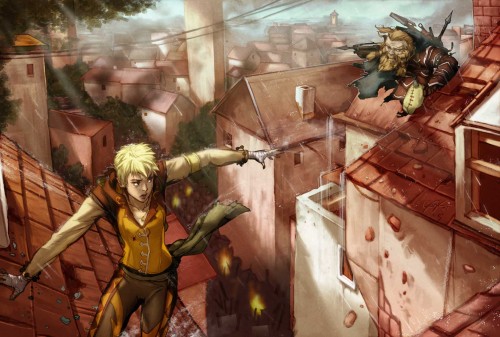
rooftop_chase-500x337

[Check out this newer post on this subject: D&D 5E – Quick Reference – Chase Rules.]

A couple of years ago I published chase rules for D&D v3.5. You can download them here.
With the release of the fifth edition of Dungeons and Dragons, those rules seem rather heavy. You can still use them if your campaign will have a lot of chases. However, in keeping with the slimmed down rules of 5e, I am proposing a simple house rule for chases. The description below is in terms of a PC character chasing a fleeing foe. Keep in mind that the same rules apply when the PC is the one fleeing.

What if your opponent tries to run away?

Most of the time the standard rules for combat work just fine. A chase may occur when one or more opponent turns and runs away. In game terms, he uses the Dash action to spend his entire turn moving away from combat as quickly as possible. If he starts his turn within 5 feet of you, or passes within 5 feet of you, you can use your Reaction to make an opportunity attack.

What if you want to chase him?

It all depends on how far away you are from him at the beginning of your turn. Compare this distance to your characters speed. There are three possible results.

1) You can use your Move to get within 5 feet of him.

  • You can attack him and combat continues.

2) You can catch up to him by using your Dash action.

[If you have enough speed to pass him you may do that, but if you come within 5 feet of him as you pass, he gets to use his Reaction to make an opportunity attack against you, so you will typically want to stop when you get within 5 feet.]
  • You stop within 5 feet of him.
  • If he continues to run away you can use your Reaction to attack him. [If you speed is the same or greater than his, this can repeat each round. This is not a good strategy for your opponent, unless he can reach shelter or he is leading you into an ambush.]
  • Or he may choose to turn and fight on his turn.

3) You cannot get to within 5 feet of him using your Dash action.

  • If your speed is greater than his, you should catch up with him in a few rounds.
  • If your speed is less than his, and you have no way to increase your speed, he will get farther away each round. You may as well attempt to shoot him with ranged weapons until he is out of range.
  • If your speed is the same as his, he will stay the same distance away from you forever. You move closer on your turn, he moves away on his. This is where a house rule is needed.

House Rule #1

A chase is not a race. There are multiple factors that could enable a creature to catch up to another one that has the same speed. Even a lucky slower creature should have a chance. Here is my house rule:

At the end of a turn where you have used a Dash action to advance toward an opponent that is fleeing, you may call for a Strength (Athletics) contest between the two characters. If you win the contest, you move an additional 5 feet toward your opponent. If you lose the contest, you move back 5 feet.

House Rule #2

Characters can’t continue running at top speed forever.  For extended chases:

After 5 rounds of continuous running, a character must make a [DC 15] Constitution save or suffer one level of exhaustion. Each additional round of continuous running requires another save at an additional +2 to the DC.

The DM may rule that certain creatures are immune to this exhaustion effect, or that they can run for longer periods before requiring this check.

D&D 5E – Threat creation using bounded accuracy

TrapThis is an expansion of an idea presented by the “Thinkerer GM” here: http://thinkerergm.wikispaces.com/Threat+creation+using+bounded+accuracy

He says: “This system allows to create a threat (monster, trap, etc) by extending the Difficulty Classes to apply it to other characteristics. ”

You can use these guidelines for monsters and traps that you can’t find in official sources, such as monsters that you are converting from an older module, or one of your own design.

Here is his table

Extended Difficulty Classes Table

Difficulty\Characteristic AC Attack
Bonus
HP Damage Save DC CR
Very Easy (DC 5) 8 +2 5 2 (1d4) 11 0
Easy (DC 10) 10 +3 10 4 (1d6) 12 1/4
Moderate (DC 15) 12 +4 20 8 (2d6+1) 13 1
Hard (DC 20) 14 +5 40 16 (2d10+5) 14 3
Very Hard (DC 25) 16 +6 80 32 (2d10+21) 15 5
Formidable (DC 30) 18 +7 160 64 (2d10+53) 16 7
Nearly Impossible (DC 35) 20 +8 320 128 (2d6+117) 17 9


This is the idea for Traps:
How hard is it to notice? [DC for WIS (Perception) check]
How hard is it to locate? [DC for INT (Investigation) check]
How hard is it to avoid? (If it is activated.) [Attack bonus]
How hard is it to deactivate? [DC for DEX (Disable device) check]
How hard is it to destroy? [Hit Points]
How hard is it to hit? (in the proper location or with enough force to cause it damage) [AC]
How hard is it to save against? (for poison and the like) [Save DC]
How hard is it to endure? [Damage]

Answer each of these questions with “very easy”, “easy”, “moderate”, “hard”, “very hard”, “formidable”, or “nearly impossible”, and look up the difficulty class table above.

Add all of the DC’s together and divide by 8 to get the average DC for the trap. Use this DC for the traps Challenge Rating (CR).

The idea is very similar for monsters:

How hard is it to detect? [DC for WIS (Perception) check]
How hard is it to avoid? [Attack bonus]
How hard is it to hit? [AC]
How hard is it to destroy? [Hit Points]
How hard is it to save against? (for poison or spells) [Save DC]
How hard is it to endure? [Damage]

Add all of the DC’s together and divide by 6 to get the average DC for the monster. Use this DC for determining the CR if the monster is encountered singly. Use the next higher DC for an encounter with two of these monsters. Increase the DC by one additional level for each doubling of the number of monsters in the encounter. For example, a DC 10 monster becomes DC 15 it there are two of them, DC 20 for 4, DC 25 for 8, etc.

For DCs above 35; For each additional level, increase the DC by 5 and increase the CR by 2.

When determining how hard it is to do these various things, you should be thinking about a single, 0 level commoner. This is what bounded accuracy is all about. Each activity is hard or easy regardless of the level of the characters attempting it. To determine how difficult an encounter this will be for your group use the CR and adjust for the number of PCs.

For Experience Points, you can use the XP values of similar CR monsters as a guide.

//

D&D 3.5 – Elves don’t have souls!


elvesEven after all of the years that I have been a Dungeon Master I am still being surprised by how much I never knew about this game.  For instance, I recently learned that in AD&D a raise dead spell wouldn’t work on elves (and half-orcs) because they didn’t have souls. In the games I ran I either overlooked this rule or simply missed it entirely.

From AD&D Deities and Demigods:

AD&D assumes that the anima, that force which gives life and distinct existence to thinking beings, is one of two sorts: soul or spirit. Humans, dwarves, halflings, gnomes, and half-elves (those beings which can have a raise dead or resurrection spell cast on them) all have souls; all other beings that worship deities have spirits. This latter group includes (but is not limited to) elves, orcs, half-orcs, and the other creatures specifically mentioned in the NON-HUMANS’ DEITIES section of this work.

This all changed with 3.5 which treats races all the same in regards to souls.

Here is a great “What Happens After Your Character Dies” article from the 3.5 Book “The Complete Divine”. [Link]

I think that in my house-rules I would add to this by saying that there is one exception. After the soul travels to an outer plane affiliated with the alignment or deity of the deceased, if that deity is displeased with the deceased he may be cast out. Anyone that has so displeased or angered his deity that his soul is barred from his plane will find his soul transported to Avernus, the first layer of ‘The Nine Hells’ of Baator.

D&D 3.5 – Iconic Sorcerer

Thinking of playing a Sorcerer ? Here is an excellent article regarding the pros and cons of playing a Sorcerer : Sorcerers with Class By Skip Williams.

Here is the information for playing an iconic Sorcerer character. Start with my post on Iconic Characters, then add this specific information.

Hit Die: d4

Class Skills: Bluff, Concentration

Class Knowledge: The planes

Spells: The sorcerer can cast any spell at any time. He doesn’t have to prepare or select his spells ahead of time, but can simply select which spell he wants to cast when he casts it. This is limited only by the number of spells of each level he is allowed to cast each day and which spells he knows. As he increases his level, he selects more known spells from the sorcerer/wizard spell list.

Special abilities: The following are the special abilities available to sorcerers. The abilities are listed under the level that they are acquired. Where an ability is described as (ref PHB), you should refer to that ability’s description in the players handbook.

1st Level
Base Attack Bonus +0, Fort Save +0, Ref Save +0, Will Save +2
Spells Known: 0 (4), 1st (2)
Spells Per Day: 0 (5), 1st (3)
Spell Penetration: You get a +2 bonus on caster level checks (1d20 + caster level) made to overcome a creature’s spell resistance.
Familiar: A sorcerer can have a familiar. (ref. PHB)
2nd Level [1,000 XP]
Base Attack Bonus +1, Fort Save +0, Ref Save +0, Will Save +3
Spells Known: 0 (5), 1st (2)
Spells Per Day: 0 (6), 1st (4)
3rd Level [3,000 XP]
Base Attack Bonus +1, Fort Save +0, Ref Save +0, Will Save +3
Spells Known: 0 (5), 1st (3)
Spells Per Day: 0 (6), 1st (5)
Magical Aptitude: You get a +2 bonus on all Spellcraft checks and Use Magic Device checks.
4th Level [6,000 XP]
Base Attack Bonus +2, Fort Save +1, Ref Save +1, Will Save +4
Spells Known: 0 (6), 1st (3), 2nd (1)
Spells Per Day: 0 (6), 1st (6), 2nd (3)
Ability Score Adjustment: Add 1 to any ability score.
5th Level [10,000 XP]
Base Attack Bonus +2, Fort Save +1, Ref Save +1, Will Save +4
Spells Known: 0 (6), 1st (4), 2nd (2)
Spells Per Day: 0 (6), 1st (6), 2nd (4)
6th Level [15,000 XP]
Base Attack Bonus +3, Fort Save +2, Ref Save +2, Will Save +5
Spells Known: 0 (7), 1st (4), 2nd (2), 3rd (1)
Spells Per Day: 0 (6), 1st (6), 2nd (5), 3rd (3)
Greater Spell Penetration: You get an additional +2 bonus on caster level checks (1d20 + caster level) made to overcome a creature’s spell resistance.
7th Level [21,000 XP]
Base Attack Bonus +3, Fort Save +2, Ref Save +2, Will Save +5
Spells Known: 0 (7), 1st (5), 2nd (3), 3rd (2)
Spells Per Day: 0 (6), 1st (6), 2nd (6), 3rd (4)
8th Level [28,000 XP]
Base Attack Bonus +4, Fort Save +2, Ref Save +2, Will Save +6
Spells Known: 0 (8), 1st (5), 2nd (3), 3rd (2), 4th (1)
Spells Per Day: 0 (6), 1st (6), 2nd (6), 3rd (5), 4th (3)
Ability Score Adjustment: Add 1 to any ability score.
9th Level [36,000 XP]
Base Attack Bonus +4, Fort Save +3, Ref Save +3, Will Save +6
Spells Known: 0 (8), 1st (5), 2nd (4), 3rd (3), 4th (2)
Spells Per Day: 0 (6), 1st (6), 2nd (6), 3rd (6), 4th (4)
Lightning Reflexes: You get a +2 bonus on all Reflex saving throws.
10th Level [45,000 XP]
Base Attack Bonus +5, Fort Save +3, Ref Save +3, Will Save +7
Spells Known: 0 (9), 1st (5), 2nd (4), 3rd (3), 4th (2), 5th (1)
Spells Per Day: 0 (6), 1st (6), 2nd (6), 3rd (6), 4th (5), 5th (3)
11th Level [55,000 XP]
Base Attack Bonus +5, Fort Save +3, Ref Save +3, Will Save +7
Spells Known: 0 (9), 1st (5), 2nd (5), 3rd (4), 4th (3), 5th (2)
Spells Per Day: 0 (6), 1st (6), 2nd (6), 3rd (6), 4th (6), 5th (4)
12th Level [66,000 XP]
Base Attack Bonus +6/+1, Fort Save +4, Ref Save +4, Will Save +8
Spells Known: 0 (9), 1st (5), 2nd (5), 3rd (4), 4th (3), 5th (2), 6th (1)
Spells Per Day: 0 (6), 1st (6), 2nd (6), 3rd (6), 4th (6), 5th (5), 6th (3)
Ability Score Adjustment: Add 1 to any ability score.
Iron Will: You get a +2 bonus on all Will saving throws.
13th Level [78,000 XP]
Base Attack Bonus +6/+1, Fort Save +4, Ref Save +4, Will Save +8
Spells Known: 0 (9), 1st (5), 2nd (5), 3rd (4), 4th (4), 5th (3), 6th (2)
Spells Per Day: 0 (6), 1st (6), 2nd (6), 3rd (6), 4th (6), 5th (5), 6th (4)
14th Level [91,000 XP]
Base Attack Bonus +7/+2, Fort Save +4, Ref Save +4, Will Save +9
Spells Known: 0 (9), 1st (5), 2nd (5), 3rd (4), 4th (4), 5th (3), 6th (2), 7th (1)
Spells Per Day: 0 (6), 1st (6), 2nd (6), 3rd (6), 4th (6), 5th (5), 6th (5), 7th (3)
15th Level [105,000 Xh]
Base Attack Bonus +7/+2, Fort Save +5, Ref Save +5, Will Save +9
Spells Known: 0 (9), 1st (5), 2nd (5), 3rd (4), 4th (4), 5th (4), 6th (3), 7th (2)
Spells Per Day: 0 (6), 1st (6), 2nd (6), 3rd (6), 4th (6), 5th (5), 6th (6), 7th (4)
Great Fortitude: You get a +2 bonus on all Fortitude saving throws.
16th Level [120,000 XP]
Base Attack Bonus +8/+3, Fort Save +5, Ref Save +5, Will Save +10
Spells Known: 0 (9), 1st (5), 2nd (5), 3rd (4), 4th (4), 5th (4), 6th (3), 7th (2), 8th (1)
Spells Per Day: 0 (6), 1st (6), 2nd (6), 3rd (6), 4th (6), 5th (5), 6th (6), 7th (5), 8th (3)
Ability Score Adjustment: Add 1 to any ability score.
17th Level [136,000 XP]
Base Attack Bonus +8/+3, Fort Save +5, Ref Save +5, Will Save +10
Spells Known: 0 (9), 1st (5), 2nd (5), 3rd (4), 4th (4), 5th (4), 6th (3), 7th (3), 8th (2)
Spells Per Day: 0 (6), 1st (6), 2nd (6), 3rd (6), 4th (6), 5th (5), 6th (6), 7th (6), 8th (4)
18th Level [153,000 XP]
Base Attack Bonus +9/+4, Fort Save +6, Ref Save +6, Will Save +11
Spells Known: 0 (9), 1st (5), 2nd (5), 3rd (4), 4th (4), 5th (4), 6th (3), 7th (3), 8th (2), 9th (1)
Spells Per Day: 0 (6), 1st (6), 2nd (6), 3rd (6), 4th (6), 5th (5), 6th (6), 7th (6), 8th (5), 9th (3)
Improved Counterspell: When counterspelling, you may use a spell of the same school that is one or more spell levels higher than the target spell.
19th Level [171,000 XP]
Base Attack Bonus +9/+4, Fort Save +6, Ref Save +6, Will Save +11
Spells Known: 0 (9), 1st (5), 2nd (5), 3rd (4), 4th (4), 5th (4), 6th (3), 7th (3), 8th (3), 9th (2)
Spells Per Day: 0 (6), 1st (6), 2nd (6), 3rd (6), 4th (6), 5th (5), 6th (6), 7th (6), 8th (6), 9th (4)
20th Level [190,000 XP]
Base Attack Bonus +10/+5, Fort Save +6, Ref Save +6, Will Save +12
Spells Known: 0 (9), 1st (5), 2nd (5), 3rd (4), 4th (4), 5th (4), 6th (3), 7th (3), 8th (3), 9th (3)
Spells Per Day: 0 (6), 1st (6), 2nd (6), 3rd (6), 4th (6), 5th (5), 6th (6), 7th (6), 8th (6), 9th (6)
Ability Score Adjustment: Add 1 to any ability score.

D&D 3.5 – Dying – Nonlethal Damage – Healing

Below are quotes from my house rules Dungeons and Dragons Lite [with notes to explain the reasoning behind the rules]:

 Dying

Characters die when their negative hit point total reaches -10 or one-third of their full normal hit points, whichever is a larger value. [This is to allow higher level characters, which tend to receive larger amounts of damage, a better change of survival.]

Opponents die when their hit points reach zero. [A monster at 0 hp is dead, and you don’t have to worry about wandering around the battlefield stabbing all your unconscious foes.] There are a few exceptions;

Exception 1 – When your opponent is a PC or major NPC (as designated by the DM). In this case your opponent dies when his hit points are reduced as indicated above for player characters. [The DM needs to allow certain powerful NPCs a chance of survival. The DM should let the PCs know if an opponent they thought they had slain is only unconscious.]

Exception 2 – When a monster’s description states that it doesn’t die when it runs out of hit points. [An example is a Vampire. If reduced to 0  hit points in combat, it automatically assumes gaseous form and attempts to escape.]

Exception 3 –When your character’s intent is to subdue and not to kill. [We are eliminating the nonlethal damage rules and substituting these rules that only apply to attacks with melee weapons or weapons that deal nonlethal damage.] You must declare your intent to subdue before making your attack roll. Subdual attacks do the normal amount of hit point damage until your opponent’s hit points reach zero.  Damage from a single subdual attack cannot reduce your opponent’s hit points below -9. Your opponent will be disabled at zero hit points, unconscious but stable at negative hit points. This unconscious character does not loose additional hit points while unconscious and can heal normally. He has a 10% chance per hour of regaining consciousness naturally. If his hit point total is reduced to -10 or below for any reason, he dies.


Magical Healing

If a character with negative hit points receives healing, he returns to 0 hp before any healing is applied. [In other words, he’ll wake up again with hit points equal to the healing provided by the effect—a cure light wounds spell for 7 hp will bring any dying character back to 7 hp, no matter what his negative hit point total had reached.]


Natural Healing

A character recovers all lost hit points with one evening of rest (8 hours of sleep). [The official rule of 1 hit point healing per character level for each full night’s rest (or twice his character level in hit points for a complete day of bed rest) is more realistic, but changing this allows for less down-time between adventuring days and makes it easier to “hold up” in a cleared out dungeon room for the night and continue the next day.]

D&D – Player Character Image Gallery


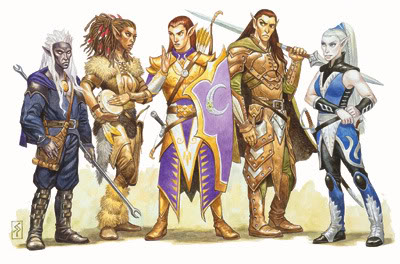
These are the images I used for all of the different character sketches for the ready-to-play character sheets. If you are trying to decide which character type to play in your next Dungeons and Dragons game, these images may give you a little inspiration.

D&D 3.5 – Animal Companion / Familiar Character Sheets

Animal-Sheet

Animal-Sheet

This is a character sheet for animal companions and familiars for Dungeons and Dragons Lite.

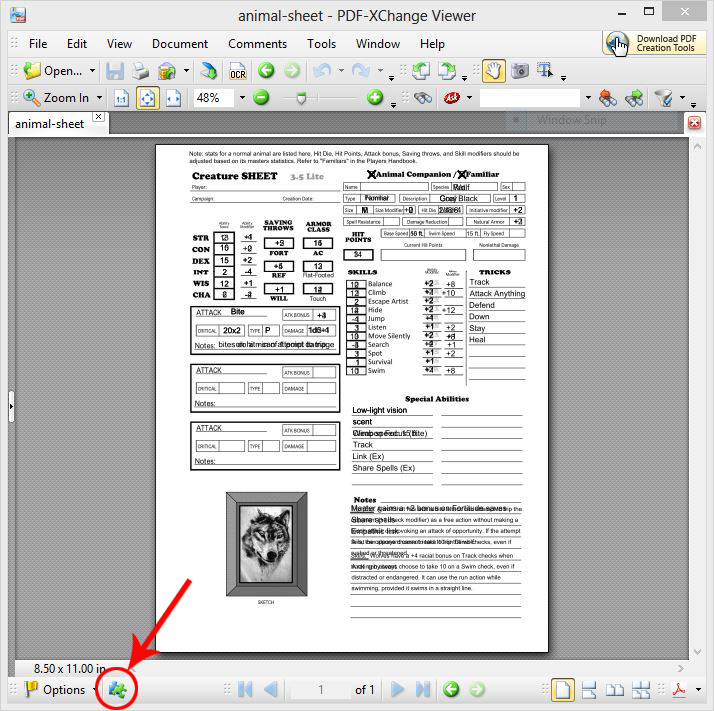
This is a multi-layer PDF file. When you open it, it will be unreadable until you turn off some of the layers. To use it simply turn off all of the layers except for those that contain the information you desire.

1) For a blank sheet – turn off all of the layers except for the “Sheet” layer.

2) Turn on the layer “Animal Companion – Wolf”  for a ready-to-play wolf animal companion.

-or-

2) Turn on the layer “Familiar-Rat” for an almost ready-to-play rat familiar. It has the information filled in for a normal rat, but you will need to adjust its statistics based on your player character’s as explained in the 3.5 Players’ Handbook.pdf-xchange_1

pdf-xchange_2

Please let me know if you discover any mistakes, or if you think I should have created these differently.

UPDATE: There is now a fillable version of this popular file – Find it on this post: Animal Companion / Familiar Character Sheets – Fillable

UPDTATE 2: By request – you can now download a completely blank version (no layers) for those of you who prefer to print out a bloak sheet and fill it in by hand. Click on this link  animal-sheet-blank

D&D 3.5 – Fast-Play Character Sheets

Character-Sheet

Human-Sheet-Front                   Human-Sheet-Back

Half-orc-Sheet-Front                 Half-orc-Sheet-Back

Halfling-Sheet-Front                  Halfling-Sheet-Back

Half-elf-Sheet-Front                  Half-elf-Sheet-Back

Gnome-Sheet-Front                  Gnome-Sheet-Back

Elf-Sheet-Front                          Elf-Sheet-Back

Dwarf-Sheet-Front                  Dwarf-Sheet-Back


These are fast-play first level character sheets for Dungeons and Dragons Lite.

They are multi-layer PDF files. When you open them they will be unreadable until you turn off some of the layers. To use them simply turn off all of the layers except for those that contain the information you desire.

1) Download the front and back sheet for your character’s race.

2) For a blank sheet – turn off all of the layers except for the “Sheet” layer.

3) Turn on the “Class” layer for the class you are going to play to get all of the standard information, including the default equipment, for your character. You can print this out and it will be ready for you to add a background skill and to roll your ability scores. Everything for a first level character will be filled in that is not dependent on your ability scores.

4) Turn on the “Abilities” layer for the class you are going to play to get a ready-to-play character sheet. Everything except the character’s name, sex and description will be filled in and ready to use. The “Abilities” layer and the “Class” layer must both be for the same class or the numbers won’t add up correctly.

5) Optionally – on the Back sheet – you can turn on a “Sketch” layer for your character class. This will give you a drawing of your character. (These were all found on the internet, converted to black and white and scaled to fit on the sheet. They are all male characters.)

EXAMPLE: If you want a ready-to-play first level Half-orc Monk character. Download the files “Half-orc-Sheet-Front.pdf” and “Half-orc-Sheet-Back.pdf”. Open both of them using Acrobat Reader. On the Layers menu turn off (by clicking on the little eye beside the layer name) all of the layers except for these: “Sheet”, “Race_Half-orc”, “Class-Monk”, and “Abilities-Monk”. On the Back sheet, you can turn on the layer “Sketch-Monk” for a drawing of the character. Print both sheets (they are designed to print on the front and back side of a single sheet). Now all you have to do is fill in the name and sex and you are ready to play. The character’s description on the back side has been left blank for you to describe him as you see fit.


BEHIND THE DOUNGEON MASTER’S SCREEN

(For those of you that are interested in what I did and why I did it this way.)

For abilities I used this default ability array: 18, 16, 14, 12, 10, 8

This makes for interesting characters with everyone having some ability that they excel at and one that they are very bad at. With most of the abilities above average this makes for heroic characters.

I then assigned the abilities (highest to lowest) based on the character’s class.

Barbarian, Fighter, Monk: STR/DEX/CON/WIS/CHA/INT

Bard, Sorcerer: CHA/DEX/CON/INT/STR/WIS

Cleric, Druid: WIS/CHA/INT/STR/ DEX/CON

Paladin:  CHA/STR/DEX/ INT/WIS/CON

Ranger, Rogue:  DEX/STR/WIS/INT/CON/CHA

Wizard: INT/DEX/CON/WIS/CHA/STR


I tried my best to make the abilities work well for each class. I am sure others might have assigned them differently.

On a side note – I originally intended to have at least one class have an ability score of 8 (a -1 ability modifier) for each of the abilities, but I decided not to give anyone a score of 8 in Dexterity. Strictly interpreting the rules, if your character’s dexterity score is very low he is easier to hit if he is aware of the attack than if he isn’t! This is the result of a negative DEX modifier on his armor class. This reminds me of Jar Jar Binks leaning into the punches, but I think that even his flat-footed AC would be lower than his normal or touch AC.

Next I applied the standard ability score modifiers for each race.

Then, based on their ability modifiers, I modified or calculated:

– Saving throws

– Initiative (Dex)

– Armor class (Dex) [and (Wis) for monks]

– Hit points (Con)

– Melee weapon attack (Str)

– Ranged weapon attack (Dex)

– All of the skills [I selected a skill that I thought would be useful for a background skill]

– Loads (Str)

I also gave the classes these default Alignments:

Barbarian, Chaotic Neutral / Bard, Chaotic Good / Cleric, Matches his Deity / Druid, True Neutral / Fighter, Lawful Neutral /Monk, Lawful Neutral / Paladin, Lawful Good / Ranger, Neutral Good / Rogue, Chaotic Neutral / Sorcerer, Chaotic Neutral/ Wizard, Lawful Neutral


A lot of people are not familiar with multi-layer PDF files, but if you have any trouble turning layers on and off just let me know.

This gives you a total of 77 different ready-to-play characters.

Please let me know if you discover any mistakes, or if you think I should have created these differently.

D&D 3.5 – Iconic Rogue

Thinking of playing a Rogue? Here is an excellent article regarding the pros and cons of playing a Rogue: Rogues  with Class By Skip Williams.

Here is the information for playing an iconic Rogue character. Start with my post on Iconic Characters, then add this specific information.

Hit Die: d6

Class Skills: Climb, Decipher Script, Disable Device, Hide, Listen, Move Silently, Open Lock, Search, Sleight of Hand, Use Magic Device

Class Knowledge: Local

Special abilities:
The following are the special abilities available to Rogues. The abilities are listed under the level that they are acquired. Where an ability is described as (ref PHB), you should refer to that ability’s description in the players handbook.

1st Level
Deceitful: You get a +2 bonus on all Disguise checks and Forgery checks.
Sneak Attack: +1d6 damage when flanking target. (ref. PHB)
Trapfinding: Can use search to find traps with DC20 or higher and can use Disable Device to disarm magic traps. Beat a traps DC by 10 or more to bypass it without disarming it.
2nd Level
Evasion:  Take no damage on a successful Ref saving throw against an attack that normally deals half damage on a save.
3rd Level
Deft Hands: You get a +2 bonus on all Sleight of Hand checks and Use Rope checks.
Sneak Attack: Like Sneak Attack above, but now you get +2d6 damage
Trap Sense: +1 on Ref saves made to avoid traps and +1 dodge bonus to AC against attacks made by traps.
4th Level
Ability Score Adjustment: Add 1 to any ability score.
Uncanny Dodge: Retain Dexterity bonus to AC (if any) even if flat-footed or struck by an invisible attacker.
5th Level
Sneak Attack: Like Sneak Attack above, but now you get +3d6 damage
6th Level
Diligent: You get a +2 bonus on all Appraise checks and Decipher Script checks.
Trap Sense: Like Trap Sense above, but your bonuses become +2.
7th Level
Sneak Attack: Like Sneak Attack above, but now you get +4d6 damage
8th Level
Ability Score Adjustment: Add 1 to any ability score.
Improved Uncanny Dodge: Can no longer be flanked, unless by another rogue at least 4 levels higher.
9th Level
Improved Initiative: You get a +4 bonus on initiative checks.
Sneak Attack: Like Sneak Attack above, but now you get +5d6 damage
Trap Sense: Like Trap Sense above, but your bonuses become +3.
10th Level
Special  Ability (Crippling Strike): Sneak attack deals an additional 2 points Strength damage.
11th Level
Sneak Attack: Like Sneak Attack above, but now you get +6d6 damage
12th Level
Ability Score Adjustment: Add 1 to any ability score.
Nimble Fingers: You get a +2 bonus on all Disable Device checks and Open Lock checks.
Trap Sense: Like Trap Sense above, but your bonuses become +4.
13th Level
Sneak Attack: Like Sneak Attack above, but now you get +7d6 damage
Special  Ability (Improved Evasion): Like Evasion above, but now you also take only half damage on a failed save.
14th Level
No special abilities added at this level.
15th Level
Quick Draw: You can draw a weapon as a free action instead of as a move action. You can draw a hidden weapon (see the Sleight of Hand skill) as a move action. You may throw weapons at your full normal rate of attacks (much like a character with a bow).
Sneak Attack: Like Sneak Attack above, but now you get +8d6 damage
Trap Sense: Like Trap Sense above, but your bonuses become +5.
16th Level
Ability Score Adjustment: Add 1 to any ability score.
Special  Ability (Defensive Roll): Once a day, when damage from combat would reduce you to 0 or fewer HP, you can attempt to roll with the damage to get half damage. (ref. PHB)
17th Level
Sneak Attack: Like Sneak Attack above, but now you get +9d6 damage
18th Level
Stealthy: You get a +2 bonus on all Hide checks and Move Silently checks.
Trap Sense: Like Trap Sense above, but your bonuses become +6.
19th Level
Sneak Attack: Like Sneak Attack above, but now you get +10d6 damage
Special  Ability (Slippery Mind): ref PHB
20th Level
Ability Score Adjustment: Add 1 to any ability score.