Dungeon Master Assistance

Where anyone over 18 can share thoughts and ideas on RPGs.

Tag Archives: House Rules

D&D 3.5 – Elves don’t have souls!


elvesEven after all of the years that I have been a Dungeon Master I am still being surprised by how much I never knew about this game.  For instance, I recently learned that in AD&D a raise dead spell wouldn’t work on elves (and half-orcs) because they didn’t have souls. In the games I ran I either overlooked this rule or simply missed it entirely.

From AD&D Deities and Demigods:

AD&D assumes that the anima, that force which gives life and distinct existence to thinking beings, is one of two sorts: soul or spirit. Humans, dwarves, halflings, gnomes, and half-elves (those beings which can have a raise dead or resurrection spell cast on them) all have souls; all other beings that worship deities have spirits. This latter group includes (but is not limited to) elves, orcs, half-orcs, and the other creatures specifically mentioned in the NON-HUMANS’ DEITIES section of this work.

This all changed with 3.5 which treats races all the same in regards to souls.

Here is a great “What Happens After Your Character Dies” article from the 3.5 Book “The Complete Divine”. [Link]

I think that in my house-rules I would add to this by saying that there is one exception. After the soul travels to an outer plane affiliated with the alignment or deity of the deceased, if that deity is displeased with the deceased he may be cast out. Anyone that has so displeased or angered his deity that his soul is barred from his plane will find his soul transported to Avernus, the first layer of ‘The Nine Hells’ of Baator.

D&D 3.5 – Iconic Sorcerer

Thinking of playing a Sorcerer ? Here is an excellent article regarding the pros and cons of playing a Sorcerer : Sorcerers with Class By Skip Williams.

Here is the information for playing an iconic Sorcerer character. Start with my post on Iconic Characters, then add this specific information.

Hit Die: d4

Class Skills: Bluff, Concentration

Class Knowledge: The planes

Spells: The sorcerer can cast any spell at any time. He doesn’t have to prepare or select his spells ahead of time, but can simply select which spell he wants to cast when he casts it. This is limited only by the number of spells of each level he is allowed to cast each day and which spells he knows. As he increases his level, he selects more known spells from the sorcerer/wizard spell list.

Special abilities: The following are the special abilities available to sorcerers. The abilities are listed under the level that they are acquired. Where an ability is described as (ref PHB), you should refer to that ability’s description in the players handbook.

1st Level
Base Attack Bonus +0, Fort Save +0, Ref Save +0, Will Save +2
Spells Known: 0 (4), 1st (2)
Spells Per Day: 0 (5), 1st (3)
Spell Penetration: You get a +2 bonus on caster level checks (1d20 + caster level) made to overcome a creature’s spell resistance.
Familiar: A sorcerer can have a familiar. (ref. PHB)
2nd Level [1,000 XP]
Base Attack Bonus +1, Fort Save +0, Ref Save +0, Will Save +3
Spells Known: 0 (5), 1st (2)
Spells Per Day: 0 (6), 1st (4)
3rd Level [3,000 XP]
Base Attack Bonus +1, Fort Save +0, Ref Save +0, Will Save +3
Spells Known: 0 (5), 1st (3)
Spells Per Day: 0 (6), 1st (5)
Magical Aptitude: You get a +2 bonus on all Spellcraft checks and Use Magic Device checks.
4th Level [6,000 XP]
Base Attack Bonus +2, Fort Save +1, Ref Save +1, Will Save +4
Spells Known: 0 (6), 1st (3), 2nd (1)
Spells Per Day: 0 (6), 1st (6), 2nd (3)
Ability Score Adjustment: Add 1 to any ability score.
5th Level [10,000 XP]
Base Attack Bonus +2, Fort Save +1, Ref Save +1, Will Save +4
Spells Known: 0 (6), 1st (4), 2nd (2)
Spells Per Day: 0 (6), 1st (6), 2nd (4)
6th Level [15,000 XP]
Base Attack Bonus +3, Fort Save +2, Ref Save +2, Will Save +5
Spells Known: 0 (7), 1st (4), 2nd (2), 3rd (1)
Spells Per Day: 0 (6), 1st (6), 2nd (5), 3rd (3)
Greater Spell Penetration: You get an additional +2 bonus on caster level checks (1d20 + caster level) made to overcome a creature’s spell resistance.
7th Level [21,000 XP]
Base Attack Bonus +3, Fort Save +2, Ref Save +2, Will Save +5
Spells Known: 0 (7), 1st (5), 2nd (3), 3rd (2)
Spells Per Day: 0 (6), 1st (6), 2nd (6), 3rd (4)
8th Level [28,000 XP]
Base Attack Bonus +4, Fort Save +2, Ref Save +2, Will Save +6
Spells Known: 0 (8), 1st (5), 2nd (3), 3rd (2), 4th (1)
Spells Per Day: 0 (6), 1st (6), 2nd (6), 3rd (5), 4th (3)
Ability Score Adjustment: Add 1 to any ability score.
9th Level [36,000 XP]
Base Attack Bonus +4, Fort Save +3, Ref Save +3, Will Save +6
Spells Known: 0 (8), 1st (5), 2nd (4), 3rd (3), 4th (2)
Spells Per Day: 0 (6), 1st (6), 2nd (6), 3rd (6), 4th (4)
Lightning Reflexes: You get a +2 bonus on all Reflex saving throws.
10th Level [45,000 XP]
Base Attack Bonus +5, Fort Save +3, Ref Save +3, Will Save +7
Spells Known: 0 (9), 1st (5), 2nd (4), 3rd (3), 4th (2), 5th (1)
Spells Per Day: 0 (6), 1st (6), 2nd (6), 3rd (6), 4th (5), 5th (3)
11th Level [55,000 XP]
Base Attack Bonus +5, Fort Save +3, Ref Save +3, Will Save +7
Spells Known: 0 (9), 1st (5), 2nd (5), 3rd (4), 4th (3), 5th (2)
Spells Per Day: 0 (6), 1st (6), 2nd (6), 3rd (6), 4th (6), 5th (4)
12th Level [66,000 XP]
Base Attack Bonus +6/+1, Fort Save +4, Ref Save +4, Will Save +8
Spells Known: 0 (9), 1st (5), 2nd (5), 3rd (4), 4th (3), 5th (2), 6th (1)
Spells Per Day: 0 (6), 1st (6), 2nd (6), 3rd (6), 4th (6), 5th (5), 6th (3)
Ability Score Adjustment: Add 1 to any ability score.
Iron Will: You get a +2 bonus on all Will saving throws.
13th Level [78,000 XP]
Base Attack Bonus +6/+1, Fort Save +4, Ref Save +4, Will Save +8
Spells Known: 0 (9), 1st (5), 2nd (5), 3rd (4), 4th (4), 5th (3), 6th (2)
Spells Per Day: 0 (6), 1st (6), 2nd (6), 3rd (6), 4th (6), 5th (5), 6th (4)
14th Level [91,000 XP]
Base Attack Bonus +7/+2, Fort Save +4, Ref Save +4, Will Save +9
Spells Known: 0 (9), 1st (5), 2nd (5), 3rd (4), 4th (4), 5th (3), 6th (2), 7th (1)
Spells Per Day: 0 (6), 1st (6), 2nd (6), 3rd (6), 4th (6), 5th (5), 6th (5), 7th (3)
15th Level [105,000 Xh]
Base Attack Bonus +7/+2, Fort Save +5, Ref Save +5, Will Save +9
Spells Known: 0 (9), 1st (5), 2nd (5), 3rd (4), 4th (4), 5th (4), 6th (3), 7th (2)
Spells Per Day: 0 (6), 1st (6), 2nd (6), 3rd (6), 4th (6), 5th (5), 6th (6), 7th (4)
Great Fortitude: You get a +2 bonus on all Fortitude saving throws.
16th Level [120,000 XP]
Base Attack Bonus +8/+3, Fort Save +5, Ref Save +5, Will Save +10
Spells Known: 0 (9), 1st (5), 2nd (5), 3rd (4), 4th (4), 5th (4), 6th (3), 7th (2), 8th (1)
Spells Per Day: 0 (6), 1st (6), 2nd (6), 3rd (6), 4th (6), 5th (5), 6th (6), 7th (5), 8th (3)
Ability Score Adjustment: Add 1 to any ability score.
17th Level [136,000 XP]
Base Attack Bonus +8/+3, Fort Save +5, Ref Save +5, Will Save +10
Spells Known: 0 (9), 1st (5), 2nd (5), 3rd (4), 4th (4), 5th (4), 6th (3), 7th (3), 8th (2)
Spells Per Day: 0 (6), 1st (6), 2nd (6), 3rd (6), 4th (6), 5th (5), 6th (6), 7th (6), 8th (4)
18th Level [153,000 XP]
Base Attack Bonus +9/+4, Fort Save +6, Ref Save +6, Will Save +11
Spells Known: 0 (9), 1st (5), 2nd (5), 3rd (4), 4th (4), 5th (4), 6th (3), 7th (3), 8th (2), 9th (1)
Spells Per Day: 0 (6), 1st (6), 2nd (6), 3rd (6), 4th (6), 5th (5), 6th (6), 7th (6), 8th (5), 9th (3)
Improved Counterspell: When counterspelling, you may use a spell of the same school that is one or more spell levels higher than the target spell.
19th Level [171,000 XP]
Base Attack Bonus +9/+4, Fort Save +6, Ref Save +6, Will Save +11
Spells Known: 0 (9), 1st (5), 2nd (5), 3rd (4), 4th (4), 5th (4), 6th (3), 7th (3), 8th (3), 9th (2)
Spells Per Day: 0 (6), 1st (6), 2nd (6), 3rd (6), 4th (6), 5th (5), 6th (6), 7th (6), 8th (6), 9th (4)
20th Level [190,000 XP]
Base Attack Bonus +10/+5, Fort Save +6, Ref Save +6, Will Save +12
Spells Known: 0 (9), 1st (5), 2nd (5), 3rd (4), 4th (4), 5th (4), 6th (3), 7th (3), 8th (3), 9th (3)
Spells Per Day: 0 (6), 1st (6), 2nd (6), 3rd (6), 4th (6), 5th (5), 6th (6), 7th (6), 8th (6), 9th (6)
Ability Score Adjustment: Add 1 to any ability score.

D&D 3.5 – Dying – Nonlethal Damage – Healing

Below are quotes from my house rules Dungeons and Dragons Lite [with notes to explain the reasoning behind the rules]:

 Dying

Characters die when their negative hit point total reaches -10 or one-third of their full normal hit points, whichever is a larger value. [This is to allow higher level characters, which tend to receive larger amounts of damage, a better change of survival.]

Opponents die when their hit points reach zero. [A monster at 0 hp is dead, and you don’t have to worry about wandering around the battlefield stabbing all your unconscious foes.] There are a few exceptions;

Exception 1 – When your opponent is a PC or major NPC (as designated by the DM). In this case your opponent dies when his hit points are reduced as indicated above for player characters. [The DM needs to allow certain powerful NPCs a chance of survival. The DM should let the PCs know if an opponent they thought they had slain is only unconscious.]

Exception 2 – When a monster’s description states that it doesn’t die when it runs out of hit points. [An example is a Vampire. If reduced to 0  hit points in combat, it automatically assumes gaseous form and attempts to escape.]

Exception 3 –When your character’s intent is to subdue and not to kill. [We are eliminating the nonlethal damage rules and substituting these rules that only apply to attacks with melee weapons or weapons that deal nonlethal damage.] You must declare your intent to subdue before making your attack roll. Subdual attacks do the normal amount of hit point damage until your opponent’s hit points reach zero.  Damage from a single subdual attack cannot reduce your opponent’s hit points below -9. Your opponent will be disabled at zero hit points, unconscious but stable at negative hit points. This unconscious character does not loose additional hit points while unconscious and can heal normally. He has a 10% chance per hour of regaining consciousness naturally. If his hit point total is reduced to -10 or below for any reason, he dies.


Magical Healing

If a character with negative hit points receives healing, he returns to 0 hp before any healing is applied. [In other words, he’ll wake up again with hit points equal to the healing provided by the effect—a cure light wounds spell for 7 hp will bring any dying character back to 7 hp, no matter what his negative hit point total had reached.]


Natural Healing

A character recovers all lost hit points with one evening of rest (8 hours of sleep). [The official rule of 1 hit point healing per character level for each full night’s rest (or twice his character level in hit points for a complete day of bed rest) is more realistic, but changing this allows for less down-time between adventuring days and makes it easier to “hold up” in a cleared out dungeon room for the night and continue the next day.]

D&D 3.5 – Animal Companion / Familiar Character Sheets

Animal-Sheet

Animal-Sheet

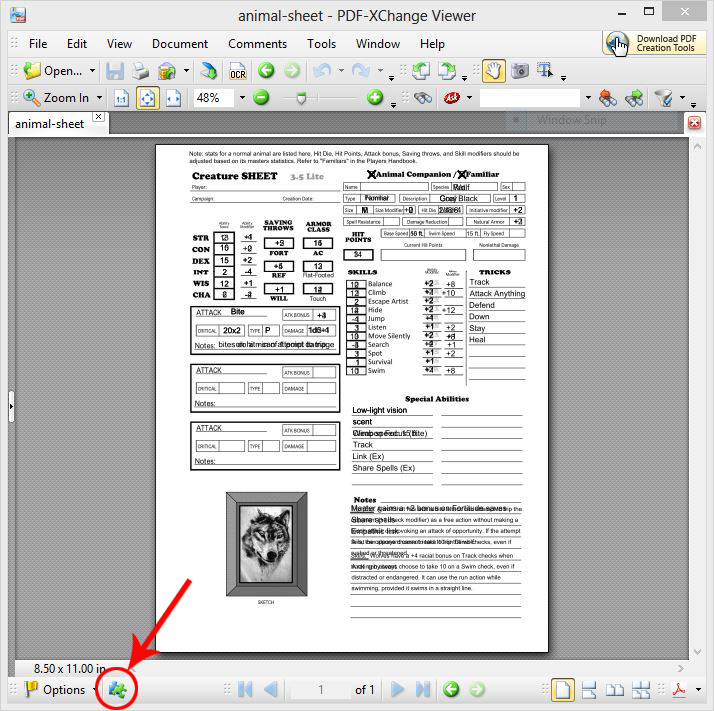
This is a character sheet for animal companions and familiars for Dungeons and Dragons Lite.

This is a multi-layer PDF file. When you open it, it will be unreadable until you turn off some of the layers. To use it simply turn off all of the layers except for those that contain the information you desire.

1) For a blank sheet – turn off all of the layers except for the “Sheet” layer.

2) Turn on the layer “Animal Companion – Wolf”  for a ready-to-play wolf animal companion.

-or-

2) Turn on the layer “Familiar-Rat” for an almost ready-to-play rat familiar. It has the information filled in for a normal rat, but you will need to adjust its statistics based on your player character’s as explained in the 3.5 Players’ Handbook.pdf-xchange_1

pdf-xchange_2

Please let me know if you discover any mistakes, or if you think I should have created these differently.

UPDATE: There is now a fillable version of this popular file – Find it on this post: Animal Companion / Familiar Character Sheets – Fillable

UPDTATE 2: By request – you can now download a completely blank version (no layers) for those of you who prefer to print out a bloak sheet and fill it in by hand. Click on this link  animal-sheet-blank

D&D 3.5 – Fast-Play Character Sheets

Character-Sheet

Human-Sheet-Front                   Human-Sheet-Back

Half-orc-Sheet-Front                 Half-orc-Sheet-Back

Halfling-Sheet-Front                  Halfling-Sheet-Back

Half-elf-Sheet-Front                  Half-elf-Sheet-Back

Gnome-Sheet-Front                  Gnome-Sheet-Back

Elf-Sheet-Front                          Elf-Sheet-Back

Dwarf-Sheet-Front                  Dwarf-Sheet-Back


These are fast-play first level character sheets for Dungeons and Dragons Lite.

They are multi-layer PDF files. When you open them they will be unreadable until you turn off some of the layers. To use them simply turn off all of the layers except for those that contain the information you desire.

1) Download the front and back sheet for your character’s race.

2) For a blank sheet – turn off all of the layers except for the “Sheet” layer.

3) Turn on the “Class” layer for the class you are going to play to get all of the standard information, including the default equipment, for your character. You can print this out and it will be ready for you to add a background skill and to roll your ability scores. Everything for a first level character will be filled in that is not dependent on your ability scores.

4) Turn on the “Abilities” layer for the class you are going to play to get a ready-to-play character sheet. Everything except the character’s name, sex and description will be filled in and ready to use. The “Abilities” layer and the “Class” layer must both be for the same class or the numbers won’t add up correctly.

5) Optionally – on the Back sheet – you can turn on a “Sketch” layer for your character class. This will give you a drawing of your character. (These were all found on the internet, converted to black and white and scaled to fit on the sheet. They are all male characters.)

EXAMPLE: If you want a ready-to-play first level Half-orc Monk character. Download the files “Half-orc-Sheet-Front.pdf” and “Half-orc-Sheet-Back.pdf”. Open both of them using Acrobat Reader. On the Layers menu turn off (by clicking on the little eye beside the layer name) all of the layers except for these: “Sheet”, “Race_Half-orc”, “Class-Monk”, and “Abilities-Monk”. On the Back sheet, you can turn on the layer “Sketch-Monk” for a drawing of the character. Print both sheets (they are designed to print on the front and back side of a single sheet). Now all you have to do is fill in the name and sex and you are ready to play. The character’s description on the back side has been left blank for you to describe him as you see fit.


BEHIND THE DOUNGEON MASTER’S SCREEN

(For those of you that are interested in what I did and why I did it this way.)

For abilities I used this default ability array: 18, 16, 14, 12, 10, 8

This makes for interesting characters with everyone having some ability that they excel at and one that they are very bad at. With most of the abilities above average this makes for heroic characters.

I then assigned the abilities (highest to lowest) based on the character’s class.

Barbarian, Fighter, Monk: STR/DEX/CON/WIS/CHA/INT

Bard, Sorcerer: CHA/DEX/CON/INT/STR/WIS

Cleric, Druid: WIS/CHA/INT/STR/ DEX/CON

Paladin:  CHA/STR/DEX/ INT/WIS/CON

Ranger, Rogue:  DEX/STR/WIS/INT/CON/CHA

Wizard: INT/DEX/CON/WIS/CHA/STR


I tried my best to make the abilities work well for each class. I am sure others might have assigned them differently.

On a side note – I originally intended to have at least one class have an ability score of 8 (a -1 ability modifier) for each of the abilities, but I decided not to give anyone a score of 8 in Dexterity. Strictly interpreting the rules, if your character’s dexterity score is very low he is easier to hit if he is aware of the attack than if he isn’t! This is the result of a negative DEX modifier on his armor class. This reminds me of Jar Jar Binks leaning into the punches, but I think that even his flat-footed AC would be lower than his normal or touch AC.

Next I applied the standard ability score modifiers for each race.

Then, based on their ability modifiers, I modified or calculated:

– Saving throws

– Initiative (Dex)

– Armor class (Dex) [and (Wis) for monks]

– Hit points (Con)

– Melee weapon attack (Str)

– Ranged weapon attack (Dex)

– All of the skills [I selected a skill that I thought would be useful for a background skill]

– Loads (Str)

I also gave the classes these default Alignments:

Barbarian, Chaotic Neutral / Bard, Chaotic Good / Cleric, Matches his Deity / Druid, True Neutral / Fighter, Lawful Neutral /Monk, Lawful Neutral / Paladin, Lawful Good / Ranger, Neutral Good / Rogue, Chaotic Neutral / Sorcerer, Chaotic Neutral/ Wizard, Lawful Neutral


A lot of people are not familiar with multi-layer PDF files, but if you have any trouble turning layers on and off just let me know.

This gives you a total of 77 different ready-to-play characters.

Please let me know if you discover any mistakes, or if you think I should have created these differently.

D&D 3.5 – Wars: Mass Combat Rules

War_book_cover

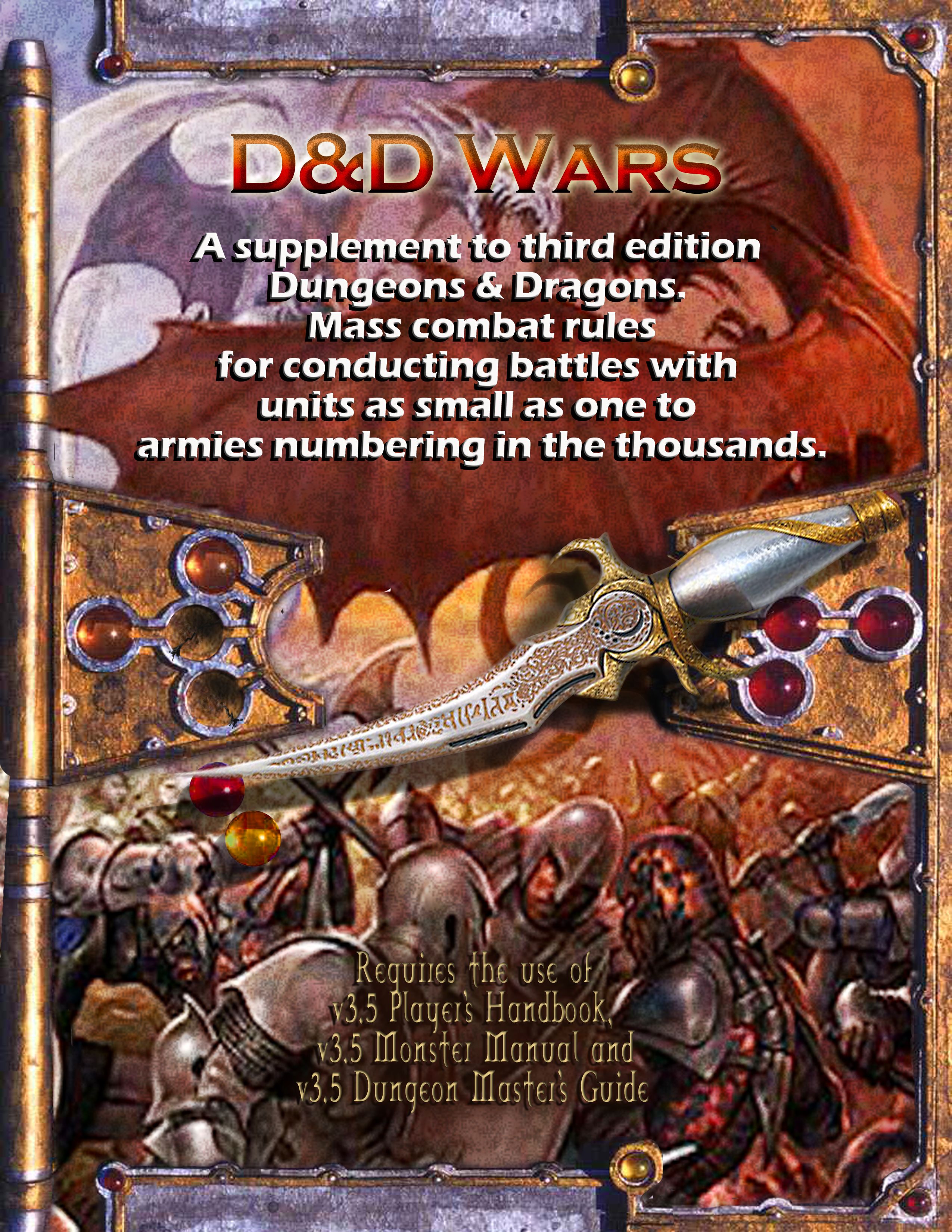
D&D Wars – Front Cover

[There is an updated version of these rules available here: D&D Wars ]

Download these mass combat rules here (free): WAR

D&D Wars is a supplement to third edition Dungeons & Dragons that provides a set of mass combat rules for conducting battles with units as small as one to armies numbering in the thousands. D&D Wars are not simply armies making battle with each other. It is armies intermixed with monsters and NPCs. Added to this mix is a group of PC heroes doing what they can to change the tide of the war.

–My goals in creating these rules —

– The rules must be compatible with Dungeons and Dragons version 3.5.

– There must be rules for creating armies comprised of units of various sizes and compositions.

– It must have consistent rules for scaling the battle from a small group of villagers with torches and pitchforks all the way up to epic battles with thousands of soldiers on both sides.

– The rules must accommodate individual monsters wandering across the battlefield as well as other NPCs and PCs that are not part of the units.

– It must use standard combat rules without modification as far as possible.

– To this end:

  • It uses a standard 6 second combat round.
  • Creatures occupy the standard amount of space. The size represented by a 1” square is larger than the standard 5 ft (15 ft. being typical). Thus accommodating larger size armies.
  • Movement, Armor Class, Hit Points and Attacks/Damage for individual creatures that are not a part of a unit remain unchanged.
  • Movement, Armor Class, Hit Points and Attacks/Damage for one counter (representing several creatures that cover 1 square as part of a unit) will be the same as for a single standard creature. That way when counters of one unit attack counters of another unit, standard combat rules apply with very few exceptions.
  • Individual creatures that are not in a unit can attack, and be attacked by, the creatures in a unit. In either case it will be creatures attacking creatures. A simple conversion is done to calculate the amount of damage.
  • To speed up play, because of the potentially large number of units, monsters, NPCs, siege weapons, and PCs involved, each of them is restricted to only one action (move, attack or defense) each round. Also creatures with multiple attacks each round (except for PCs) will get only one attack action.
  • Then of course there must be special morale rules and rules for how to handle magic spells cast by or against units.
  • Throw in some rules for siege engines and I’m done.

Before creating these rules, I tried to find out if someone else had already done this, and I found several who had.

First, there are several excellent wargame systems. A mass combat system for an RPG and a wargame are not the same thing. Excellent wargames don’t necessarily deliver as RPG mass combat systems so I passed on them.

Second, I found several homebrew systems. Most of these are of the “treat a unit as a really large monster” variety. These all work for their games, of course, but most fall short of what I was looking for.

Third, there are a few serious, published attempts at creating RPG mass combat rules.

The best of these are described below in no particular order.

__________________________

Adamant Entertainment’s “Warpath

This is a Pathfinder supplement.

Even though it is not specifically for v3.5 it is close enough with only minor adjustments.

What I like:

It is an excellent, well thought out system. It uses a clever idea of making each 1” square represent 10 feet and each unit be represented by a 3”x6” index card.

It also contains information on the upkeep of an army, mustering armies, supplying an army and siege warfare. There is an alternate way to quickly resolve mass combat in only a few rolls of the dice.

It uses a standard 6 second combat round.

It is well presented and I got a lot of good information from here.

Why I didn’t use it:

It assumes that the PCs are commanders of the army, or at least unit leaders. There are no good rules to allow a PC to act independently from the unit (other than being a solo unit).

There are no rules to deal with units in combat against individual monsters or heroes.

It doesn’t scale well for different size battles. The rules for larger battles are unsatisfactory. It simply recommends that you use larger unit cards and to “be sure you have the space available” for all of the additional space it will take up on the battle matt.

_____________________________________________

Mongoose Publishing’s “Mass Combat

This is a supplement to Conan The Roleplaying Game which is v3.5 compatible.

What I like:

This is one of the best set of rules that I found. It does a good job of integrating v3.5 rules into a set of mass combat rules.

They have good rules for resolving magic use against units and for war machines.

It treats units as a group of counters, with each counter representing a number of individuals.

It uses a standard 6 second combat round.

Why I didn’t use it:

It relies heavily on unit formations, unit faces and a special “surge” attack. I wanted to avoid having facing rules. D&D 3.5 has no facing rules for creatures, so I didn’t want to introduce this into my mass combat system.

It is a little vague on how much space a counter covers.

Units do not make saving throws, but always take the average amount of damage they would have received if each individual had made a separate saving throw.

There are no rules to deal with units in combat against individual monsters or heroes.

__________________________________________________________

Wizards of the Coast’s “Complete Warrior

This official D&D accessory contains a chapter on Fantasy Warfare.

What I like:

It has a very good overview of how one can integrate warfare into a standard D&D campaign.

It has a good list of ways PCs can tern the tide of battle, with a table of possible missions and mission complications.

It would be good to use if the war is simply going on around the PCs.

Why I didn’t use it:

It doesn’t have any mass combat rules.

__________________________________________________________

Udo’s D20 Mass Combat

This is a small (5 pages) document that attempts to bring mass combat to d20 games.

What I like:

It scales up nicely. One 1 inch square can represent a 5, 25 or 100 ft. square.

It uses standard rules for the most part.

Why I didn’t use it:

It uses a 0-10 scale for health and attack damage, rather than standard hit points.

Any monster or character would have to be converted to the 0-10 FSP (Force Strength Points) system for both hit points and attack damage.

The system, although workable, is a little too rules light for my taste.

__________________________________________________________

Races of War’s Mass Combat Minigame

A 3.5e Sourcebook

“It’s a mini-game inside regular 3.5e that has been designed for simplicity and a minimum of bookkeeping.”

What I like:

It introduces a morale score (similar to Hit Points). When the unit’s morale score reaches 0, the unit flees form the battlefield.

Why I didn’t use it:

It uses squares that represent 50’ x 50’. This is workable, but I wanted more flexibility for larger or smaller armies.

It doesn’t use a simple initiative order, but each army acts in an order depending on its position and type of attack.

The rules for attacking a unit with spells (other than damage causing spells) are turned into damage causing spells or have no effect.

It has no rules for anything other than units or PCs (No rules for monsters or siege weapons for example).

D&D 3.5 – Iconic Rogue

Thinking of playing a Rogue? Here is an excellent article regarding the pros and cons of playing a Rogue: Rogues  with Class By Skip Williams.

Here is the information for playing an iconic Rogue character. Start with my post on Iconic Characters, then add this specific information.

Hit Die: d6

Class Skills: Climb, Decipher Script, Disable Device, Hide, Listen, Move Silently, Open Lock, Search, Sleight of Hand, Use Magic Device

Class Knowledge: Local

Special abilities:
The following are the special abilities available to Rogues. The abilities are listed under the level that they are acquired. Where an ability is described as (ref PHB), you should refer to that ability’s description in the players handbook.

1st Level
Deceitful: You get a +2 bonus on all Disguise checks and Forgery checks.
Sneak Attack: +1d6 damage when flanking target. (ref. PHB)
Trapfinding: Can use search to find traps with DC20 or higher and can use Disable Device to disarm magic traps. Beat a traps DC by 10 or more to bypass it without disarming it.
2nd Level
Evasion:  Take no damage on a successful Ref saving throw against an attack that normally deals half damage on a save.
3rd Level
Deft Hands: You get a +2 bonus on all Sleight of Hand checks and Use Rope checks.
Sneak Attack: Like Sneak Attack above, but now you get +2d6 damage
Trap Sense: +1 on Ref saves made to avoid traps and +1 dodge bonus to AC against attacks made by traps.
4th Level
Ability Score Adjustment: Add 1 to any ability score.
Uncanny Dodge: Retain Dexterity bonus to AC (if any) even if flat-footed or struck by an invisible attacker.
5th Level
Sneak Attack: Like Sneak Attack above, but now you get +3d6 damage
6th Level
Diligent: You get a +2 bonus on all Appraise checks and Decipher Script checks.
Trap Sense: Like Trap Sense above, but your bonuses become +2.
7th Level
Sneak Attack: Like Sneak Attack above, but now you get +4d6 damage
8th Level
Ability Score Adjustment: Add 1 to any ability score.
Improved Uncanny Dodge: Can no longer be flanked, unless by another rogue at least 4 levels higher.
9th Level
Improved Initiative: You get a +4 bonus on initiative checks.
Sneak Attack: Like Sneak Attack above, but now you get +5d6 damage
Trap Sense: Like Trap Sense above, but your bonuses become +3.
10th Level
Special  Ability (Crippling Strike): Sneak attack deals an additional 2 points Strength damage.
11th Level
Sneak Attack: Like Sneak Attack above, but now you get +6d6 damage
12th Level
Ability Score Adjustment: Add 1 to any ability score.
Nimble Fingers: You get a +2 bonus on all Disable Device checks and Open Lock checks.
Trap Sense: Like Trap Sense above, but your bonuses become +4.
13th Level
Sneak Attack: Like Sneak Attack above, but now you get +7d6 damage
Special  Ability (Improved Evasion): Like Evasion above, but now you also take only half damage on a failed save.
14th Level
No special abilities added at this level.
15th Level
Quick Draw: You can draw a weapon as a free action instead of as a move action. You can draw a hidden weapon (see the Sleight of Hand skill) as a move action. You may throw weapons at your full normal rate of attacks (much like a character with a bow).
Sneak Attack: Like Sneak Attack above, but now you get +8d6 damage
Trap Sense: Like Trap Sense above, but your bonuses become +5.
16th Level
Ability Score Adjustment: Add 1 to any ability score.
Special  Ability (Defensive Roll): Once a day, when damage from combat would reduce you to 0 or fewer HP, you can attempt to roll with the damage to get half damage. (ref. PHB)
17th Level
Sneak Attack: Like Sneak Attack above, but now you get +9d6 damage
18th Level
Stealthy: You get a +2 bonus on all Hide checks and Move Silently checks.
Trap Sense: Like Trap Sense above, but your bonuses become +6.
19th Level
Sneak Attack: Like Sneak Attack above, but now you get +10d6 damage
Special  Ability (Slippery Mind): ref PHB
20th Level
Ability Score Adjustment: Add 1 to any ability score.

D&D 3.5 – Iconic Ranger

Thinking of playing a Ranger? Here is an excellent article regarding the pros and cons of playing a Ranger: Rangers with Class By Skip Williams.

Here is the information for playing an iconic Ranger character. Start with my post on Iconic Characters, then add this specific information.

Hit Die: d8

Class Skills: Climb, Handle  Animal, Move Silently, Track, Search, Spot and Survival

Class Knowledge: Geography

Special abilities: The following are the special abilities available to Rangers.  The abilities are listed under the level that they are acquired. By the time your character reaches second level he must specialize in one of two different combat styles.  He can choose between the archery combat style and the two-weapon combat style. As indicated in the table below – some of the special abilities he receives as he advances in level will depend on the combat style he pursues. Where an ability is described as (ref PHB), you should refer to that ability’s description in the players handbook.

1st Level
Skill Focus (Survival): You get a +3 bonus on all Survival checks.
Favored Enemy: Select a type of creature from Table 3–14: Ranger Favored Enemies. You get a +2 bonus on Bluff, Listen, Sense Motive, Spot, and Survival checks against creatures of this type, and a +2 bonus on weapon damage
Wild  Empathy:  Can improve the attitude of an animal with a successful Cha check.
2nd Level
Combat Style: Select one of two combat styles to pursue: archery or two-weapon combat. You lose all benefits of your combat style when wearing medium or heavy armor.
Rapid Shot:  [If you are pursuing the archery combat style] You can get one extra attack per round with a ranged weapon. The attack is at your highest base attack bonus, but each attack you make in that round (the extra one and the normal ones) takes a -2 penalty. You must use the full attack action to use this ability.
-or-
Two-Weapon Fighting: [If you are pursuing the two-weapon combat style] Your penalties on attack rolls for fighting with two weapons are reduced. The penalty for your primary hand lessens by 2 and the one for your off hand lessens by 6. See the Two-Weapon Fighting special attack.
3rd Level
Endurance: You gain a +4 bonus on the following checks and saves: Swim checks made to resist damage, Constitution checks made to continue running, Constitution checks made to avoid damage from a forced march, Constitution checks made to hold your breath, Constitution checks made to avoid damage from starvation or thirst, Fortitude saves made to avoid damage from hot or cold environments, and Fortitude saves made to resist damage from suffocation. Also, you may sleep in light or medium armor without becoming fatigued.
Point Blank Shot: [If you are pursuing the archery combat style] You get a +1 bonus on attack and damage rolls with ranged weapons at ranges of up to 30 feet.
-or-
Two-Weapon Defense: [If you are pursuing the two-weapon combat style] When wielding a double weapon or two weapons (not including natural weapons or unarmed strikes), you gain a +1 shield bonus to your AC. See the Two-Weapon Fighting special attack. When you are fighting defensively or using the total defense action, this shield bonus increases to +2.
4th Level
Ability Score Adjustment: Add 1 to any ability score.
Animal Companion: (ref PHB)
Spells: You gain the ability to cast a small number of divine spells (ref PHB)
5th Level
Favored Enemy: Like Favored Enemy above but now you can select a second creature type from the table and the bonus against one of your favored enemies is increased by 2.
6th Level
Far Shot: [If you are pursuing the archery combat style] When you use a projectile weapon, such as a bow, its range increment increases by one-half (multiply by 1½). When you use a thrown weapon, its range increment is doubled.
-or-
Animal Affinity:  [If you are pursuing the two-weapon combat style] You get a +2 bonus on all Handle Animal checks and Ride checks.
Manyshot:  [If you are pursuing the archery combat style] As a standard action, you may fire two arrows at a single opponent within 30 feet. Both arrows use the same attack roll (with a -4 penalty) to determine success and deal damage normally (but see Special). For every five points of base attack bonus you have above +6, you may add one additional arrow to this attack, to a maximum of four arrows at a base attack bonus of +16. However, each arrow after the second adds a cumulative -2 penalty on the attack roll (for a total penalty of -6 for three arrows and -8 for four). Damage reduction and other resistances apply separately against each arrow fired. Special –  Regardless of the number of arrows you fire, you apply precision-based damage only once. If you score a critical hit, only the first arrow fired deals critical damage; all others deal regular damage.
-or-
Improved TwoWeapon Fighting: [If you are pursuing the two-weapon combat style] In addition to the standard single extra attack you get with an off-hand weapon, you get a second attack with it, albeit at a -5 penalty. See the Two-Weapon Fighting special attack.
7th Level
Woodland Stride: Can move through any normal undergrowth at normal speed and without taking damage.
8th Level
Ability Score Adjustment: Add 1 to any ability score.
Swift Tracker: Can move at normal speed while following tracks without the normal –5 penalty. Take only a –10 penalty when moving at up to twice normal speed while tracking.
9th Level
Precise Shot: [If you are pursuing the archery combat style] You can shoot or throw ranged weapons at an opponent engaged in melee without taking the standard -4 penalty on your attack roll.
-or-
Lightning Reflexes:  [If you are pursuing the two-weapon combat style] You get a +2 bonus on all Reflex saving throws.
Evasion:  Take no damage on a successful Ref saving throw against an attack that normally deals half damage on a save, only if wearing light or no armor.
10th Level
Favored Enemy: Like Favored Enemy above but now you can select a second creature type from the table and the bonus against one of your favored enemies is increased by 2.
11th Level
Improved Precise Shot: [If you are pursuing the archery combat style] Your ranged attacks ignore the AC bonus granted to targets by anything less than total cover, and the miss chance granted to targets by anything less than total concealment. Total cover and total concealment provide their normal benefits against your ranged attacks. In addition, when you shoot or throw ranged weapons at a grappling opponent, you automatically strike at the opponent you have chosen.
-or-
Greater TwoWeapon Fighting: [If you are pursuing the two-weapon combat style] You get a third attack with your off-hand weapon, albeit at a -10 penalty. See the Two-Weapon Fighting special attack.
12th Level
Ability Score Adjustment: Add 1 to any ability score.
Skill Focus (Hide): You get a +3 bonus on all Hide checks.
13th Level
Camouflage: Can use the Hide skill in any sort of natural terrain.
14th Level
No special abilities added at this level.
15th Level
Favored Enemy: Like Favored Enemy above but now you can select a second creature type from the table and the bonus against one of your favored enemies is increased by 2.
Skill Focus (Listen): You get a +3 bonus on all Listen checks.
16th Level
Ability Score Adjustment: Add 1 to any ability score.
17th Level
Hide in Plain Sight: Can use the Hide skill even while being observed – while in any natural terrain
18th Level
Skill Focus (Spot): You get a +3 bonus on all Spot checks.
19th Level
No special abilities added at this level.
20th Level
Ability Score Adjustment: Add 1 to any ability score.
Favored Enemy: Like Favored Enemy above but now you can select a second creature type from the table and the bonus against one of your favored enemies is increased by 2.

D&D 3.5 – Skyships

D&D Skyships

Cover Image for D&D Skyships

D&D Skyships is a supplement to third edition Dungeons & Dragons set in a universe of ships that fly between the worlds and of battles in the air and in space. What you will not find here is a setting with descriptions of new worlds to explore, monsters to defeat and new races defined. You will not find any new feats and very few new magical spells and magical items. There are also no maps or ship plans.

What you will find here is a basic set of rules compatible with Dungeons & Dragons v3.5 that will provide a foundation for taking your D&D adventures into space.

These rules are based roughly on Spelljammer.

Differences between the Skyship system and the Spelljammer system

The skyship system uses some of the best features of Spelljammer and discards or replaces others.

Crystal Spheres and Phlogiston

The original Spelljammer system had “Crystal Spheres” that in turn bobbed about in a substance called Phlogiston, or the Flow. The Crystal Spheres allowed each different AD&D product line to exist in its own sphere, and the Flow allowed for travel between them. The skyship system eliminates all of this and instead uses “planetary systems” and introduces “interstellar teleport” as a way to travel between them.

Gravity planes

In the original Spelljammer system, every object exerted its own gravity, but only objects of a certain size exerted enough force for a gravity plane to develop. Spherical objects attracted objects towards their surfaces uniformly. Objects with a more irregular shape developed a gravitational plane. This plane worked in both directions so that it was possible, for instance, to walk on the bottom of a ship. The skyship system drops this concept and substitutes a simpler one as explained in the “Gravity” section below. Basically, only very large (planet sized) objects have enough gravity to make any difference and the magical device that controls the ship (the helm) also magically creates gravity on board the ship.

Objects dragging air

The Speljaming idea was that all objects would drag air with them whenever they leave an air envelope. A typical human, for example, would drag enough fresh air with him to breathe for 2-20 turns. After that time ran out the air turned foul for a period of time and then became deadly and unbreathable. Larger objects (such as Spelljammers) would drag larger amounts of air that would stay fresh longer. The skyship system abandons this concept entirely. The magical devices that propel the skyships also create breathable air. A PC that leaves an air envelope doesn’t die instantly (refer to the “Vacuum Exposure” section below) but will not last long unaided.

The Spelljammer Helm

The Spelljammer system used a magical devise called a helm. It was a throne like chair and the mage that controlled it was required to be seated on it to control the ship. When he did so, he lost all of his spells. It effectively removed one PC from all rollplaying activity other than controlling the ship. The skyship system also uses a magical helm. It can be controlled by anyone that can cast magical spells. After the helm is activated the pilot is free to move around the ship. He doesn’t loose his spells and can attempt to cast spells while continuing to control the skyship. The pilot can even leave the ship and travel a short distance away without losing all control. Spelljammer had other types of helms as well. The skyship system has only one type of helm, although it isn’t required to be in the form of a chair. There is no reason other helm types couldn’t be added to your campaign if you choose to do so. Simply use the modifications made here as a guide.

Basic Concepts for D&D Skyships

Skyships

Sailing ships are fitted with magical devices that give them the ability to fly through space. These ships are often called skyships. Some races on some worlds have been building skyships for a very long time. Many create them specifically as flying vessels. Some of these are designed to land on land rather than water. Some are designed to never land at all.

Helms

With few exceptions, vehicles capable of interplanetary travel are powered by a powerful magical device known as a magical helm. This magical item can be any shape or size. It is sometimes incorporated into the ship’s wheel. The only requirement is that it must be bolted securely to the ship’s deck. It is most usually created in the form of a large throne like chair.  The helm not only allows the magic user that activated it to control the vessel’s direction and velocity, but also provides an envelope of breathable air at a comfortable temperature and creates an artificial gravity that allows everyone on board to move about on the ship as they would if it were on the water.

Air

A helm maintains breathable air at a comfortable temperature that extends 300 feet in all directions centered on the helm itself. This air provides forward pressure on the sails as if the ship were sailing in a moderate wind. This allows a crew of experienced sailors to maneuver the ship as needed. Without sailors manning the sails the ship can only move forward or turn in a very wide arc.

Beyond the bubble of air created by the helm lies the vacuum of space. Most planets have breathable air surrounding them out to 32,000 feet (about 6 miles).

Gravity

A helm creates a magical gravity similar to normal gravity on the Earth. This magical effect extends to the edge of the air bubble (300 feet). This magical gravity pulls down in relation to the orientation of the ship. Anyone falling overboard will fall as they would on the Earth until they reach the edge of the air bubble. Ten feet beyond the edge of the magical bubble they will stop falling and simply hover there weightless in the vacuum of space (refer to vacuum exposure below). This will be true for anything dropped. If the ship is moving, anything that falls overboard will simply be left behind once it has left the ships gravity bubble. Anything thrown or fired from the ship will behave normally, as it would on the Earth, until it reaches the edge of the magic bubble. It will then continue in a straight line at its current speed forever, unless it hits something or enters another source of gravity.

If two or more ships get close enough to each other that their gravity bubbles touch, they will automatically orient themselves so that “down” on all ships is in the same direction. If a ship enters the gravity of a planet, it will orient itself with that planet’s natural gravity. This alignment of gravity fields occurs almost instantly with no adverse effects to anyone aboard the ship.

All planets, even small ones or large asteroids, have natural gravity. The effects of a planet’s gravity extend 32,000 feet above its surface. All planets have gravity roughly equivalent to that experienced on the Earth regardless of the size or mass of the planet. Not all planets are ball shaped. Some may be disk shaped. Others may be in the shape of a cube. Regardless of the shape of the planet, natural gravity (in this fictional universe) always pulls down toward each of the primary surfaces. This will be toward the center of spherical planets, or towards each of the major flat surfaces of a planet with flat sides.

Pilots

It requires someone with magical abilities to control a helm. A player character must be proficient with magic and capable of casting magical spells. The person that controls the helm is called the pilot.  The more powerful the pilot, the faster he can fly the skyship. Player characters are considered to have a pilot level equal to the highest level spell they can cast. For instance, a 5th level Wizard or 5th level Cleric or an 11th level Paladin can each cast 3rd level spells, so they would each be a 3rd level pilot.

Activating a Helm

It requires a minimum of a level 1 pilot (as defined above) to activate a helm. The helm must be securely bolted to a skyship that is in reasonably good shape. If the helm is currently inactive it takes one hour to activate it. This is called powering up. During this time the pilot must remain in physical contact with the helm and maintain full concentration. The air and gravity bubble expands slowly out from the helm at a rate of 5 feet per minute until it reaches a radius of 300 feet. At this time it becomes fully activated. The pilot can not use the helm to move the ship until it is fully activated. Once activated, as long as the pilot is on the skyship he can control the ship with no need to keep in physical contact with the helm. A pilot may disengage from the helm at will at any time. A helm doesn’t loose all of its power the moment it is disengaged. As soon as it is disengaged it stops moving and floats in place. It then takes an hour before it becomes fully inactive. During this time, the air and gravitational bubble grows smaller at a rate of 5 feet per minute until, after one hour, it completely collapses and the helm again becomes inactive. Any pilot can re-activate a helm while it is in the process of powering down. The new pilot must remain in contact with the helm and maintain concentration while it powers up. It must power up for the same amount of time as it has been powering down.

A helm deactivates and begins powering down if the pilot is reduced to 0 or fewer hit points.

If the pilot becomes unconscious or for some other reason is unable to provide the minimum concentration required to control the ship, it will continue at its current speed and direction.

Another qualified pilot can take over control of the ship by simply placing his hand on the helm while the existing pilot disengages. Pilots can not be removed from control of their ship against their will as long as they are in physical contact with the helm. If the existing pilot is not in contact with the helm and refuses or is unable to disengage, the prospective new pilot can gain control of the helm by maintaining contact with the helm and wining an opposed Willpower check against the current pilot.

Piloting the Skyship

The pilot is the individual steering the vessel and controls the general direction and speed of the skyship. He directs the ship’s general motion (fine maneuvering is provided by sails, rigging, and crew).

The pilot in a sense merges with the ship, he feels as if he is personally flying through space, and can perceive the world around the ship as if he were flying just above the ships highest mast. The pilot perceives damage to the ship as white flashes of pain, but takes no actual, personal damage in most cases. Sometimes, however, the pain is intense enough to cause unconsciousness; this is called “pilot shock” and is usually a result of a critical hit.

In many ways, piloting a vessel is instinctual, because the pilot feels he “merges” with the vessel he can generally control the vessel as easily as walking. The ship handling crew control all of the finer aspects of maneuver.

While flying the pilot retains his normal senses and can hold a conversation with those nearby. In general, piloting is no more difficult then walking so that anything a person can reasonably be expected to concentrate on while walking can be done while flying. This includes casting spells. Because it does require a bit of concentration to maintain control of the skyship, any spell he attempts requires a (DC 10) concentration check. A skyship always flies smoothly, so other spell casters do not require a concentration check due to the ship’s motion.

If a pilot leaves a skyhip that he is controlling it will stop moving and float in space at that location. He will not be able to make the ship move while he is off of it. He will regain full control once he returns. If the pilot travels more than six miles away from the ship the helm will disengage as described above.

Voyages often require several days or months of continuous travel aboard the skyship. The pilot requires 8 hours of rest or sleep each day. During this time and during the time he spends preparing his spells, praying, studying his spell books, meditating, etc. he can not control the ship. During those times the ship will continue at the same speed and direction he last set.

Vacuum Exposure

Beings exposed to the airless cold of space are not immediately doomed. Contrary to popular belief, characters exposed to vacuum do not immediately freeze or explode, and their blood does not boil in their veins. While space is very cold, heat does not transfer away from a body that quickly.

A character exposed to the vacuum of space can hold his breath for 2 rounds per point of Constitution. After this period of time, you must make a DC 10 Constitution check in order to continue holding your breath. The save must be repeated each round, with the DC increasing by +1 for each previous success. When you fail one of these Constitution checks, you begin to suffocate. In the first round, you fall unconscious (0 hit points). In the following round, you drop to -1 hit points and are dying. In the third round, your character suffocates.

In addition to the lack of air, you must also deal with the extreme cold which deals 1d6 points of lethal damage per minute (10 rounds), no save. At the end of each minute you must also make a Fortitude save (DC 15, +1 per previous check) or take 1d4 points of nonlethal damage. Those wearing metal armor or coming into contact with very cold metal are affected as if by a chill metal spell.

Characters (in this fictional universe) are not affected by radiation in any way. Whether this is because there is no radiation, or living beings are immune to it is left to your imagination.

Languages

Almost everyone on all planets can speak common. Also Elves speak Elvin, Dwarves speak Dwarven, etc. Sages have many theories to explain this, but the truth is that no one really knows why creatures on different planets would evolve to speak the same languages. Those who travel between the planets are just happy that they do.

Download the Skyship rules here (free): Skyships
D&D 3.5 – Iconic Paladin

Thinking of playing a Paladin? Here is an excellent article regarding the pros and cons of playing a Paladin: Paladins with Class By Skip Williams.

Here is the information for playing an iconic Paladin character. Start with my post on Iconic Characters, then add this specific information.

Hit Die: d10

Class Skills: Ride, Heal

Class Knowledge: Nobility and royalty

Deity: Heironeous (recommended)

Alignment: must be Lawful Good

Code of Conduct: A paladin loses all class abilities if she ever willingly commits an evil act. Additionally, a paladin’s code requires that she respect legitimate authority, act with honor (not lying, not cheating, not using poison, and so forth), help those in need (provided they do not use the help for evil or chaotic ends), and punish those who harm or threaten innocents.

Associates: A paladin will never knowingly associate with evil characters, nor will he continue an association with someone who consistently offends his moral code.

[Paladins “detect evil” becomes “detect unholy”.  (Refer to  Turn Unholy ) This means that they can detect un-dead, demons, and devils. Some Paladins may be able to detect other kinds of creatures as well if they are defined in their faith’s holy scriptures as unholy. This means that a Paladin can not detect someone who has an evil alignment, evil thoughts, of is simply an all-around evil dude unless he is defined as unholy to his faith in his faith’s holy writings.]

Special abilities:

The following are the special abilities available to Paladins. The abilities are listed under the level that they are acquired. Where an ability is described as (ref PHB), you should refer to that ability’s description in the players handbook.

1st Level
Toughness: You gain +3 hit points.
Aura: same as for a Cleric
Detect Unholy: Can use detect unholy, as the spell, once per day.
Smite Unholy: Can attempt to smite unholy with one normal melee attack, once per day. Add your Charisma bonus (if any) to your attack roll and deal 1 extra point of damage per paladin level.
2nd Level
Divine Grace: Bonus equal to your Charisma bonus (if any) on all saving throws.
Lay on Hands: Can heal wounds, or deal damage to unholy, by touch. (ref. PHB)
3rd Level
Weapon Specialization: You gain a +2 bonus on all damage rolls you make using the selected weapon.
Aura of Courage: Immune to fear (magical or otherwise). Each ally within 10 feet of you gains a +4 morale bonus on saving throws against fear effects.
Divine Health : You gain immunity to all diseases, including supernatural and magical diseases (such as mummy rot and lycanthropy).
4th Level
Ability Score Adjustment: Add 1 to any ability score.
Turn Unholy: Can turn unholy. You may use this ability a number of times per day equal to 3 + your Charisma modifier. You turn unholy as a cleric of three levels lower would.
Spells: You can cast spells. You cast spells on the Paladin spell list. Refer to the cleric for information on preparing and casting spells. You cast spells as a cleric, but you don’t get domain spells and you don’t get to lose a prepared spell to spontaneously cast a cure spell in its place. Your caster level is one-half of your paladin level.
5th Level
Smite Unholy 2: Like smite unholy above, but now you can do it 2 times per day.
Special Mount: You gain the service of an unusually intelligent, strong, and loyal steed to serve you in your crusade against the unholy. This mount is usually a heavy warhorse. (ref. PHB)
6th Level
Negotiator: You get a +2 bonus on all Diplomacy checks and Sense Motive checks.
Remove Disease: Can produce a remove disease effect, as the spell, once per week.
7th Level
No special abilities added at this level.
8th Level
Ability Score Adjustment: Add 1 to any ability score.
9th Level
Magical Aptitude: You get a +2 bonus on all Spellcraft checks and Use Magic Device checks.
Remove Disease 2: Like remove disease above, but now you can do it 2 times per week.
10th Level
Smite Unholy 3: Like smite unholy above, but now you can do it 3 times per day.
11th Level
No special abilities added at this level.
12th Level
Ability Score Adjustment: Add 1 to any ability score.
Leadership: Having this ability enables the character to attract loyal companions and devoted followers, subordinates who assist him. See the table in the PHB for what sort of cohort and how many followers the character can recruit.
Remove Disease 3: Like remove disease above, but now you can do it 3 times per week.
13th Level
No special abilities added at this level.
14th Level
No special abilities added at this level.
15th Level
Greater Weapon Focus: You gain an additional +1 bonus on all attack rolls you make using the selected weapon.
Smite Unholy 4: Like smite unholy above, but now you can do it 4 times per day.
Remove Disease 4: Like remove disease above, but now you can do it 4 times per week.
16th Level
Ability Score Adjustment: Add 1 to any ability score.
17th Level
No special abilities added at this level.
18th Level
Greater Weapon Specialization: You gain an additional +2 bonus on all damage rolls you make using the selected weapon.
Remove Disease 5: Like remove disease above, but now you can do it 5 times per week.
19th Level
No special abilities added at this level.
20th Level
Ability Score Adjustment: Add 1 to any ability score.
Smite Unholy 5: Like smite unholy above, but now you can do it 5 times per day.