Dungeon Master Assistance

Where anyone over 18 can share thoughts and ideas on RPGs.

Plans for 2015

2015

My plans for this blog for 2015.

Now that the fifth edition is here, my goal for the coming year is first to convert all of my previous rule supplements to D&D 5E. I have already done this with my module “Fires of Hell” and Chase rules. Still to do are Ship to Ship Combat, Time Travel, Mass Combat, and  Skyships (rules for battles in the air and in space). If you have a need for one of these, let me know and I will try to do it first. I will also continue to add chapters to my novel “Dragon Hunt“. As ideas come to me regarding playing aids, I will add them.

As I have mentioned here before, 5E is the version I had hoped 4E would have been. If it had been, I would have never created “Dungeons and Dragons 3.5 – Lite“. I will leave it here for any of you who may be playing with those rules, but I will not be making any future changes or revisions to it.

If there are any areas of the game not covered in the Player’s Guide or the Dungeon Master’s Guide that you would like for me to address, please don’t hesitate to ask.

Here’s hoping you each have a wonderful year. Happy Gaming!

//

D&D 5E – CURSED ITEMS!

Big Rich's avatarChildren of the Ampersand

CURSED ITEMS

wardukeadndpointsword Warduke

Cursed items are magic items with some sort of potentially negative impact. Sometimes they’re directly bad for the user; sometimes they’re just inconvenient. Occasionally they mix bad with good, forcing characters to make difficult choices.

Cursed Item Common Curses

d%Curse
01–15Delusion
16–35Opposite effect or target
36–45Intermittent functioning
46–60Requirement
61–75Drawback
76–90Completely different effect

91–100

Substitute specific cursed item

Delusion: The user believes the item is what it appears to be, yet it actually has no magical power other than to deceive. The user is mentally fooled into thinking the item is functioning and cannot be convinced otherwise without the help of a remove curse spell.

Opposite Effect or Target: These cursed items malfunction, so that either they do the opposite of what the creator intended, or they target the user instead of someone else. The interesting point to keep in mind…

View original post 1,443 more words

D&D 5E – Stealth and Hiding

sneaky

PCs being sneaky. Clarification of Stealth and Hiding Rules.

In the new 5th edition Player’s Handbook, the rules for Hiding/Sneaking are a bit unclear. In my attempt to make sense out of rules for hiding, I finally realized that the rules for stealth and for hiding are one in the same.

The rulebooks never give a precise definition of hiding. There is no “hidden condition”. After searching through the rulebooks, the best definition of “being hidden” that I could come up with is this: “Your opponent either doesn’t know that you are there, doesn’t pay any attention to you, or doesn’t know where exactly you are located”. Using this broad definition works well with all of the rules as presented. It also means that you could be hidden even if all your foe had to do is to look in your direction to see you. When he did, you would no longer be hidden. It also means that when you are successful at being stealthy, it has the same effect as being hidden.

The main rule in the Player’s Handbook for hiding is: “You can’t hide from a creature that can see you.” This sounds like it is saying that you must either be in a heavily obscured area or have total cover to even attempt to hide. I contend that this is not correct. It only means that whoever you are attempting to hide from is not looking in your direction (the DM has the final say on this).

“Being stealthy” is trying to remain undetected which is the same as trying to hide. Examples abound in the Player’s Handbook to support this idea. In the section on surprise, the terms “be stealthy” and “hiding” are used to mean the same thing. In the section on noticing threats “hidden threats” obviously includes “a stealthy creature following the group”. On the section on stealth – traveling at a slow pace, it says to refer to the rules on hiding when trying to “surprise or sneak by other creatures.” In the section on perception “hear monsters moving stealthily in the forest,” “orcs lying in ambush on a road,” and “thugs hiding in the shadows of an alley” are all examples of creatures that your Wisdom (Perception) check lets you detect. And in the section on stealth “Make a Dexterity (Stealth) check when you attempt to conceal yourself from enemies, slink past guards, slip away without being noticed, or sneak up on someone without being seen or heard.” Which are all examples of being hidden.

So when can I attempt to hide?

You can attempt to hide whenever the creature or creatures you are attempting to hide from can’t see you. You could be invisible. (Being hidden is different from the “Invisible” condition in that you can be invisible and still not be hidden if your opponent can tell where you are by hearing you or by some other means.) Or you could be on the opposite side of anything that provides total cover, or in a heavily obscured area (such as darkness if your foe doesn’t have darkvision), or your foe could be distracted (if the DM agrees). You can also attempt to hide if you are in a lightly obscured area if you have the Skulker feat.

With the wood elf’s “Mask of the Wild” ability you can attempt to hide even when you are only lightly obscured by foliage, heavy rain, falling snow, mist, and other natural phenomena. From the wording, I take it to mean that you can’t use this ability to attempt to hide in dim lighting (although your DM might allow it), but you can in the area of effect of an insect plague.

With the lightfoot halfling’s “Naturally Stealthy” ability you can attempt to hide even when you are obscured only by a creature that is at least one size larger than you. You would have to first move to a position that placed that creature between you and the creature you are hiding from.

The Rogue’s “Cunning Action” that allows him to take a hide action as a bonus action each round, does not release him from the need to meet at least one of the above requirements before attempting to hide.

How do I hide?

As a hide action in combat, or any time you attempt to hide, you make a Dexterity (Stealth) check and write down that number. As long as you remain in hiding, if any creature has a chance to detect your presence, their Passive Wisdom (Perception) score must beat your stealth check. I would rule that if you are hiding and cannot be seen and are silent the creatures would normally have no chance to detect you. If a creature is actively trying to locate you, compare your check to a Wisdom (Perception) check that the creature makes at that time. If you cannot be seen, or if you are in an area that is lightly obscured, they have disadvantage on the check.

What benefits do I receive from being hidden?

If you are hidden before the first round of combat you can surprise your opponents and get a free round to attack them before they can react. (You are no longer hidden after you attack.)

On all attacks against you, the attacker must first identify where he thinks you are located. The attack will automatically miss if you are not in that 5 foot area. If you are in that area, the attack is made with disadvantage on the attack roll. The DM should require a roll with disadvantage, even if you are not in the targeted area and simply tell the attacker that his attack missed.

If you are hidden you make attacks with advantage. However, you will no longer be hidden if the attack hits or misses.

When am I no longer hidden?

You can come out of hiding at any time of your choosing. You are no longer hidden if you attack someone even if the attack misses (exception: if you have the Skulker feat, attacking with a ranged weapon and missing doesn’t reveal your position).

If you move to a location where your opponent can see you, or if your opponent moves into a position where he can see you, or if the object or creature that was providing your total cover moves or is no longer providing cover for some reason, if you make a noise, or do anything that could give away your position, the creature you are hiding from can make another Wisdom (Perception) check to attempt to detect you.

If you move from a heavily obscured area to a lightly obscured area you can try to continue to hide but the creatures you are hiding from get a Wisdom (Perception) check to detect you.

Once you are no longer hidden your opponents will know where you are so they no longer have to guess where to attack. But if you can still not be seen (if you are invisible, for example), attack rolls against you have disadvantage, and your attack rolls still have advantage.

If I am hiding behind a tree, can I stand out and attack with my ranged weapon with advantage and then return to hiding on my round of combat?

It depends. If you are doing this during a fight, it is assumed that all the creatures in the fight are alert and aware their surroundings, so they get a Wisdom (Perception) check to spot you when you move out from behind total cover. If they succeed you are no longer hiding so you don’t get advantage to the attack. However, if the fight hasn’t started yet, you have a chance to surprise them as long as they aren’t looking in your direction. In that case you an attack with advantage, but you will no longer be hidden as soon as you attack. If you are a 2nd level or higher rogue you can use a bonus action to attempt to hide again. But remember, if they see you duck behind a tree, they have a good guess at where you are hiding. In that case, when you stuck your head out I would give them advantage on their perception check – or give them an automatic success, depending on the circumstances.

Be a good DM and have the players describe what their characters are doing. If it makes logical sense, go for it. Don’t let the players use the rules to turn “hide” into a magical condition.

D&D 5E – Adventure Module – Fires of Hell

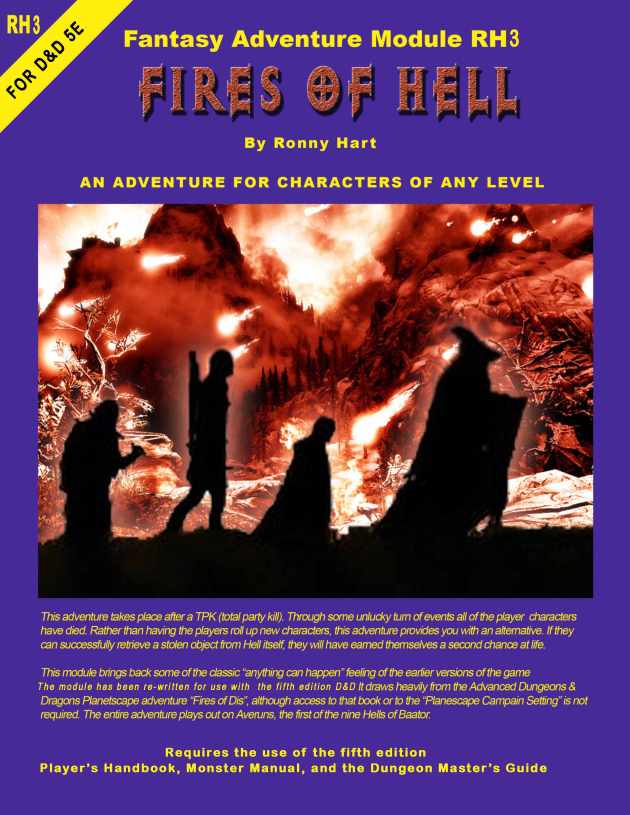
Fires of Hell - Cover

A free adventure module for fifth edition Dungeons and Dragons.

Download the free adventure here: Fires of Hell

This  adventure takes place after a Total Party Kill (TPK).  It allows a group of DEAD PCs to earn a second chance by fighting their way through the first layer of Hell to retrieve a stolen artifact. It is unlike other modules in that it is written to accommodate a party of any size and any level (1 to 20).

This is a complete re-write of the module I posted previously. I updated the entire module to work with D&D 5E rules. It also includes converted monsters that are not in the 5E Monster Manual – on new color reference sheets – Abishai Devils, Kaorti Devils, Nupperibo Devils, Cranium Rat Swarms, and Winged Fiend Swarms (a new monster of my own creation), and Charon (Boatman of the Lower Planes).                           

I hope you enjoy this as much as I enjoyed writing it. Please post any comments you may have. Let me know if you find any of this useful.

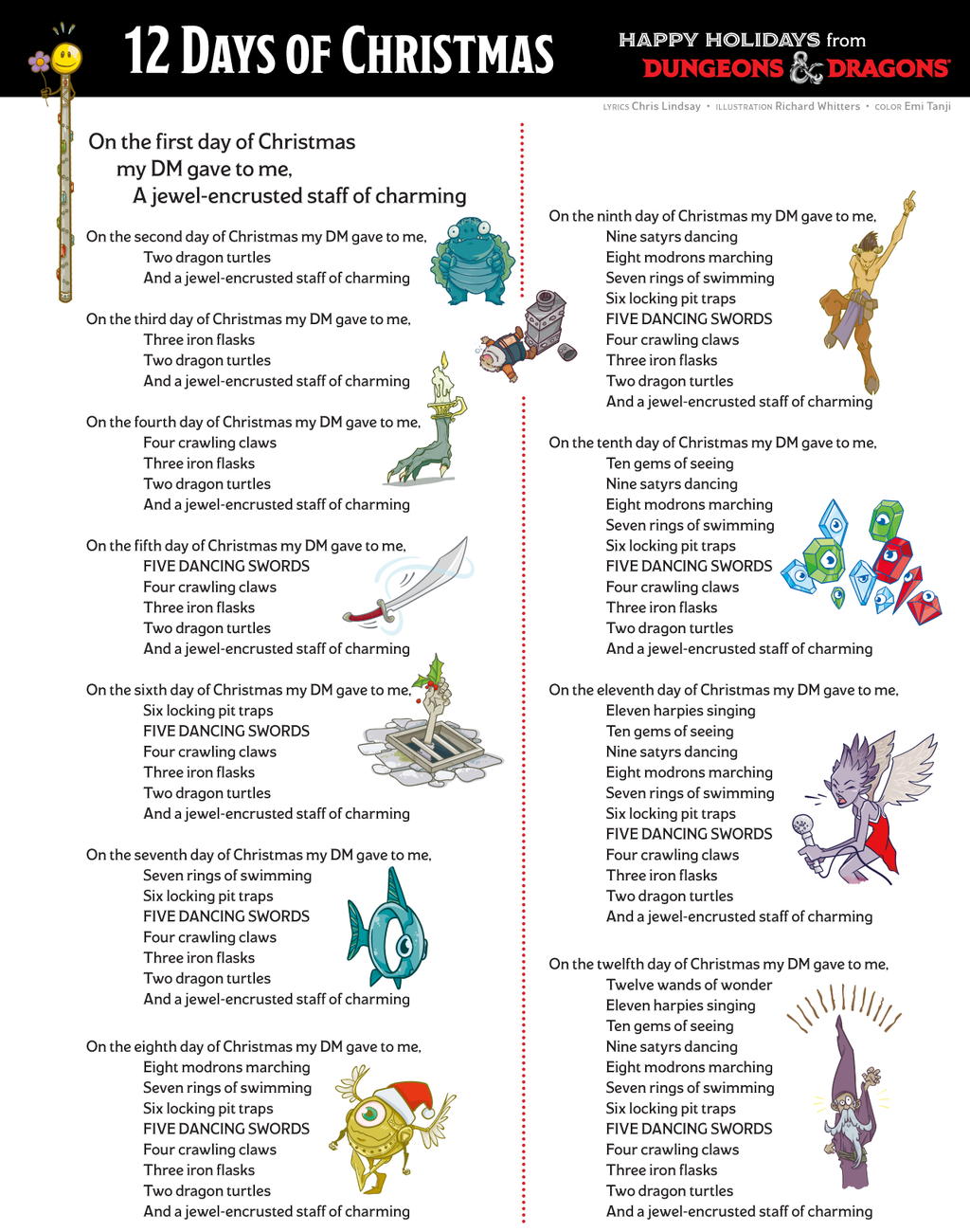
D&D – 12 Days of Christmas

12DaysOfChristmasThanks to our friends at https://twitter.com/wizards_dnd

D&D 5E – Uses for a shield

Pal_Shield

What is the best use of a Shield and Longsword combo?

I received this inquiry the other day: “I like to play a Paladin that often uses a Shield and Long Sword combo. However, I have noticed that there is no shield bash in 5E. I have been using the shove instead as an action between a Trip and Shield bash. Are you aware of any attack that tries to leverage a Shield in 5E? I would really like to stress a shield proficiency for my build if possible.”

Here are my thoughts:

A shield is an improvised weapon dealing 1d4 bludgeoning damage.

Paladins are proficient with shields. Whether said proficiency extends to it being used as an improvised weapon is not specified, but there’s no reason why it shouldn’t be.

Note that shields aren’t light weapons, and thus can’t be used for normal two-weapon fighting.

If your Paladin adopts the “protection” fighting style at 2nd level:

“When a creature you can see attacks a target other than you that is within 5 feet of you, you can use your reaction to impose disadvantage on the attack roll. You must be wielding a shield.”

If your group is using feats (I think most are) there is the “Shield Master” feat:

You use shields not just for protection but also for offense. You gain the following benefits while you are wielding a shield:

If you take the Attack action on your turn, you can use a bonus action to try to shove a creature within 5 feet of you with your shield. (If I was DMing the game, I would allow the use of this bonus action to either shove a creature or to attack it with the shield as an improvised weapon.)

If you aren’t incapacitated, you can add your shield’s AC bonus to any Dexterity saving throw you make against a spell or other harmful effect that targets only you.

If you are subjected to an effect that allows you to make a Dexterity saving throw to take only half damage, you can use your reaction to take no damage if you succeed on the saving throw, interposing your shield between yourself and the source of the effect.

And the “War Master” feat will allow you to cast spells while holding both your shield and sword.

I would like to hear if anyone has any other thoughts on this matter.

D&D 5E – Initiative Cards

Init_Cards

Free fillable initiative cards for 5th edition Dungeons and Dragons.

Download the fillable pdf file here: Int_cards

The Initiative Cards in this download include eight 2 1/2″ x 3 1/2″ cards on one 8 1/2″ x 11″ sheet. They include examples of how they can be filed out for both PCs and Monsters. What I do is have each player roll for their PC’s initiative and write the results on their card. I do the same for the monsters. I then gather all the cards and sort them in initiative order before the start of combat. I can then refer to the stats on the cards during combat.

For those of you who (like me) prefer a larger card, here are the same cards only these cards are  3″ x 5″: INIT_MONSTER_CARD_3x5

As always, comments are welcome.

//

D&D 5E – Quick Play Character Sheets

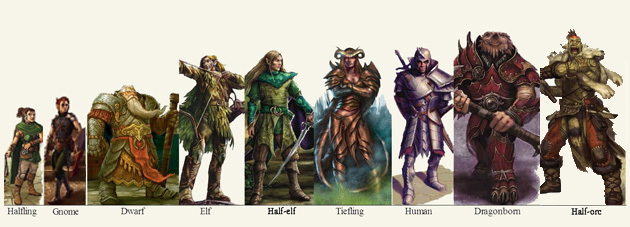
races

Ready-To-Play First Level Character Sheets

If you want a ready-to-play first level character for fifth edition dungeons and dragons, simply select your character sheet below. Pick the race and class you want, download the filled-in character sheet, give him a name and he will be ready to play.

There is a newer version of these sheets HERE.

I used the Autofill Character Sheet that I posted [here] and used the suggested quick build from the Player’s Handbook as a guide to fill in the information.

If you want, you can change any of the information.

Changing the level will only update the next level XP goal, the proficiency bonus and all of the fields that are effected by the changed proficiency bonus. You will have to make all other adjustments that may be needed for the new, higher level character.

I used the standard array [15, 14, 13, 12, 10, and 8] for ability scores. I placed the first two scores in the abilities as suggested in the Player’s Handbook for the quick build for the class, and I put the others where I thought best for the class. I then adjusted them based on the character’s race.

For all the rest of the information, I used my best judgment to create what I thought would be a “typical” build for each race and class.

I only have Human and Dwarf for now. I will be adding the other races as I get the time to work on them.  Finished

Human

Human_Barbarian, Human_Bard, Human_Cleric, Human_Druid, Human_Fighterr, Human_Monk, Human_Paladin, Human_Ranger, Human_Rogue, Human_Sorcerer, Human_Warlock, Human_Wizard

Dwarf

Dwarf_Barbarian, Dwarf_Bard, Dwarf_Cleric, Dwarf_Druid, Dwarf_Fighter, Dwarf_Monk, Dwarf_Paladin, Dwarf_Ranger, Dwarf_Rogue, Dwarf_Sorcerer, Dwarf_Warlock, Dwarf_Wizard

Elf

Elf_BarbarianElf_BardElf_ClericElf_DruidElf_FighterElf_MonkElf_PaladinElf_RangerElf_RogueElf_SorcererElf_WarlockElf_Wizard

Halfling

Halfling_BarbarianHalfling_BardHalfling_ClericHalfling_DruidHalfling_FighterHalfling_MonkHalfling_PaladinHalfling_RangerHalfling_RogueHalfling_SorcererHalfling_WarlockHalfling_Wizard

Dragonborn

Dragonborn_BarbarianDragonborn_BardDragonborn_ClericDragonborn_DruidDragonborn_FighterDragonborn_MonkDragonborn_PaladinDragonborn_RangerDragonborn_Rogue, Dragonborn_SorcererDragonborn_WarlockDragonborn_Wizard

Gnome

Gnome_BarbarianGnome_BardGnome_ClericGnome_DruidGnome_FighterGnome_MonkGnome_PaladinGnome_RangerGnome_RogueGnome_SorcererGnome_WarlockGnome_Wizard

Half-Elf

Half-Elf_Barbarian,  Half-Elf_Bard,  Half-Elf_Cleric,  Half-Elf_Druid,  Half-Elf_Fighter,  Half-Elf_Monk,  Half-Elf_Paladin,  Half-Elf_Ranger Half-Elf_Rogue,  Half-Elf_Sorcerer,  Half-Elf_Warlock,  Half-Elf_Wizard

Half-Orc

Half-Orc_BarbarianHalf-Orc_BardHalf-Orc_ClericHalf-Orc_DruidHalf-Orc_FighterHalf-Orc_MonkHalf-Orc_PaladinHalf-Orc_RangerHalf-Orc_RogueHalf-Orc_SorcererHalf-Orc_Warlock Half-Orc_Wizard

Tiefling

Tiefling_BarbarianTiefling_BardTiefling_ClericTiefling_Druid Tiefling_FighterTiefling_Monk Tiefling_PaladinTiefling_RangerTiefling_RogueTiefling_SorcererTiefling_WarlockTiefling_Wizard

Enjoy.

D&D 5E – Poisons

poison

Poisons in D&D 5e explained

Although save or die poisons haven’t been in D&D since before the 3rd edition, I still regret the time I was running an adventure and a first level character encountered a poison spider. He failed his save and died. Not fun. D&D 5e has really simplified the use of poisons. No more initial and secondary damage. No more ability damage. No onset time. No multiple saves (I was always forgetting to require the second saving throw a few minutes later for secondary damage). And, of course, no save or die.

I am sure there will be more about poison when the Dungeon Master’s Guide comes out, but for now here is my attempt to remove some of the confusion about poisons in the current, fifth edition of Dungeons and Dragons.  [As expected, the Dungeon Master’s Guide contains additional information regarding poisons. Starting on page 257 it describes the four different types of poisons (contact, ingested, inhaled and injury). It also has a list of 14 different sample poisons with their descriptions and prices. It also has information on purchasing poison and on crafting and harvesting poison.]

Using Poison

The only poison listed in the Player’s Handbook is basic poison. You can buy a vile for 100gp. You can coat one slashing or piercing weapon or up to three pieces of ammunition with it. Applying the poison takes an action. A creature hit by the poisoned weapon or ammunition must make a DC 10 Constitution saving throw or take 1d4 poison damage. Once applied, the poison retains potency for 1 minute before drying.

The description doesn’t say that the poison wipes off when you hit a creature with it, so you can continue doing damage for 1 minute after it is applied. Plenty of time for the typical encounter. The poison damage is in addition to any other damage the weapon would normally inflict. The creature hit by this poison takes poison damage but doesn’t become poisoned (see below).

Unlike previous editions, the Player’s Handbook doesn’t say that using poison is an evil act. So it is up to the DM to decide. Perhaps some types of poison are more evil than others?

Some poisons do hit point damage, some give you the poisoned condition, and some do both.

Taking poison damage

Poison damage is hit point damage, the type of damage is poison. Most poisons allow a Constitution saving throw to avoid any poison damage [basic poison and poison spray spell for example], but some don’t allow a saving throw [like basilisk poison]. Still others do poison damage on failed save, or half as much damage on a successful save [like the cloudkill spell or dragon breath].

Becoming poisoned

Although a failed saving throw is not always required to receive poison damage, you must always fail your Constitution saving throw to become poisoned. When the description says you “become poisoned” it means that you will have the poisoned condition, which gives you disadvantage on attack rolls and ability checks.

The poison description will indicate how long this condition will last. The weakest last only until the start of your next turn. Others last until end of your next turn, or for 1 minute or for 24 hours. Some last until saved against and allow you to attempt a saving throw each round. The most powerful last until removed by the lesser restoration spell or similar magic.

On a successful saving throw against some creature’s poison, you are immune to this creature’s poison for 24 hours

Additional conditions

While the poison condition is in effect, different poisons may also impose one or more additional conditions (sometimes the additional conditions are only in effect if the saving throw fails by 5 or more). The additional condition might be Paralyzed, Incapacitated or Unconscious. For the Unconscious condition, some poisons allow another creature to use an action to shake the target awake. Although awake, he would still have the poison condition. Another effect could be that you can take either an action or a bonus action on your turn, not both, and you can’t take reactions. Other poisons have you take some amount of poison damage at the start of each turn, or not allow you to regain hit points while you are poisoned.

Diseases

Arguably, the worst poisons are those that leave you infected with a disease.

These allow a saving throw against disease or become poisoned until the disease is cured.

Here are the diseases listed in the Monster Manual:

GAS SPORE – Spores invade an infected creature’s system, killing the creature in a number of hours equal to 1d12 +the creature’s Constitution score, unless the disease is removed. In half that time, the creature becomes poisoned for the rest of the duration. After the creature dies, it sprouts 2d4 tiny gas spores that grow to full size in 7 days.

OTYUGH and DEATH DOG: Every 24 hours that elapse, the target must repeat the saving throw, reducing its hit point maximum by 5 (1d10) on a failure. The disease is cured on a success. The target dies if the disease reduces its hit point maximum to 0. This reduction to the target’s hit point maximum lasts until the disease is cured.

D&D 5E – Character Sheet – Autofill

Sheets2

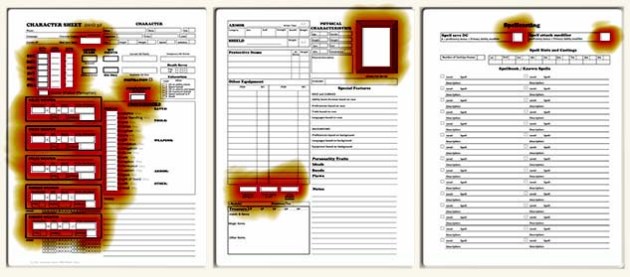
I added autofill to my Character Sheet. You fill in most of it but, where it can, it will make the calculations and fill in the rest.

UPDATE: The character sheets on this page are an older version. For the most recent auto-calculate Character Sheets click HERE.

UPDATE – Need more room to enter all of your information? Need a reference sheet listing the features for your class? Go to this more recent post for a larger character sheet and class feature sheets:
https://olddungeonmaster.wordpress.com/2017/09/21/dd5e-character-sheet-rev7/

[I made a minor correction to the file – it wasn’t calculating the weapon damage bonus correctly – if you downloaded this file before Oct 7, 2014 – you should replace it with the new one]
[I made another minor revision to the file. After using it for a while, I decided that it needed a fer minor formatting changes. if you want the older file it is available here. ]

I recommend that you make a copy of this before making any changes, and save a separate copy for each character. You can save a separate copy each time you advance a level to have an historical record.

I tested it on Adobe Reader XI (Version 11.0.5). If you use another PDF reader and something doesn’t work, download and use this one (it’s free).

What has changed from the previous version?

Page 1

This form no longer calculates the “Character Creation Date.” You can enter any date you want.
When you enter your character’s “level” The “Next Level Goal” will be filled in with the total  XP required to advance to the next level. For example, if you enter your character’s level 5, it fills in the experience point total required to advance to level 6. The exceptions are for levels 0 and level 20. It leaves the spaces blank if you enter 0, and it lists the XP required to reach level 20, even when you are already at level 20, because there are no riles for advancing beyond that level.

Entering your “level” also calculates and fills in your “proficiency bonus.”

Initiative is not filed in for you. Typically this will be your Dex modifier, but there are feats and effects that might change this.

When you fill in your Ability Scores, the form automatically fills in your ability modifiers and also puts these in the appropriate spots for your saving throws and skills.

Click on the little boxes next to a saving throw or skill and your Proficiency Bonus is automatically added to it. If you have additional bonuses to a skill or save, you will need to note it in the Notes section.

The Passive Wisdom (Perception) bonus is filled in for you based on your level and wisdom modifier.

It does not calculate Hit Points or Armor Class.

The spaces in the Weapon boxes remain blank until you enter text on the line provide for the weapon’s description. Type in any name or description and it will fill in your ability bonus for attack and damage. If you have proficiency with this weapon, click on the box next to the word proficiency and your proficiency bonus will be added to the attack bonus. If you are using a finesse weapon and want to use your Dex bonus on attacks instead of your Str bonus, click on the “Finess Weapon” button and it will switch them. If you want to use your strength modifier on a range weapon and it has the thrown property, click “thrown”. Any magical bonus you enter will also be added to the attack and damage bonus.

Page 2

Your “Carrying Capacity” and “Push, Pull or Lift” numbers are calculated and filled in based on your strength.

The “total weight carried” box is calculated based on the total weight entered for all the items above. You must use only whole numbers or decimal numbers (don’t enter 1/2 for instance, use .5 instead). If you enter anything other than a number it will display “NaN”. This total does not include weight of coins or treasure.

Refer to my Weight of Standard Equipment Packs.

You can insert an image into the “character sketch” area. Just click on it and locate the image you want to use. This must be a PDF format image. If you want to use an image from my Player Character Image Gallery, you must first convert it to PDF format. There are several available programs for doing this. If you have a problem with it, just let me know.

Page 3

This page remains blank until you use the pull down box to select your spellcaster’s primary ability: Intelligence, Wisdom or Charisma. When you select one, it fills in your spell save DC and spell attack modifier.

If you need more room for spell descriptions, you can download spell cards here: Spellbook Cards

NON-PRINT BOXES
There are two shaded Buttons on the bottom of page 1 that do not print. The first is “Update Calculations.” All of the fields on all 3 sheets should update whenever any change is made to any one of them. Sometimes it doesn’t do this right away. That is what this button is for. Click it and all of the calculations for all of the fields that are field in for you are forced to recalculate and update. I recommend that you click on this button before you print the sheets. Of course you can click on it at any time to be sure the values are all correct.

The other button is “Clear”. This clears all information from all of the fields. You can click this to clear all information and start over, or if you want to print a blank sheet to fill in by pencil. Be careful though, this clears all information on all 3 pages. I found that sometimes this doesn’t clear the image from the character sketch. If this happens to you, try saving and closing the file. Re-open it and you should then be able to clear the character sketch.
If you realize you clicked the clear button it by mistake, you have one chance to restore the erased information. You can press Ctrl Z to restore the form. But you must do this before you do anything else or it may be too late.

The previous version of this form is still available here: 5e Character Sheet