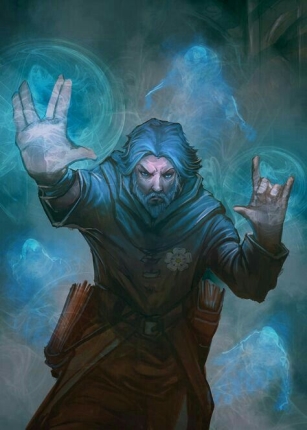
In Dungeons and Dragons, according to the Great Wheel cosmology, all souls in the multiverse originate from fonts on the Positive Energy Plain, sometimes called the Plane of Life. When a sentient being is born his soul enters his body with his first breath. How long that soul existed before it occupied the newborn and how the choice of host is made is not known. A PC’s soul then continues throughout his life and beyond. A PC’s soul isn’t typically destroyed when he dies and if he is brought back to life, his soul re-joins his body. It is possible for his soul to be moved into an object or another body or travel to other planes and other timestreams. In a very real sense, a player’s character’s soul is that character.
What is a “soul” in D&D? Is that different than a “spirit”?
In 1st-edition D&D; humans, dwarves, gnomes, halflings, and half-elves had souls. Elves, orcs, and half-orcs had spirits. Those with souls could be resurrected and the others could not. This was changed in later editions.
In D&D 5E, a “spirit” is a creature’s bodiless life force. As mentioned in the “Speak with Dead” spell, an animating spirit is the part of your life force that makes your body move to your soul’s wishes and has some semblance of awareness. A “soul” is a creatures spirit that also includes it’s memories, personality, and alignment. All souls have a spirit but a spirit can exist without a soul.
The Dungeon Master’s Guide (DMG) seams to imply that all living creatures have souls:
“When a creature dies, its soul departs its body, leaves the Material Plane, travels through the Astral Plane, and goes to abide on the plane where the creature’s deity resides. If the creature didn’t worship a deity, its soul departs to the plane corresponding to its alignment.” (DMG p.24)
In D&D 5E what creatures have, or don’t have, souls?
There is nothing official that I can find in any of the published books, so here are my thoughts on this subject.
As a house rule, I propose that most creatures have souls. Creatures that don’t have souls are: beasts, constructs, elementals, oozes, plants, unaligned creatures, and most undead.
The following are the undead in the Monster Manuel (MM) that specifically DO have souls.
A ghost has a soul:
“A ghost is the soul of a once-living creature, bound to haunt a specific location, creature, or object that held significance to it in its life.” (MM p.147)
A rvenant has a soul:
“A revenant forms from the soul of a mortal who met a cruel and undeserving fate.” (MM p.259)
A will-o’-wisp has a soul:
“Will-o’-wisps are the souls of evil beings that perished in anguish or misery as they wandered forsaken lands permeated with powerful magic.” (MM p.301)








 Dungeon Master Assistance