Dungeon Master Assistance

Where anyone over 18 can share thoughts and ideas on RPGs.

Category Archives: House Rules

D&D 5E – Armor Grades

There has been a lot of talk about how Armor Class (AC) is calculated in D&D and how armor could be be handled differently. This post is not about that. Without changing any of the basic D&D rules, the house rule I am proposing here simply adds to (or subtracts from) your armor class depending on the quality of the armor.

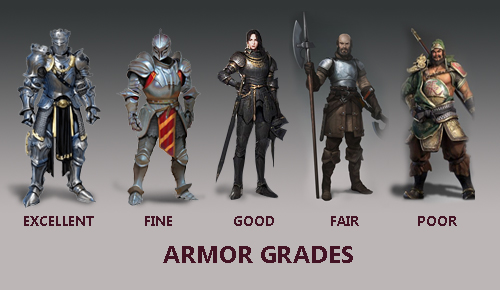
This system is simple and easy to remember. This works with all armor. Use the armor in the PHB but change the price and Armor Class (AC) based on the grade of the armor as indicated below. Shields are not available in Excellent or Poor condition.

EXCELLENT
These are created by the best armor smiths in the land. Armor of this grade isn’t always available.
Cost: 4 times the PHB price
Armor Class: +2 bonus to the AC

FINE
This is a the best armor most people will ever see. It is highly prized and often passed down from father to son.
Cost: 2 times the PHB price
Armor Class: +1 bonus to the AC

GOOD
This is the grade of the armor in the PHB.
Cost: PHB price
Armor Class: Use the AC in the PHB

FAIR
A peasant or low CR monster might have such armor. No fighter would use such low grade armor if he could passably get something better.
Cost: 1/2 the PHB price
Armor Class: −1 penalty to the AC

POOR
These may be found discarded or abandoned on a battlefield. They are often rusted, chipped, broken or have pieces missing. They would typically only be used when there is no other option.
Cost: 1/4 the PHB price (or found)
Armor Class: −2 (or greater) penalty to the AC.

DAMAGING ARMOR [Optional Rule]
When you take Slashing, Piercing, Bludgeoning, Acid, Lightning, or Force damage from a critical hit your armor takes a permanent and cumulative −1 penalty to its AC. The damage is applied to your shield unless your opponent had advantage on the attack. In that case, or if you aren’t using a shield, the damage is applied to your other armor. If this penalty drops the armor’s AC to 0, it is destroyed.

The DM might apply the penalty in other situations where the armor might be damaged.


D&D 5E – Weapon Grades

Wanting to add more weapon options to your Dungeons and Dragons 5E game? The weapons available in the Player’s Handbook (PHB) are simple and easy to play, but there is no variety based on the quality of the weapon. All short swords do the same damage. The house rules I am presenting here will allow allow your characters to spend more gold for a higher quality weapon that does more damage, or if they can’t afford the best they can get a lower quality weapon that does less damage.

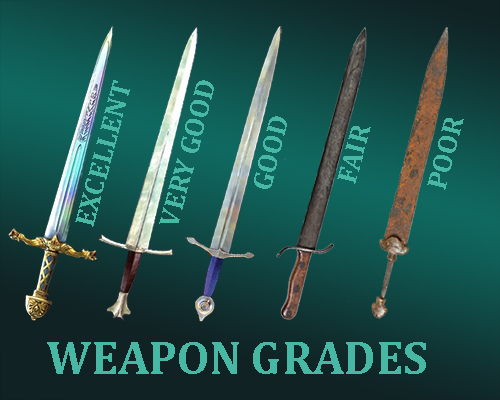
This system is simple and easy to remember. This works with all weapons. Use the weapons in the PHB but change the price and damage dice based on the grade of the weapon as indicated below.

EXCELLENT
These are created by the best weapon smiths in the land. Weapons of this grade aren’t always available.
Cost: 4 times the PHB price
Damage Dice: Roll two additional dice and drop the lowest 2.

VERY GOOD
These are a the best weapons most people will ever see. They are highly prized and often passed down from father to son.
Cost: 2 times the PHB price
Damage Dice: Roll one additional die and drop the lowest one.

GOOD
This is the grade of the weapons in the PHB.
Cost: PHB price
Damage Dice: PHB damage

FAIR
A peasant or low CR monster might have such a weapon. No fighter would use such a low grade weapon if he could passably get a better one.
Cost: 1/2 the PHB price
Damage Dice: Roll one additional die and drop the highest one.

POOR
These may be found discarded or abandoned on a battlefield. They are often rusted, chipped, or broken. They would typically only be used when there is no other option.
Cost: 1/4 the PHB price (or found)
Damage Dice: After rolling the standard damage dice, roll one additional die and subtract that from the total of the others. If this total is zero or less, your weapon damage will only be the ability modifier you are using for this weapon (STR or DEX).

CRITICAL HIT
If your attack roll is a natural 20 (a 20 on the dice before any modifiers), roll double the standard damage dice before making an adjustment for weapon quality.

CRITICAL MISS [Optional Rule]
If your attack roll is a natural 1 (a 1 on the dice before any modifiers), the weapon attack misses. There is also a chance your weapon is damaged. Immediately make another attack roll applying all of the same modifiers against the same AC but this isn’t an attack, it is a roll to see if you damaged your weapon. If this second roll is a miss your weapon drops to the next lower grade. If your weapon is already poor quality, it is destroyed.

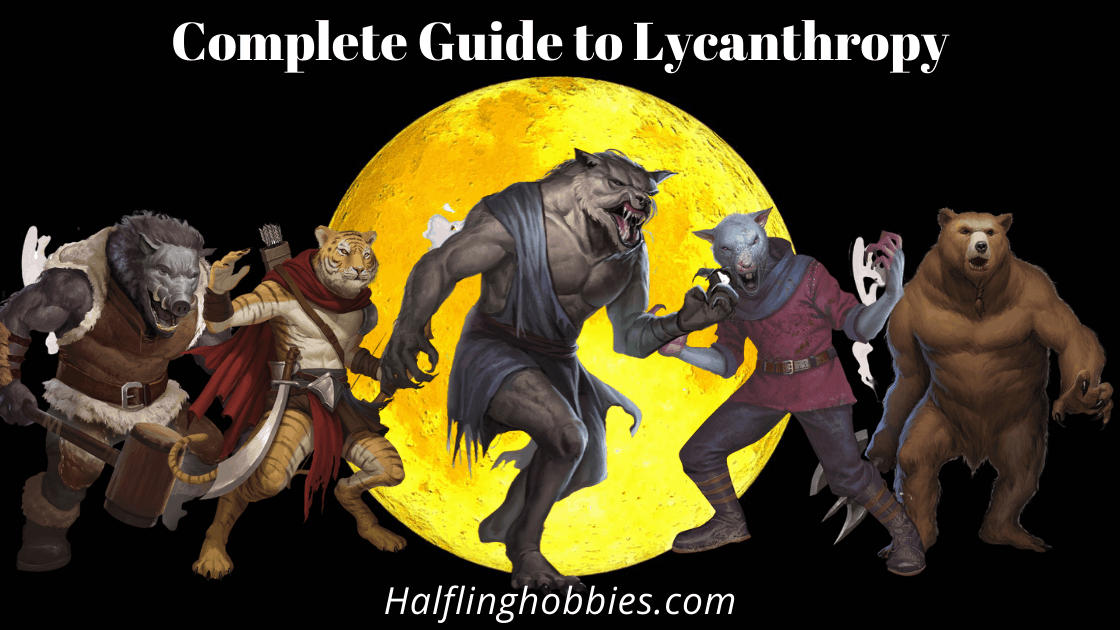
D&D 5E – The Complete Guide to Lycanthropy

The official rules for Lycanthropy in D&D 5E don’t make it clear on how a DM should run the game should a player’s character become effected by the curse. I was looking to come up with some house rules when I ran across this post by Halfling Hobbies. I didn’t think I could improve on it much so I thought I would share.

Source: The Complete Guide to Lycanthropy in D&D 5e | Halfling Hobbies & Trinkets

D&D 5E – How to Publish D&D Content

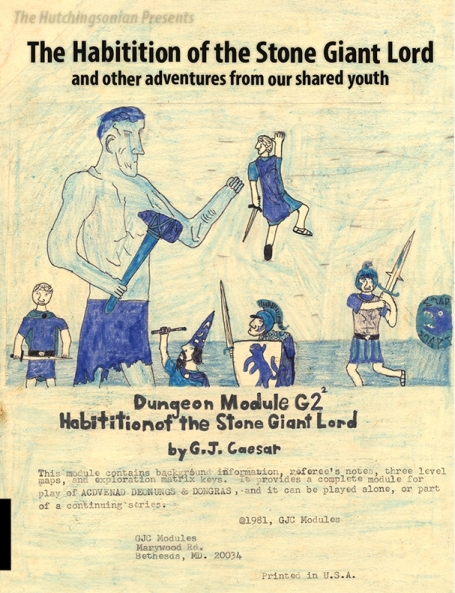
habitation cover

How to publish your own D&D 5E adventure (or any other D&D related content such as alternate rules or home-brew monsters).

If you just want to share your stuff.

If you are just a fan and only want to share your stuff for free with other fans (like I do on this blog) you could simply abide by the WotC’s (Wizards of the Coast) fan content policy.

What is WotC’s fan content policy?

WotC claims the IP (intellectual property) rights to everything they publish. I am a fan, and everything I share here is free and unofficial. To the best of my understanding, everything I make available here complies with their fan content policy. WotC’s fan content policy explains what you, as a fan, can and can’t do with their IP. Most of it is pretty simple. Don’t claim any of their stuff is yours and don’t try to sell it.
There is a little more to it than that. You should read their official fan content policy (HERE).

If you want to sell your stuff.

Then it gets a little more complicated. WotC does a good job explaining most of this (HERE). Below are my thoughts on the subject. (You should check with a lawyer. I am not a lawyer and nothing contained here should be taken as legal advice.)

Probably the safest way to avoid any legal hassles is to use the WotC’s OGL (Open Game License), OGC (Open Game Content), and SRD (System Reference Document). Abiding by these rules you can publish anything you want, any where you want. WotC also provides an easy way to publish your stuff on-line with the Dungeon Masters Guild.

What is the OGL (Open Game License)?

The OGL is a short contract Wizards of the Coast created. It contains provisions that explain the rules surrounding what D&D material you can use in your published work.

What is OGC (Open Game Content)?

OGC is a “body of work” that many creators have contributed to over time. It’s the open-source world of D&D material. Anything in the OGC is free to use as long as you properly credit and cite the original publisher and abide by the OGL’s rules.

What is the SRD (System Reference Document)?

The SRD is an example of OGC you can use in your writing if you use the OGL. The SRD contains most of the basic D&D 5E rules and guidelines for publishing content under the OGL.

What is the Dungeon Masters Guild?

The Dungeon Masters Guild is an officially supported website that allows you to create content using Wizards of the Coast intellectual property (IP) and sell it on their site. You can charge whatever you want, you get 50% of your sales. The other 50% goes to Wizards of the Coast and OneBookShelf, which runs the DMs Guild marketplace. They have their own set of somewhat more flexible rules (HERE).

Another, riskier, option

You could ignore all of the above and use your own common sense (and a good copyright lawyer wouldn’t hurt).

Why some people choose NOT to use the “Open Gaming License”.

If you agree to the terms and conditions in the OGL, you are bound by it. That means that WotC doesn’t need specific legal backing to go after things – they can leverage their license itself to enforce things.

Many things that WotC wants to protect by the OGL are already covered by existing copyright and trademark laws. The primary things in 5e that you are not allowed to use in your work because they are protected under these laws are:

  1. Product identity – terms like Dungeons and Dragons, 5e, Dungeon Master, etc.
  2. Lore, settings, adventures, and characters. This includes places like the Faerun, the Underdark, specific monsters like Beholders and races like Githyanki. This also includes the proper names referenced by spells and items. Spell names like Bigby’s Hand are protected, though spell names like Fireball are not (too generic).
  3. Actual wording and expression of the rules. This includes the specific text that describes spells, items, and features.

If you agree to the OGL, it does allow you to use a bunch of their stuff exactly as they worded it. But the OGL gives you very few other rights you do not already have, and by agreeing to it you are giving up the right to do a lot of stuff you could have done otherwise.

  • For one thing, no one can copyright, trademark, or patent the rules of a game.
  • For another, take the phrase “world’s greatest role-playing game”. That’s required by the OGL, but under normal conditions, having never signed on to the OGL, you could just say “Compatible with D&D 5e rules” as much as you like. The only thing stopping you from doing that is the OGL.
  • No one can claim mythical creatures, literary archetypes, or that kind of thing as their intellectual property. That includes the overwhelming majority of the names of all D&D classes, races, and monsters. You can already use those names. The stuff you can’t use are names like beholder or Illithid that were invented by WotC. But they are not available in the OGL anyway. As long as you never agreed to the OGL, you can create generic versions with different names and you’re okay. For any creature, pact, effect, etc., as long as you don’t copy the WotC descriptions word for word you should still be okay. Any one of these names in and of itself can’t be copyrighted, but the paragraph of description can. So, just be careful. Or, better still, just create your own stuff from scratch.

I hope this helps. Good luck writing your own D&D 5E Adventure.

P.S. If you are interested, you can purchase and download a copy of the adventure whose cover I show above (HERE).

D&D 5E – Combining Different Speeds

Speed

“Using different Speeds” on page 190 of the Player’s Handbook says:

“If you have more than one speed, such as your walking speed and a flying speed, you can switch back and forth between your speeds during your move. Whenever you switch, subtract the distance you’ve already moved from the new speed. The result determines how much farther you can move.
For example, if you have a speed of 30 and a flying speed of 60 because a wizard cast the fly spell on you, you could fly 20 feet, then walk 10 feet, and then leap into the air to fly 30 feet more.

This rule is simple and makes for fast game play, but it bothers me because of all the ways it can be used that make no logical sense. Foe instance, you can not do their example in reverse. You cannot first fly 30 feet and then walk 10 feet. That would not be allowed because if you subtract the distance you’ve already moved (30 feet) from the new speed (30 feet) you get zero – no move remaining.

I do it this way:

A combat round is only 6 seconds. When you switch from one move rate to another you see how much time you have used and then see how much time you have left. Use this to see how much farther you can move.

Because one round is 6 seconds, to convert “speed” to “feet per second” divide the speed by 6.

  • Walk speed of 30 ft. = 5 ft per second
  • Fly speed of 60 ft. = 10 ft per second

If you fly 30 feet (taking 3 seconds) you could then walk 10 feet (taking 2 seconds) and then you could take the rest of your time (1 second) to fly an another 10 feet. And your trip back will work the same way.

Lets say you only walked 20 feet, and then flew as far as you could. It took you 4 seconds to walk that 20 feet so you only have 2 seconds left. You can fly another 20 feet.

If you walk 30 feet you can’t move any farther because it took all 6 seconds to move that 30 feet.

This also applies if you get up from prone. This takes half you move, therefore it takes 3 seconds to stand up, leaving only 3 more seconds regardless of your move rate.

D&D 5E – Spirits and Souls

Soul_Magic

In Dungeons and Dragons, according to the Great Wheel cosmology, all souls in the multiverse originate from fonts on the Positive Energy Plain, sometimes called the Plane of Life. When a sentient being is born his soul enters his body with his first breath. How long that soul existed before it occupied the newborn and how the choice of host is made is not known. A PC’s soul then continues throughout his life and beyond. A PC’s soul isn’t typically destroyed when he dies and if he is brought back to life, his soul re-joins his body. It is possible for his soul to be moved into an object or another body or travel to other planes and other timestreams. In a very real sense, a player’s character’s soul is that character.

What is a “soul” in D&D? Is that different than a “spirit”?

In 1st-edition D&D; humans, dwarves, gnomes, halflings, and half-elves had souls. Elves, orcs, and half-orcs had spirits. Those with souls could be resurrected and the others could not. This was changed in later editions.

In D&D 5E, a “spirit” is a creature’s bodiless life force. As mentioned in the “Speak with Dead” spell, an animating spirit is the part of your life force that makes your body move to your soul’s wishes and has some semblance of awareness. A “soul” is a creatures spirit that also includes it’s memories, personality, and alignment. All souls have a spirit but a spirit can exist without a soul.

The Dungeon Master’s Guide (DMG) seams to imply that all living creatures have souls:
“When a creature dies, its soul departs its body, leaves the Material Plane, travels through the Astral Plane, and goes to abide on the plane where the creature’s deity resides. If the creature didn’t worship a deity, its soul departs to the plane corresponding to its alignment.” (DMG p.24)

In D&D 5E what creatures have, or don’t have, souls?

There is nothing official that I can find in any of the published books, so here are my thoughts on this subject.

As a house rule, I propose that most creatures have souls. Creatures that don’t have souls are: beasts, constructs, elementals, oozes, plants, unaligned creatures, and most undead.

The following are the undead in the Monster Manuel (MM) that specifically DO have souls.

A ghost has a soul:
“A ghost is the soul of a once-living creature, bound to haunt a specific location, creature, or object that held significance to it in its life.” (MM p.147)

A rvenant has a soul:
“A revenant forms from the soul of a mortal who met a cruel and undeserving fate.” (MM p.259)

A will-o’-wisp has a soul:
“Will-o’-wisps are the souls of evil beings that perished in anguish or misery as they wandered forsaken lands permeated with powerful magic.” (MM p.301)
D&D 5E – My House Rules

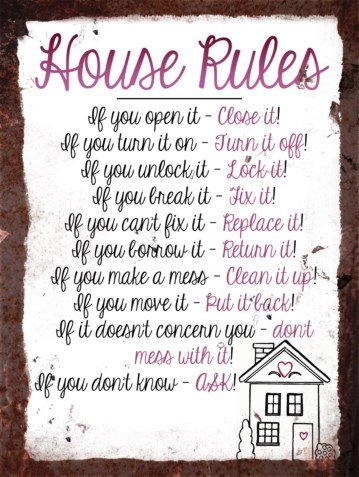
House Rules

Below are the house rules I use when I run a 5th Edition D&D game.

1) Inspiration
You can wait until the d20 is cast to decide if you’re going to use your inspiration to roll the second die to get advantage.

2) Initiative Order
On the first round only – On your turn you can change your initiative to one less than another character which has a lower initiative.
Clarification: This will change your initiative to that lower number for the rest of the encounter.

3) Passive Perception
I very seldom use it.
Clarification: If it is something you would probably notice, you notice it. If it is something you might not notice, I have you make a Perception check.

4) Changing weapons
Attacking with a weapon includes drawing the weapon.
Clarification: If you have a weapon in your hand and want to change to a different weapon you can use “interact with one object” to sheath the weapon you are holding and then draw and attack with a different weapon.

5) Secret Doors
If you are searching for a secret door and there is one, you will automatically find it.
Clarification: This also means that if there is some kind of trap there, you will activate it. You have to say where and how you are searching. Saying “I am always searching for secret doors” is not allowed. Sometimes I may require you to make an investigation check to determine how to open it.

6) Invisible Creatures
If a creature can’t be detected by using any of your senses then you can only guess at its location.
Clarification: If you can notice some clue as to its location you must succeed in a Perception check to locate it. You can make this check with advantage if you use the Search action. If it has taken the Hide action your Perception check will be against its Stealth check.

7) Attacking unseen creature
You only get advantage on attack against a creature that can’t see you if you can see the creature.

8) Magic Spells – Components
V – Verbal: It must be spoken in a clear voice that could normally be heard 20 feet away. It cannot be whispered.
S – Somatic: You cannot cast a spell that requires a somatic component if your hands are bound or tied together.
M – Material: 1) A spellcasting focus must be presented boldly. 2) It is assumed that you stocked up on material components with no listed value during your downtime. 3) For a material component with a listed value under 100gp you can assume that your character acquired it during your down time and you can simply deduct its value from your character sheet at the time you cast the spell. 4) For more valuable components you must have procured the item and have it listed on your character sheet.

9) Magic Spells – Area of Effect
A creature is considered to be in the area of effect if the center of the square it occupies is wholly inside the defined area.
Clarification: You can aim your AoE any way you want, but if it just touches the center the creature’s square it is unaffected. So if a 5 ft. wide “line” AoE runs horizontally or vertically between two 5 ft. squares, it won’t effect creatures on either side.

—LINKS TO MY OTHER HOUSE RULES—
1) Falling
2) Falling Times & Distance
3) Falling Objects
4) Detecting & Identifying Magic
5) Underwater
6) Playing on a 1″=10′ Grid
7) Learning New Languages

D&D 5E – Learning New Languages (House Rule)

Thr One Ring

For learning new languages without having to spend down time.

1) You can become proficient in a new language by having another character spend a few hours per day training you in a language that they are proficient in.
2) You can only learn one new language at a time.
3) The teacher can only teach one student each day.
4) It will take 125 days of in-game play minus your intelligence score to learn the language.
5) You must pay the teacher a minimum of 2 gp per day of training.
6) If you have had one or more days of training but are not yet proficient in the new language, the DM may allow you to attempt to read, write, speak or understand a short phrase or sentence of ten words or less in the new language. This will require an intelligence check. The DC of the check is the number of your training days remaining divided by 4. A natural 1 on the check will be an automatic fail.
7) The maximum number of new languages you can learn this way is equal to your Intelligence modifier.
8) If your intelligence score is 11 or lower, you can learn one new language this way, but you will only become proficient in speaking the language, you will not be able to read or write it.

D&D 5E – Character Wealth per Level

If a character doesn’t start at level 1, what should they start with in terms of gold and magic items?

Whenever a PC dies and the player rolls up a new character, I always have the new character start at the same level as the rest of the party. The same goes whenever a new player joins an existing game. So when they roll up their new higher level character I have them start with their first level inventory and any appropriate equipment based on their class and level. I also give them magic items similar in power to the items the other PCs have.

However, sometimes it is not that easy. That is when I use the following.

Starting Gold:

I give them gold based on their level. They start with their level 1 gold based on their class, and then add the following gold based on their starting level.

Level Gold
1 0
2 376
3 751
4 1,504
5 2,632
6 16,267
7 29,902
8 43,537
9 57,172
10 70,807
11 84,442
12 156,842
13 229,242
14 301,642
15 374,042
16 446,442
17 518,842
18 1,190,892
19 1,862,942
20

2,534,992

They spend from this to equip their character. They can spend as much of their gold on magic items as they choose up to the limit shown below.

Magic Items:

I use this for Magic Item Prices:
https://drive.google.com/file/d/0B8XAiXpOfz9cMWt1RTBicmpmUDg/view

Note that this is for newly created characters only.
Your character gets 2 points for each character level. You can buy magic items from the provided list (I often modify the list based on the campaign) based on the chart below.

Rarity Cost
Common 2 points
Uncommon 4 points
Rare 8 points
Very Rare 16 points
Legendary 36 points

You can’t have more than one of any non-consumable magic item. For every combat item you get, you must get at least one noncombat item before selecting another combat item.

Example: If you are 8th level you will have 16 points to spend. You can get 1 very rare, or 2 rare, or 8 common, or 1 rare and 1 uncommon and 2 common magic items, or any other combination that adds up to 16. Half or more must be noncombat items.

D&D 5E – Simplified Rules

5.0-EZ Version 6

Download your free copy here.

This version contains several minor corrections to the previous version.

This is a supplement to fifth edition dungeons and dragons for those who prefer simpler rules or want an easy way to introduce the game to new players.

If you sometimes feel that the fifth edition Dungeons and Dragons rules are too complicated, this is for you. I created this set of house rules to simplify character creation and advancement among other things. It also introduces a whole new way to select and track the casting of magic spells.
One thing I tried very hard to do was keep the characters levels and power as close as possible to the Player’s Handbook characters so that if you play using these rules, you can still use published 5th edition adventures, and the monsters will require little or no modifications