Dungeon Master Assistance

Where anyone over 18 can share thoughts and ideas on RPGs.

Category Archives: Optional rules

D&D 5E – Mass Combat Rules

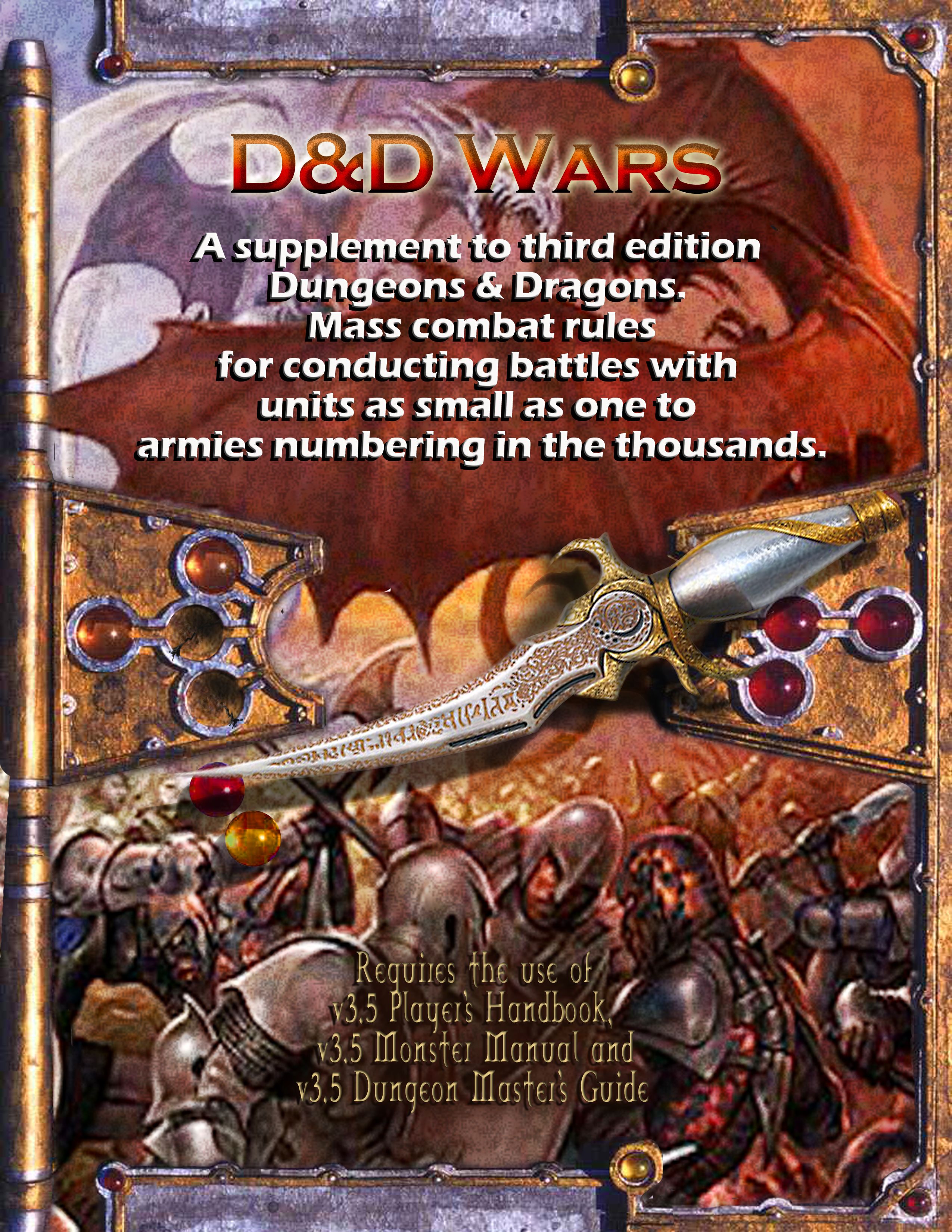
Wars_Book_Cover

Rules for conducting massive battles in D&D.

You can download a free copy here: D&D Wars 5E.pdf

This is a complete re-write of the rules I published before (3.5 version here) (Next version here). In keeping with the spirit of 5e, these are simpler and play faster than any of my previous attempts.

D&D Wars is a supplement to fifth edition Dungeons & Dragons that provides a set of mass combat rules for conducting battles with units as small as one to armies numbering in the thousands. D&D Wars are not simply armies making battle with each other. It is armies intermixed with monsters and NPCs. Added to this mix is a group of PC heroes doing what they can to change the tide of the war.

– The rules are compatible with Dungeons and Dragons version 5E.

– There are rules for creating armies comprised of units of various sizes and compositions.

– It has consistent rules for scaling the battle from a small group of villagers with torches and pitchforks all the way up to epic battles with thousands of soldiers on both sides.

– The rules accommodate individual monsters wandering across the battlefield as well as other NPCs and PCs that are not part of the units.

– It uses standard combat rules without modification as far as possible.

Enjoy!

D&D 5E – Time Travel

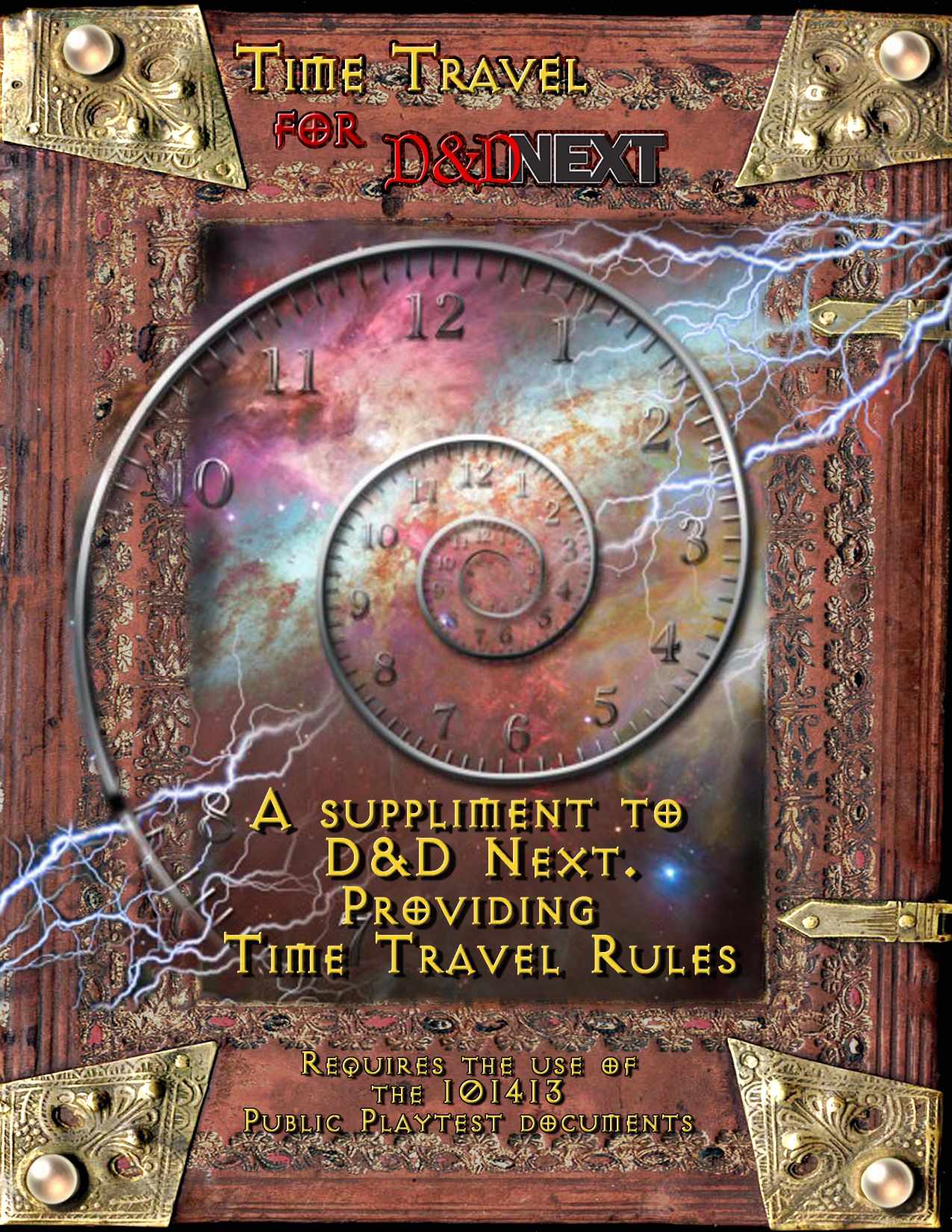
Time-Travel-5E-Book_Cover

Time Travel Rules for Fifth Edition D&D

You can download a free copy here: Time Travel for DnD 5E.pdf

I finally updated my Time Travel rules for 5E. They aren’t much different than the rules I made for D&D Next (here), but I have expanded them and added a section with ideas on how to incorporate these rules into a Time Travel Campaign. I also added a Forgotten Realms timeline to which I added some Pre and Post history for use in a time travel campaign.

Enjoy!

D&D 5E – Chase rules

Optional House Rules for D&D 5e

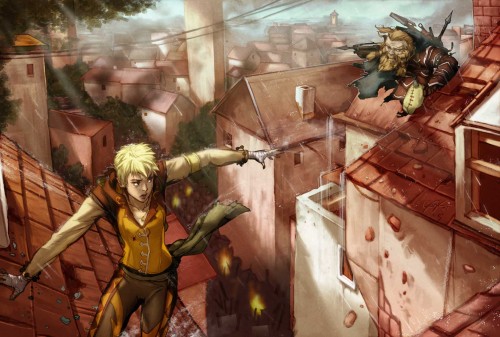
rooftop_chase-500x337

[Check out this newer post on this subject: D&D 5E – Quick Reference – Chase Rules.]

A couple of years ago I published chase rules for D&D v3.5. You can download them here.
With the release of the fifth edition of Dungeons and Dragons, those rules seem rather heavy. You can still use them if your campaign will have a lot of chases. However, in keeping with the slimmed down rules of 5e, I am proposing a simple house rule for chases. The description below is in terms of a PC character chasing a fleeing foe. Keep in mind that the same rules apply when the PC is the one fleeing.

What if your opponent tries to run away?

Most of the time the standard rules for combat work just fine. A chase may occur when one or more opponent turns and runs away. In game terms, he uses the Dash action to spend his entire turn moving away from combat as quickly as possible. If he starts his turn within 5 feet of you, or passes within 5 feet of you, you can use your Reaction to make an opportunity attack.

What if you want to chase him?

It all depends on how far away you are from him at the beginning of your turn. Compare this distance to your characters speed. There are three possible results.

1) You can use your Move to get within 5 feet of him.

  • You can attack him and combat continues.

2) You can catch up to him by using your Dash action.

[If you have enough speed to pass him you may do that, but if you come within 5 feet of him as you pass, he gets to use his Reaction to make an opportunity attack against you, so you will typically want to stop when you get within 5 feet.]
  • You stop within 5 feet of him.
  • If he continues to run away you can use your Reaction to attack him. [If you speed is the same or greater than his, this can repeat each round. This is not a good strategy for your opponent, unless he can reach shelter or he is leading you into an ambush.]
  • Or he may choose to turn and fight on his turn.

3) You cannot get to within 5 feet of him using your Dash action.

  • If your speed is greater than his, you should catch up with him in a few rounds.
  • If your speed is less than his, and you have no way to increase your speed, he will get farther away each round. You may as well attempt to shoot him with ranged weapons until he is out of range.
  • If your speed is the same as his, he will stay the same distance away from you forever. You move closer on your turn, he moves away on his. This is where a house rule is needed.

House Rule #1

A chase is not a race. There are multiple factors that could enable a creature to catch up to another one that has the same speed. Even a lucky slower creature should have a chance. Here is my house rule:

At the end of a turn where you have used a Dash action to advance toward an opponent that is fleeing, you may call for a Strength (Athletics) contest between the two characters. If you win the contest, you move an additional 5 feet toward your opponent. If you lose the contest, you move back 5 feet.

House Rule #2

Characters can’t continue running at top speed forever.  For extended chases:

After 5 rounds of continuous running, a character must make a [DC 15] Constitution save or suffer one level of exhaustion. Each additional round of continuous running requires another save at an additional +2 to the DC.

The DM may rule that certain creatures are immune to this exhaustion effect, or that they can run for longer periods before requiring this check.

D&D Next – Time Travel Rules

Download a free copy of Time Travel for D&D [ here].

This is a complete re-write of the Time Travel supplement to third edition Dungeons & Dragons that I published [here] in 2012. This completely abandons those rules in preference to these new simplified rules and brings them in line with D&D Next (the current playtest version of v5.0). You can use these rules with v3.5 with a little adjustment.

Consider this an interim version of these rules. I will make any needed tweaks to them and re-publish them when the official v5.0 rules are published.

I got a lot of good information from “Chronomancer” published by TSR in 1995. I am using it’s concept of Temporal Prime as a tool for time travel. I also used some of the spells presented there, with a little modification.

As always, all comments are welcome.

Enjoy!

D&D Next – Time Travel Re-visited

Time-Travel

“Time flies like an arrow. Fruit flies like a banana.”

Time travel is easy, explaining it is hard.

I was looking over my time travel rules (posted here). I was thinking that I hadn’t explained them very well and that I also needed to re-work them for the next version of D&D. The more I thought about it, the more I realized that they needed a complete overhaul. Before posting a new set of time travel rules I wanted to post this. Below is a summary of my current thinking on how time travel should work for D&D.

First a little thought experiment

Consider this. Your friend the wizard travels 24 hours into the past. While there, he sneaks into your room and shaves your head while you sleep. The question is this: If you are watching him when he cast the spell and he disappears into the past, what do you experience? Are you now bald? There are problems with every answer.

1) You can’t still have your hair. If you do it would mean that the wizard was unsuccessful in changing the past.

2) You couldn’t just suddenly become bald. What if the wizard doesn’t cast another spell to “return” to the present, but simply hangs out with you all day?

3) Okay, then perhaps your head is shaved, and it has been since you woke up this morning. This is a paradox, because if you have been bald all day it would mean that you were that way before the wizard cast the spell that resulted in your current condition.

There must be another answer, and I believe that I have found it. Think about this a little. I will give you the answer a little later.

This is how I think time travel should work in the D&D game.

Timelines

There is only one timeline. Everyone is in it. The “river of time”. It is easy to travel forward in time. Everyone does it. You are doing it now. It takes only one second to move forward one second into the future. If you were to sleep for 17 years, you would wake up 17 years in the future.

All time travel is along this one timeline. Although there is only one timeline, this doesn’t mean that it can’t be changed.

Rule #1 – “Everything that you do changes the future.”

This may seem so obvious that it is hardly worth mentioning. However remember that we are talking about time travel. If you travel along the timeline to a point in the past anything you do there will change everything on the timeline from that point forward.

Rule #2 – “You can’t change the past.”

Well, I suppose you could travel to the past and then change it, but nothing that you do now can change anything that was done before. Again, this seems obvious but it is worth remembering that you can’t travel into the future and do anything that will change what is happening in the present.

There are two types of time travel, tactical and strategic.

Tactical Time Travel

Similar to time travel in the movie “Groundhog Day”.

Tactical time travel is free from most time travel paradoxes. It moves the timeline forward or back to the appointed time. It is not normally used to travel farther than a single day and cannot be used to travel back to a time before the time traveler was fully grown. Tactical time travel has no “return” spell that allows the traveler to go back to his original time, but he can use strategic time travel to go back should he choose to.

Tactical Time Travel to the Future

In its simplest form, this is how everyone travels through time, one second at a time. For a time traveler that uses tactical time travel to go into the future the time passes so quickly that he seems to instantly appear at the appointed time in the future. To those around him, he disappears and later re-appears. The timeline has moved on and he has moved with it as if he had been in a type of suspended animation during the time that passed. This is often used to “hide” from an otherwise unavoidable encounter or to disappear until the storm passes.

Tactical Time Travel to the Past

This is often used to correct some mistake in the recent past, or to re-fight a recent battle. The timeline is erased back to the time traveled to. It is like pressing the “rewind” button. Everyone and everything reverts to the way it was then. The time traveler finds himself in the body he had then, where it was then, doing what he was doing then, and everything is as it was then with the exception that the time traveler, and he alone, recalls future events as they happened before. He is free to repeat his previous actions or change them as he sees fit. Everyone else will do what they did before unless the time traveler intervenes. Purely random events may have different outcomes. All dice will be re-rolled for any battle or game of chance that the time traveler participates in.

The time traveler cannot magically “return” to the time he left because that timeline has been completely erased. If he does use a strategic time travel spell to travel forward again, he disappears and doesn’t re-appear until he reaches the time he is traveling to. No time will have passed for him but to everyone else, time will have passed normally until he re-appears. This effectively erases him form the timeline for that period of time. The time traveler that travels into the past using tactical time travel will typically continue through time at the normal pace making whatever changes to his previous actions as he chooses. When he arrives at the point in time where he originally chose to travel into the past, he is free to do so if he wishes. The reason for him to travel back in time may no longer exist, so he may choose to not repeat his trip to the past.

Strategic Time Travel

Similar to the time travel in the movie “Back to the Future”.

Unlike tactical time travel, strategic time travel is susceptible to time travel paradoxes so care should be taken to prevent them. Refer to the section below on time travel paradoxes.

Strategic time travel allows travel both forward and back in time to any point in the past or future.

With strategic time travel, the traveler appears at the appointed time in the past or future, and his original body disappears – usually to return in a few seconds when the traveler returns from his journey. The time traveler arrives at the prescribed time with a duplicate of his body and everything he was wearing or carrying. Any time while on his journey, he can cast a spell to “return” to the time he left. When he returns his body is in the condition it was in at the end of his journey and he will bring back with him whatever he is wearing and carrying.

If, at any time during his journey, he is knocked unconscious or killed he will return to his original timeline and his body will re-appear and collapse to the floor still wearing and carrying only what he had when he left. Everyone at the time that he traveled to will see him collapse. His body and everything that he was wearing or carrying when he began his journey will disappear, leaving behind anything he may have picked up while he was there.

Strategic Travel to the Future

The time traveler appears at the appointed time in the future, and at the same location as when the spell was cast. The future that he finds is the most likely future based on how events were progressing when he left. The time traveler himself disappeared when the spell was cast and has not been there to effect changes. If he travels to the same time in the future more than once, each time he will find the future somewhat different. He cannot meet with himself in the future because each trip forward is to a different future that did not have him in it.

Strategic Travel to the Past

The time traveler appears in the past but he has not moved from where he was standing when the spell was cast. Using strategic time travel, it is possible for the time traveler to encounter himself. It should be fairly easy to avoid such encounters and avoiding them should be encouraged. Strategic time travel spells can be used to travel to times before the time traveler was born.

When the traveler cast the “return” spell to go back to the time he had left, things may not be as they were when he left. If he traveled far into the past, before he was born, things that he did then will affect the way things are now. For example, if he killed someone in the past, not only will that person no longer exist, but everything that that person did after he killed him will never have happened. This includes any children that that person may have had after that point, they were never born.

Back to the thought experiment

The problem with the thought experiment I presented above is in the question. It assumes that you will still be there after the spell is cast.

The answer depends on whether the wizard used a tactical or strategic time travel spell (as described above).

If it was a tactical spell, not only would the wizard disappear, but you and everyone else would also. The timeline will have been erased back to a point in time that existed 24 hours earlier. You will have no memory of anything that happened in the last 24 hours, which is now in your future. Everything will progress from there and when you wake in the morning you will be bald. When it comes around to the time where he originally cast the spell, he will have no reason to cast it this time.

If the spell that the wizard cast was a strategic spell you would see him disappear and would notice nothing else unusual until he re-appears a few seconds later. When he re-appears you will at that instant be bald. You still won’t notice anything else unusual because you won’t feel that you suddenly become bald. When you woke up this morning someone had shaved your head while you slept.

Time Travel Paradoxes

The Grandfather paradox

So… You may ask, “What if I were to accidently kill my Father or Grandfather?”

To answer this we must first examine the role of the soul in D&D.

When a player character travels in time, his is moving with his soul to a different point on the time line.

All sentient beings, including all player characters, have a soul. In earlier versions of D&D elves did not have souls, but that was changed in more recent versions of the game. Each soul experiences time in an uninterrupted string of events, starting when the soul is created and ending when, or if, it is destroyed.

In Dungeons and Dragons, all souls in the multiverse originate from fonts on the positive energy plain. When a sentient being is born, his soul enters his body with his first breath. How long that soul existed before it occupied the newborn and how the choice of host is made is not known. A PC’s soul then continues throughout his life and beyond. A PC’s soul isn’t typically destroyed when he dies and if he is brought back to life, his soul re-joins his body. It is possible for his soul to be moved into an object or another body or travel to other planes. In a very real sense, a player’s character is his soul. Everything about him can change, but his soul remains and it existed before his body did. If his newborn body wasn’t available for his soul to inhabit because he was prevented from being born for any reason, his soul would have gone into another body. This body would have been as close to the same as possible. In order of preference the chosen newborn would have the; same Mother, same Father, same family or close relative, same neighborhood and similar family.

This means that you can’t really prevent yourself (meaning your soul) from being born. At the worst you will have been raised in a different family. Regardless of which newborn your soul first inhabited you would now still be the same sex and race. Your physical appearance would be nearly identical and all of your abilities would not change.

The Butterfly Effect

“What if I do something like, say, accidentally stepping on a bug in the past? Couldn’t that possible cause great changes in the future?”

Well, that is one theory. Just like the way that a butterfly flapping its wings in Brazil can affect a weather system in Texas, one tiny change in the past can lead to all kinds of Rube Goldbergian complications that can subtly — or seriously — affect the present. However, that would put a serious damper on the fun of doing things in the past. Time travel in D&D must be more forgiving that that. So let’s say this; “The river of time is hard to change.”

Time flows forward as a viscous, syrupy thick river that is quiet difficult to change in any meaningful way. Although small day-to-day changes are easy to make, the course of history is such a wide and powerful force that actions taken by individuals have little effect on future history. As this relates to time travel, you can forget about the “butterfly effect”. Minor changes in the past have no effect on the present. Even large changes have only a small chance of affecting the present. The farther you travel into the past, the less likely it is that anything you do will have any effect on the present.

All major events in the past would have still happened even if the person (or creature) that caused that event was killed. Another would have done almost the same thing. Perhaps it would have been done at a slightly later date, or in a different way, but it would have still happened. The existing opportunity and situations will result in someone else filling the void left when the original perpetrator was not there.

This doesn’t mean that you can’t effect the present by changing the past. Otherwise why bother with time travel? It is just that the changes you make must be deliberate and specific to have much effect on the present.

All Other Paradoxes

“Are you trying to tell me that there is no danger of creating a time paradox? What If I caused my past self to be killed? What if something travels from the future to the past, and becomes the item that was sent back in time in the first place, thus, having no discernible origin, creating an infinite loop? I can think of a dozen other potential ‘impossible’ situations that could be caused by time travel. What about those?”

The potential for creating paradoxes is quite high. Part of the fun for players and DMs alike is how the PCs handle this potential danger. What I am attempting to do here is help the players by providing a consistent set of rules and to help the DM by providing a logical overview of how time travel works so he can apply his understanding of the concepts involved when dealing with all of the unexpected things that the PCs may do. Rather than saying that there can be no paradoxes it is my opinion that the DM should make accidental paradoxes unlikely by handling the Grandfather paradox and any Butterfly Effect paradoxes as indicated above. The DM can also provide the players with an easy way to avoid paradoxes. He should remind the players that there is no reason for you to interact with your previous self if you choose not to. This simple precaution should avoid most potential paradoxes.

How to Handle a Paradox

Regardless of precautions the PCs may end up creating a paradox. The best way to handle this is to assume that the timeline is self-correcting. Any paradox will cause the destruction of the part of the time and space affected by the paradox.

So, if a PC travels back and kills his former self, then it will cause himself to disappear. History will erase all traces of the person’s existence, and the death of the PC will have been caused by another reason. Thus, the paradox will have never have occurred from the historical viewpoint.

So now what?

I intend to create a set of rules compatible with D&D Next using the ideas presented above. If you have any questions or comments please let me know. As I said, explaining time travel is hard.
D&D – Firearms

Here is an excellent post on this subject:

On Firearms

D&D Next – Mass Combat Rules

Download a free copy of D&D Wsrs for D&D Next here [D&D Wars Next].

This is a complete re-write of the D&D Wars supplement to third edition Dungeons & Dragons that I published here[D&D Wars] in 2012. This re-write simplifies those rules and brings them in line with D&D Next (the current playtest version of v5.0). You can use these rules with v3.5 with little or no adjustments.

Consider this an interim version of these rules. I will make any needed tweaks to them and re-publish them when the official v5.0 rules are published.

As always, all comments are welcome.

Enjoy!

Addendum: On page 13, it says” For every 10 points healed, a counter is added back to the unit.” That should instead say “A counter is added back to the unit every time the number of hit points healed is equal to the maximum number of hit points in one counter.”

//

//

//

D&D Next – Cranium Rat

I converted this monster to D&D Next. I may have to re-do it once the official new rules are published. It is unusual in that it is not your typical swarm. It can contain any number of rats and the more rats the more powerful the swarm. Let me know how you think I did on this. Comments are always welcome.

An individual cranium rat is almost indistinguishable from a normal rodent, except that a portion of its large brain is exposed and pulses with a soft glow. Singly, the creatures are also virtually identical to normal rats, but they are never encountered singly.

Download the PDF file here: Cranium Rat

D&D 3.5 – Cranium Rat Swarm – scalable to any level!


cratThe Fiend Folio has 3 listings for Cranium Rat Swarm (Lesser Pack, Average Pack and Greater Pack). I combined them to make the stat block below.

In the stat block below np = number of packs in the swarm. A pack contains 30 rats. The number of packs in the swarm determines the Challenge Rating (divide the total number of rats by 30). If “np” is preceded by a number, multiply the number of packs in the swarm by that number. For example where it says Listen = +3 np; If there are 6 packs (180 rats) in the swarm then Listen will =+18 (3×6).

CRANIUM RAT SWARM (CR = np) – NE Diminutive Magical Beast (Extraplanar, Swarm) (FF p.167 – modified)

DETECTIONSenses Darkvision 60-ft; Listen +3 Packs, Spot +3 Packs; Init +7; Languages Cranium rats do not speak, but swarms containing 5 or more packs can communicate telepathically.

DEFENSES –  AC 14 (+3 Dex, +1 natural), Touch 13, Flat Footed 11; hp 18 np; Resist cold 10

ACTIONSSpd 40 ft., climb 20 ft.; Melee Swarm (3d6); Space 5 ft. (1 pack), 10 ft. (2 to 10 packs), 15 ft.(11 to 20 packs) ; Reach 0 ft.; Base Atk 2 ½ np; Grapple -; SA Distraction, mind blast, spells

SQ hive mind, low-light vision, swarm traits, telepathy

STR 2, DEX 17, CON 14, INT 2 np (max 20), WIS 14, CHA 13

FORT np+3 (max 16), REF np+4 (max 19), WILL np+2 (max 12)

FEATS – Alertness, Combat Casting, Iron Will

SKILLS – Climb +3 np, Listen +3 np, Spot +3 np, (if the number of packs in the swarm is 10 or more add: Balance +29, Concentration +29, Sense Motive +31)

Spells: If the swarm’s np (number of packs) is 4 or less its intelligence is too low to cast spells. Larger swarms can cast arcane spells as a sorcerer of a level equal to the swarm’s np up to a maximum 10th-level sorcerer (spells/day and spells known are the same as for a sorcerer of the appropriate level; save DC is 10+ the sorcerer level + spell level). A typical 10th-level spells known list: 0—dancing lights, daze, detect magic, flare, ghost sound, mage hand, open/close, prestidigitation, grease; 1st— charm person, expeditious retreat, magic missile, ray of enfeeblement, shocking grasp; 2nd—blur, knock, mirror image, see invisibility; 3rd—fireball, lightning bolt, slow; 4th—contagion, fire shield; 5th—hold monster.

Distraction (Ex): Any living creature that begins its turn with a swarm in its space must succeed on a Fortitude save or be nauseated for 1 round. The save DC is Constitution-based. DC 15 for np of 4 or less, DC 18 for np 5 to 9, DC 24 for np 10 or more.

Mind Blast (Su): This attack is a 60-foot cone. Anyone caught in this cone must succeed on a Will save (DC 14 for np of 4 or less, DC 17 for np 5 to 9, DC 23 for np 10 or more) or be stunned for 3d4 rounds. A cranium rat swarm with 4 or less packs can use this power every 2 rounds. Larger swarms can use it at will.

Hive Mind (Ex): A cranium rat swarm has a hive mind, which makes it susceptible to mind-affecting spells. For purposes of such spells, the swarm is a single creature of the magical beast type.

Telepathy (Su): An swarm of cranium rats that contain 5 or more packs can communicate telepathically with any creature within 80 feet that has a language.

Skills: Cranium rat swarms have a +8 racial bonus on Climb checks and can always choose to take10 on Climb checks, even if rushed or threatened.

Combat: While dangerous and unpleasant, cranium rats are not aggressive creatures. They avoid open attacks in favor of flight or ambushes. Cranium rats use their spells and mind blast ability to soften or incapacitate victims before swarming over them, then they drain their victims’ blood through a hundred tiny wounds.

Like ten thousand eyes and ears dispatched to gather secrets for some dark deity of knowledge, cranium rats are everywhere—seeing, hearing, and sharing what they learn in a bizarre hive mind.

An individual cranium rat is almost indistinguishable from a normal rodent, except that a portion of its large brain is exposed and pulses with a soft glow. Singly, the creatures are also virtually identical to normal rats, but they are never encountered singly. A pack of cranium rats has a group mind—and the more rats, the more intelligent the group mind.

D&D 3.5 – Wars: Mass Combat Rules

War_book_cover

D&D Wars – Front Cover

[There is an updated version of these rules available here: D&D Wars ]

Download these mass combat rules here (free): WAR

D&D Wars is a supplement to third edition Dungeons & Dragons that provides a set of mass combat rules for conducting battles with units as small as one to armies numbering in the thousands. D&D Wars are not simply armies making battle with each other. It is armies intermixed with monsters and NPCs. Added to this mix is a group of PC heroes doing what they can to change the tide of the war.

–My goals in creating these rules —

– The rules must be compatible with Dungeons and Dragons version 3.5.

– There must be rules for creating armies comprised of units of various sizes and compositions.

– It must have consistent rules for scaling the battle from a small group of villagers with torches and pitchforks all the way up to epic battles with thousands of soldiers on both sides.

– The rules must accommodate individual monsters wandering across the battlefield as well as other NPCs and PCs that are not part of the units.

– It must use standard combat rules without modification as far as possible.

– To this end:

  • It uses a standard 6 second combat round.
  • Creatures occupy the standard amount of space. The size represented by a 1” square is larger than the standard 5 ft (15 ft. being typical). Thus accommodating larger size armies.
  • Movement, Armor Class, Hit Points and Attacks/Damage for individual creatures that are not a part of a unit remain unchanged.
  • Movement, Armor Class, Hit Points and Attacks/Damage for one counter (representing several creatures that cover 1 square as part of a unit) will be the same as for a single standard creature. That way when counters of one unit attack counters of another unit, standard combat rules apply with very few exceptions.
  • Individual creatures that are not in a unit can attack, and be attacked by, the creatures in a unit. In either case it will be creatures attacking creatures. A simple conversion is done to calculate the amount of damage.
  • To speed up play, because of the potentially large number of units, monsters, NPCs, siege weapons, and PCs involved, each of them is restricted to only one action (move, attack or defense) each round. Also creatures with multiple attacks each round (except for PCs) will get only one attack action.
  • Then of course there must be special morale rules and rules for how to handle magic spells cast by or against units.
  • Throw in some rules for siege engines and I’m done.

Before creating these rules, I tried to find out if someone else had already done this, and I found several who had.

First, there are several excellent wargame systems. A mass combat system for an RPG and a wargame are not the same thing. Excellent wargames don’t necessarily deliver as RPG mass combat systems so I passed on them.

Second, I found several homebrew systems. Most of these are of the “treat a unit as a really large monster” variety. These all work for their games, of course, but most fall short of what I was looking for.

Third, there are a few serious, published attempts at creating RPG mass combat rules.

The best of these are described below in no particular order.

__________________________

Adamant Entertainment’s “Warpath

This is a Pathfinder supplement.

Even though it is not specifically for v3.5 it is close enough with only minor adjustments.

What I like:

It is an excellent, well thought out system. It uses a clever idea of making each 1” square represent 10 feet and each unit be represented by a 3”x6” index card.

It also contains information on the upkeep of an army, mustering armies, supplying an army and siege warfare. There is an alternate way to quickly resolve mass combat in only a few rolls of the dice.

It uses a standard 6 second combat round.

It is well presented and I got a lot of good information from here.

Why I didn’t use it:

It assumes that the PCs are commanders of the army, or at least unit leaders. There are no good rules to allow a PC to act independently from the unit (other than being a solo unit).

There are no rules to deal with units in combat against individual monsters or heroes.

It doesn’t scale well for different size battles. The rules for larger battles are unsatisfactory. It simply recommends that you use larger unit cards and to “be sure you have the space available” for all of the additional space it will take up on the battle matt.

_____________________________________________

Mongoose Publishing’s “Mass Combat

This is a supplement to Conan The Roleplaying Game which is v3.5 compatible.

What I like:

This is one of the best set of rules that I found. It does a good job of integrating v3.5 rules into a set of mass combat rules.

They have good rules for resolving magic use against units and for war machines.

It treats units as a group of counters, with each counter representing a number of individuals.

It uses a standard 6 second combat round.

Why I didn’t use it:

It relies heavily on unit formations, unit faces and a special “surge” attack. I wanted to avoid having facing rules. D&D 3.5 has no facing rules for creatures, so I didn’t want to introduce this into my mass combat system.

It is a little vague on how much space a counter covers.

Units do not make saving throws, but always take the average amount of damage they would have received if each individual had made a separate saving throw.

There are no rules to deal with units in combat against individual monsters or heroes.

__________________________________________________________

Wizards of the Coast’s “Complete Warrior

This official D&D accessory contains a chapter on Fantasy Warfare.

What I like:

It has a very good overview of how one can integrate warfare into a standard D&D campaign.

It has a good list of ways PCs can tern the tide of battle, with a table of possible missions and mission complications.

It would be good to use if the war is simply going on around the PCs.

Why I didn’t use it:

It doesn’t have any mass combat rules.

__________________________________________________________

Udo’s D20 Mass Combat

This is a small (5 pages) document that attempts to bring mass combat to d20 games.

What I like:

It scales up nicely. One 1 inch square can represent a 5, 25 or 100 ft. square.

It uses standard rules for the most part.

Why I didn’t use it:

It uses a 0-10 scale for health and attack damage, rather than standard hit points.

Any monster or character would have to be converted to the 0-10 FSP (Force Strength Points) system for both hit points and attack damage.

The system, although workable, is a little too rules light for my taste.

__________________________________________________________

Races of War’s Mass Combat Minigame

A 3.5e Sourcebook

“It’s a mini-game inside regular 3.5e that has been designed for simplicity and a minimum of bookkeeping.”

What I like:

It introduces a morale score (similar to Hit Points). When the unit’s morale score reaches 0, the unit flees form the battlefield.

Why I didn’t use it:

It uses squares that represent 50’ x 50’. This is workable, but I wanted more flexibility for larger or smaller armies.

It doesn’t use a simple initiative order, but each army acts in an order depending on its position and type of attack.

The rules for attacking a unit with spells (other than damage causing spells) are turned into damage causing spells or have no effect.

It has no rules for anything other than units or PCs (No rules for monsters or siege weapons for example).