Dungeon Master Assistance

Where anyone over 18 can share thoughts and ideas on RPGs.

Tag Archives: Reference

D&D 5E – Tracking Time in a Dungeon

Time

Gary Gygax said “YOU CANNOT HAVE A MEANINGFUL CAMPAIGN IF STRICT TIME RECORDS ARE NOT KEPT.

I almost didn’t post this for fear of it being misused. Please don’t simply look up the parties travel pace below, determine what was found, mark off the time and move on. This is a role playing game after all. The following is intended as an aid in Dungeon Mastering a game, not as a substitute for it.

Time in a dungeon is measured in minutes – switching to 6 second rounds when there is an encounter.

The following is my interpretation of the official rules and a few of my house rules mixed in, presented here as advice to Dungeon Masters. Where I refer to “you”, I mean the DM. This is specifically for a dungeon crawls, but most of it applies to all similar situations. This is intended as a guide for tracking time passage in a dungeon and also for a guide in deciding when to use a character’s passive perception score or to roll a perception check.

The Dungeon Master describes what the PCs can see, hear, etc. Most of the time you can expect that the PCs are being observant so if they could notice something, they will notice it. So don’t wait for a player to say his character is examining the floor, or looking for footprints to tell them that there’s an obvious set of footprints on the floor in front of him. Players can ask questions or tell you what their PCs are going to do (or attempt to do). Players should never have to refer to skill names to do this. You decide if they need to roll an ability or skill check and which one. To keep the game moving at a reasonable pace, I recommend that you keep the die rolling to a minimum. If a player’s character would most likely notice something or recognize something or understand something based on his abilities and background, no roll is required. Just tell him.

The DM will roll all of the PCs search checks in secret and tell the players what, if anything, their characters found. That way, if they don’t find anything, they won’t know if there wasn’t anything there or if there was something and they didn’t find it. Another advantage of rolling behind your DM screen is that you can ignore the roll when necessary.  If you want them to find something (or not find it), ignore the roll and tell them what they found (or that they didn’t find anything).

Ask them for their marching order, but don’t ask if they are moving at a “fast pace”, “normal pace” or “slow pace”. That makes it sound too much like a computer game. Instead, simply ask them what they are doing. Use their answer to determine their pace and use that to help you determine how long it will take and what they do or do not notice.

In addition to the fast pace, normal pace and slow pace listed in the Player’s Handbook, I have added a “very fast” pace and an  ”extremely slow” pace.

Overview:

1)         Moving at a very fast pace they automatically fail all perception checks. If they say “We are getting out of here as fast as we can” they are obviously not going to take the time to check for traps or secret doors so they are moving at a very fast pace (600 feet per minute).

2)         Moving at a fast pace uses their passive perception scores with a -5 penalty. If they say “We are going to move through here as quickly as we can and still be on the lookout for traps”, you can say to yourself that that sounds like a fast pace (400 feet per minute).

3)         Moving at a normal pace uses their passive perception scores. If they don’t give you any indication of how fast or cautiously they are moving through corridors, assume that they are moving at this pace. If they say “We are going to be watching for hidden monsters and checking for traps and secret doors as we proceed cautiously down the corridor”, you know that, even though this sounds like it might be a slow pace it is actually the normal way adventurers would explore a dungeon so it is a normal pace (300 feet per minute).

4)         Moving at a slow pace they can be stealthy or search for things. If they don’t give you any indication of how fast they are searching a room, assume that they are moving at this pace. They make a Dexterity (Stealth) check if they are hiding or being stealthy. Make a Wisdom (Perception) check for them if they are searching for secret doors or traps. If not actively searching, they use their passive perception scores. If they say “We are trying not to be noticed as we proceed cautiously down the corridor” they are being stealthy and can only move at a slow pace (200 feet per minute).

5)         Moving at an extremely slowly pace they will automatically find anything that can be found. If they say “We know there must be a secret door in this corridor, so we are going to search until we find it”,  you know that they are going to keep looking until they find it if they can, so they are traveling at a extremely slow pace (30 feet per minute).

The times listed below are the suggested minimum times required. Additional time may be required depending on circumstances and PC actions. Anything found (secret doors, traps, treasures, and especially monsters) will add to the listed times below as they take the time to deal with what they have found.

    • If they find a secret door they may then attempt to find a means to open it.
      • I might have the searcher make an Intelligence (Investigation) check and subtract the results form 20 minutes for low long it takes. I will never let them find a secret door and never find out how to open it!
    • If they find a trap they may then attempt to disarm or avoid it.
      • It takes 5 minutes to disarm traps or pick a lock if proficient with thieves tools; 10 minutes otherwise. This assumes fairly straightforward mechanisms, not complex puzzles
    • If they find a treasure they may then check it for traps.

I typically check for wandering monsters every 10 minutes (dungeon time).


Details:

Traversing corridors, stairs, and other passageways:

  • When moving at a very fast pace (600 feet per minute), all attempts to notice any secret doors, hidden monsters or traps will fail. This speed is equivalent to the Dash action.
  • When moving at a fast pace (400 feet per minute), passive Wisdom (Perception) scores, with a -5 penalty, will be used to see if they notice any secret doors, hidden monsters or traps.
  • When moving at a normal pace (300 feet per minute), passive Wisdom (Perception) scores will be used to see if they notice any secret doors, hidden monsters or traps.
  • When moving at a slow pace (200 feet per minute), the characters can attempt to hide or be stealthy. If hiding, Dexterity (Stealth) checks will be used against the Wisdom (Perception) checks of any monsters that are actively searching for them, and against the passive Wisdom (Perception) scores of any monsters that aren’t searching. Moving at this pace they can actively search for hidden doors or traps. Roll a Wisdom (Perception) check for the searchers and let them know if they found anything in this 200 foot length of corridor. Let the single roll be for detecting hidden doors and/or traps regardless of what they say they are searching for. Note that if they say they are being stealthy, but don’t express an interest in watching out for traps or finding secret doors, only roll Dexterity (Stealth) checks and use passive Wisdom (Perception) scores. Conversely, if they say that they are looking for traps, or secret doors but don’t seem interested in being stealthy, roll Wisdom (Perception) checks only.
  • If the party intends to take as much time as required to thoroughly search a section of corridor, the party will be moving at an extremely slowly pace (30 feet per minute). This represents that the character is being extremely cautious and diligent in his searching. At this pace that character will automatically succeed at finding any secret doors, hidden monsters or traps that can be found by that character. [The DMG says “In some cases, a character is free to [retry a failed ability check]; the only real cost is the time it takes[…] To speed things up, assume that a character spending ten times the normal amount of time needed to complete a task automatically succeeds at that task.” This is the 5e equivalent to the 3.5e “Taking 20” rule.]
    • One character can search the walls, floor and ceiling of a 5 foot wide passage, or one side of a wider passage out to 5 feet from the wall.
    • 2 characters can cover a 10 foot wide passage.
    • Characters that are searching can perform no other activities.
    • Characters that are not searching can be on the lookout for monsters. For large parties they may need one lookout near the front and another one in the rear. If a monster approaches the group from a direction that is being watched, the Dexterity (Stealth) check of that character will be used against the Wisdom (Perception) checks of any monsters that are actively searching for them, and against the passive Wisdom (Perception) scores of any monsters that aren’t searching.

Searching a Room:

If the party opens a door but doesn’t enter a room and only observes it from the doorway it doesn’t take any additional time to be able to map its location and general notes about it, but not its exact size or anything about the room that cannot be quickly seen. A detailed description will require that the party enters the room.

After they enter the room, describe what they see and ask what each character is doing.  Describe the results of their activities. If they say “I am searching the room”. Don’t ask “What are you searching for?” rather say something like “What does searching the room look like? Describe exactly what your character is doing.” If they say “I am looking for secret doors.” Don’t ask which 5 foot section of wall he is searching, rather assume he will search all of the walls and use the travel paces descried below to determine his success or failure. If it makes a difference, or if you simply want him to think it might, you could ask where he is starting his search and which direction he will be searching from there. A room can be memorable and fun if you can get them to describe how they are interacting with the objects in the room.

The party may have a different travel pace for rooms than it does for corridors. Their pace may change in a room if they discover something interesting (or dangerous) but I wouldn’t normally mark off more than 10 minutes per room unless they slow to an extremely slow pace. Your players should be able to search as much as they want. Just warn them of the consequences (time passing, wandering monsters, etc.) ahead of time.

How pace of travel effects checking out rooms:

  • Very fast pace (600 feet per minute – measured from entrance to exit by the shortest path). Treat these rooms like corridors. They are almost running through the rooms and won’t notice anything much more than their size and location. They automatically fail all perception checks. They will be surprised by any monsters waiting for them. They may surprise monsters that aren’t expecting them.
  • Fast pace (1 minute per room). They are mostly just passing through. They can note what is in the room, its size, number and location of its exits. The Passive Wisdom (Perception) scores of the searchers, with a -5 penalty, will be used to see if they notice any secret doors, hidden monsters or traps. They are moving through the room too fast to search for any hidden treasure but will notice things that are in plain sight.
  • Normal pace (5 minutes per room). Use this pace if they want to search the room but want to be quick about it. The passive Wisdom (Perception) scores of the searchers will be used to see if they notice any secret doors, hidden monsters or traps. At this pace they can make a quick search for hidden treasure at a disadvantage using their Wisdom (Perception) scores.
  • Slow pace (10 minutes per room). Use this pace if they don’t give you any other indication of how fast they are searching a room. Use this pace if they want to loot the room, or if they want to be stealthy. Roll the Wisdom (Perception) checks of the searchers to see if they notice any secret doors, hidden monsters, hidden treasure or traps. If they are being stealthy, their Dexterity (Stealth) checks will be used against the Wisdom (Perception) checks of any monsters that are in the room or that enter the room and that are watching for them, and against the passive Wisdom (Perception) scores of any monsters that aren’t.
  • Extremely slowly pace (1 hour per room). At this pace they can carefully examine every inch of the room. At this pace they will automatically succeed at finding any secret doors, hidden monsters, hidden treasure or traps that can be found by their characters. If there is something in the room that they wouldn’t be able to find even if they rolled a 20 on an ability check and added all of their bonuses, it is beyond their ability to find so it will remain hidden.
    • The times above represent at least 2 characters searching.
    • Two characters can search the walls, floor and ceiling and everything inside of a room up to 30’ x 30’. Larger rooms, or rooms with a large amount of “stuff” may take longer. Rooms smaller than 30’ x 30’ still take the indicated time to search.
    • A single character searching the same room will take twice as long.
    • More than two characters searching the room do not reduce the time any further unless it is a very large room.
    • Characters that are searching can perform no other activities.
    • Characters that are not searching can be on the lookout for monsters. One character can watch only one entrance without penalty. If a monster approaches the group through an entrance that is being watched, the Dexterity (Stealth) check of that character will be used against the Wisdom (Perception) checks of any monsters that are actively searching for you, and against the passive Wisdom (Perception) scores of any monsters that aren’t searching.

D&D 5E – Condition Cards

Condition-1

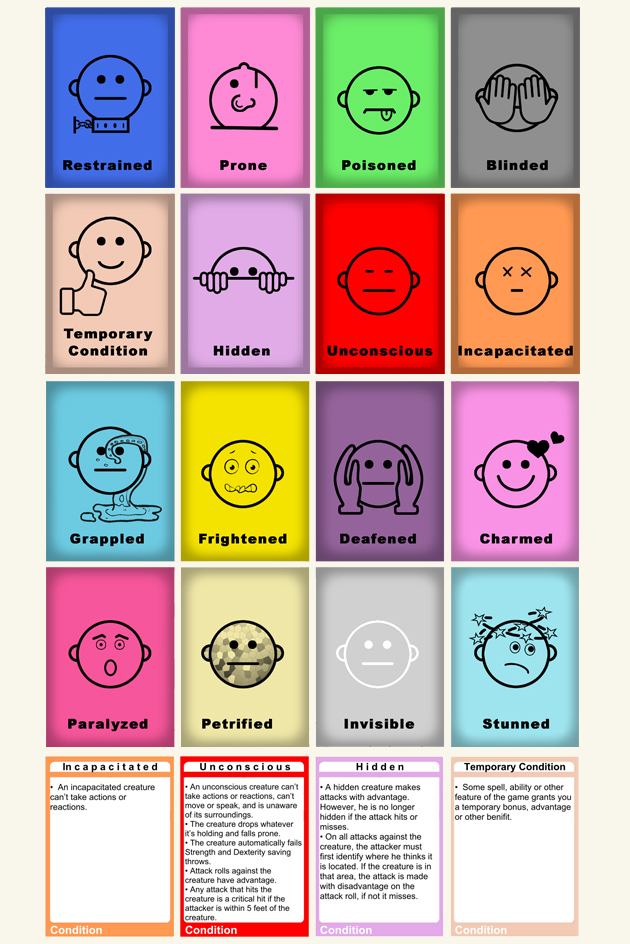
Condition Cards

Here is a set of generic cards that I have filled in with all of the conditions listed in the Player’s Handbook. They are on two separate PDFs. page1 and page2

They are form-fillable so you can make changes to them if you want to and there are a couple of blank cards on page 1.

Enjoy!

D&D 5E – Character Creation Sheet

Character CreationCharacter Creation Cheat Sheet

Download your free pdf copy here.

I found this great character creation help sheet on line. It is poster sized, so I modified it into a 5 page PDF file that will be more useful at the gaming table.

Does anyone know who the original author of this is? I would like to thank him or her and give them credit. This is NOT my original work.

D&D 5E – Combat Reference Sheet

CombatReference

2 sided Combat Reference Sheet

Download your free copy  HERE.

Many thanks to Jennifer Brahm for sharing her one page (printed front and back) cheat sheet. Using my Quick Reference Combat post as a basis, she created a wonderful game table reference sheet. I simply made a few corrections and cleaned it up a bit.

D&D 5E – Advantage/Disadvantage

disadvantage

When to use Advantage/Disadvantage

Essentially, an advantage allows you to roll 2d20, taking the higher roll result, whilst a disadvantage requires you to roll 2d20, taking the lower result. You never roll more than two dice because multiple advantage/disadvantage conditions don’t stack. If you have conditions that give you both advantage and disadvantage, they cancel each other out and you get neither.

It is up to the DM do decide if you get advantage or disadvantage on a roll. When trying to determine if a situation warrants an advantage or disadvantage, it may be helpful to review the specific situation listed in the PHB. This list does not include special abilities or magic spells or magic items.

Advantage

  • If you have inspiration, you can expend it when you make an attack roll, saving throw, or ability check. Spending your inspiration gives you advantage on that roll.
  • Using a crowbar grants advantage to Strength checks where the crow bar’s leverage can be applied.
  • A magnifying glass grants advantage on any ability check made to appraise or inspect an item that is small or highly detailed.
  • A military saddle gives you advantage on any check you make to remain mounted.
  • When mounted – You have advantage on melee attack rolls against any unmounted creature that is smaller than your mount.
  • Helping another with a task (where your assistance could actually be of help) adds advantage to their check.
  • If you are hiding – “the Dungeon Master might allow you to stay hidden as you approach a creature that is distracted, allowing you to gain advantage on an attack before you are seen.”
  • When a creature can’t see you, you have advantage on attack rolls against it.
  • Attack rolls against a blinded creature have advantage.
  • Invisible creature’s attack rolls have advantage.
  • Attack rolls against paralyzed and petrified creatures have advantage.
  • An attack roll against a prone creature has advantage if the attacker is within 5 feet of the creature.
  • Attack rolls against restrained or stunned or unconscious creatures have advantage.

Disadvantage

  • If you wear armor that you lack proficiency with, you have disadvantage on any ability check, saving throw, or attack roll that involves Strength or Dexterity.
  • If the Armor table shows “Disadvantage” in the Stealth column, the wearer has disadvantage on Dexterity (Stealth) checks.
  • Small creatures have disadvantage on attack rolls with heavy weapons.
  • In lightly obscured areas – creatures have disadvantage on Wisdom (Perception) checks that rely on sight.
  • When attacking a target beyond normal range, you have disadvantage on the attack roll.
  • You have disadvantage when you use a lance to attack a target within 5 feet of you.
  • When you attack a target that you can’t see, you have disadvantage on the attack roll.
  • You have disadvantage on a ranged attack roll if you are within 5 feet of a hostile creature that can see you and that isn’t incapacitated
  • Blinded creature’s attack rolls have disadvantage.
  • Attack rolls against Invisible creatures have disadvantage.
  • Any level of exhaustion gives you a disadvantage on ability checks
  • A poisoned creature has disadvantage on attack rolls and ability checks.
  • A prone creature has disadvantage on attack rolls.
  • An attack roll against a prone creature has disadvantage if the attacker is more than 5 feet from the creature.
  • Restrained creatures have disadvantage on Dexterity saving throws and attack rolls.

D&D 5E – House Rules – Underwater -Depth and Temperature

uNDERWATER

Into the Depths

Underwater – Depth and Temperature

The water’s depth and temperature will determine a character’s survivability when they are under the water.

DAMAGE FROM WATER PRESSURE

Depth CON Save Points of Damage
0-200 ft  none  none
201-250 ft  DC 10  1d6/minute
251-300 ft  DC 15  2d6/minute
301-400 ft  DC 20  3d6/minute
401-500 ft  DC 25  4d6/minute
501-1000 ft DC 30 5d6/minute
1001 ft or deeper DC 35  6d6/minute

The deeper a character ventures down into the water, the greater the water pressure. Freedom of movement and water breathing will not protect characters from either the crushing effects of deep water or the effects of cold. The indicated Constitution saves must be made one round after being at a certain depth. If the save is failed, then the damage is taken and another save must be made each minute until the character makes a Constitution save, after which further saves are not necessary. The character is then considered acclimated to that depth. Descending to a deeper depth range as indicated on the table, however, requires another saving throw be made.

DAMAGE FROM COLD WATER TEMPERATURE

Temperature  Degree F  CON Save  Points of Cold Damage
Tropical  >86  none  none
Warm  65-85  none  none
Cold  55-64  DC 10  1d6/minute
Frigid  45-54  DC 15  2d6/minute
Icy  32-44  DC 20  4d6/minute

Water conducts heat much more efficiently than air; therefore cold water causes much greater loss of body temperature than does cold air. It is also important for DMs to note that water becomes heavier as it cools until it reaches a temperature of about 37 degrees Fahrenheit (just above freezing). Below 37 degrees, as water crystallizes into ice, it becomes lighter so that ice will float on the surface of the water. Therefore, the bottom of any large body of water will tend to remain at 37 degrees F most of the year. The above table outlines the necessary saves and resultant cold damage from being in water at various temperatures. Unlike pressure, Constitution saves against cold damage from water must be made each minute, even after a successful save. The table assumes that the creature is not wearing anything that will provide meaningful insulation while in water. Normal clothing or armor is of no benefit. A creature wearing a watertight outfit that captures a layer of water next to the skin (like a wet suit) has advantage on Constitution checks against the cold damage. Smearing the skin with grease or fat, which repels water, will provide a +5 bonus to the necessary Constitution saves. Of course, magical forms of protection from cold also apply.

D&D 5E – House Rules – Falling

falling

FALLING

One of the great things about the 5th edition of Dungeons and Dragons is that it is vert light on rules. One problem with adding more rules is that if we add too many we run the risk of this edition devolving back into  3rd edition. However that will not stop me from suggesting potential house rules. Think of these as possible ways to address common issues that may arise during play.

Falling Damage: The basic rule is simple: 1d6 points of damage per 10 feet fallen, to a maximum of 20d6.

Jumping to avoid damage: If a character deliberately jumps instead of merely slipping or falling, the character receives no damage for the first 10 feet and on a DC 15 DEX (Acrobatics) check he receives no damage for the first 20 feet and lands on his feet.
Clarification: A character who slips from a ledge 30 feet up takes 3d6 points of damage. If the same character deliberately jumped, he takes 2d6 points of damage. And if the character leaps down with a successful Dexterity (Acrobatics) check, he takes only 1d6 points of damage from the plunge.

Falling onto Soft Surface: Falls onto yielding surfaces (soft ground, mud) ignores the first 1d6 points of damage.
Clarification: This reduction is cumulative with reduced damage due to deliberate jumps and the Athletics skill check.

Falling into Water: If the water is at least 10 feet deep, you must succeed on a DC 10 Dexterity (Acrobatics) check to enter the water without damage. Otherwise you receive 1d6 points of damage from any fall up to 20 feet of falling. Regardless of the save, you receive an additional 1d6 of damage for every 10 feet fall beyond 20 feet.

Diving into Water: Characters who deliberately dive into water take no damage on a successful DC 10 Dexterity (Acrobatics) check, so long as the water is at least 10 feet deep (or 20 feet deep if the dive is over 100 feet). However, the DC of the check increases by 1 for every 10 feet of the dive beyond 20 feet. There is a maximum DC of 35.

Landing on Your Feet: The official rule is that you land prone unless you receive no damage from the fall. I have no problem with this. However, I don’t think it would break anything if you allow the character to land on his feet if he makes his Athletics check.

D&D – Horse Descriptions

fave_horses_by_darktara-d6slc0c

Horses

I have been looking through my files and ran across several that you might find useful. I will make adjustments for 5E as necessary and share them. First here is one I ran across a couple of years ago.

You can use these tables to determine exactly how tall, what color, and what distinguishing markings were on the horses at the stables when the characters go shopping.

Hands Light (1d10) Medium (1d8) Heavy (1d6) Draft (1d6)
13-3 (4′-7″) 1 – 1,050 lbs.
14 (4′-8″) 2 – 1,100 lbs.
14-1 (4′-9″) 3 – 1,150 lbs.
14-2 (4’10”) 4 – 1,200 lbs
14-3 (4’11”) 5 – 1,250 lbs.
15 (5′-0″) 6 – 1,300 lbs. 1 – 1,400 lbs.
15-1 (5′-1″) 7 – 1,350 lbs. 2 – 1,425 lbs.
15-2 (5′-2″) 8 – 1,400 lbs. 3 – 1,450 lbs.
15-3 (5′-3″) 9 – 1,450 lbs. 4 – 1,475 lbs.
16 (5′-4″) 10 – 1,500 lbs. 5 – 1,525 lbs 1 – 1,550 lbs.
16-1 (5′-5″) 6 –  1,550 lbs. 2 – 1,575 lbs.
16-2 (5′-6″) 7 – 1,600 lbs. 3 – 1,625 lbs
16-3 (5′-7″) 8 – 1,625 lbs. 4 – 1,650 lbs. 1 – 1,875 lbs.
17 (5′-8″) 5 – 1,675 lbs. 2 – 1,900 lbs.
17-1 (5′-9″) 6 – 1,700 lbs. 3 – 1,925 lbs.
17-2 (5′-10″) 4 – 1,950 lbs.
17-3 (5′-11″) 5 – 1,975 lbs.
18 (6′-0″) 6 –  2,000 lbs.
The height of a horse is measured by hands at the shoulder, with the number of hands followed by the number of fingers.  There are four fingers to a hand, and in modern times each finger is equal to an inch.

It is apparent that horses of the same height may fall into different categories.  The girth and weight of the horse and its overall build and musculature have as much to do with the “size” of a horse as its height.

The color of the horse and its markings may be rolled on this table.  This is not an all-inclusive collection; some horse colors may have black markings (socks and stockings, mostly), and all markings are individual to the horse, but this list gives sufficient variety for play.  1d20 is rolled to determine what color the horse is (the first two columns), and the remaining columns express the probability of the indicated markings.  If the horse has socks or stockings, roll 1d4 to determine how many it has. Socks and stockings are rolled separately and, although a horse may have some socks and some stockings, it can’t have a sock and a stocking on the same foot….

1d20 Horse
Color
1d8
White
Star
1d10
White
Splash
1d6
White
Socks
1d6
White
Stockings
1d20
White
Mane &
Tail
1d6
Black
Mane &
Tail
1-2 Brown Pinto  –  –  –  –  –  –
3 Black Pinto  –  –  –  –  –  –
4-6 Chestnut 8 10 6 6  –  –
7-10 Bay 8 10 6 6  –  –
11-12 Buckskin  –  –  –  –  –  –
13-16 Gray  –  –  –  –  – 5-6
17-19 Black 8 10 6 6 20  –
20 White*  –  –  –  –  –  –
*White horses are rather rare; most “white” horses are light-skinned Grays, and the referee may allow a roll to determine whether any particular Gray horse appears white, especially if it does not have dark markings.

But is it a boy or a girl horse?  From an historical perspective, occidental cavalry at the time of the Crusades rode stallions almost exclusively, while their mid-eastern opponents had an equally strong preference for mares; however, the first battle fought in the spring gave both sides an understanding of the disadvantages of this situation, and more geldings appeared (on both sides, I suspect) thereafter.  These balances reflect more the modern situation than the historic ones; the referee might determine that characters of a particular class or race will always ride one or another type.
1d6
1 Stallion
2-3 Gelding
4-6 Mare

D&D 5E – Writer’s Guide

WritersGuide

Style Guide for Dungeon Masters

I was looking for an official writer’s guide, or style sheet, from Wizards of the Coast for the 5th edition Dungeons and Dragons. Perhaps they have one and I just couldn’t find it. So I took the copies I had from 3.5 and 4.0 and updated them for 5th edition. The following is what I came up with.

Format Instructions

Capitalization

Capitalize abilities (Strength, Dexterity, and so on), skill names (Acrobatics, Sleight of Hand, Survival, and so on), feat names (Crossbow Expert, Healer, and so on), domains (Trickery, War, and so on), schools (Transmutation, Necromancy, and so on), names of languages (Common, Dwarvish, and so on), and sizes (Small, Medium, Large, and so on). The term “Dungeon Master” and the abbreviation “DM” are always capitalized. The term “Difficulty Class” and the abbreviation “DC” are always capitalized. Creatures, classes, alignments, spells, weapons, and magic items that do not include proper nouns are all lower case. Magic items and spell names are italicized. For example, magic weapons, potions, and other items should be fully italicized. If a magic item grants a numerical modifier, treat that modifier as part of the item’s name, placing it at the beginning of the name. Examples: +1 longsword, a potion of healing, +2 cloak of resistance, and a scroll of arcane lock.

Monster names. When you refer to a monster in a sentence, do not capitalize the monster’s name unless it is a proper noun. Example: Baphomet’s minotaur cultists often summon goristros …

Races. When you refer to a race in a sentence, do not capitalize the race’s name (unless English grammar demands capitalization). Example: Love of stories inspires many gnome heroes to become bards.

Character races are to appear in the following singular/plural terminology; dwarf/dwarves, elf/elves, halfling/halflings, human/humans, dragonborn/dragonborn, gnome/gnomes, half-elf/half-elves, half-orc/half-orcs, tiefling/tieflings.

Abbreviations

Abbreviations usually use all capital letters and no periods (DM, DC, NPC, HD, XP). The abbreviations for hit points and coins use lower case letters and no periods (hp, gp, sp). The abbreviation for experience points is XP.

Ability scores are abbreviated as follows: STR (Strength), DEX (Dexterity), CON (Constitution), INT (Intelligence), WIS (Wisdom), CHA (Charisma), and are always listed in that order.

Class abbreviations are as follows:
Bbn = Barbarian
Brd = Bard
Clr = Cleric
Drd = Druid
Ftr = Fighter
Mnk = Monk
Pal = Paladin
Rgr = Ranger
Rog = Rogue
Sor = Sorcerer
Wiz = Wizard
Wrk = Warlock

 Race abbreviations are as follows:
Hum = Human
Drb = Dragonborn
Drw = Drow
Dwf = Dwarf
Elf = Elf
Gno = Gnome
1/2Elf = Half-Elf
1/2Orc = Half-Orc
Hlf = Halfling
Tfl = Tiefling

Rule books
PHB = Player’s Handbook
DMG = Dungeon Master’s Guide
MM = Monster Manual

You should type out the entire title the first time it is mentioned. Example: “Use the standard combat rues as described in the Player’s Hand Book (PHB).”

Time

Do not abbreviate standard game units of time; i.e., round (alternatively; melee round may also be used), and turn should be fully spelled out.

Temperature

When describing temperature, always use a degrees symbol; i.e., 100˚. When describing an angle or slant, always spell out the word ‘degrees’; i.e., 100 degrees.

Inches and feet

Never use ‘hash’ marks. Inches and feet should always be expressed as an abbreviation when used in a table or stat block – otherwise, they should not be abbreviated. When indicating the attribute being measured, insert a hyphen between the number and unit. Examples: 8-in wide, 12-ft deep

Movement

Movement rate in feet should always be expressed as an abbreviation. Example: 30 ft.

Advantage/Disadvantage

A creature may “have advantage” (or “have disadvantage”) in certain situations. A roll (saving throw or ability check for instance) may be made “with advantage” (or “with disadvantage”). Examples: The target can repeat the saving throw at the end of each of its turns, with disadvantage if the spectator is visible to the target. The owl bear has advantage on Wisdom (Perception) checks that rely on sight or smell.

I recommend that you not abbreviate the words advantage or disadvantage, but when you must – you can abbreviate advantage Adv and disadvantage Disad.

Hyphenation

Always hyphenate class and spell levels when they precede a noun (4th-level rogue, 1st-level spell). Hyphenate compound adjectives before nouns (the red-haired, 18-foot-tall fire giant). Do not hyphenate before the suffix “-like” except after double-l endings (for example, snakelike, spell-like).

Die Rolls

How many and what kind; a lowercase d followed by a number (4, 6, 8, 10, 12, 20, %) indicates a specific polyhedral die to be rolled. It is preceded by a number indicates the number of times to roll the indicated die; i.e., 3d6. It is not acceptable say, “three six-sided die,” to achieve the same result.

Die result; when specifying a die roll result that triggers some action, to specify the range of numbers use a dash to separate the low from the high; i.e., 1–2 on 1d6.

Skill Checks

You should list the skill check in the running text with the DC number listed first. Example: Player characters must make a successful DC 15 Dexterity (Acrobatics) check to climb the wall.

Generally, set DCs for tasks that characters can retry at 5 to 10 points higher than DCs for tasks that PCs can’t retry.

Tense

Write in the present tense. Wherever possible, avoid using the future tense “will” to describe NPC or monster actions. For example, do not say “If the player characters open the door, the golem will attack.” Instead say, “If the player characters open the door, the golem attacks.”

Damage

Use the phrase “points of damage” when giving damage in numbers or ranges. Always use a die range when giving damage, and always include a numeral before the type of die, even if there is only one. For example: “The skeleton deals 1d3 points of damage with each claw” is correct. Do not use “d3 points of damage,” “1d3 damage,” or “1d3 hp damage.”
Creatures deal or take damage. They do not inflict or suffer damage.
Example: “If the saving throw fails, the character takes 1d6+1 points of damage from the poison.”
D&D 5E – DM Screen

DM_Screen_+RRH5E – DM Screen

Download your free copy here.

Wizards has an excellent Dungeon Master’s Screen. It is well made and good looking and well worth the price. However, It falls short (in my opinion) on the reference material on the DM’s side. I searched for a fan made version and found several that were better than the Wizard’s version, but still weren’t exactly what I had in mind, so I finally broke down and made my own. You can download the PDF file and print it for your own use. There are several ways to make these into a DM Screen. The simplest is to attach the prints to cardboard and tape the panels together. You can find pictures to decorate the Players side to suit your campaign.

Here is what I ended up with.

1)  I felt that 3 panels was plenty. By making them 8 1/2″ x 11″ they are easy to print and to find backings or plastic sleeves to fit them in. I oriented them with the long dimension horizontally to make it easier for the DM to see over.

2) I only listed information that might be needed during play – so no player creation or dungeon creation information.

3) To make it easy to quickly find what you are looking for I organized it into three columns on each panel. Each column has a large title on the top with information related to that topic listed below. The Headings are: Vision, Travel, Combat, Survival, Conditions, Money, Encounters, Objects, and Abilities.

Enjoy!