My first inclination was to make the rules regarding lava as realistic as possible but eventually gave up. I have decided to not even try to make lava in D&D realistic. Here is why.
As I see it, you have two different options when coming up with house rules for lava in your D&D games. You can try to make interactions as realistic as possible or you can give it more of a fantasy feel. As an example, here are two different ways I might come up with house rules for falling into lava.
Falling into Lava (2 options)
Option 1 – Reality
In the first second falling towards the lava, the air temperature rises to 200 degrees Fahrenheit. At this point any exposed skin will immediately blister. It feels as though every inch of your skin is touching a hot stove.
You fall for another second toward the lava, and now the air temperature has doubled to 410 degrees. At this point your hair and any clothes you were wearing ignite into flames.
A second or two later you approach the surface of the pool of lava which is between 1200 – 2500 degrees Fahrenheit. You lose consciousness from the immense pain as your flesh is charring, your blood and fluids are boiling.
You begin to asphyxiate as your lings are charring due to the hot gases above the surface.
The superheated air is burning your lungs filling them with fluid much like a blister from a burn fills with fluid.
You are have a cardiac arrest before you ever touch the lava. Your brain isn’t registering much if anything at all at this point.
As you get closer to the lava the water in your body rapidly turns into steam, causing your cells to burst and rapidly swell your body. The pressure from the created steam passes the amount of pressure that your skin and muscles can tolerate, and they begin to tear apart – either in an explosion, or by creating large openings for said steam to escape.
As your skull gets closer to the lava, the water inside your brain behaves similarly, causing your head to explode as the pressure from your brain boiling alive goes above the threshold of what amount of pressure pushing outward your skull can contain.
When hitting this super dense substance at a high speed you may break your neck or crack your skull open.
Then, resting on a bed of molten rock four times hotter than the broiler in an oven, you quickly burst into flames.
In the blink of an eye, it is just your bones and ashes on top of the lava.
Your bones are all burned to ash a few seconds later.
D&D reality house rule: If you fall into lava you die. No saves.
Option 2 – Fantasy
You can sink into the lava like Gollum does in the movie “Lord of the Rings: Return of the King.”
Lava should be scary and potentially lethal but possibly survivable, like falling form impossible heights. Some examples where D&D rules aren’t very realistic:
Fireball damage: The fireball spell does 8d6 fire damage on a failed save, or half as much damage on a successful one. Objects that are worn or carried are not affected.
Falling damage: A creature takes 1d6 bludgeoning damage for every 10 feet it falls, to a maximum of 20d6.
Power Word Kill: This spell has no effect on creatures with more than 100 hit points.
Also, lava would not make a good backdrop for an encounter if it was strictly realistic.
D&D fantasy house rule: Any creature that falls into lava or starts its turn there takes 55 (10d10) fire damage.
Here are the rest of my house rules regarding lava (these apply to magma as well). Whether it is because lava is different or for some other reason it is just more “fun” if works like this.
How lava behaves (in my fictional D&D world)
You can think of lava as being similar to thick oatmeal that is extremely hot.
Crust: It doesn’t normally form a “crust”.
As long as it is in motion the surface stays liquid, hot, red, and glowing but there may be exceptions.
When it stops moving and pools up it will form a crust after cooling for 24 hours. (It cools twice as fast if underwater.)
The crust is 1 foot thick and does 1d6 fire damage per round to any creature that walks on it.
After 10 days the crust will be 2 feet thick and no longer does fire damage when you walk on it.
The crust continues to thicken one additional foot every 10 days until the lava all becomes solid stone.
Lava rate of flow: It flows slowly enough that you can normally avoid it. Lava flows at 5 ft. per round (50 ft. per minute, 1/2 mph). This is the same at any angle or over any terrain, even straight down without any support.
Swimming in Lava: Swimming speed in lava is 1/4 your walking speed, or 1/2 your swim speed.
Walking on Lava: Even if you are immune to fire, you can’t walk on the surface without magic, such as the “Walk on Water” spell.
Wading through Lava: If the depth of the lava is not above your shoulders you can wade through it. When wading through it, if its depth is no higher than your knees it is treated as difficult terrain, otherwise your speed is reduced to 1/4 of your walking speed..
Immunity to Lava: An immunity or resistance to fire serves as an immunity or resistance to lava. However, a creature immune to fire might still drown if completely immersed in lava.
Gasses: Lava doesn’t normally also have toxic or dangerous gasses emanating from it.
How it spreads: When it reaches a relatively flat surface it will spread. As an example, in one round a 5 foot cube of lava will spread to fill 5 random adjacent 5 ft. spaces to a depth of 1 foot. Lava that is only 1 foot deep no longer spreads unless more lava is added.
Damage:
Being Close: When a creature enters to within 10 feet of the lava, or starts its turn there, it takes 1d6 fire damage due to the heat radiating off the lava. It takes this same damage if it is using the “Water Walk” spell to walk on the surface of the lava.
Wading: A creature takes 5d10 fire damage each round when wading through a lava stream
Falling In: Any creature that falls into the lava or starts its turn there takes 55 (10d10) fire damage.
Objects: Any object that isn’t being worn or carried takes fire damage as a creature does. An object that is reduced to 0 hit points from taking fire damage from lava is completely destroyed.
Dying: A creature that is reduced to 0 hit points from taking fire damage from lava is disintegrated and everything it is wearing or carrying is completely destroyed (no saving throw, no death saves).
Note: the damage is less than indicated in the DMG but I have added the no death saves and destroying all objects rules.
I have previously posted my D&D 5E House Rules rules on for drowning, casting spells underwater, and entire supplements on running nautical adventures. I have recently given more thought to these matters. I have never adequately presented rules to handle issues such as standing above the water and attacking a creature below the water. In this post I address this and other issues as well as reimagining some of my earlier rules. Enjoy!
A few words about “Swim Speed” • Having a swim speed does more than effect your speed when you are swimming. It implies a familiarity with the underwater environment that effects other things you do underwater such as speaking and using weapons. These abilities are reflected in the sections below.
How fast do you swim? • Unless you have a swim speed, your movement speed is halved.
Swimming in Armor • Light Armor: Requires a DC 10 Strength (Athletics) check each round. Failure means you have a speed of 0 for that round. • Medium Armor: Requires a DC 15 Strength (Athletics) check each round. Failure means you have a speed of 0 for that round and you sink 10 feet. • Heavy Armor: Requires a DC 20 Strength (Athletics) check each round. Failure means you have a speed of 0 for that round and you sink 20 feet.
Swimming to Exhaustion • You must make a DC 10 Constitution saving throw each hour that you are swimming or you gain one level of exhaustion. The check is made every half hour if wearing medium armor or every 15 minutes if wearing heavy armor.
Holding Your Breath • You can hold your breath for a number of minutes equal to 1 + your Constitution modifier. If you have a Constitution score of less than 10 you can hold your breath for 30 seconds. At that point, you fall unconscious. • When you don’t have time to prepare to enter the water, like if you were surprised, the time that you can hold your breath is halved, to a minimum of 30 seconds. • Once unconscious, you can survive for a number of rounds equal to your Constitution modifier (minimum of 1 round.) At that point, you drop to zero hit points, begin to drown and must start making death saving throws. • When drowning, a you cannot regain hit points or be stabilized until you are once again able to breathe. • When in combat, if you take any action other than the dodge action, at the end of combat you lose 1 minute from the time that you can hold your breath. For a long combat, for every 10 rounds you lose 2 additional minutes. • When you are hit, you must make a DC 12 Constitution saving throw. On a failure you lose an additional 30 seconds from the time you can continue to hold your breath. If it was a critical hit, you must instead make a DC 20 Constitution saving throw. On a failure you loose your breath and fall unconscious.
Melee Weapons • When your target is underwater, if you don’t have a swim speed, your weapon attacks are made at disadvantage unless you attack with a dagger, javelin, shortsword, spear, or trident. And your unarmed strikes are made at disadvantage.
Ranged Weapons • If your target is underwater, all ranged weapon attacks other than crossbows, nets, javelins, spears, tridents, and darts are made with disadvantage and even for these, attacks made beyond the weapon’s normal range automatically miss.
Shooting and Casting Spells Into Water • From the point of view of a creature out of the water, creatures that are underwater are considered to have 3/4 cover (+5 to the creature’s AC).
Speaking or Casting Spells While Underwater • Speaking underwater expends some of your air. Each round that you speak or attempt to cast a spell with a verbal component removes 30 seconds from the time you can hold your breath. If you are talking, this can be no more than about 10 words. • You are harder to understand when you talk while underwater. If you don’t have a swim speed, there is a 50% chance that you won’t be understood when speaking, and a 50% chance that your spell will fail when uttering the verbal component. • Sound travels further underwater. The verbal component of a spell will be heard at least 40 feet away. The same for normal speech. Anyone further than 40 feet away will have to succeed in a perception check with a DC = the number of feet beyond 40 feet to understand what is said. • You can’t whisper or yell underwater. • Creatures that aren’t in the water with you can’t hear you well. If you don’t have a swim speed and you are underwater, anyone that is not in the water will not be able to understand anything that you are saying. • If you can breathe underwater you can talk and cast spells without restriction.
Fire Spells • All creatures have resistance to fire damage when submerged underwater. • The range and AoE of fire spells are both halved. In the case of AoE spells, creatures have advantage on their saving throw.
Lightning Spells • Creatures have disadvantage when attempting to make a save against an AoE lightning spell. The range and AoE of lightning spells are doubled underwater.
Spells and Magic Items:
Water Walk [PHB p. 287] 3rd-level transmutation (ritual) Casting Time: 1 Action Ritual Range: 30 ft Components: V, S, M (a piece of cork) Duration: 1 Hour This spell grants the ability to move across any liquid surface – such as water, acid, mud, snow, quicksand, or lava – as if it were harmless solid ground (creatures crossing molten lava can still take damage from the heat). Up to ten willing creatures you can see within range gain this ability for the duration. If you target a creature submerged in a liquid, the spell carries the target to the surface of the liquid at a rate of 60 feet per round.
Ring of Water Walking [DMG p. 193] Ring, uncommon While wearing this ring, you can stand on and move across any liquid surface as if it were solid ground.
House Rules for the Water Walk spell. The second part applies only when you target a creature submerged in a liquid, i.e. at the time of casting.
House Rules for Ring of Water Walking • This does not mention the “Water Walk” spell. The spell says “as if it were harmless solid ground”. Note that the word “harmless” has been omitted from the ring’s description. So walking across acid or any other harmful liquid would inflict damage. It also won’t carry you to the surface if you put it on while underwater.
House Rules for both the Water Walk spell and the Ring of Water Walking • You can chose to dive under the water whenever you choose. In combat, this will be considered part of your move action. • If you are underwater and swim to the surface, it will take an action to climb back onto the surface of the water. • The effect of the spell or the ring will allow you to stand, walk, run, jump or engage in combat. It will also support the weight of your body and everything you are carrying even if you aren’t on your feet. So you can sit, lay down, or stand on your hands or head if that is what you want to do. Any object you are carrying can enter the water as it normally would if your intention is not to support your weight with it. As an example, you could use a walking stick or crutch and a monk could do a kick jump with his staff. • Your movement is not affected by the current. But, the surface of the water can change (such as with the tide) so the surface you are walking can raise or lower with the surface of the water. This means that waves will cause the surface to rise and fall. Breaking waves could present a problem. • While you are on the surface you can attack any underwater creature that is within range with your sword or ranged weapon. • While you are on the surface you can dip up some water in a bowl or even with your hands. You can also reach under the surface to do other things with your hands such as picking up items that you can reach, or open a chest. • Don’t forget and set your backpack down beside you, it will sink!
“To target something [with a spell], you must have a clear path to it, so it can’t be behind total cover. If you place an area of effect at a point that you can’t see and an obstruction, such as a wall, is between you and that point, the point of origin comes into being on the near side of that obstruction.”
This isn’t especially clear and and leads to many questions. A clear definition of “line of effect” would clear up much of the confusion. However, neither the Player’s Handbook nor the Dungeons Master’s Guide use this term at all. Because fifth edition doesn’t define a line of effect, below is my unofficial definition. I went back to the definition in third edition and modified it to account for the differences in 3rd and 5th edition. Because the following is not official, you should consider it a house rule.
Line of Effect [for Spells]
You must have a clear line of effect to any target that you cast a spell on or to the point of origin for any spell’s area of effect. A spell’s area of effect affects only an area, creature, or object to which it has line of effect from its origin. Line of effect is a straight, unblocked path that indicates what a spell can affect. A line of effect is canceled by a solid barrier. It’s like line of sight for ranged weapons, except that it’s not blocked by fog, darkness, and other factors that limit normal sight. A line of effect is also blocked by a solid barrier that doesn’t block sight, such as clear glass. An otherwise solid barrier with a hole of at least 1 square foot through it does not block a spell’s line of effect. Such an opening means that the 5-foot length of wall containing the hole is no longer considered a barrier for purposes of a spell’s line of effect. Line of effect is required for spells unless the spell description specifically states otherwise. Any spell that says that you need to see the target still requires a line of effect. If the spell description says that an effect spreads around corners that effect doesn’t require a line of effect.
Concentration Spells
If a spell must be maintained with concentration, you must have a line of effect to cast the spell, but you do not need to maintain a line of effect to maintain concentration. However, if the concentration spell allows you to use an action, bonus action or reaction to effect a creature or object then any round that you perform that action you must have line of effect to the target.
Line of Effect [for Auras]
The line of effect for an Aura is different than for spells. To be effected by (or to detect) an Aura there must be a straight path to the source of the aura that isn’t blocked by 1 foot of stone, 1 inch of common metal, a thin sheet of lead, or 3 feet of wood or dirt.
These tables more closely conform to the guidelines in the Dungeon Master’s Guide than the ones I published in 2020. Many thanks to Andrea Mosconi for pointing out my mistakes and taking the time to create these revised tables. [For my followers that are Italian speakers, you might find the site he used to help manage a useful resource www.dragonslair.it ]
There are separate tables for groups of 3, 4, 5, or 6 PCs. Just use the PDF file for the number of PCs in your party. Then go to the Easy, Medium, Hard, or Deadly encounter table. Find their average character level on the left side of the table and go across to the column that corresponds to the CR of the monster you want to use to see how many monsters you should use for the encounter (according to the DMG).
This works even if the encounter has different types of monsters as long as they each have the same CR. But what if you want the encounter to have monsters with different CRs? Just see how many of each CR monster you need for an Easy, Medium and Hard encounter. Then you can put them together in a single encounter using these formulas: 1D=4E=2M=2E+1M=1E+1H, 1H=3E=1E+1M, 1M=2E Where D is Deadly, H is Hard, M is Medium and E is Easy.
Or, if you aren’t a math geek: For a Deadly encounter you can use four Easy, or two Medium, or two Easy and one Medium, or one Easy and one Hard encounter. For a Hard encounter you can use three Easy, or one Easy and one Medium encounter. For a Medium encounter you can use two Easy encounters.
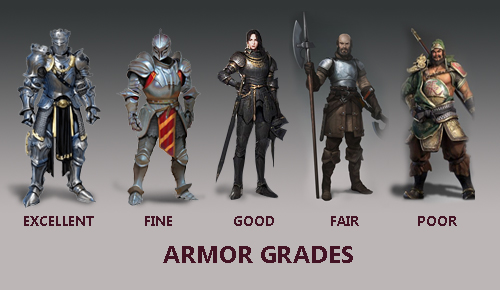
There has been a lot of talk about how Armor Class (AC) is calculated in D&D and how armor could be be handled differently. This post is not about that. Without changing any of the basic D&D rules, the house rule I am proposing here simply adds to (or subtracts from) your armor class depending on the quality of the armor.
This system is simple and easy to remember. This works with all armor. Use the armor in the PHB but change the price and Armor Class (AC) based on the grade of the armor as indicated below. Shields are not available in Excellent or Poor condition.
EXCELLENT These are created by the best armor smiths in the land. Armor of this grade isn’t always available. Cost: 4 times the PHB price Armor Class: +2 bonus to the AC
FINE This is a the best armor most people will ever see. It is highly prized and often passed down from father to son. Cost: 2 times the PHB price Armor Class: +1 bonus to the AC
GOOD This is the grade of the armor in the PHB. Cost: PHB price Armor Class: Use the AC in the PHB
FAIR A peasant or low CR monster might have such armor. No fighter would use such low grade armor if he could passably get something better. Cost: 1/2 the PHB price Armor Class: −1 penalty to the AC
POOR These may be found discarded or abandoned on a battlefield. They are often rusted, chipped, broken or have pieces missing. They would typically only be used when there is no other option. Cost: 1/4 the PHB price (or found) Armor Class: −2 (or greater) penalty to the AC.
DAMAGING ARMOR [Optional Rule] When you take Slashing, Piercing, Bludgeoning, Acid, Lightning, or Force damage from a critical hit your armor takes a permanent and cumulative −1 penalty to its AC. The damage is applied to your shield unless your opponent had advantage on the attack. In that case, or if you aren’t using a shield, the damage is applied to your other armor. If this penalty drops the armor’s AC to 0, it is destroyed.
The DM might apply the penalty in other situations where the armor might be damaged.
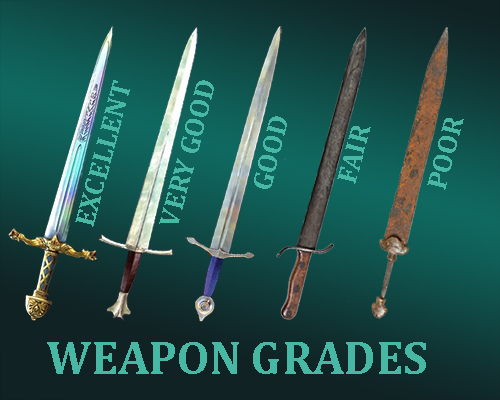
Wanting to add more weapon options to your Dungeons and Dragons 5E game? The weapons available in the Player’s Handbook (PHB) are simple and easy to play, but there is no variety based on the quality of the weapon. All short swords do the same damage. The house rules I am presenting here will allow allow your characters to spend more gold for a higher quality weapon that does more damage, or if they can’t afford the best they can get a lower quality weapon that does less damage.
This system is simple and easy to remember. This works with all weapons. Use the weapons in the PHB but change the price and damage dice based on the grade of the weapon as indicated below.
EXCELLENT These are created by the best weapon smiths in the land. Weapons of this grade aren’t always available. Cost: 4 times the PHB price Damage Dice: Roll two additional dice and drop the lowest 2.
VERY GOOD These are a the best weapons most people will ever see. They are highly prized and often passed down from father to son. Cost: 2 times the PHB price Damage Dice: Roll one additional die and drop the lowest one.
GOOD This is the grade of the weapons in the PHB. Cost: PHB price Damage Dice: PHB damage
FAIR A peasant or low CR monster might have such a weapon. No fighter would use such a low grade weapon if he could passably get a better one. Cost: 1/2 the PHB price Damage Dice: Roll one additional die and drop the highest one.
POOR These may be found discarded or abandoned on a battlefield. They are often rusted, chipped, or broken. They would typically only be used when there is no other option. Cost: 1/4 the PHB price (or found) Damage Dice: After rolling the standard damage dice, roll one additional die and subtract that from the total of the others. If this total is zero or less, your weapon damage will only be the ability modifier you are using for this weapon (STR or DEX).
CRITICAL HIT If your attack roll is a natural 20 (a 20 on the dice before any modifiers), roll double the standard damage dice before making an adjustment for weapon quality.
CRITICAL MISS [Optional Rule] If your attack roll is a natural 1 (a 1 on the dice before any modifiers), the weapon attack misses. There is also a chance your weapon is damaged. Immediately make another attack roll applying all of the same modifiers against the same AC but this isn’t an attack, it is a roll to see if you damaged your weapon. If this second roll is a miss your weapon drops to the next lower grade. If your weapon is already poor quality, it is destroyed.
Never heard of ICRPG? I believe that Index Card Role Playing Game (ICRPG) is only a little over 5 years old. The latest version (Master Edition) came out last month. Quoting from the Quick Start “How to use the ICRPG rules? Short answer: don’t.”
“Index Card RPG is a way of thinking. Your players invested in another system? No problem. … Take what is useful for you, and toss the rest!”
The basics are simple. Here are some examples.
Movement and distance are somewhat abstract. Everything is either close, near, or far.
Turns are always taken clockwise around the table.
In combat, your character can either move far, move near and take an action, or take an action and not move.
A target number is set for the room or encounter area. It becomes the AC for all monsters and the DC for anything else you may attempt.
I couldn’t find any good conversion guides, so I wrote this one. If any of this sounds interesting to you, I recommend downloading the free ICRPG Quick Start available on “DriveThru RPG”.
You might want to run an ICRPG session or two using this conversion guide. If you and your players think any of these rules would enhance your D&D 5e game, drop all of the ones you don’t like and just use the ones you like as house rules in your next D&D game.
Let me know how it goes.
Revision #1, 1/8/2022: Removed copyrighted text and images as requested by Alex from Runehammer Games.
This is a major update to my earlier Nautical Adventures supplement. I have changed form a Ship Record Sheet to the Ship Stat Block format as presented in the “Ghost of Saltmarsh” book under its “Of Ships and The Sea” appendix and have streamlined the special officer actions. This has made running ship to ship combat much faster and easier to play. Everything here is fully comparable with “Ghost of Saltmarsh”. I highly recommend its “TRAVEL AT SEA”, “OCEAN ENVIRONS”, “ENCOUNTERS AT SEA”, “RANDOM SHIPS”, “MYSTERIOUS ISLANDS”, and “UNDERWATER LOCATIONS” sections for use in your nautical adventures.
The official rules for Lycanthropy in D&D 5E don’t make it clear on how a DM should run the game should a player’s character become effected by the curse. I was looking to come up with some house rules when I ran across this post by Halfling Hobbies. I didn’t think I could improve on it much so I thought I would share.








 Dungeon Master Assistance