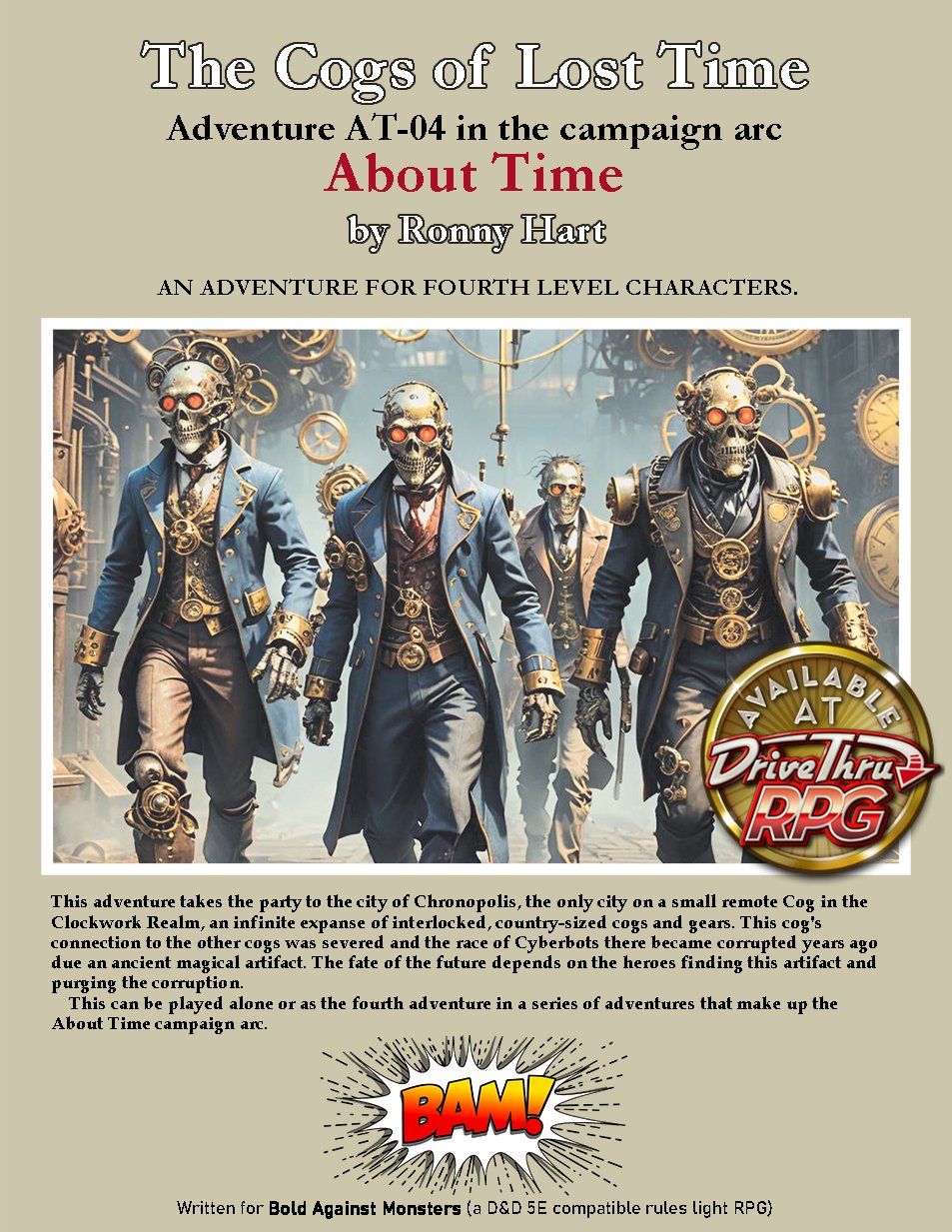
The Cogs of Lost Time,written for 4 fourth level characters, can be played alone (a set-up is provided to play as a stand-alone adventure for newly-arrived PCs) or as the fourth adventure in a series of adventures that make up the About Time campaign arc. The previous adventure ended with our heroes learning that there are several corrupted artifacts scattered throughout time and space. If they are not found and cleansed of their corrupting influence they will eventually cause the end of all that is lawful and good in the universe. They received a vital clue as to the identity and location of one. The Chronometer of Harmony resides within the lawful Clockwork Realm. They are going there now. The fate of the future rests on their shoulders.
Also included: ➛This adventure is written to be ran as “theater of the mind.” This relies on your imagination and the descriptions to visualize the world and encounters. There are no maps provided, but there is an abundance of descriptions and illustrations. ➛There are tips for running a theater of the mind adventure. ➛It introduces the Clockwork Realm, and its inhabitants, the Cyberbots. ➛The entry for each area includes everything you need to know about that area including: how to handle any encounters, the full stat block for any monster and how it should act, and a simple list of all treasure that the PCs may have found. ➛There are random encounter tables. ➛There are 13 new monsters, all complete with full stat blocks and tokens. ➛There are 5 new magic items. ➛ It includes Puck, a companion for the group, a detailed and illustrated NPC with a full stat block and information to help the GM play the character, a tiny fey creature (sprite) with a playful nature. + Free VTT Pack with high quality images for locations, magic items and monsters as well as Monster and NPC Tokens.
The Cogs of Lost Time is written for the rules light, D&D 5E compatible, RPG Bold Against Monsters (also called BAM). It requires either the use of the Bold Against Monsters Core Rule Book, or the D&D fifth edition Player’s Handbook, or the Tales of the Valiant Player’s Guide.
The first adventure was AT-01 An Ancient Evil – primarily an Urban Adventure. The second adventure was AT-02 Quest for the Mithral Sphere – a Micro-Hex Crawl. The third adventure was AT-03 Secret of the Shattered Temple – a Dungeon Crawl. This is the fourth adventure AT-04 The Cogs of Lost Time – Theater of the Mind, on another plane. The next adventure will be AT-05 The Whispering Wood – a City and Overland Adventure
If you would like to purchase The Cogs of Lost Time as a soft cover book, or to support me by paying for the PDF, go to DriveThruRPG.
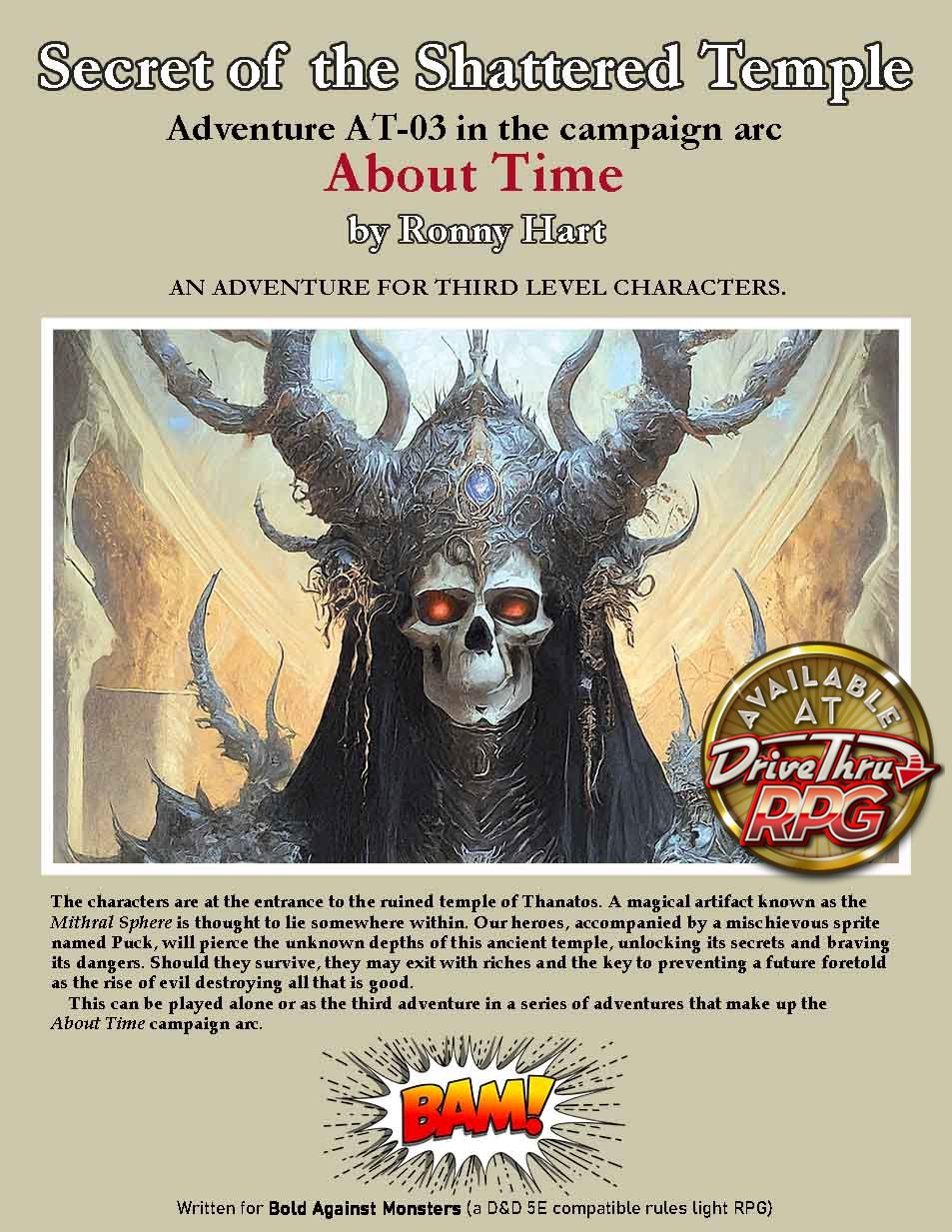
Secret of the Shattered Temple,written for 4 third level characters, can be played alone (a set-up is provided to play as a stand-alone adventure for newly-arrived PCs) or as the third adventure in a series of adventures that make up the About Time campaign arc. The previous adventure ended with our heroes locating the hidden entrance to the ruined temple of Thanatos on the island of Aethelgard. They were told by Lander, a Flying Cyanea with powerful magical abilities, about an artifact called the Mithral Sphere reported to be somewhere on the island. He said that they must find the artifact to prevent the future destruction of the world. Our heroes have searched the island and everything points to the artifact being in this ancient temple.
Also included:
➛ This is an old fashion dungeon crawl. The ancient temple consists of two levels, with a total of 39 numbered areas, with secret doors, traps and puzzles. ➛ There are tips for running a dungeon crawl. ➛ The entry for each area includes everything you need to run that encounter including: a separate map of just that area, how to handle any encounters, the full stat block for any monster and how it should act, and a simple list of all treasure that the PCs may have found. ➛ It has 18 monsters (3 of them new), all complete with full stat blocks and tokens. ➛ For each encountered monster, that monsters full stat block is included on the page with the encounter. ➛ There are three new magic items. ➛ It includes Puck, a companion for the group, a detailed and illustrated NPC with a full stat block and information to help the GM play the character, a tiny fey creature (sprite) with a playful nature. + Free VTT Pack with high quality Battle Maps and Tokens.
Quest for the Mithral Sphere is written for the rules light, D&D 5E compatible, RPG Bold Against Monsters (also called BAM). It requires either the use of the Bold Against Monsters Core Rule Book, or the D&D fifth edition Player’s Handbook, or the Tales of the Valiant Player’s Guide.
The first adventure was AT-01 An Ancient Evil – primarily an Urban Adventure. The second adventure was AT-02 Quest for the Mithral Sphere – a Micro-Hex Crawl, where the characters explored an island. This is the third adventure AT-03 Secret of the Shattered Temple – a Dungeon Crawl. The next adventure will be AT-04 The Cogs of Lost Time – a “Theater of the Mind” adventure set in the Clockwork Realm – a plane devoted to ultimate order inhabited by sentient Cyberbots.
If you would like to purchase Secret of the Shattered Temple as a soft cover book, or to support me by paying for the PDF, go to DriveThruRPG.
I introduced the It’s About Time Campaign arc here in May 2024 when I posted AT-01 An Ancient Evil. I haven’t finished writing these adventures. The last one I posted here was AT-08 The Pirate Queen’s Ploy in March this year. I still intend to finish these, but first I am re-writing them specifically for use with my new rules light 5E compatible RPG game rules Bold Against Monsters (BAM). I have just finished the first of these and it is now for sale on DriveThruRPG.
Because BAM only supports player characters up to 10th level, the target now is to wrap up the campaign at that level. I have also dropped the tie-in with my time travel rules. For those of you waiting for the conclusion of the original adventures, I apologize for the delay. Hopefully you will enjoy these revised adventures. I’m going to convert everything, other than the images, to avoid any copyright issues. I’m cleaning up and polishing all of the text. Practically every location and encounter will be improved. I think you will enjoy the new consistency and ease of play.
I am providing it free here as a thank you to my loyal followers on this blog.
Download your free PDF files below. These are the exact same files that I am selling on DriveThruRPG.
This is the first installment in a series of adventures collectively called About Time. An Ancient Evil starts out as an urban adventure for 4 first level characters, set in the small fishing village of Saltport Cove. It highlights many of the village’s locations. A mixture of encounters includes roleplaying, investigation, combat, and a festival with games where they compete with the local fishermen. Just before midnight, while celebrating the coming of the new year, a fireball zooms overhead and crashes into a nearby island causing a large wave to destroy much of the dock area. The party is hired to map the island and report any threats. As they step onto the island they are teleported to another location and 10,000 years into the past, where they fight monsters and learn of a threat to their entire world. They are then returned to the present where they can continue their exploration of the island in the next episode in the About Time campaign arc.
The fully bookmarked 36 page PDF includes: ➛ An abbreviated stat block for every NPC and monster on the page of the encounter, with a link to the full stat block in the appendix. ➛ An introduction to the world of Manoria – a new campaign setting. ➛ Manoria’s creation myth and the full BAM pantheon with all the major and minor deities, their domain, associated races, worshipers, alignment, and holy symbol. ➛ An overview of time travel with tips on solving potential paradoxes. ➛ Detailed and illustrated NPCs with full stat blocks and information to help the GM play the character. ➛ New monsters with full stat blocks: Barracuda Swarm, Buccaneer, Cave Lion, Cultist Fanatic, Mammoth Calf, Neanderthal Warrior, Giant Octopus, Minor Siren.
The VTT Pack includes: ➛ High quality Battle Maps ➛ Player handouts ➛ Tokens
An Ancient Evil is written for the rules light, D&D 5E compatible, RPG Bold Against Monsters (also called BAM). It requires the use of the Bold Against Monsters Core Rule Book (available free HERE), or the D&D fifth edition Player’s Handbook, or the Tales of the Valiant Player’s Guide.
If you would like to purchase An Ancient Evil as a soft cover book, or to support me by paying for the PDF, go to DriveThruRPG.
The print-on-demand book version of my Bold Against Monsters (BAM) is now available on DriveThruRPG. I found that it isn’t easy to charge for the printed version but make the PDF free (pay what you want). As a result, I no longer offer the PDF for free on DriveThruRPG. SO I AM POSTING IT HERE! For the foreseeable future, everything that I post for sale on DriveThruRPG, I will also post for free here.
I am providing these free here as a thank you to my loyal followers on this blog.
Download your free PDF files below. These are the exact same files that I am selling on DriveThruRPG, and are a major update to the rules I previously posted on this blog. They are all 8.5″ x 11″. The Rule book is full color, and the others are all black and white.
BAM Rules[80 page PDF 6,870 KB] BAM Character Sheet [1 page form-fillable PDF 1,015KB] You can select Ancestry, Class, Weapons, Equipment, and more from drop-down lists and many calculstions are done for you. BAM Class Reference Sheets [6 page PDF 112KB] Intend to be used along with the Character Sheet. BAM Weapons [4 page PDF 159KB] A list of every weapon type with information regarding their special features – useful when players are selecting their weapons. BAM Weapon Cards[22 page PDF 2,479KB] You can print these 2 sided and cut them out for cards, one for each weapon type. Perfect for each player to have a card for each of their character’s weapons, with that weapon’s properties and special features to use during game play. There is also space on the card to calculate the weapon’s bonuses to hit and damage. On the back is a drawing of the weapon along with its name and cost.
Bold against Monsters (or BAM) is a 5E compatible rules-light fantasy Role Playing Game (RPG). Everything needed to play or run a game is in this book. It is compatible with any published 5E adventure for characters up to level 10. It can serve as an introduction to 5E role playing for new players or anyone looking for a game with familiar characters you can easily create and quickly play. Character creation, level advancement, weapons, inventory tracking, proficiencies, spellcasting, combat, and more have been simplified.
BAM includes: ➛ Information on how BAM compares to D&D and how to convert 5E Adventures to BAM. ➛ Five ancestries (called “Race” in 5E, “Species” in 5.5): Beastkin (a bipedal humanoid with some beast features), Dwarf, Elf, Halfling, Human, and Half-Orc. ➛ Eighteen backgrounds: Acolyte, Chirurgeon, Cult Initiate, Farmer / Rancher, Herbalist, Jeweler, Mercenary, Minstrel, Noble, Ranger, Sailor, Scholar, Scout, Sheriff or Watchman, Soldier, Thief, Urchin,and Wizard’s Apprentice. ➛ Six classes: Barbarian, Cleric, Fighter, Paladin, Rogue, and Wizard. All the class features gained through all levels are presented on a single page. There are no subclasses and no multiclassing. Character Levels. Characters only advance to level 10. Gaining Feats: Every character gets a feat at level 1, 4, and 8. Humans get one additional feat at level 1. ➛ Twenty-five Feats: Ability Enhancement, Alert, Arcanist, Archer, Armor Expert, Armor Training, Athlete, Brawler, Careful Observer, Charger, Combat Caster, Elemental Savant, Fighting Styles, Medic, Polyglot, Quick, Savage Attacker, Scout, Shield Mastery, Spell Duelist, Strength of Mind, Tough, Trap Specialist, Vanguard, Weapon Expert, and Weapon training. ➛ Gear Slots: Each item you carry fills a number of gear slots that represents its approximate weight and/or its carrying difficulty. The number of filled gear slots you can carry is equal to 10 + twice your STR modifier (minimum of 10 slots total). ➛ Weapon Types: Weapons fall into 3 broad categories; Melee, Thrown, and Ranged. Each of those are further divided into Light, Medium, or Heavy. ➛ Weapon special features: Most of the weapons have a feature that is unique to that weapon. For example, for the Javalin; “On a critical hit: Rather than doing damage, you can choose to pin a humanoid target to an adjacent wall or surface. Its speed becomes 0 until the start of your next turn, unless the target, or another creature, uses its action to release the target.” ➛ Deities: Clerics and Paladins are required to specify which deity they worship. The BAM pantheon is provided should you choose to use it. ➛ Combat: On your turn you can move up to your speed and perform one action, Or you can move twice if you don’t perform any action. ➛ Spellcasting: There are no Spell Slots. You can cast any spell you know. To cast a spell, you must roll a spellcheck. If it succeeds the spell takes effect, otherwise it fails. A natural 20 is a critical success, you double one of the spell’s numerical effects. A natural 1 is a critical failure, the spell is removed from your list of know spells. There are no Spell Components, no Spellbooks, no Casting at Higher Levels, and no Rituals. ➛ Monsters: BAM includes a few monsters based on ones from Tales of the Valiant. You must get your other monster stats from other sources. Any monster that you would pit against a party of 5E PCs will provide an encounter of similar difficulty using BAM against a party with the same number of PCs at the same level.
If you would like to purchase BAM rules as a soft cover book, or to support me by paying for the PDFs, go to DriveThruRPG.
In their travels, the PCs often find themselves in a settlement that is unfamiliar to them. While there they want to buy supplies. I have spent countless hours in the past deciding on what shops are in the town. What each shop has for sell. How many of each item, and its cost. Not to mention shop names and the names and stats for the shop owner and others who work there. How about a description of what the shop looks like and what patrons may be there. This is what is expected of the DM. Right? Well … most of the time, the PCs only want to replenish their ammunition, upgrade their armor and maybe buy a couple of healing potions. They just want to know if what they want is available in this settlement, and how many can they buy. So here is what I have come up with. I don’t enjoy role-playing a haggling session, and my players have never been much into that aspect of the game either. So I simply use the prices that are in the Players Handbook. When running a game where buying magic items is allowed, I typically use the prices found in Sane_Magical_Prices.pdf and I often don’t allow the purchase of certain items. Of course you can modify these however you think is appropriate for your campaign, but I have found that that is an unnecessary complication. I thought there could be a simple table to find how many of any particular item (if any) are available in a settlement based on how large a settlement it is. The result of my attempt to create that table is what I am presenting here.
There are two tables. One for mundane (non-magical) items, and another for magical items. There are also Spellcasting Services and Spell Scrolls at the end.
How to use the tables. 1) Find the cost of the item you are seeking to purchase. This should be the cost of a single item unless it is commonly sold in a bundle consisting of several identical items, such as arrows for example.
2) Refer to the Mundane Item Availability table for anything other than a magic item, magic scroll, or potion. For those refer instead to the Magic Item Availability table.
3) Find the row on the table that corresponds to the settlement size.
4) If the cost of the item is higher than the value in the MAX Value column, there are none of these items available for purchase here. Otherwise, continue to step 5.
5) Refer to the value in the # Available column (for magic items refer to the die roll indicated under the items rarity: Common, Uncommon, Rare or Very Rare). This indicates the roll needed to determine how many of this particular type of item is available in this settlement.
A note regarding the Availability Roll. This is expressed in the standard format for making modified die rolls. Treat any negative result as zero. If you are unfamiliar with this: Dice rolls are described with expressions such as “1d4-2,” which means “roll one four-sided dice and subtract 2” (resulting in either -1, 0, 1, or 2). The first number tells you how many dice to roll (adding the results together). The number immediately after the “d” tells you the type of die to use (a 4 sided die in our example). Any number after that indicates a quantity that is added or subtracted from the result.
Mundane Item Availability
Type
Population
Max Value
# Available
Purchase Limit
Thorp
< 20
50 gp
1d4-3
500 gp
Hamlet
21–60
200 gp
1d4-2
1,000 gp
Village
61–200
500 gp
1d4-1
2,500 gp
Small town
201–2,000
1,000 gp
1d4
5,000 gp
Large town
2,001–5,000
2,000 gp
1d6
10,000 gp
Small city
5,001–10,000
4,000 gp
1d8
25,000 gp
Large city
10,001–25,000
8,000 gp
2d8
50,000 gp
Metropolis
25,001 >
*16,000 gp
2d10
100,000 gp
* In a metropolis, single items valued over 16,000 gp may be available for purchase on a case by case basis subject to the DM’s discretion. The item may need to be created/built/fabricated and may require that the PC furnish some needed components. All of this and how long it takes to create the item is also to be determined by the DM.
Max Value: There is no single item for sale with a value higher than this.
# Available: For any specific type of item (other than a magic item), if the value of the item is the Max Value or less, the modified die roll indicated determines how many (if any) are available for purchase.
Purchase Limit: This maximum total that the entire party can spend on items, including magic items.
Magic Item Availability
Type
Population
Max Value
# Available
Common
Uncommon
Rare
Very Rare
Thorp
< 20
50 gp
1d4-3
—
—
—
Hamlet
21–60
200 gp
1d4-2
1d4-3
—
—
Village
61–200
500 gp
1d4-1
1d4-2
1d4-3
—
Small town
201–2,000
1,000 gp
1d4
1d4-1
1d4-2
1d4-3
Large town
2,001–5,000
2,000 gp
1d6
1d4
1d4-1
1d4-2
Small city
5,001–10,000
4,000 gp
1d8
1d6
1d4
1d4-1
Large city
10,001–25,000
8,000 gp
2d8
1d8
1d6
1d4
Metropolis
25,001 >
16,000 gp
2d10
2d8
1d8
1d6
Legendary magic items are not commonly for sale.
Max Value: There is no single magic item for sale with a value higher than this.
# Available: For any specific magic item, if the value of the item is the Max Value or less, the modified die roll indicated in the column for the items rarity determines how many (if any) are available for purchase.
Spellcasting Services The following is a rough pricing guide to have someone cast a spell for you and the smallest settlement in which you might find a spellcaster to cast a spell of that level. It also requires you to find someone that is capable and willing casting it for you. To these prices you must add the cost of material components (if any). Cantrip (Thorp) – 15 gp; 1st Level (Hamlet) – 25 gp; 2nd Level (Village)- 100 gp; 3rd Level (Small town) – 150 gp; 4th Level (Large town) – 1,000 gp; 5th Level (Small city) – 1,500 gp. It is not typically possible to hire someone to cast a spell that is higher than 5th Level, but they may be persuaded to cast it in exchange for some item or service that the PCs could provide.
Spell Scrolls The cost of a spell scroll is double the cost of having the spell cast for you.
These weapons are intended as a replacement for the weapons in the official rules. They have been modified somewhat to work with Bold Against Monsters (BAM) and ShadowDark, but could be used with Tails of the Valiant (ToV), Dungeons and Dragons 2014 (D&D 5e) or Dungeons and Dragons 2024 (D&D 5.5). This free PDF file contains all the weapons that are in D&D 5.5 (except for the Musket and the Pistol). There is a card for each weapon containing the features for the weapon and a box at the top for calculating the Attack modifier and Damage for each weapon. For ranged weapons, there is a space at the bottom of the card for tracking used ammunition.
Update #1: 8/2/2025 Removed “Long” feature and added special features to most of the weapons.
This a black and white 22 page (8.5″x11″) PDF file. There are four 3″x5″ cards on each page that you will have to cut out (except on page 1). If printed 2 sided by long edge you will have 36 two sided weapon cards with a drawing of the weapon on the back of each card. Page 1 contains a card with information regarding Ability Modifiers and Character Sizes. It also has an example card with information on how to fill in the blanks that are on the weapon cards. There are also cards for Unarmed attack, Improvised weapons (both melee and thrown), and blank cards.
What I changed and why.
First I was just going to make a set of printable cards so each player could have a card for each of the weapons their PC had that would contain the basic information and the calculations used to arrive at that weapon’s damage and attack bonus. After working on this for a while, I realized that the old categories and properties needed to be re-organized and simplified.
Weapon Properties: I added a “medium” weight property and changed the weight property on a few weapons. I added the “light” property to the dagger, dart, spear, sling, flail, rapier, whip, blowgun, and hand crossbow. Then I added a “medium” weight property to the other weapons that weren’t listed as having the “light” or “heavy” property.
I got rid of the Simple and Martial categories so, for D&D, you will need to adjust Weapon Proficiencies for the Classes.
Barbarian, Fighter, Paladin, and Ranger – “Simple and Martial weapons” changes to “All weapons.”
Bard, Cleric, Druid, Sorcerer, Warlock, and Wizard – “Simple weapons” changes to “Light and medium weapons.” [Note: To exactly match D&D 5.5 this will have to change to “No heavy weapons. No medium weapons other than the greatclub, javelin, mace, quarterstaff, light crossbow, or shortbow. All light weapons except for the flail, rapier, scimitar, shortsword, or whip.“]
Monk and Rogue – “Simple weapons and Martial weapons that have the Light property” changes to “Light weapons.” [Note: To exactly match D&D 5.5 this will have to change to “All light and medium weapons except for the Battleaxe, Longsword, Morningstar, Trident, Warhammer, or War Pick.“]
Added the “Thrown” weapon type and replaced “Reach” with “Long“.
Some melee weapons could be throne and some had to be thrown, making them more like ranged weapons. To clarify, I added the “Throne” weapon type.
ABILITY Which ability modifier to use for attack and damage.(For D&D, I removed the “finesse” property and added the DEX or STR option to the cards where it applies.)
Melee and Thrown weapons
Light: use your DEX modifier
Medium: use your STR modifier
Ranged weapons
Light: use your DEX modifier
Medium: use your DEX modifier
Heavy: use your STR modifier
ONE or TWO HANDED Which weapons can your character use one handed, based on your size, unless noted otherwise.
Large (or larger) character:
You can weld any weapon one handed.
Medium character:
Light weapons – You can weld them one handed.
Medium weapons – You can weld them one handed.
Heavy weapons – You must use 2 hands to weld them.
Small character:
Light weapons – You can weld them one handed.
Medium weapons – You must use 2 hands to weld them.
Heavy weapons – You must use 2 hands to weld them, and you have disadvantage on attacks.
Tiny character:
Light weapons – You must use 2 hands to weld these.
Medium weapons – You must use 2 hands to weld them, and you have disadvantage on attacks.
Heavy weapons – You can’t use these weapons
ADDITIONAL FEATURES Many of the weapons have a feature that is specific to that specific weapon type. For example, The greataxe has a feature called Second Target: “On a hit that drops the target, your swing can continue to also hit a target next to the first that is within range. If your attack could hit its AC, any remaining damage will be applied to the second target.”
When reading through these, keep in mind that in both BAM and ShadowDark your character only gets a single attack each round, making things like not adding your DEX modifier to your second attack made with a weapon in your other hand doesn’t apply.
I would love to hear your feedback on these weapon cards. Let me know what you think in the comments below.
This is an optional rule for Bold Against Monsters (BAM). Also, heroic actions can replace Weapon Masteries in D&D 5.5 or Weapon Actions in ToV. There are also Tips for the GM that might be useful when running any RPG.
In a combat round your character can move and take an action (or move twice if you don’t take an action). The core rules say, “Your action can be anything that your character can do, or attempt to do, that would normally take no more than 6 seconds.” And goes on to describe the “Attack Action” and the “Magic Action” – the two most common actions.
The “your character can do anything” rule may be intimidating to players, and GMs as well. So here a few examples of things the PCs can attempt and rules for succeeding. I’m calling these “Heroic Actions.”
Any player character can attempt a heroic action. Heroic actions do not do damage per se but may cause damage to be done as a result – dependent on environment or impact – so pushing someone off a cliff doesn’t do damage … it’s the fall that does it! If a heroic action forces a target creature into damaging terrain, such as lava or off a cliff, it can make a STR or DEX (target’s choice) save to avoid the move.
Performing a heroic action. To perform a heroic action requires making an ability check. First name what you intend to do and the effect you want to achieve. Like all other ability checks, the GM chooses the relevant ability and the target number, called a difficulty class (DC). To make an ability check, roll 1d20 and add the relevant ability modifier. If this is something you are proficient at you also add your proficiency bonus (PB). If the total is equal to or greater than the DC, you succeed; otherwise, you fail.
When characters succeed in performing a heroic action with a weapon, rather than doing damage they use the weapon to perform some other function as described.
The guide-lines that follow are only a few examples of how heroic actions are to be resolved. Creative players will certainly come up with new heroic actions.
DISARM (Unarmed) You must have at least one hand free. You specify which weapon, shield, or object you are attempting to make the target creature drop. Make a STR or DEX check (you decide which), adding your PB to the roll. The DC of the ability check is the AC of the target creature. You make the check with disadvantage. (With a light melee weapon) Select a weapon, shield, or object the target is holding. Make an attack roll against the target with a light melee weapon that you are proficient with. You make the attack roll with disadvantage. (On a success) The target drops the item. The item lands in an unoccupied space, chosen by you, within 5 feet of the target. If no unoccupied space is within range, it lands at the target’s feet.
GRAPPLE (Unarmed) You must have at least one hand free. Against a large or smaller creature, make a STR check, adding your PB to the roll. The DC of the ability check is the AC of the target creature. (On a success) The target must succeed on a STR or DEX save (it chooses which), or it has the Grappled condition. The DC for the saving throw and any escape attempts equals 8 plus your STR modifier + your PB. (Ending a Grapple) A Grappled creature can use its action to make a STR or DEX check against the grapple’s escape DC. It also ends if you are incapacitated. You can release the target at any time (no action required). PUSHBACK (Unarmed or with a shield) You must have at least one hand free or be wielding a shield. Make a STR check, adding your PB to the roll. You make the check with disadvantage unless you first move 20 feet in a straight line up to the creature. The DC of the ability check is the AC of the target creature. (With aheavy melee weapon) Make an attack roll with a heavy melee weapon that you are proficient with, against a large or smaller creature. You make the attack roll with disadvantage. (On a success) You push the creature up to 10 feet straight away from you.
TRIP OR THROW (Unarmed) You must have at least one hand free. Against a large or smaller creature, male a STR or DEX check (you decide which), adding your PB to the roll. The DC of the ability check is the AC of the target creature. (With along melee weapon) Make an attack roll with a long melee weaponthat you are proficient with, against a large or smaller creature. You make the attack roll with disadvantage. (On a success) The target falls prone. If the target is mounted, it can make a STR or DEX (target’s choice) save to avoid falling prone.
Tips for the GM:
How to handle it when a player wants to do something not covered in the rules. What if a player wants his character to swinging on a chandelier, jump onto the back of a monster or throw sand in an opponent’s eyes? Game Masters (GMs) have to quickly respond to these and many other unique situations that crop up all of the time in any RPG. This is a skill that GMs develop with experience. For new GMs, or anyone who would appreciate a few pointers, this will walk you through my thought process when faced with unexpected player requests.
Have the player describe the action and what they expect it to accomplish.
This does two things. First, it makes the player visualize the current situation and its environment. Would the action even be possible for the character to do? If not, it is part of your job to occasionally say no to a player. You should explain to the player why the action is impossible. Example: If they want to jump over a pit of lava that is 200 feet wide. Without flight or any kind of magical assistance, this will be impossible. Might it be possible if the rules were loosened? If they could “almost” do it, but the rules don’t allow it, you may want to make an exception in this specific case. It should require an ability check. Example: If they can jump over a 10 foot wide pit and the lava pit is 15 feet wide, I might allow a DC 15 STR check to succeed, but with a dire warning of the consequences of failing the attempt (you fall into the lava pit and take appropriate damage). How exactly will they do it? You may need to have the player explain how the character intends to accomplish what he is wanting to do. I find that the player is often thinking that all their character needs to do to accomplish something is to roll a high enough number on the die. By describing exactly how their character will do it, they often realize that they don’t have any way to accomplish their goal. Example: The player says, “While the others are fighting the monster, I run over to the coffin and remove its lid.” Depending on the specifics of the adventure, you might just describe what happens when he opens the coffin. If they haven’t examined the coffin or you haven’t described it, it might be made of stone and the lid is too heavy for a single PC to remove it. The lid may have been sealed by lead or gold. The coffin may be made of wood and the lid may be nailed shut. Another Example: The action may require a tool that the PC doesn’t possess. Maybe they could remove the lid if they had a crowbar. Does the character have what is needed and maybe the proficiency needed to accomplish the intended action?
Second, it gives you, the GM, a little time to decide how to handle the request.
Setting the difficulty. Always remember, you set the DC and can also require the check to be made with advantage or disadvantage. If they must succeed: If it is important to the story that they succeed, don’t ask for a check. Regardless of how easy you make it, they might fail (it has happened to me!) If they must fail: If it would ruin the story if they do succeed, you must resist the temptation to make it too hard for them. Regardless of the difficulty, they may succeed! It will be much better if you don’t allow a check and just say that they can’t do it. If you make it impossible for them to succeed on a natural 20, then why are you letting them roll at all?
If you feel that you must allow them a chance to succeed, be prepared for them to roll a natural 20. You must allow a natural 20 to succeed. If you allowed them to roll for it, they must have a chance to succeed or what is the point in rolling?
The following rules apply to “unique” actions.
1. A unique action will be your action for a combat round but it can also include some or all of your move for the round. 2. You must describe the action before you roll. 3. The action must be within the reasonable ability of your character to perform, as decided by your GM, given the character’s level and the difficulty of the action. 4. If the action is approved by the GM, they will determine the DC and the result of success or failure. 5. If you roll a natural 1 your attempt fails regardless of any bonuses. 6. A natural 20 is always a success.
Here are a couple of example unique actions.
Action: “I want to swing on the chandelier and land on the ogre’s back.” If the proposed action can’t be done, explain why not. But for this example let’s say that it is possible. You could always say something like, “Make a DC15 DEX check, if you fail you land prone at the ogre’s feet, if you succeed you are on his back.” Or you could make it more interesting. First, you need to visualize the physical layout of the room in 3 dimensions and the location of all the actors. To keep it simple, let’s say this is a large room with a chandelier hanging in the center of the room. It is hanging 10 feet above the floor from a chain attached to the ceiling high above. There is an open staircase on the side of the room with a landing 15 feet above the floor. Let’s also say that the chandelier would reach just above the handrail on the landing, if it were pulled over there. You might say that the character can’t just jump over and grab the chandelier where it is hanging, or if they did they wouldn’t make it swing very far, not far enough to reach the ogre on the other side of the room. For now, we will assume the chandelier is well made and could support the character’s weight. Remember we have already made the assumption that this action is possible. So, assuming the character is standing on the landing, you might ask, “How are you going to move the chandelier over to where you can grab it?” There may be several different options here. He, or another character may have some magic spell they could cast to move the chandelier. He might say he will use his whip, or make a lasso out of his rope and pull it over that way. Most options for retrieving the chandelier will use his action this round, and may also require an ability check. Let’s say at the start of his next round he has retrieved the chandelier and is ready to swing across the room and land on the ogre’s back. When he describes exactly how he will do this, he realizes (perhaps with some prompting from you) that he must have both hands free to hold the chandelier. If you are feeling generous, you may allow him to stow his shield and sheath his sword as part of this action. Where the chandelier is now, the center of the room and the ogre should form a straight line. You, as the GM, could dismiss with this requirement, especially if you are playing a more theater of the mind kind of game. That leaves, how does the character land on the ogre’s back and what happens if he fails? I wouldn’t make it too hard, perhaps a DC 10 DEX check to land on the ogre’s back without falling off. If he fails the check he falls prone within 5 feet of the ogre and takes 1d6 points of damage. At the end of his turn he will either be prone at the ogre’s feet, or hanging on to the ogres back. Either way he is holding no weapon and no shield. But if he succeeds, I would reward him for his creativity by giving him one luck point. And, if he is now on the ogre’s back I would give him advantage on melee attacks he makes against the ogre, and give the ogre disadvantage on attacks against the character. I might add that at the start of each of the characters turns, he must make a STR check to remain on the ogre’s back (The GM sets the DC, maybe 15). I might allow the ogre to use his action to attempt to remove the character from his back. This would be a good place to use a contest comparing a STR check from the ogre to a STR or DEX (player’s choice) check from the character.
You might make different decisions, but the point is that you and the player really need to take a minute to visualize, and analyze the situation. What would it look like if you were actually there? Base your decisions on that and you will do fine. Everyone will have fun.
Action: I want to throw sand in the assassin’s eyes. You could always say something like, “Make a DEX check, adding your PB to the roll. The DC of the check is 8 + the DEX modifier of the target creature. On a success the target is blinded until the end of your next turn.” This would be good if their response to your request to “Describe the action and what you want to accomplish.” Was something like, “The assassin just knocked me prone and you said that the ground there was sandy. I try to keep the assassin from noticing that I close my fist around a handful of sand. As I stand up I fling the sand into his face, trying to blind him.” Or, if the player didn’t make it so easy for you, you could still just make it a DEX check, or there are several things you may want to consider.
You can’t throw a handful of sand very far, so I think the target would need to be within 5 feet of the character.
Also, you would have to be unaware that someone is about to throw sand in your face, or you would instinctively block against it. So the player needs to indicate that he is attempting to be stealthy. Even if they do, you may want them to make a stealth check opposed by the targets perception check for the target to not notice the handful of sand about to be flung in their face.
Preventing sand from going into your eyes is relatively easy. You could turn away; block it with your hand, arm or shield; close your eyes; or all three. So I would either make the DC relatively high, have the PC make the check with disadvantage, or give the target a DEX save to avoid bring blinded.
As you see, there is always a balance between a fast, easy to play game and one that takes longer but is more “realistic.” The decision is up to you as the GM. The trick is to be consistent. Don’t make it easy for one player but more complicated for another player. And don’t get bogged down in all the numbers and the physics of reality. It’s a game, not a physics class. In the end, most of the decisions you make will, in the end, only add or subtract a few numbers from the die roll, and there are a lot of numbers on a 20 sided die. The big secret is that, no matter what ruling the GM makes, it won’t really make much difference! So, if there isn’t a rule for something, make one up! If you feel it is an important rule, make a note of it and, before the next gaming session, do some research and see if you feel a need to change the rule you just made. White that down and tell the group at the beginning of the next gaming session.
Let me know what you think in the comments below .
I am proud to announce that I have just published my first title on DriveThruRPG. My new title, Bold Against Monsters, was just activated for public sale. It’s free (or pay what you want) so please check it out and, if you like it, please tell all your friends!
This is an update to the version that I posted here last week. I added information regarding magic items, revised the cover image, and made many minor corrections and revisions (mostly cosmetic). The file is somewhat larger because it is 2 pages longer and I increased the resolution on all the images.
Get your free copy there (or pay what you like if you can and want to help support me). Also it would help a lot if you could spread the word about it and where it can be found.
Some of you have mentioned in the past that I should publish some of the stuff that I have always provided here for free. I want to assure everyone that everything on this blog will continue to be free. I am hoping that by publishing on DriveThruRPG I might reach a larger audience and maybe even start making a little more than I get from the adds here on this site. Please let me know your thoughts on this in the comments below.
Update: 11/2/2025 The PDF is no longer free on DriveThruRPG. But I am now providing a freee copy HERE on this blog.
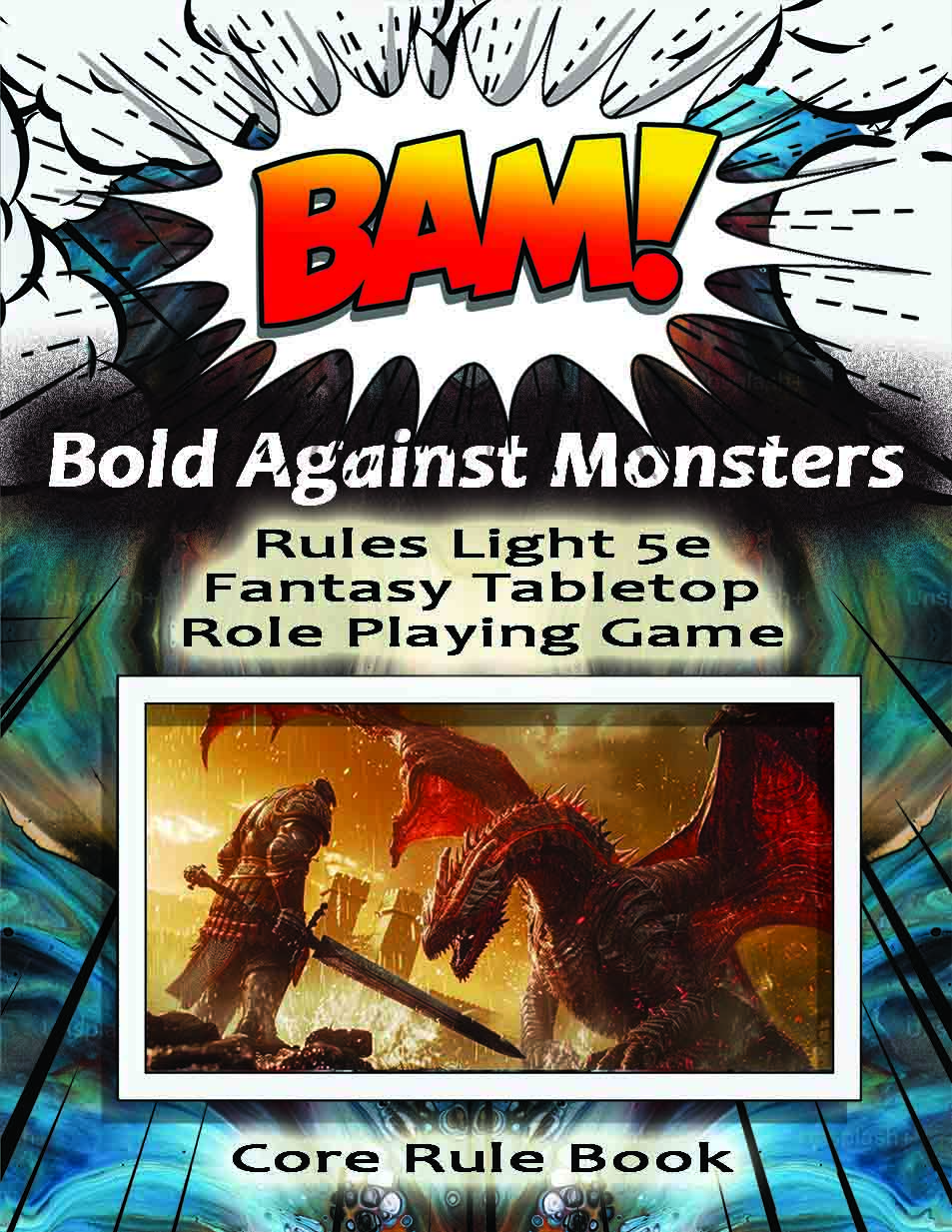
Let me introduce Bold Against Monsters. (You can call it BAM.). This is a new D&D 5E compatible rules-light Role Playing Game that I – the Old Dungeon Master – just finished writing.
I started with the 2014 versions of Dungeons and Dragons (5E). Then, based on my 40+ years of DMing, I eliminated or changed things I thought could be improved, added things I prefer from the 2024 versions of Dungeons and Dragons (5.5) and Tales of the Valiant (ToV), and used some of the concepts found in ShadowDarkRPG (SD), modified for a more 5E compatible campaign. To all of this, I added some of my favorite house rules to come up with the Table Top Role Playing Game – Bold Against Monstrers. This is the game I like best. Give it a try, I think you will like it too.
This Core Rule Book contains everything you need to play the game (except for the dice). It is compatible for use with any published 5E adventure for characters up to level 10. It can serve as an introduction to 5E role playing for new players or anyone looking for a game with familiar characters you can easily create and quickly play. Character creation, level advancement, inventory tracking, proficiencies, spellcasting, combat, and more have been simplified without moving too far from the basics I love about the 5E game system.
This was made possible through the use of the D&D 5E and D&D 5.5 rules as published under Creative Commons License in SRD_CC_v5.1 and SRD_CC_v5.2 respectively, the ToV rules published as “Black Flag Roleplaying” under the ORC license, and the “Shadowdark RPG Third-Party License V1.1”. No AI was used in creating this. All artwork was found on-line with commercial licenses, or created by the author.
Update #1: 6/24/2025 (BAM Rules_v2.pdf) Minor changes Removed the “Lifting and Carrying” and the “Push, Drag, or Lift” sections. They were in conflict with “Gear Slots”. I renumbered the pages (and updated the Table of Contents) so now when going to a page in the PDF, the number on the page will match the page number of the PDF file. Corrected misspellings (thanks to the comment from larrymannplays). Made a couple of cosmetic and formatting changes.
I’m always looking to improve my resources for the D&D community! I would love to hear your feedback on this new RPG. Let me know what you think in the comments below. I am especially interested in your opinion on which rules you like or would have done differently.
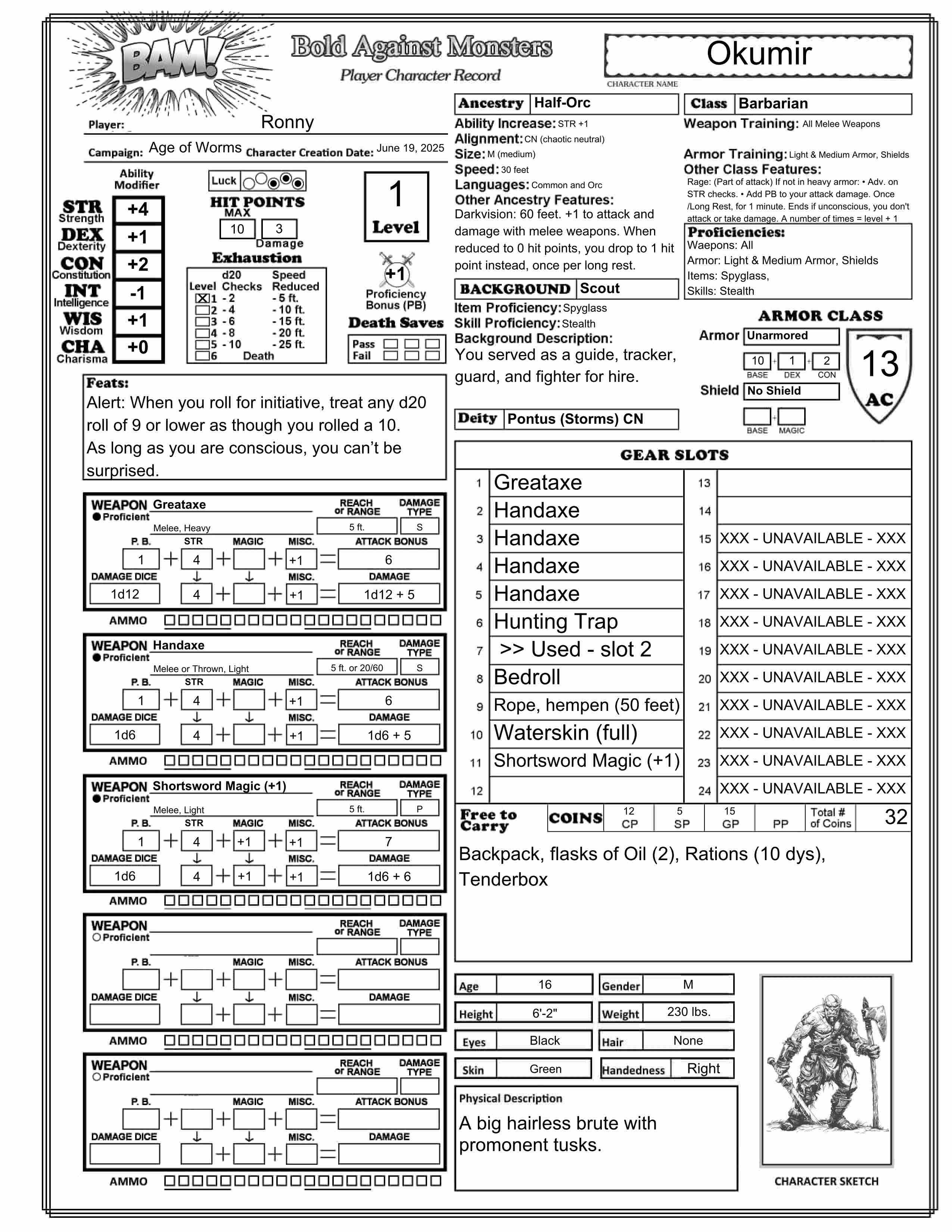
Download your free form-fillable PDF BAM character sheet HERE.
The BAM Core Rule Book includes a character sheet on the back cover, but I also created this form-fillable version.
You will need to enter your ability modifiers and character level before the calculations for Weapons and Armor Class can be made. You can select Ancestry, Background, Class, Deity, and Weapons from drop-down lists, or enter any text in the box. For selected text, the features and other information below will fill in. For Ancestry, Background, Class, or Weapons text you typed in, you can enter any information below as you would like. To change the information below a selection you made, just change the name (adding a space behind the name will do). Clearing the text in the box, or making a different selection from the drop-down, will delete all the text below it.
Selecting your armor and shield from the drop-downs will calculate and display your Armor Class (AC).
Refer to the BAM Core Rule Book for information regarding Gear Slots. All the Weapons, Armor, Tools, and other equipment listed in that book can be selected from drop-downs, or you can type any text you want into the boxes.
There are now free Class Reference Sheets available to download HERE.
Comparing the Tales of the Valiant Monster Vault to the Dungeons and Dragons (2014 and 2025) Monster Manuals.
This is an overview of the Tales of the Valiant Monster Vault. Refer to my post 5.5 Monster Manual Reviewfor a more in-depth review of the new D&D Monster Manual. Tales of the Valiant is a roleplaying game (RPG) published in 2024 by Kobold Press. It includes material taken from the System Reference Document 5.1 (“SRD 5.1”) by Wizards of the Coast. The SRD 5.1 is licensed under the Creative Commons Attribution 4.0 International and is is compatible with the fifth edition of Dungeons & Dragons. Both the new D&D Monster Manual and the Tales of the Valiant Monster Vault were published as upgrades to the D&D Monster Manual that was published in 2014. They are both intended to be compatible with D&D 5E which was published in 2014. The Monster Manual was published as one of the three core rulebooks that were upgraded in 2014; the Players Handbook, the Dungeon Master’s Guide and the Monster Manual.
Using Monsters
2014 Monster Manual (5E MM)
The 5E MM has an 8 page Introduction explaining what a monster is, where they live and how to read the stat block.
2025 Monster Manual (5.5 MM)
The 5.5 MM has 5 pages mainly explaining how to read the stat block.
The Tales of the Valiant Monster Vault (ToV MV)
Chapter 1: Using Monsters is 10 pages with lots of information on building challenging encounters based on the party’s level and the monsters Challenge rating. With several tables based on the number of PCs and their level. And lots of information on customizing combat and modifying monsters. Chapter 2: Understanding Monster Statistics adds another 10 pages expounding on the monster’s stat block. Chapter 3: Understanding Terrain and Creature Types is 21 pages filled with tables and descriptions.
Number & Location of Stat Blocks
NOTE: the following counts are my own. I apologize in advance for any inaccuracies.
5.5 MM
Contains 504 stat blocks. The Main Section The main section contains 408 creature stat blocks. On page 374 of the 5.5 MM there is a Stat Block Conversion table that lists 69 creatures whose stat blocks were in the 5E MM and don’t appear in the 5.5 MM. These are all creatures that either had their name changed or have been removed. For each, a different monster with the same CR is listed that could be used in place of the older monster. Creatures in 5E MM that are not in 5.5 MM: Deep Gnome, Drow, Drow Elite Warrior, Drow Mage, Drow Priestess of Lolth, Duergar, Green Blue Indigo and Violet Faerie Dragons, Lizardfolk, Orc, Orc Eye of Gruumsh, Orc War Chief, Orog, Half-Elves, and Half-Dragons. They changed some other creatures from humanoid to a different creature type, specifically: Aarakocra, Goblins, Hobgoblins, Bugbears, Bullywugs, Githyanki, Githzerai, Grimlocks, Kuo-toa, Gnolls, Jackalwere, Kenku, Kobolds, and Lizardfolk. There are 55 others where the name was changed. Some examples: The Androsphinx was renamed Sphinx of Valor. The Gynosphinx was changed to Sphinx of Lore. The Half-Ogre (Ogrillon) was renamed Ogrillon Ogre. The Poisonous Snake was renamed Venomous Snake. And the Quipper was renamed Piranha. Appendix A: Animals Contains 96 stat blocks for animals including and fantastic variants of animals. Note that dinosaurs have been moved out of the main section of the book and into this appendix where they are listed alphabetically, mixed in with the other animals. AppendixB: Nonplayer Characters This appendix was in the 5E MM but has been removed from the 5.5 MM. Each of the 35 NPC stat blocks are now listed, grouped by type and those groups sorted alphabetically, in the main section of the book. It has all the NPCs that are in the 5E MM and has added Pirates: Pirate, Pirate Captain, and Pirate Admiral. It also added Performers: Performer, Performer Maestro, and Performer Legend. To Berserker it added Berserker Commander. To Cultist it added Cultist Hierophant, Aberrant Cultist, Death Cultist, Elemental Cultist, and Fiend Cultist. To Guard it added Guard Captain. To Knight it added Questing Knight. To Noble it added Noble Prodigy. To Priest it added Priest Acolyte and Archpriest. To Scout it added Scout Captain. To Spy it added Spy Master. To Thug it added Tough Boss. It changed the name of Wild Warrior to Warrior Infantry and added Warrior Veteran, and Warrior Commander.
ToV MV
Contains 419 stat blocks. The Main Section Contains 302 creature stat blocks. 229 of these creatures are also in the 5E MM. Some of the creature names have changed, and the stats have all been revised, some more heavily than others. Similar to 5E MM, they are arranged alphabetically by creature type, so all Dragons are listed together, all Dinosaurs are listed together, etc. Notably, the creatures listed under “Oozes” in the 5E MM are listed separately in the ToV MV. There are 95 creatures that were in the main section of the 5E MM but are not in the ToV MV. This is primarily because they were left out of the SRD and are considered exclusive property of Wizards of the Coast. They are: Aarakocra, Banshee, Beholder, Death Tyrant, Spector, Needle blight, Twig blight, Vign blight, Bullywug, Cambion, Carrion Crawler, Crawling Claw, Cyclops, Demilich, Barlgura Demon, Chasme Demon, Goristro Demon, Manes Demon, Shadow Demon, Yochlol, Spined Devil, Allosaurus, Pteranondon, Displacer Beast, Dracolitch, Shadow Dragon, Drow Elite Warrior, Drow Mage, Drow Priestess of Loth, Empyrean, Faerie Dragon, Flameskull, Flump, Fungi, Gas Spore, Galeb Duhr, Dao, Marid, Fomorian, Githyanki Warrior, Githyanki Knight, Githzerai Monk, Githzerai Zerth, Gnoll Pack Lord, Gnoll Fang of Yeenoghu, Hobgoblin Warlord, Grell, Half-Dragon, Helmad Horror, Hook Horror, Intellect Devourer, Jackalwere, Kenku, Winged Kobold, Kuo-Toa, Kuo-Toa Archpriest, Kuo-Toa Whip, Pentadrone, Mud Mephit, Smoke Mephit, Mind Flayer, Mycolid Sprout, Mycolid, Quaddoth Spore Servant, Nagam Bone, Nothic, Half-Ogre, Orc Eye of Gruumsh, Orog, Peryton, Piercer, Pixie, Quaggoth, Young Remorhaz, Revenat, Fire Snake, Scarecrow, Slaad Tadpole, Slaad Red, Slaad Blue, Slaad Green, Slaad Grey, Slaad Death, Thri-Kreen, Troglodyte, Umber Hulk, Water Weird, Yeti, Adominable Yeti, Tuan-Ti Abomination, Tuan-Ti Malison, Tuan-Ti Pureblood, Arcanaloth, Mezzoloth, Nyaloth, Ultroloth, and Beholder Zombie. The main section of the ToV MV contains 64 new (unique) creatures. They are: Astral Destroyer, Balara, Chol, Uulgol, Icthol, Trillipol, Crimson Jelly, Deathless, Golmana Demon, Husk Demon, Mire Fiend, Unska Demon, Wrack Demon, Derro, Void Eater Derro, Velociraptor, Void Dragon Wyrmling, Young Void Dragon, Adult Void Dragon, Ancient Void Dragon, Yellow Dragon Wyrmling, Young Yellow Dragon, Adult Yellow Dragon, Ancient Yellow Dragon, Scorch Drake, Feral Hunter, Fey Guardian, Flinderbeast, Hinn (Genie), Sila (Genie), Necrophage Ghast, Dirgesinger Giant, Hobgoblin Conjurer, Morlock, Ambush Hag, Hippocampus, Hivebound, Infernal Champion, Insatiable Brood, Swiftblade Kobold, Tinkerer Kobold, Witch Kobold, Lantern Hagfish, Virtuoso Lich, Living Colossus, Moon Knight, Mordovermis, Nimbostratus Spirit, Robot Drone, Robot Warden, Satarre, Satarre Destroyer, Selang, Void Piper Selang, Selkie, Skullbloom Sporeborn, Bloatblossom Sporeborn, Star Crow, Vampire Thrall, Voidling, Lesser Voidling, Wickerbeast, Wood Herald, and Wyrdling. Appendix: Animals This contains 91 stat blocks. The 5 dinosaurs are under “Dinosaurs” in the main section. It contains all the animals in Appendix A: Miscellaneous Creatures of the 5E MM. It changed the name of the Giant Toad to Giant Poisonous Frog and added a Seal. Appendix: NPCs This contains 26 stat blocks. This includes all the NPCs that were in the 5E MM and adds: Archdruid, Bard, and Mechanist (a new ToV character class).
What’s New?
5.5 MM
Monster Tables Many of the monsters include a table for inspiration on why the creature might be there or what it may be doing. Stat Block Conversions: Lists every monster that was in the 5E MM that isn’t in the 5.5 MM. Even if it was just a name change, this list tells you the name of the monster in this book you can substitute for the old one. Monster by Habitat: The habitats are: Any, Arctic, Coastal, Desert, Forest, Grassland, Hill, Mountain, Swamp, Underdark, Underwater, and Urban. Monsters by Creature Type: The creature types are: Aberration, Beast, Celestial, Construct, Dragon, Elemental, Fey, Fiend, Giant, Humanoid, Monstrosity, Ooze, Plant, Undead, Monsters by Group: The groups are: Angles, Beholders, Demons, Devils, Dinosaurs, Dragons (Chromatic), Dragons (Metallic), Genies, Goblinoids, Lycanthropes, Titans, and Yugoloths. Monsters by Challenge Rating: List all the monsters sorted by CR.
ToV MV
Chapter 1:Using Monsters is 10 pages with lots of information on building challenging encounters based on the party’s level and the monsters Challenge rating. With several tables based on the number of PCs and their level. And lots of information on customizing combat and modifying monsters. Chapter 2:Understanding Monster Statistics adds another 10 pages expounding on the monster’s stat block. Appendix: Creatures by Challenge List all the monsters sorted by CR. Appendix: Creatures by Tag (called Group in 5.5) Creatures tags are: Animal, Golem, Outsider, Outsider (Angel), Outsider (Demon), Outsider (Devil), Shapechanger, or Shapechanger (Lycanthrope). Appendix: Creatures by Terrain (called Habitat in 5.5) Terrain types are: Any, Arctic, Badlands, Coastal, Desert, Farmland, Forest, Grassland, Hills, Mountain, Planar, Swamp, Underground, Underwater, and Urban.
The Stat Blocks
Example 5E MM Stat Block
This is the Unicorn stat block from the 5E MM. If you have been playing fifth edition D&D you are probably familiar with this stat block format. I picked this as a typical stat block of a monster that is in all three Monster Books, the 2014 Monster Manual (5E MM), 2025 Monster Manual (5.5 MM), and the Tales of the Valiant Monster Vault (ToV MV).
Example 5.5 MM Stat Block
This is the Unicorn stat block from the 5.5 MM. The stat blocks have all been gone over and changes were made. For the most part, the monster names and CR have remained the same, but all of the monster stats were modified as needed to make all monsters of a CR do similar amounts of damage and be about the same when it comes to how hard they are to defeat. The descriptions were made shorter and easier for the DM to use during combat. For example, in the Unicorn stat block the description for the action Hooveshas been changed from: “Hooves.Melee Weapon Attack: +7 to hit, reach 5 ft., one target. Hit: 11 (2d6+4) bludgeoning damage.” to “Hooves.Melee Attack Roll: +7, reach 5 ft. Hit: 11 (2d6 + 4) Bludgeoning damage.” The 5.5 stat block is laid out in basically the same format as the 5E stat block, but you will notice some differences. First, beside the AC there is “Initiative +8 (18).” This is the monster’s Initiative modifier followed by the monster’s Initiative score in parentheses. You can add the modifier to your monsters roll for the monsters initiative, or you can just use the number in parentheses. The most obvious change is in the ability score block. In the 5.5 stat block, for each ability it lists the modifier and its saving throw modifier. In the 5E stat block it simply lists each ability score and it’s modifier. In the 5E stat block if the monster has any saving throw modifiers that are different from the abilities modifier there is a separate list of those below the abilities block. For example, in the Shadow Demon stat block it says “Saving Throws: Dex +5, Cha +4.” Resistances, Vulnerabilities and Immunities lists have been simplified. For example, in the Unicorn stat block you can see that instead of Damage Immunities and Condition Immunities, the 5.5 stat block just lists “Immunities Poison; Charmed, Paralyzed, Poisoned.” Note the semicolon separating the Damage Immunities from the Condition Immunities. The Proficiency Bonus (PB) is shown after the XP. The following section is now labeled “Traits.” The list of traits are often changed. “Innate Spellcasting” has been moved into the “Actions” section and renamed “Spellcasting.” In most of the stat blocks the list of spells has been shortened and/or the list has changed somewhat. This is typically how spellcasting is handled. Here are some of the other changes in this example: “Charge” and “Magic Weapons” was removed from Traits, and “Legendary Resistance (3/Day)” was added. The “Horn” action was replaced with the “Radiant Horn” action that does a little more damage of a different type (radiant instead of piercing). “Teleport (1/Day)” was removed. The action “Healing Touch (3/Day)” was replaced by the bonus action “Unicorn’s Blessing (3/Day).” The legendary actions “Hooves” and “Heal Self (cost 3 Actions)” were removed. The legendary action “Charging Horn” was removed. The legendary action “Shimmering Shied (Cost 2 Actions)” changed to “Shimmering Shield” and it now gives temporary hit points in addition to adding 2 to the targets AC.
Example ToV MV Stat Block
This is the Unicorn stat block from the ToV MV. Like in the 5.5 MM, the stat blocks for monsters that are in the 5E MM, the monster names and CR have remained the same but the monster stats are modified as needed to make all monsters of a CR do similar amounts of damage and be about the same when it comes to how hard they are to defeat. Challenge Rating (CR). This has been moved to the top. To the right of the monster’s name. Experience Points (XP). The ToV MM stat block does not list the monster’s XP. The book does have a table showing Experience Points by Challenge Rating. Alignment. The ToV game doesn’t use Alignment at all, so the monster’s stat bocks do not include the monster’s alignment. Armor Class (AC). The AC is calculated using this formula: AC = 10 + DEX modifier + any additional bonuses (from equipment, natural armor, or special traits). Note that the AC is calculated before the PB is added to the ability modifiers (refer to abilities below). Hit Points. Most (possibly all?) monster’s hit points have been revised to more closely align with their CR. In this example they were increased from 67 to 92. Perception. ToV adds this to the stat block. It is calculated using this formula: Perception Value = 10 + WIS modifier. To successfully hide from this monster, the PC’s DEX (Stealth) check must be equal to or higher than this value. Stealth. ToV adds this to the stat block. It is calculated using this formula: Stealth Value = 10 + DEX modifier + some creatures add their PB or double their PB. When a creature attempts to hide, it doesn’t make a hide check, instead it used its stealth value. When trying to detect signs of a creature, the PC’s WIS (Perception) check must be equal to or higher than the creature’s stealth score. For example: A PC’s WIS (Perception) check result must be a 12 or better to detect the Unicorn when it is trying to hide from the PC. Abilities. The ToV stat block shows the ability modifier and doesn’t show the ability score. Unlike 5E, or 5.5, the Proficiency Bonus (PB), which is based on the monster’s CR, is already included in this modifier so you use the ability modifier that is shown when making an ability check or save. In the example stat block shown here, the PB has been added to the WIS and CHA modifiers. Vulnerable, Resistant, and Immune. As in the new 5.5 MM, these lists have been simplified. Spellcasting. For creatures that have the spellcasting ability, this has been moved to be listed as an action and the lists has been shortened to list only the spells most likely to be used during combat. In some cases some (or all) the spells have been removed and replaced with magical actions. On the Unicorn example: detect evil and good has been replaced with the Sense the Unnatural trait, pass without trace has been replaced with the Woodland Walk trait, druidcraft has been moved into the Unicorn Magic action which also adds the dancing lights cantrip, the other spells (calm emotions, dispel evil and good, and entangle) have been removed. Here are some of the other changes in this example: The Chargetrait was removed. The Celestial Resilience, and the Speak with Beasts and Plants traits were added. The Hooves action was removed. The damage was increased on the Hornaction. The Horn Bolt action was added (this gives the Unicorn a ranged attack). The Teleport (1/Day) action was removed. Shimmering Shield was removed as a legendary action and became a reaction. The legendary action Hooveswas removed. The legendary actions Canterand Radiant Stomp were added.
Final Thoughts
When I started writing this review I was expecting to unconditionally recommend the Tales of the Valiant Monster Vault (ToV MV) over the 2025 version of the Dungeons and Dragons Monster Manual (5.5 MM). However, after a closer look at both of them it’s not that easy. First, let me say that if you are currently using the 2014 Monster Manual (5E MM) and are wondering if switching to one of these would be an improvement, the answer in my opinion is yes. Even though they differ in many specific details they have both done a good job in making the Difficulty Class (DC) for the monsters avoid most of the wild fluctuations they have in the 5E MM, making the creation of balanced encounters an easier task for the DM.
5.5 MM
By my count, the 5.5 MM has 85 more stat blocks than the ToV MV. So if you are looking for the most number of monsters you can’t go wrong with the 5.5 MM. It doesn’t have monster stats for Orcs, Drow or Duerger but you can still use your old Monster Manual for those. The other creatures that were humanoid in the 5E MM have changed to a different creature type. Refer to my post 5.5 Monster Manual Review for more of my thoughts on the 5.5 MM.
ToV MV
ToV MV suffers from not being able to use any of Wizards of the Coast’s proprietary monsters, so you will need to continue using your 5.5 MM for those. But it does have a much larger number of new monsters to surprise your players with. Kobold Press has been publishing great monsters for several years and they are very good at it. I think you will love these new monsters. Also, I personally think that they did a better job in the changes they made to the existing monsters. ToV MV does a good job explaining how to create a balanced encounter. It even has a table that shows, for each creature, its common allies. This is a great tool for coming up with a boss monster and its minions. It also has a lot of small things that are useful, such as a pronunciation guide for every creature. ToV MV has not changed the creature type of the humanoid creatures. I prefer the organization of the ToV MV to the 5.5 MM. For instance, I like having all the dragons together.
If you are staying with the 2014 version of D&D there is no reason you couldn’t just stick with the 2014 Monster Manual. But adding either the 5.5 MM or the ToV MV (or both) would not be a mistake. They both offer improvements to the old stat blocks and many new monsters.
If you are switching to the 2024 version of D&D you don’t have to switch monster books. The 2014 Monster manual still works just fine with D&D 5.5. If you decide to switch to the 5.5 MM I recommend that you keep your old MM handy, you may want to still use some of the older monster stats. You could just as easily add the ToV MV for its new monsters and updates to most of the monsters found in the 5E MM.
If you are switching to Tales of the Valiant you will probably want the ToV MV, but you can use the 5E MM if you already have that. It will work seamlessly with ToV. If you do get the ToV MV you might be tempted to also get the new 5.5 MM for updated stats for the WotC proprietary monsters but it’s probably not worth it for just that, especially if you already have access to the 5E MM.





 Dungeon Master Assistance