Dungeon Master Assistance

Where anyone over 18 can share thoughts and ideas on RPGs.

Tag Archives: combat rules

D&D Next – Mass Combat Rules

Download a free copy of D&D Wsrs for D&D Next here [D&D Wars Next].

This is a complete re-write of the D&D Wars supplement to third edition Dungeons & Dragons that I published here[D&D Wars] in 2012. This re-write simplifies those rules and brings them in line with D&D Next (the current playtest version of v5.0). You can use these rules with v3.5 with little or no adjustments.

Consider this an interim version of these rules. I will make any needed tweaks to them and re-publish them when the official v5.0 rules are published.

As always, all comments are welcome.

Enjoy!

Addendum: On page 13, it says” For every 10 points healed, a counter is added back to the unit.” That should instead say “A counter is added back to the unit every time the number of hit points healed is equal to the maximum number of hit points in one counter.”

//

//

//

D&D 3.5 – Wars: Mass Combat Rules

War_book_cover

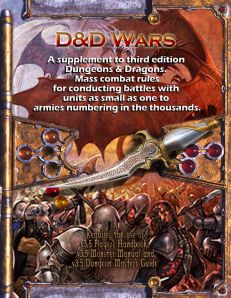
D&D Wars – Front Cover

[There is an updated version of these rules available here: D&D Wars ]

Download these mass combat rules here (free): WAR

D&D Wars is a supplement to third edition Dungeons & Dragons that provides a set of mass combat rules for conducting battles with units as small as one to armies numbering in the thousands. D&D Wars are not simply armies making battle with each other. It is armies intermixed with monsters and NPCs. Added to this mix is a group of PC heroes doing what they can to change the tide of the war.

–My goals in creating these rules —

– The rules must be compatible with Dungeons and Dragons version 3.5.

– There must be rules for creating armies comprised of units of various sizes and compositions.

– It must have consistent rules for scaling the battle from a small group of villagers with torches and pitchforks all the way up to epic battles with thousands of soldiers on both sides.

– The rules must accommodate individual monsters wandering across the battlefield as well as other NPCs and PCs that are not part of the units.

– It must use standard combat rules without modification as far as possible.

– To this end:

  • It uses a standard 6 second combat round.
  • Creatures occupy the standard amount of space. The size represented by a 1” square is larger than the standard 5 ft (15 ft. being typical). Thus accommodating larger size armies.
  • Movement, Armor Class, Hit Points and Attacks/Damage for individual creatures that are not a part of a unit remain unchanged.
  • Movement, Armor Class, Hit Points and Attacks/Damage for one counter (representing several creatures that cover 1 square as part of a unit) will be the same as for a single standard creature. That way when counters of one unit attack counters of another unit, standard combat rules apply with very few exceptions.
  • Individual creatures that are not in a unit can attack, and be attacked by, the creatures in a unit. In either case it will be creatures attacking creatures. A simple conversion is done to calculate the amount of damage.
  • To speed up play, because of the potentially large number of units, monsters, NPCs, siege weapons, and PCs involved, each of them is restricted to only one action (move, attack or defense) each round. Also creatures with multiple attacks each round (except for PCs) will get only one attack action.
  • Then of course there must be special morale rules and rules for how to handle magic spells cast by or against units.
  • Throw in some rules for siege engines and I’m done.

Before creating these rules, I tried to find out if someone else had already done this, and I found several who had.

First, there are several excellent wargame systems. A mass combat system for an RPG and a wargame are not the same thing. Excellent wargames don’t necessarily deliver as RPG mass combat systems so I passed on them.

Second, I found several homebrew systems. Most of these are of the “treat a unit as a really large monster” variety. These all work for their games, of course, but most fall short of what I was looking for.

Third, there are a few serious, published attempts at creating RPG mass combat rules.

The best of these are described below in no particular order.

__________________________

Adamant Entertainment’s “Warpath

This is a Pathfinder supplement.

Even though it is not specifically for v3.5 it is close enough with only minor adjustments.

What I like:

It is an excellent, well thought out system. It uses a clever idea of making each 1” square represent 10 feet and each unit be represented by a 3”x6” index card.

It also contains information on the upkeep of an army, mustering armies, supplying an army and siege warfare. There is an alternate way to quickly resolve mass combat in only a few rolls of the dice.

It uses a standard 6 second combat round.

It is well presented and I got a lot of good information from here.

Why I didn’t use it:

It assumes that the PCs are commanders of the army, or at least unit leaders. There are no good rules to allow a PC to act independently from the unit (other than being a solo unit).

There are no rules to deal with units in combat against individual monsters or heroes.

It doesn’t scale well for different size battles. The rules for larger battles are unsatisfactory. It simply recommends that you use larger unit cards and to “be sure you have the space available” for all of the additional space it will take up on the battle matt.

_____________________________________________

Mongoose Publishing’s “Mass Combat

This is a supplement to Conan The Roleplaying Game which is v3.5 compatible.

What I like:

This is one of the best set of rules that I found. It does a good job of integrating v3.5 rules into a set of mass combat rules.

They have good rules for resolving magic use against units and for war machines.

It treats units as a group of counters, with each counter representing a number of individuals.

It uses a standard 6 second combat round.

Why I didn’t use it:

It relies heavily on unit formations, unit faces and a special “surge” attack. I wanted to avoid having facing rules. D&D 3.5 has no facing rules for creatures, so I didn’t want to introduce this into my mass combat system.

It is a little vague on how much space a counter covers.

Units do not make saving throws, but always take the average amount of damage they would have received if each individual had made a separate saving throw.

There are no rules to deal with units in combat against individual monsters or heroes.

__________________________________________________________

Wizards of the Coast’s “Complete Warrior

This official D&D accessory contains a chapter on Fantasy Warfare.

What I like:

It has a very good overview of how one can integrate warfare into a standard D&D campaign.

It has a good list of ways PCs can tern the tide of battle, with a table of possible missions and mission complications.

It would be good to use if the war is simply going on around the PCs.

Why I didn’t use it:

It doesn’t have any mass combat rules.

__________________________________________________________

Udo’s D20 Mass Combat

This is a small (5 pages) document that attempts to bring mass combat to d20 games.

What I like:

It scales up nicely. One 1 inch square can represent a 5, 25 or 100 ft. square.

It uses standard rules for the most part.

Why I didn’t use it:

It uses a 0-10 scale for health and attack damage, rather than standard hit points.

Any monster or character would have to be converted to the 0-10 FSP (Force Strength Points) system for both hit points and attack damage.

The system, although workable, is a little too rules light for my taste.

__________________________________________________________

Races of War’s Mass Combat Minigame

A 3.5e Sourcebook

“It’s a mini-game inside regular 3.5e that has been designed for simplicity and a minimum of bookkeeping.”

What I like:

It introduces a morale score (similar to Hit Points). When the unit’s morale score reaches 0, the unit flees form the battlefield.

Why I didn’t use it:

It uses squares that represent 50’ x 50’. This is workable, but I wanted more flexibility for larger or smaller armies.

It doesn’t use a simple initiative order, but each army acts in an order depending on its position and type of attack.

The rules for attacking a unit with spells (other than damage causing spells) are turned into damage causing spells or have no effect.

It has no rules for anything other than units or PCs (No rules for monsters or siege weapons for example).

D&D 3.5 – Replacing Attacks of Opportunity

Wizards of the Coast admits on their website that “Arguments about attacks of opportunity happen frequently.” I seriously considered eliminating them altogether, but that creates problems of its on. For instance, in D&D v3.5 there is nothing other than attacks of opportunity (AoO) that would prevent a hero from walking past a row of armed guards to get to the wizard they are protecting. My proposal to eliminate AoO and to simplify combat is this: Don’t allow anyone to pass through a threatened square. Also, don’t allow anyone to perform non-attack actions within a threatened square. That is too simple, of course, so we will allow you to do any of these things if you make a successful ability check – what I call a “heroic action.” Below is from my Dungeons and Dragons Lite house rules.

There are no Attacks of Opportunity. Ignore all references in the PHB to Attacks of Opportunity and use this rule instead.

Definition of a threatened square: A creature threatens all squares into which it can make an armed melee attack.

In a combat round your character can enter or exit a threatened square, but you must use a heroic action to enter and then exit (pass through) one or more threatened squares. (Refer to my previous Heroic Actions post.)

While within a threatened square the only thing you are allowed to do is attack with a melee weapon you have in your hand. Anything else you may want to attempt will require a successful heroic action check.

WITHIN A THREATENED SQUARE
Some of the things that require a heroic action to accomplish while within a threatened square are:

  • Attack with (or load or prepare to attack with) a ranged weapon, including splash weapons
  • Cast a spell, read a scroll, drink a potion or apply an oil
  • Pick up, retrieve, draw or store an item (including weapons)
  • Deliver a coup de grace
  • Escape from a net or any other entanglement
  • Light a torch or perform any other non-combat activity other than speaking

MODIFIER: Dex modifier
DC MODIFIER: +5
SUCCESS: You can attempt the desired action.
FAILURE: You loose your turn.

MOVING THROUGH THREATENED SQUARES (a move action)
As part of your move action, you enter into a threatened square and proceed out the other side. You may want to use this to get past armed guards to reach the magic user they are guarding, or to attack someone armed with a reach weapon.
MODIFIER: Tumble modifier
DC MODIFIER: +5, +2 for each additional opponent after the first one
SUCCESS: You tumble through the threatened squares. Your move rate for your entire move is 1/2 your normal move rate.
OPTIONS: Add +2 to the DC to move at your normal move rate.
FAILURE: Failure results in your move ending inside the first threatened square you enter.

Note regarding reach weapons: When your opponent is using a reach weapon, you must use a heroic action to pass through a threatened square in order to attack him. Otherwise, your move must end when you enter the threatened square.

These rules apply only to squares that are threatened by your opponents. There are no restrictions on your activity within squares that are only threatened by your allies.

D&D 3.5 – Heroic actions

This is an excerpt from my D&D Lite rules. It is a house rule intended to simplify D&D v3.5 special combat rules.

Special attacks become “heroic actions” which are level checks. This one mechanic replaces the rules for: Bull rush, Disarm, Grappling, Overrun, Sunder, Trip and others. It allows for other special attacks and actions as well.

The reasons for this change:
1) To reduce the number of complex rules – making the game easier, faster and more fun. We don’t want to be looking up the rules all of the time. The last thing anyone wants is for someone to not use a special attack because they think that the rule makes it too difficult to use.
2) Combat is not all about running through a series of trained moves like an automaton. A successful warrior seizes every opportunity to give him an advantage and makes use of the environment to give him an edge. Heroic actions can be anything from throwing sand in an opponent’s eyes, swinging on a chandelier or pushing opponents back 10 feet and off a cliff. Any class can attempt a heroic action. Heroic actions do not do damage per se but rather do damage as dependent on environment or impact, so pushing someone over a cliff does damage… as does setting fire to them.

A heroic action check is a level check to which the character will add an ability or skill modifier. The DC is 10 + the creature’s Challenge Level + any additional modifiers that may apply.

To perform a heroic action check:
First name what you intend to do and the effect you want to achieve. The DM will determine and tell you the DC. You then roll 1d20 and add your character level. To this you can add certain modifiers. Examples of possible modifiers are given below. The Difficulty Class (DC) for heroic actions is 10 + the challenge level (CL) of your opponent + modifiers (if any).  If your total matches or exceeds the DC your heroic action succeeds.

The following rules apply to heroic actions:
1.    A heroic action may be a move action, an attack action, or a full round action.
2.    You may only attempt one heroic action per round.
3.    You must declare the heroic action before you roll.
4.    The heroic action must be within the reasonable ability of your character to perform, given the character’s level and the enemy’s size and power.
5.    You can not take 10, or take 20 on a heroic action check
6.    If you roll a natural 1 your attempt fails regardless of any bonuses.
7.    A roll of a natural 20 is always a success.

The guide-lines that follow are only a few examples of how heroic actions are to be resolved. Creative players will certainly come up with new heroic actions.

DISARM (an attack action)
Disarming attacks include called shots to the hand, shattering an opponent’s weapon, severing a spear shaft, entangling a sword arm, and using the flat of a blade to smack a weapon from an enemy’s hand.
MODIFIER: Dex modifier
DC MODIFIER: the defenders Dex modifier
SUCCESS: Your opponent drops his weapon. The weapon is knocked out of reach (but still within his 5 foot square) so he must move to retrieve it and cannot simultaneously attack on its next round (unless he chooses to fight unarmed or draw a new weapon).
OPTIONS: Add +2 to the DC to knock your opponent’s weapon 5 ft away. To retrieve it, he will have to use his entire next round. Add another +2 for each additional 5 ft.
FAILURE: Your opponent maintains a firm hold on his weapon.

PUSHBACK (an attack action)
Pushbacks include shield bashes, tackles, bull rushes, overruns, tables hurled into enemies, doors smashed into opponents on the other side, and so on. Generally speaking, any attempt to use brute strength to force-fully move an opponent is considered a pushback. Any attempt to shove creatures off a nearby cliff, through a railing, out a chapel’s stained-glass window, and so on will allow the creature a reflex save.
MODIFIER: Str Modifier
DC MODIFIER: the defenders Str modifier
SUCCESS: The opponent is pushed back a few feet – enough space to open access to a door or staircase the target was defending.
OPTIONS: Add +2 to the DC to push your opponent back 5 ft. Add an additional +2 for each additional 5 ft attempted.
FAILURE: Your actions do not result in moving the opponent from his position.

TRIP OR THROW (an attack action)
Trips and throws include any attempt to knock an enemy off its feet. Whether it’s hooking an enemy’s leg, stabbing a kneecap, knocking an opponent off-balance, sweeping an enemy’s legs, or some other maneuver, these heroic actions allow the warrior to knock an enemy prone, limit his movement, and potentially keep him down.
MODIFIER: Str modifier
DC MODIFIER: the larger of the defenders Str or Dex modifier
SUCCESS: The attacker can knock the defender off- balance. The defender is knocked prone and must spend its next move action standing up. Remember that melee attacks against a prone opponent receive a +4 bonus.
OPTIONS: Add +2 to the DC to knock the opponent down and throw him up to 5 feet away so he must spend its next round standing.
FAILURE: The opponent may stumble, but catches himself and doesn’t fall.

SPRING ATTACK (a full round action)
You move  both  before  and  after  the  attack, provided that your total distance  moved  is  not  greater  than your speed and you are attacking with a melee weapon. You may want to run past, swinging your sword as you pass. You may want to fly by (if you are able to fly), or swing past on a rope or chandelier, or jump over. If successful, you move at twice your normal move rate and may use a single melee attack against your foe as you pass.
MODIFIER: Dex modifier
DC MODIFIER: +5
SUCCESS: You run or swing past your opponent and deliver one melee attack.
OPTIONS: You can attempt to run past and attack more than one opponent (up to the maximum number of attacks you are allowed in one round) for a +2 to the DC for each additional opponent.
FAILURE: Your move ends in the first square adjacent to your foe. You may still attack but you receive a -4 circumstance penalty on your attack.

GRAPPLE (an attack action)
If you succeed the creature can pull free from the hold, on his turn, with an opposed strength check. While engaged in grapple both you and your opponent lose your Dex bonus to your AC.
MODIFIER: Str modifier
DC MODIFIER: the larger of the defenders Str or Dex modifier
SUCCESS: You grab and hold the creature. You do not damage the creature but the only actions he can take until he escapes are to try to pull free. In future rounds, you can release the creature and back away 5 feet with no penalty, or continue the hold from round to round until the creature pulls free.
OPTIONS: Add +2 to the DC to pin your opponent to the floor, or otherwise keep him immobile, or move with him at half of your normal move rate. The creature will get a -4 penalty on opposed strength checks until you release him.
FAILURE: You are pushed back and your opponent suffers no penalties on his next turn.
SPECIAL RULES FOR GRAPPLING LARGER CREATURES:
For an attacker to successfully grapple a creature one or more size categories larger than himself there must be multiple attackers. Until all successful opponents added together have roughly the same size/ mass as he does, the attacked creature doesn’t loose his Dex bonus, and he can make multiple opposed strength checks to remove the attackers as a free action on his turn. The grappled creature makes concentration checks at -2 for each opponent that is currently grappling him.
For grappling a creature with multiple limbs or other strange configuration the DM will decide on whether grappling is even possible, and if it is what the impacts are.


D&D 3.5 – Combat Basics

I have found that the rules for Dungeons and Dragons v3.5 regarding combat are not presented in a way that is easy for a beginner to understand. Below is my attempt to make the combat rules easer to understand.

Each round represents 6 seconds in the game world.

In a round, you can do one of the following things:

  • Attack and move
  • Move and attack
  • Move and move again
  • Perform a full-round action

-You may also perform any number of free actions (within reason) and take a 5 foot step (if you haven’t moved otherwise).

Attack

You can make an attack, cast a spell, or perform an equivalent action – also called a standard action. Some standard actions are: Aid another, Bull rush, Drink a potion, Feint, Overrun and Read a scroll. Refer to Attack Basics below.

Move

A move action lets you move your speed in a round or perform an equivalent action that takes a similar amount of time. Equivalent actions include climbing, drawing or loading a weapon, opening a door, and picking up an item. Refer to Move Basics below.

Full-Round Actions

A full-round action consumes all of your effort in a round. Attacking more than once (if you are of sufficient level to do so), Charge, Load a heavy or repeating crossbow, Light a torch, Run, or Withdraw are all considered full-round actions.

Free Actions

Free actions don’t take any time at all, though there may be limits to the number of free actions you can perform in a turn. Free actions include dropping an Item and speaking.

Five foot step

In any round when you don’t perform any other kind of movement, you can take a 5-foot step before, during, or after your other actions in the round.

—-Move Basics—-

Speed

Your speed tells you how far you can move in a round and still do something, such as attack or cast a spell.

Humans, Elves, Half-elves, and Half-orcs

Speed wearing no armor or light armor: 30 ft. (6 spaces)
Speed wearing medium or heavy armor: 20 ft.(4 spaces)

Gnomes and Halflings

Speed wearing no armor or light armor: 20 ft. (4 spaces)
Speed wearing medium or heavy armor: 15 ft. (3 spaces)

Dwarves

Speed: 20 ft. (4 spaces)
(Dwarves have no speed penalty for wearing armor.)

Moving

Tactical Movement
We use a battle grid to help keep track of where everybody is during combat. It is divided into 1 inch squares. One space on the grid represents 5 feet. Your character can move up to his speed rating in spaces (20 feet = 4 spaces) each round. Count every second square moved diagonally as 2 spaces. He may move through, but not stop in, a space occupied by a friend. Either before or after moving he may also attempt one standard action, usually an attack.
Double Move
If your character doesn’t do anything else in this round, he can move up to twice his speed. He is assumed to be on alert for potential threats, dodging arrows, avoiding blows from hand held weapons, and the like.
Charge
He can move up to twice his speed in a straight line up to an opponent and attack him. You get to add a +2 bonus to your attack roll because of the charge. This will be all that your character can do in this round so it is called a “full round action”.
Run
If your character doesn’t do anything else in this round, he can move up to 4 x his normal speed (or 3 x if wearing heavy armor). He is moving as fast as he can so he is not taking the time to avoid being hit from attacks the way he is if you just take a double move. Because of this, he looses his dexterity bonus (if any) to his armor class for the entire round.
Other Move Actions
There are rules for other forms of movement during a fight such as moving while balancing, moving silently, moving while attempting to hide, tumbling, climbing, swimming or crawling. Your character normally can’t use his full speed while moving in any of these ways and there may be other penalties as well.

—-Attack Basics—-

Making an Attack Roll:

Roll 1d20 and add the bonus listed for the weapon your character is using. If the result is equal to or greater than his opponent’s armor class, he hits. Then you can roll damage.

Making a Damage Roll:

Roll the type of die indicated for the weapon used and add its bonus (if any). Damage reduces your opponent’s hit points.

Critical Hits:

If you make your attack roll and it comes up 20 before any bonuses are added, this is called a “natural” 20. A natural 20 is always a hit. In most cases it is also a potentially critical hit. You then roll a second time and if the results of the second roll is also a hit then it is a critical hit. You then roll the damage twice. Whenever a you roll a natural 20 to hit and a natural 20 to confirm the critical, the resultant hit does maximum critical damage.

Some weapons will threaten critical damage on a natural 18 or 19. And with some weapons a critical hit may do 3 or 4 times normal damage.

Full Attack

Attacking more than once (if you are of sufficient level to do so) consumes all of your effort in a round. You must make the attacks in order from highest bonus to lowest. You can take no move actions or other actions this round except for free actions (such as speaking) and taking a 5 foot step. You can take a 5 foot step at any point during your round – before, during or after your attacks. All of the attacks don’t have to be against a single opponent. Melee attacks can be against anyone within reach or who comes within reach as a result of your 5 foot step.

D&D 3.5 – Dungeons and Dragons – Lite

D&D Lite Cover

Cover page for D&D Lite

The following is a document of House Rules. In this document are alternatives to the normal Dungeons & Dragons v3.5 d20 rules.

I have been playing Dungeons and Dragons since it came out in the late 1970’s. I eagerly awaited each new release of the game and embraced all of the new rules. With each new release it got better. When 3.0 was released I saw it as a re-visioning of the original game with more logical and consistent rules. It was soon followed by 3.5 which corrected some of 3.0s failings. I had great expectations for the 4.0 release, but I was greatly disappointed. Instead of streamlining and simplifying the rules, it was a whole new game. I’m not saying that it is a bad game, it simply isn’t one that I choose to play. Others felt the way that I do and other companies have tried to “fix” D&D v3.5. The Pathfinder RPG is an attempt to improve on 3.5. While Pathfinder is an improvement over 3.5 they didn’t go far enough, in my opinion, to simplify the 3.5 rules. There are also some rules-light game systems based on the d20 SRD v3.5 such as Basic Fantasy and others but after reviewing them  I found most of them to be too light on the rules for my taste.  So, instead of throwing it all out and starting over, I decided to simply make the changes that I felt v3.5 needed to make it easier and faster to play.

Overview

This is a set of “House Rules” designed to meet the following criteria:

1. Character creation and promotion should be simple, fast and easy.

2. The rule set should be fully compatible with other v3.5 stuff (adventures, sourcebooks, etc).

3. Complicated rules should be simplified to the point where you can play 90% of the time without having to look up a rule.

The intention is to simplify and speed up play, bringing back a lot the feel of the original D&D game while preserving most of the enhancements that the d20 game provides.

To accomplish this we will use the Players Handbook v3.5 (abbreviated here as PHB), with some modifications. The major changes are:

No Multiclass characters. You will be playing iconic D&D characters. These are the 11 core classes, without regard to race or sex, with each class being the “typical” stereotype character for that class.

No Feats. Each character class has its own set of special abilities; additional abilities are added as the character advances in level.

No selection and distribution of Skill Points. You get a set of core skills by class. These increase as you increase in level.

No Proficiencies. You can use the weapons and armor you start with and can quickly learn to use others in-campaign.

No Alignment. Or, more accurately, there are no alignment related game rules and effects. Character alignment is optional.  We will substitute “Unholy” for “Evil” in most Clerical spells and effects.

No separate rules for Bull rush, Disarm, Overrun, Sunder or Trip. These are replaced with one simple “heroic actions” mechanic.

No Attacks of Opportunity. Characters are required to make an ability check (a “heroic action”) to attempt to pass through a threatened square, or perform non-attack actions within a threatened square. This eliminates the need for Attacks of Opportunity.

Rules for Grapple, Turn Undead, nonlethal damage and Counterspells have all been simplified.

This document is not intended to replace the PHB, but to supplement it. Many of the rules from the PHB have been repeated here for convince. Wherever something is mentioned for which I haven’t provided adequate information (Darkvision for instance) refer to the PHB.

You can download a free copy of this PDF file here: Dungeon-n-Dragon-Lite

The above file contains a Character Record Sheet, but here it is as a seperate PDF file: Character Sheet

Here are some Fast-Play Character Sheets.

Hare is an Animal Companion / Familiar Character Sheet.

Corrections and changes are  posted in this addendum.

As always, I would greatly appreciate any comments or suggestions.

D&D 3.5 – Ship to Ship Combat

Optional rules for D&D v3.5

I was not happy with the ship combat rules in D&D v3.5 so I came up with a system that allows multiple ships to combat each other and, at the same time, allow for each PC to contribute in his own way each round. I simply (or not so simply as it turns out) extended the D&D combat rules to work with ships as well. What I came up with is in a PDF file you can download here: Ship to Ship Combat

There is also a fast start version here: Ship to Ship Combat (fast start rules)

You can use this to keep track of your ships: Ship Record Sheet

I would really appreciate any comments, especially if you use them in play (they have not yet been play-tested).