Dungeon Master Assistance

Where anyone over 18 can share thoughts and ideas on RPGs.

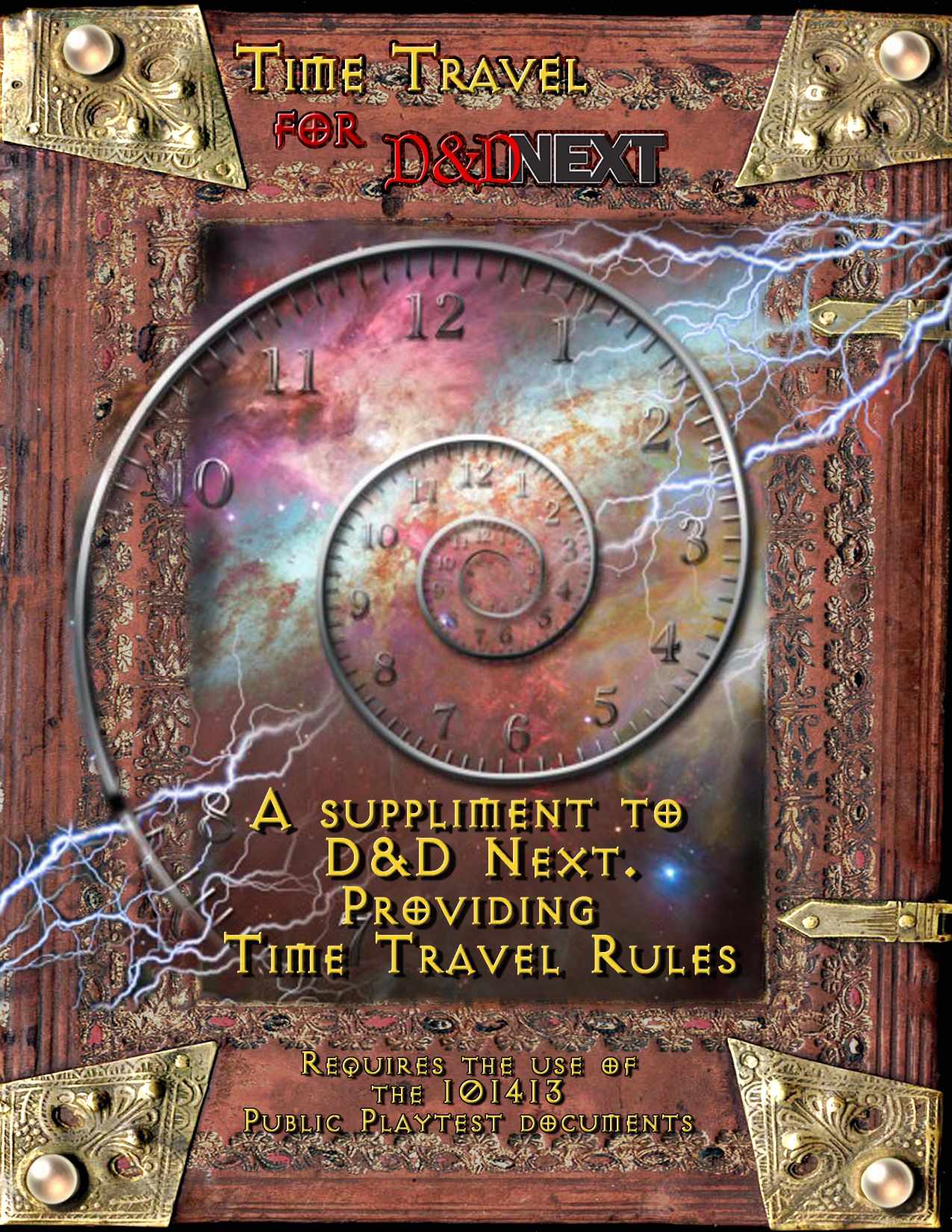
D&D Next – Time Travel Re-visited

Time-Travel

“Time flies like an arrow. Fruit flies like a banana.”

Time travel is easy, explaining it is hard.

I was looking over my time travel rules (posted here). I was thinking that I hadn’t explained them very well and that I also needed to re-work them for the next version of D&D. The more I thought about it, the more I realized that they needed a complete overhaul. Before posting a new set of time travel rules I wanted to post this. Below is a summary of my current thinking on how time travel should work for D&D.

First a little thought experiment

Consider this. Your friend the wizard travels 24 hours into the past. While there, he sneaks into your room and shaves your head while you sleep. The question is this: If you are watching him when he cast the spell and he disappears into the past, what do you experience? Are you now bald? There are problems with every answer.

1) You can’t still have your hair. If you do it would mean that the wizard was unsuccessful in changing the past.

2) You couldn’t just suddenly become bald. What if the wizard doesn’t cast another spell to “return” to the present, but simply hangs out with you all day?

3) Okay, then perhaps your head is shaved, and it has been since you woke up this morning. This is a paradox, because if you have been bald all day it would mean that you were that way before the wizard cast the spell that resulted in your current condition.

There must be another answer, and I believe that I have found it. Think about this a little. I will give you the answer a little later.

This is how I think time travel should work in the D&D game.

Timelines

There is only one timeline. Everyone is in it. The “river of time”. It is easy to travel forward in time. Everyone does it. You are doing it now. It takes only one second to move forward one second into the future. If you were to sleep for 17 years, you would wake up 17 years in the future.

All time travel is along this one timeline. Although there is only one timeline, this doesn’t mean that it can’t be changed.

Rule #1 – “Everything that you do changes the future.”

This may seem so obvious that it is hardly worth mentioning. However remember that we are talking about time travel. If you travel along the timeline to a point in the past anything you do there will change everything on the timeline from that point forward.

Rule #2 – “You can’t change the past.”

Well, I suppose you could travel to the past and then change it, but nothing that you do now can change anything that was done before. Again, this seems obvious but it is worth remembering that you can’t travel into the future and do anything that will change what is happening in the present.

There are two types of time travel, tactical and strategic.

Tactical Time Travel

Similar to time travel in the movie “Groundhog Day”.

Tactical time travel is free from most time travel paradoxes. It moves the timeline forward or back to the appointed time. It is not normally used to travel farther than a single day and cannot be used to travel back to a time before the time traveler was fully grown. Tactical time travel has no “return” spell that allows the traveler to go back to his original time, but he can use strategic time travel to go back should he choose to.

Tactical Time Travel to the Future

In its simplest form, this is how everyone travels through time, one second at a time. For a time traveler that uses tactical time travel to go into the future the time passes so quickly that he seems to instantly appear at the appointed time in the future. To those around him, he disappears and later re-appears. The timeline has moved on and he has moved with it as if he had been in a type of suspended animation during the time that passed. This is often used to “hide” from an otherwise unavoidable encounter or to disappear until the storm passes.

Tactical Time Travel to the Past

This is often used to correct some mistake in the recent past, or to re-fight a recent battle. The timeline is erased back to the time traveled to. It is like pressing the “rewind” button. Everyone and everything reverts to the way it was then. The time traveler finds himself in the body he had then, where it was then, doing what he was doing then, and everything is as it was then with the exception that the time traveler, and he alone, recalls future events as they happened before. He is free to repeat his previous actions or change them as he sees fit. Everyone else will do what they did before unless the time traveler intervenes. Purely random events may have different outcomes. All dice will be re-rolled for any battle or game of chance that the time traveler participates in.

The time traveler cannot magically “return” to the time he left because that timeline has been completely erased. If he does use a strategic time travel spell to travel forward again, he disappears and doesn’t re-appear until he reaches the time he is traveling to. No time will have passed for him but to everyone else, time will have passed normally until he re-appears. This effectively erases him form the timeline for that period of time. The time traveler that travels into the past using tactical time travel will typically continue through time at the normal pace making whatever changes to his previous actions as he chooses. When he arrives at the point in time where he originally chose to travel into the past, he is free to do so if he wishes. The reason for him to travel back in time may no longer exist, so he may choose to not repeat his trip to the past.

Strategic Time Travel

Similar to the time travel in the movie “Back to the Future”.

Unlike tactical time travel, strategic time travel is susceptible to time travel paradoxes so care should be taken to prevent them. Refer to the section below on time travel paradoxes.

Strategic time travel allows travel both forward and back in time to any point in the past or future.

With strategic time travel, the traveler appears at the appointed time in the past or future, and his original body disappears – usually to return in a few seconds when the traveler returns from his journey. The time traveler arrives at the prescribed time with a duplicate of his body and everything he was wearing or carrying. Any time while on his journey, he can cast a spell to “return” to the time he left. When he returns his body is in the condition it was in at the end of his journey and he will bring back with him whatever he is wearing and carrying.

If, at any time during his journey, he is knocked unconscious or killed he will return to his original timeline and his body will re-appear and collapse to the floor still wearing and carrying only what he had when he left. Everyone at the time that he traveled to will see him collapse. His body and everything that he was wearing or carrying when he began his journey will disappear, leaving behind anything he may have picked up while he was there.

Strategic Travel to the Future

The time traveler appears at the appointed time in the future, and at the same location as when the spell was cast. The future that he finds is the most likely future based on how events were progressing when he left. The time traveler himself disappeared when the spell was cast and has not been there to effect changes. If he travels to the same time in the future more than once, each time he will find the future somewhat different. He cannot meet with himself in the future because each trip forward is to a different future that did not have him in it.

Strategic Travel to the Past

The time traveler appears in the past but he has not moved from where he was standing when the spell was cast. Using strategic time travel, it is possible for the time traveler to encounter himself. It should be fairly easy to avoid such encounters and avoiding them should be encouraged. Strategic time travel spells can be used to travel to times before the time traveler was born.

When the traveler cast the “return” spell to go back to the time he had left, things may not be as they were when he left. If he traveled far into the past, before he was born, things that he did then will affect the way things are now. For example, if he killed someone in the past, not only will that person no longer exist, but everything that that person did after he killed him will never have happened. This includes any children that that person may have had after that point, they were never born.

Back to the thought experiment

The problem with the thought experiment I presented above is in the question. It assumes that you will still be there after the spell is cast.

The answer depends on whether the wizard used a tactical or strategic time travel spell (as described above).

If it was a tactical spell, not only would the wizard disappear, but you and everyone else would also. The timeline will have been erased back to a point in time that existed 24 hours earlier. You will have no memory of anything that happened in the last 24 hours, which is now in your future. Everything will progress from there and when you wake in the morning you will be bald. When it comes around to the time where he originally cast the spell, he will have no reason to cast it this time.

If the spell that the wizard cast was a strategic spell you would see him disappear and would notice nothing else unusual until he re-appears a few seconds later. When he re-appears you will at that instant be bald. You still won’t notice anything else unusual because you won’t feel that you suddenly become bald. When you woke up this morning someone had shaved your head while you slept.

Time Travel Paradoxes

The Grandfather paradox

So… You may ask, “What if I were to accidently kill my Father or Grandfather?”

To answer this we must first examine the role of the soul in D&D.

When a player character travels in time, his is moving with his soul to a different point on the time line.

All sentient beings, including all player characters, have a soul. In earlier versions of D&D elves did not have souls, but that was changed in more recent versions of the game. Each soul experiences time in an uninterrupted string of events, starting when the soul is created and ending when, or if, it is destroyed.

In Dungeons and Dragons, all souls in the multiverse originate from fonts on the positive energy plain. When a sentient being is born, his soul enters his body with his first breath. How long that soul existed before it occupied the newborn and how the choice of host is made is not known. A PC’s soul then continues throughout his life and beyond. A PC’s soul isn’t typically destroyed when he dies and if he is brought back to life, his soul re-joins his body. It is possible for his soul to be moved into an object or another body or travel to other planes. In a very real sense, a player’s character is his soul. Everything about him can change, but his soul remains and it existed before his body did. If his newborn body wasn’t available for his soul to inhabit because he was prevented from being born for any reason, his soul would have gone into another body. This body would have been as close to the same as possible. In order of preference the chosen newborn would have the; same Mother, same Father, same family or close relative, same neighborhood and similar family.

This means that you can’t really prevent yourself (meaning your soul) from being born. At the worst you will have been raised in a different family. Regardless of which newborn your soul first inhabited you would now still be the same sex and race. Your physical appearance would be nearly identical and all of your abilities would not change.

The Butterfly Effect

“What if I do something like, say, accidentally stepping on a bug in the past? Couldn’t that possible cause great changes in the future?”

Well, that is one theory. Just like the way that a butterfly flapping its wings in Brazil can affect a weather system in Texas, one tiny change in the past can lead to all kinds of Rube Goldbergian complications that can subtly — or seriously — affect the present. However, that would put a serious damper on the fun of doing things in the past. Time travel in D&D must be more forgiving that that. So let’s say this; “The river of time is hard to change.”

Time flows forward as a viscous, syrupy thick river that is quiet difficult to change in any meaningful way. Although small day-to-day changes are easy to make, the course of history is such a wide and powerful force that actions taken by individuals have little effect on future history. As this relates to time travel, you can forget about the “butterfly effect”. Minor changes in the past have no effect on the present. Even large changes have only a small chance of affecting the present. The farther you travel into the past, the less likely it is that anything you do will have any effect on the present.

All major events in the past would have still happened even if the person (or creature) that caused that event was killed. Another would have done almost the same thing. Perhaps it would have been done at a slightly later date, or in a different way, but it would have still happened. The existing opportunity and situations will result in someone else filling the void left when the original perpetrator was not there.

This doesn’t mean that you can’t effect the present by changing the past. Otherwise why bother with time travel? It is just that the changes you make must be deliberate and specific to have much effect on the present.

All Other Paradoxes

“Are you trying to tell me that there is no danger of creating a time paradox? What If I caused my past self to be killed? What if something travels from the future to the past, and becomes the item that was sent back in time in the first place, thus, having no discernible origin, creating an infinite loop? I can think of a dozen other potential ‘impossible’ situations that could be caused by time travel. What about those?”

The potential for creating paradoxes is quite high. Part of the fun for players and DMs alike is how the PCs handle this potential danger. What I am attempting to do here is help the players by providing a consistent set of rules and to help the DM by providing a logical overview of how time travel works so he can apply his understanding of the concepts involved when dealing with all of the unexpected things that the PCs may do. Rather than saying that there can be no paradoxes it is my opinion that the DM should make accidental paradoxes unlikely by handling the Grandfather paradox and any Butterfly Effect paradoxes as indicated above. The DM can also provide the players with an easy way to avoid paradoxes. He should remind the players that there is no reason for you to interact with your previous self if you choose not to. This simple precaution should avoid most potential paradoxes.

How to Handle a Paradox

Regardless of precautions the PCs may end up creating a paradox. The best way to handle this is to assume that the timeline is self-correcting. Any paradox will cause the destruction of the part of the time and space affected by the paradox.

So, if a PC travels back and kills his former self, then it will cause himself to disappear. History will erase all traces of the person’s existence, and the death of the PC will have been caused by another reason. Thus, the paradox will have never have occurred from the historical viewpoint.

So now what?

I intend to create a set of rules compatible with D&D Next using the ideas presented above. If you have any questions or comments please let me know. As I said, explaining time travel is hard.

Pathfinder – Animal Companion / Familiar Character Sheets

animal-sheet-fillable-AnaRchX

Thanks to AnaRchX, here is a fillable version of my Animal Companion / Familiar Sheet modified for Pathfinder. He also made a couple of other minor improvements.

The original version (here) has been my most popular post. e is a link to my fillable version (here).

Here is a link to his post on the Pathfinder forum:

http://paizo.com/threads/rzs2r18a?PetFamiliarCompanionAnimal-Fillable-PDF-Sheet#1

Many thanks to George for doing this:


UPDATE: George has made several major improvements to this.

Added BAB fill able field. (Basic Attack Bonus)

Added CMB and CMD bonuses. (Combat Maneuver Bonus – Combat Maneuver Defence)

  • CMB = BAB + STRmod + SizeMod + MiscMod + MiscMod
  • CMD = BAB + STRmod + SizeMod + DexMod + MiscMod + 10

Cleaned up every fill able field. (Previously overlapping fields or fields not covering the entire box area)

Added javascript code to prevent showing numbers if the required fields are blank.

Changed the order of calculations on the form to include CMB and CMD.

Added a non  print-able button that clears everything on the form.


UPDATE 2:

George has made some minor fixes on how the CMB and CMD are displayed and are calculated. Download the updated file here: animal-sheet-fillable-AnaRchX

He has also added a version with NO grey text indicating the Ability Modifiers. Just blank boxes. (It was a suggestion from a Pathfinder user on the forum.) Download it here: animal-sheet-fillable-AnaRchX-Blank

UPDATE 3:

In response to a comment regarding his fillable animal sheet,  George  responded “I updated the companion sheet once again regarding the issue with the text still showing after the boxes were filled mentioned in the comments.”

Download it here: animal-sheet-fillable-anarchx.pdf

Thank you George.

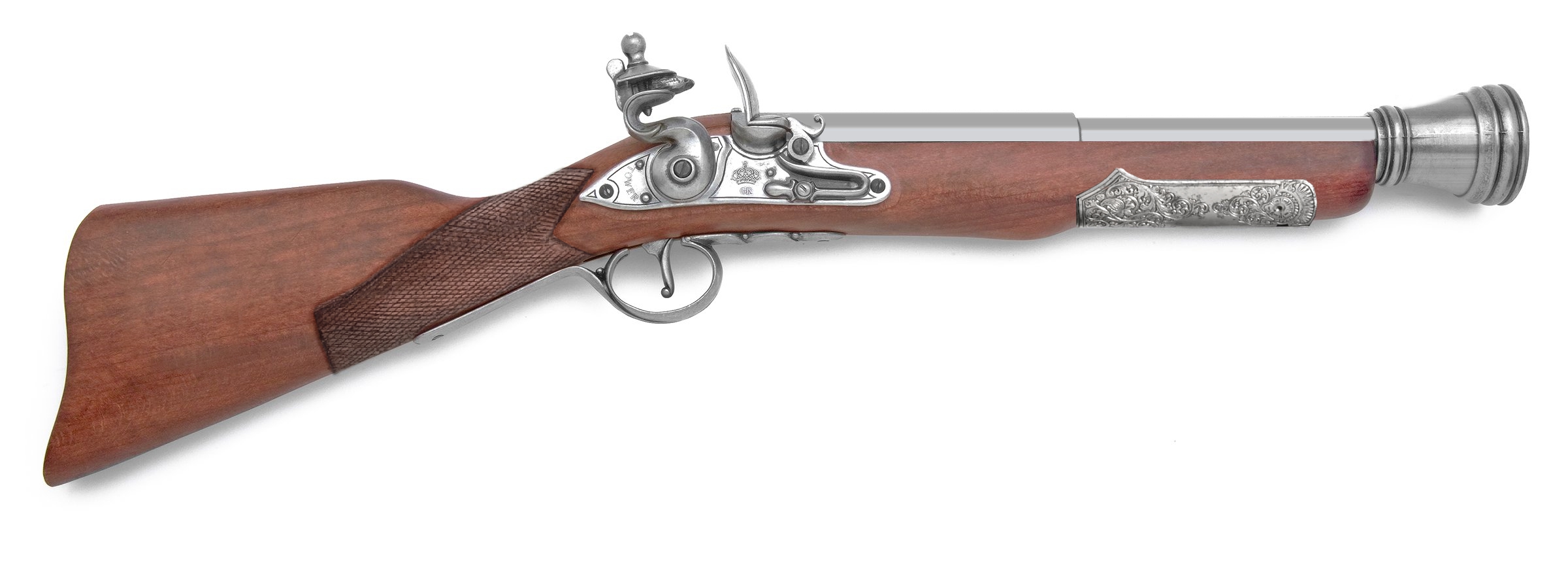
D&D – Firearms

Here is an excellent post on this subject:

On Firearms

D&D Next – Mass Combat Rules

Download a free copy of D&D Wsrs for D&D Next here [D&D Wars Next].

This is a complete re-write of the D&D Wars supplement to third edition Dungeons & Dragons that I published here[D&D Wars] in 2012. This re-write simplifies those rules and brings them in line with D&D Next (the current playtest version of v5.0). You can use these rules with v3.5 with little or no adjustments.

Consider this an interim version of these rules. I will make any needed tweaks to them and re-publish them when the official v5.0 rules are published.

As always, all comments are welcome.

Enjoy!

Addendum: On page 13, it says” For every 10 points healed, a counter is added back to the unit.” That should instead say “A counter is added back to the unit every time the number of hit points healed is equal to the maximum number of hit points in one counter.”

//

//

//

D&D Next – Winged Fiend – A New monster

I  created this monster for my Fires of Hell module. It is included in the module but I thought that I would also post it here. You can send in a LOT of these little guys to give your players a hard time. Individually they are laughably easy to kill and do a tiny amount of damage, but in large groups they can be quite nasty.It helps if you have a lot of 20 sided dice (I know that I do). Once you figure what you must role to hit, roil your handful if to-hit dice (up to 16 Wing Fiends can attack a single opponent) but you don’t have to roil damage because each hit inflicts only one point of damage.  I had to add a smaller size category to those included in the play test rules.

Enjoy!

D&D Next – New Module – “Fires of Hell”

Download a free copy of this adventure here [Fires_of_Hell-Nextl].

This is a complete re-write of the module I posted last year. I updated the entire module to work with D&D Next rules. It also includes converted monster specs – on new color reference sheets.

This  adventure (like the 3.5 version) takes place after a Total Party Kill (TPK).  I modified an old AD&D adventure (The Fires of Dis) to accommodate a group of DEAD PCs to earn a second chance by fighting their way through the first layer of Hell to retrieve a stolen artifact.


D&D Next – Cranium Rat

I converted this monster to D&D Next. I may have to re-do it once the official new rules are published. It is unusual in that it is not your typical swarm. It can contain any number of rats and the more rats the more powerful the swarm. Let me know how you think I did on this. Comments are always welcome.

An individual cranium rat is almost indistinguishable from a normal rodent, except that a portion of its large brain is exposed and pulses with a soft glow. Singly, the creatures are also virtually identical to normal rats, but they are never encountered singly.

Download the PDF file here: Cranium Rat

Dragon Hunt – Chapter 2, Part 9 – The Wizard (or What to do with a Dead Dragon)

Maylock walked out the south gate of Rockport with an almost imperceptible stride that made her appear to be floating along the ground. When they were quite clear of the city gates her rat familiar, whom she called Bedřich, darted out from under her quilted silk robe and scurried around the bushes and weeds that lined the south road. Others usually called him Fredric, or simply Fred.

The road followed the line of the beach which quickly narrowed and then rose to a rocky cliff at the water’s edge. After walking for about twenty minutes, she came to the top of a small rise and saw for the first time the south fork of Blood River. Where the road met the river there was a stone bridge. Two hundred yards east of the bridge the river spilled over a small waterfall down to the rocks below. A hundred feet beyond the river stood a twenty foot tall wooden wall that started at the cliff edge, extended past the bridge, turned south for about that same distance and then back west to the cliff at the other end. There were slate roofs on the buildings that attached to the inside of the wall. The road went straight up to the wall where there was a wagon gate. A dirt path ran around the outside of the wall. There was a wagon full of dead animals between the wall and the river. Men were removing the remains and placing them on a large table where other men with large cleavers were working on the carcasses. This was beside a spot on the river where it had been widened to provide a shallow rocky area where others were washing the remains.

All morning there had been a slight breeze blowing in from the ocean, but it suddenly shifted and Maylock was nearly overcome by a terrible odor of manure and rotting flesh mixed with that of other offensive smells that she couldn’t quite identify. Bedřich seemed to be offended by the stench as well. He scurried back under her robe and into the familiar crook in her arm where he liked to snuggle. Maylock cast a quick spell, a sweeting cantrap, on a silk scarf and held it under her nose.

As she drew closer to the bridge she saw two young boys talking to a large man in a dirty leather apron. He gave each of the boys a copper piece and took from them a small dirty sack. Whatever it contained was soaking through. The entire bottom of the sack was dark, oily and nearly dripping. He held the sack away from his body and looked up as Maylock approached.

“I have come to talk to the owner of the tannery,” she said through her scarf. “I believe his name is Ricven.”

The man looked her over, head to toe. “I am Ricven,” he said. “From the descriptions I have heard, you must be the Iron Sodality’s wizard.”

“I am Maylock,” she replied with a slight bow. “I am here to survey your tannery to ascertain your readiness and capability to process the dragon’s body when it is delivered to here.”

Richen grunted and stopped himself just before saying something that he would regret later. He remembered that if she did deliver the dragon to him, he would become a very wealthy man. “I will gladly give you a tour, if that is your desire.” He cleared his throat and stood up as straight as he could. He had been a tanner for most of his life and his body showed the effects of numerous mishaps. His stringy black hair never grew back on the left side of his head and his skin on that side of his face still showed the scar from when he was splashed with acid. He had lost three fingers on his left hand and a large scar on his right leg prevented him from standing to his full height.

“Are you familiar with tanneries?” he asked.

She answered “No, this is the first one I have ever visited.”

“Then you should be impressed with this one. We are much more here than just a tannery. I not only employ the preparers of the raw material — the tanners, curriers, and tawers — but I also have the leather workers who make the actual objects. I have shoemakers, glovers, book binders, and saddlers as well as master armorers.”

Still holding his sack, he turned and they both walked over the bridge. He pointed to the workers at the river bank. “We tended to acquire the hides of cattle, sheep, goat and deer as a by-product of butchery, and the hooves and horns will still be attached. After the removal of the hooves and horns, the hide must be washed to remove any dung, dirt or blood present. That is what these workers are doing.”

Maylock said, “When Abraxas has been killed, I will cast a Gentle Repose spell on the body, so that it will be fresh and whole when you get it.”

“That is excellent,” Richen said. “Often when we get monster hides to process, they are in very poor condition.”

“What types of creatures have you worked on here?

“We have processed many cattle, ox, elk, buffalo, otter, moose, beaver, seals, pig, sheep, goat, horse, dog, goose, red deer, roe, wild pig, brown hare, red fox, wolf and badger. Monsters are usually individual specimens, and often I don’t know what type of monster it is. We have never processed an entire dragon, but I have tanned a fire drake hide.”

He escorted her through the open gate in the wall. The foul odor was much stronger here. She could see that most of this large area surrounded by the wall on three sides was filled with a great number of circular pits. Many of them were brightly colored. Each pit was about ten feet across and lined with stones and about half of them were empty. The stones extended up out of the ground making each pit about three feet deeper and allowing the workers easier access. The buildings all shared a wall with the exterior wall of the enclosure. They were the same height as the wall and extended across the entire north and west side of the enclosure. Some were two stories, but most consisted only of the upper story, providing a covered workspace below, supported only by the wall on one side and a series of wooden columns on the other. These were all connected by a wooden walkway above. There were stairs at several places along the walkway allowing access to the courtyard.

They walked to the cliff edge, where she could see steps down to a wooden dock. “This is where ships from as far away as the seven cities come bearing unprocessed hides and leaving with leather goods of all kinds. With all of the dragon trouble here lately, the number of ships has decreased to only one every month or so. After the attack yesterday, I am afraid there may be no more ships until the dragon is killed.”

Turning back to the pits, Maylock asked, “How exactly is the tanning done? Could you walk me through the process?”

“Of course,” Richen said as he walked her to a nearby pit. “After the skins are cleaned, the next process in the manufacture of leather requires the fat, hair and flesh to be removed. This process begins by the submergence of the hide into a urine solution like the one we have here.” Then he pointed to a man sitting on a stool with a wooden beam between his legs, one end on the stool and the other end on the ground in front of him. Over this beam was a damp hide that he was scraping with a large curved two-handled knife. “When the hair is loosened sufficiently, the hide is spread over wooden beams and both sides are scraped. The hair or grain side is scraped with a blunt single-edged unharing knife. This is also where the last of the dragon scales will be removed from the dragon hide. The flesh side is scraped with a sharper two-edged fleshing knife. After more soaking, the skin is scraped with a blunt scudding knife.”

Maylock looked a little surprised, “You don’t leave the scales attached to the dragon hide?”

“No. That is not possible,” Richen said. “Most of the scales would fall off during tanning even if we tried to keep them attached. Also the hide cannot be properly tanned and conditioned with the scales attached. But don’t worry, the scales are too valuable to be lost or damaged. They will be processed separately from the hide, sorted and graded as to size and condition. Then they can be re-attached to the hide for those items that require it, such as dragon scale armor.”

Richen walked with her over to a different vat and continued, “After the hair, or scales, are removed we soak the hide in a solution of crushed animal brains and emulsified oils, like the one here. The hide is then rewashed and the skins opened.” He then walked with her over to a different vat, where he dumped the contents of his sack. “The skins are immersed in a warm infusion of dog dung which removes the lime and gives the hide structure a softer, more flexible grain.” He smiled at her and said, “It is the nature of the materials used in these processes that make us unpleasant neighbors.”

“So that is how you tan leather?” she asked.

“No, it is only after this and after a final washing of the hides and division of the skin into its different qualities that the tanning process can begin.” He escorted her over to yet another vat. The contents of this vat were bright red and there was a worker stomping around it, up to his knees. “The hides begin by being immersed in a solution of crushed oak bark and water. Then the skins are soaked in these vats filled with natural pigments.” He pointed to other vats as he continued, “red from poppies, orange from henna, brown from cedar wood, or white from mint. They are moved around in the pits continuously to ensure an even spread of color. The workers must knead these skins by foot. Due to the constant need for the tanner to move the skins, the pits are referred to as ‘handlers.’” He then led Maylock to a group of pits near the far south wall. “Following this, the hide goes through a process of alternative layering with ground oak bark and then these pits are filled with a weak tanning solution. The length of time for this process will vary, depending on thickness of the hide, and for what purpose it was intended. The hides are often left in the solution for a year and a day.”

“You mean that it will take a year to tan the dragon’s hide?”

“Except for the thinner, lighter parts, yes. Perhaps the wing and some of the other thinner hides won’t take as long, but the process cannot be rushed, or the resulting leather will not be good.” He then walked over to a large bench. “After they are tanned, the shaved hides are once again washed clean and worked on this flat wooden bench with the stones, slickers and brushes you see hanging on the wall there to flatten the leather and stretch it. It is then stuffed or impregnated with a warm dubbin of mixed tallow and lush oils that we keep in these barrels. After the skins have been piled up to allow the fats to penetrate evenly, they are hung in this room over here.” He opened a heavy wooden door to reveal a large dark room with hides hanging from ropes strung from one side of the room to the other. “Here the surplus grease is removed. If a firm leather product is required for shoe soles, harness, or other purposes, the hides are simply left here to dry and season. If a softer, finer product is required, further operations such as ‘boarding’ are carried out.” Maylock looked at him questioningly, and he explained “That is simply rubbing it down on a smooth table.” He closed the door and continued, “The leather is then colored or the surface polished using a smooth stone.”

“If you would like to see what we can do with the leather we make, follow me.” He started up the nearest set of stairs. Maylock followed.

As they climbed the open wooden stairs, Maylock said, “Why haven’t you built your tannery of stone, and have ballista towers, like the rest of Rockport? Aren’t you afraid of dragon attacks?”

Richen answered, “Of the three times Rockport has been destroyed, Abraxas has never attacked the tannery. However, there is not much that fire can do but destroy the wall and the buildings. They can be re-built easy enough. Most everything of value here is in the pits, and they won’t burn. That is not to say that we don’t have a plan if we are attacked.” He stopped at the top of the stairs and pointed down at a heavy wood door that Maylock hadn’t noticed before. It looked like it was mounted into a stone frame that was lying on the ground next to the south wall. “That opens to our escape tunnel. It extends to a series of natural caves that open onto the side of the cliffs over the water. It is a rather easy climb up to safety from there.”

He turned and started along the walk in front of the upper buildings. “We make everything from shoes, saddles, harness, leather bottles, chests, books, coffers and containers, sheaths and belts, gloves, armor, great tankards and drinking vessels, bottles and buckets.”

Several men looked up momentarily from the tables where they were cutting sheets of leather into various shapes and designs. “This is where the final cutting is done. The correct cutting of the skin or hide provides adequately sized pieces of material of the right thickness without blemish.” He walked over to a table which had many different knives laying on it and picked up a large bladed knife. “Several kinds of knives are used for leather cutting. One of the most distinctive is this half-moon knife.”

They walked to the next building, “This is one of the assembly rooms.” There was no one in this room at the time. He walked around the room, point out various items on tables and shelves as they passed. “Leather objects are assembled by a number of techniques. Stitching is the most common. This thread is made from flax yarn rolled with beeswax. Hot animal glue is used for box covering and attaching leather to other structures. Objects such as armor, great tankards, drinking vessels, bottles and buckets are made by molding. This is done by soaking the leather in cold water until it is thoroughly saturated. It can then be modelled over molds of plaster, wood or metal.”

He took them to the next building. “This is where ornamentation is applied,” he said as he opened the door. “Ornamentation of the leatherwork is quite common. This is done in a variety of ways. Incising with blunt or sharp tools. Punching or stamping with a variety of iron and bronze tools. Stamping is used widely in book binding. Modeling, to leave the important features in low relief. Embossing, which is performed with a ball tool from the backside of the leather.” He pointed out the various tools as he described them.

He opened a door to another room in this building. There were tables and many brushes and pots. There were various colored stains on the tables and floor. “The final process for many objects is adding decoration with colored dyes and paints. Some small sections may even receive gold leaf, which is adhered to the surface under the heat and pressure of this book-binding tool.”

They left that building and continued on. “This next building is our kitchen. You are welcome to join us for lunch.”

“I am afraid that I have lost my appetite for some reason,” Maylock said from behind her scented scarf.

“No one ever wants to eat with me,” Richen said with a grin. “I don’t suppose that I can blame you. Most of the workers here prefer to wait until they get away from here before they eat. It takes a long time to grow accustomed to the smell. It even keeps the rats away. I hardly notice it anymore.” They came to the last building. “This is my office. Come in and we can discuss any issues, or questions you may have.” He held open the door and Maylock glided in.

His office was spacious and had large windows that could overlook the yard below. There was a large, leather topped desk, and several chairs made from horns and antlers, upholstered in the finest leather. To one side there was a wooden frame that contained the preserved skin of a fire drake. This was complete with outstretched wings and complete head. “I am quite proud of that one,” said Richen as he sat down behind his desk “The owner has never returned to collect it. I am afraid he may have come to an untimely death. Such is the fate of many an adventurer.” He paused to allow Maylock to examine his trophy. “Would you be interested in purchasing this perhaps? I can let you have it at a preferred client price.”

“I am not here to talk about fire drakes, but red dragons,” Maylock said. “I am satisfied that you can handle the dragon’s hide, but there is much more to be considered when dealing with the carcass of a colossal red dragon.”

Maylock motioned to one of the chairs and it moved to a position across the desk from Richen. She settled into it and said, “It will all depend upon how much damage is done to the body before it is killed. For now, let’s assume the best.” Richen nodded and Maylock continued, “I have determined, conservatively, that a properly preserved and carefully processed Colossal Dragon should be able to provide a minimum of 8 vials of Blood, 4 vials of Stomach Acid, 3 vials of Gall, 3 vials of musk, 8 sets of scale male sized for medium sized creatures and 16 shields. The armor created has no special properties other than being extremely tough and its masterwork quality. However, a spell caster with the proper Dragoncrafter training can imbue even greater powers into the armor. The carcass can provide not only armor, but also weapons, rings, rods, staffs, and other wondrous items created from various dragon parts.”

“Now let’s discuss each of the major parts in detail.”

“Fine,” said Richen as he noticed a black rat’s nose twitching as it poked out from one of Maylock’s large sleeves.

“First the head,” Maylock said. “Skulls are more expensive than any other bone inside a dragon’s body, believed to be the seat of their intelligence and spellcasting power, not to mention that there is only one per dragon. If the skull is too badly damaged to sell intact, you should carefully remove each of the teeth, to be fashioned into weapons or sold separately. The brain (which is surprisingly small), eyes, and tong must each be carefully removed and preserved. If the head is in reasonably good condition, the church requires that it be mounted on its skull for display in a location of their choosing. You must carefully remove and tan the skin. All of the larger scales must be removed and carefully marked so they can be re-attached in their original locations. The same goes for all of the horns and spines. Plaster can then be added to the skull where needed before gluing the skin back in place and re-attaching the scales and horns. Perhaps glass eyes and a replica tong can be added, if we can find someone with the proper skill to create these.”

“I know just the man to create those,” said Richen.

“Good,” said Maylock. “Now special care must be taken with the eyes. Dragons tend to lose the pupil as they age, turning into glowing slits of molten metal. The eye of a dragon can be turned into a powerful scrying device or become the ingredient of items that bestow the user with the dragon’s acute and supernatural senses. Even as baubles, dragon eyes are impressive to behold, and are among the most expensive ingredients found in dragoncraft.”

“Dragon tongues are a soft yet extremely tough material, for they must withstand the dragon’s breath weapon while still serving as a very sensitive sensory organ. The tongue is an organ heavily laden with magical energies as the dragon uses it for spellcasting. It also resonates strongly with the energy type of a dragon’s breath, which makes it useful for items that grant an attack with or protection from that energy type, fire in this case.”

“Next let’s discuss the neck,” she said. “A dragon’s neck is not as useful as other parts of the body, mostly salvageable for the spine, bony ridges, crest and flesh. Red dragons have the organs for their breath weapon located in the neck, so that must be removed and preserved.”

“After that comes the dragon’s torso. This contains the bulk of usable hide, the largest scales, the thickest part of the spine and ridges and last but not least, the internal organs. It also contains the powerful musculature that moves the wings and limbs. The internal organs found in the torso of a dragon vary in size and function, not to mention the prices they accrue. Hearts are perhaps the most coveted of a dragon’s internal organs but you can also find good use for the liver, lungs and stomach of a dragon. The liver can be used for Dahak’s fire, a volatile alchemical reagent. Their stomach acids are powerful and could be used for quite a few things. All of these things must be carefully removed and preserved. I will be here to direct and help with magics where required.”

“I will be glad for the help,” Richen said. “I have been offered the assistance of every butcher in Rockport, but they have limited knowledge of internal organs.”

“Continuing on,” said Maylock. “The dragon’s extremities are extremely valuable as well. They contain the strongest and largest bones in a dragon’s body, suitable to be made into weapons or even building materials. The muscles and sinews are also very strong. The paws of a dragon are nimble and strong. The bones are well suited for crafting small magical items.”

“The tail suffers from much of the same stigma as the neck, except that it has no internal organs apart from the musculature and the skeleton. The muscles are, however, as strong as those from the limbs”

“Dragon wings are mainly exploited for their leathery spans, used to craft clothing and sometimes leather armor. The ‘fingers’ that hold the wings together serve the same purpose as the fingers from the paws. A dragon wing can be rendered flexible enough to wear as a cloak, but on older dragons it often has many large holes and scars.”

“You mentioned the blood,” said Richen. “We normally just drain it all and wash it away. Is it worth trying to save some?”

Maylock could hardly believe he was asking this question. “Of course you must save as much as possible. The blood of dragons is said to have powerful properties. It can be used as the component of potions and unguents. It could also be smeared over any other kind of magic item, along with the proper incantation, to imbue it with a portion of the dragon’s nature. Common folk believe that bathing in red dragon’s blood can bestow upon someone a gift of protection against weapons or the dragon’s fire breath. This may not be true, but it is a common belief.”

She realized that she needed to go into as much detail as possible, so she continued, “The hide, of course, has many uses. The most obvious use for dragonhide is the crafting of armor and shields but several other types of worn magical items can be made from dragon hide.”

“The bones must all be saved. They have many uses depending on the caster who gets his hands on them and even the kind of bones they are. They can be used as the frame for a magical item, powdered into spell components or ingredients for balms, potions, inks and other minor but not less powerful items. A weaponsmith could craft the bone of a dragon into the haft of a weapon or even fashion it into a weapon itself. Dragon knuckles have been known to serve as scrying and fortune-telling devices, while the bones from the limbs of great wyrms are a much coveted architectural material.”

“The softer tissue must also all be saved. The softer tissue of a dragon’s body has more value than its bones, as it decays quickly unless magically treated. Construct builders can use a dragon’s flesh to create very strong golems, although it could also serve well as an offering to summoned outsiders, particularly to those of evil inclinations. The sinews and ligaments have proven to be extremely strong and make for very good ropes, cords, belts and similar items. It is said that nothing can escape from a net of dragon sinews, and a bowstring of dragon tendons can surpass the strength capabilities of a mighty bow. Dragon flesh must be cured or kept fresh before it decays, or it becomes worthless. The torso and tail provide most of the meet. There is no recorded benefits from eating dragon meet, but it always sales at a premium because of its rarity. Selling dragon meet for consumption is extremely insulting to dragonkind, so care should be taken to keep secret the identity of those who purchase it.”

“The dragon’s ‘pointy bits’, the claws, teeth, bony ridges and horns are ideal for making weapons, although they also see use as charms and ornaments for wizards’ staves. The horns are also the best part of a dragon to build blowing horns to summon and/or control dragons, although smaller specimens find their way to a fighter’s helm all too frequently.”

“We discussed scales earlier, and I must stress the need to save and preserve as many of them as possible. Dragon scales vary in size according to the part of the body where they are taken from, not to mention the size of the dragon in question. A single scale may be fashioned into amulets or small carvings, or a collection can be used to make armor.”

“Yes,” said Richen. “And any remnants that are not of a quality to be sold to users of magic, or to the trades, can be sold to the common people. Some popular beliefs are that dragon liver can cure a cold, dragon powder grows hair, with dragon blood you’ll never grow old, dragon cartilage keeps you thin, dragon fat is for burns, and that a dragon tear will clear up your skin.”

Maylock objected, saying “magical and alchemical study has not confirmed the truth of any of these.”

“No,” said Richen. “But they can be exploited in the sale of these items to the uneducated.”

Maylock stood and her chair moved back out of her way. “I believe the dragon body will be in good hands here with you. You can rest assured that I will give you a good report to the church elders when I meet with.”

Richen rose and said, “It was a pleasure to have met you.”

With that Maylock and Bedřich left the tannery and returned to Rockport.

Dragon Hunt – Chapter 2, Part 8 – The Rogue

Olorry Gleamheart referred to his adventuring group as “The Military Sodality of Crossbowmen, Archers, Swordsmen, Clerics and Wizards of the First Order Dedicated to Serving the Deity Heironeous with a Will of Iron” – or simply the “Iron Sodality.” At this time his group consisted of 4 people. There was Olorry himself, of course, who was known to all as Sir Gleamheart, first paladin of Heironeous. There was also the cleric of Heironeous whose name was Pitchlight, the mysterious female Half -elf Wizard, Maylock, and Sir Gleamheart’s oldest friend, a rogue named Shaster Carter that some still referred to by his old nickname “Pickman.” The Iron Sodality had spent the last several years adventuring on the high seas where they traveled from port to port fighting pirates, monsters, and combating enemies of the faith. Now that they had returned to their home port to lead a quest to defeat the dragon Abraxas they were experiencing a major setback. The dragon’s attack on the town left their expedition short on people, equipment and funds.
After rallying their remaining forces and evaluating their situation, each of the four members of their group went off in a different direction. Each had a separate task that needed to be done as quickly as possible.

Shaster, the green caped rogue, went down to the docks, to their ship, the Deadwater Bay. There were only a few ships still docked where there had been at least a dozen two days earlier. The wet wood of the docks was littered with ropes, boards and the scattered remains of broken crates and torn nets. The ship docked at the next pier had been burned by the dragon. It was still afloat but had burned nearly to the water line before the fire had been put out. An old man with gray hair and scraggly gray beard was standing on the pier and calling out instructions to the three bare-chested sailors that were in the process of dismantling and removing the charred main mast from the ships burned middeck.
“Mister Rashid!” Shaster called out to the old man as he approached. “Mister Rashid!” he called out again as he got a little closer.
The old man heard him this time, “Boss!” he answered as he waved to the rogue. Aram Rashid was the Deadwater Bay’s carpenter and he had always referred to all 4 of the adventures that owned the ship as Boss. It was commonly thought by the crew that he simply never bothered to learn their names. “Watch your step Boss. Don’t trip on that breast line.”
“What are you doing over here?” Shaster asked with a smile. “Have you run out of repairs to do on your own ship?”
“No sir Boss,” he said while guiding the sailors to position the removed mast on sawhorses that were positioned on the dock to receive it. “You know that I have been needing to replace my topmast ever since that Kraken gave it a twist. It hasn’t set true since then.” As he talked he walked to one end of the mast bending down, looking along its length and gently rolling it right and left. “This ship’s captain was killed in the attack and the harbor master says that we can help ourselves to any salvage we want off of her,” he said. “This should do just fine. It is of a fine, old growth oak and has a dense strong core. It is charred but it is straight and the core is unharmed. I can plane off the charred wood and trim it to length. What good luck.”
“I doubt that that ship’s captain would have seen it that way. How soon can you have all the repairs done sufficient to sail?”
“I can have this shaped and installed by day’s end. There are no other repairs needed that would keep us from sailing at first light tomorrow. I was hoping that we could stay long enough to remove most of the barnacles from the hull. Are we leaving port soon? I thought you had a dragon to catch.”
“I need to talk to Captain Casey first. Just don’t delay any repairs and stay close.”
The familiar voice of his ship’s first mate called from the other side of the pier, from the rigging of the Deadwater Bay, “Ahoy Mister Carter!”
As Shaster turned to look in that direction a shadow passed over him and a large harry ape-like creature landed on the pier beside him. They clasped each other’s forearms in friendly greeting. Shaster said “Hello, Garsh. How’s the ship?” His ship’s first mate was an Hadozee.  He had glided down by means of his patagium, a furry parachute-like membrane that stretched from wrist to ankle.
Garsh said, “Captain had us stow all the sails and most of the rigging below decks. On account of possible fire breath attacks don’t you see? The men are just now stowing the last of the canvas. Will you be coming aboard now sir?”
As he turned to walk toward his ship, Shaster said “Yes, I need to talk to the captain as soon as possable.” Garsh grabbed him with one great harry arm around the waist and dived with him over the edge of the pier. He grabbed a line with his other hand and they both swung in a wide loop down and then up over the gunwale. Shaster’s big floppy hat flew off but Garsh Caught it with his hand-like foot and they landed safely on the quarterdeck. Shaster snatched his hat and started to yell at Garsh, “Don’t ever …” when his boots were splashed with a bucket of water.
A startled sailor with an empty water bucket in his hands said, “I am so sorry sir! I didn’t see you there until it was too late to stop. The captain is having us wet down the decks twice every hour. That is so the ship won’t catch fire if the dragon comes back.”
Garsh said, “You said you were in a hurry.” Then he jumped from board to boom to half-mast and away through the rigging he went.
Shaster just turned and stomped down to the captain’s cabin. When he entered, the captain looked up from his desk. “What happened to you?” he asked with a bit of a chuckle. “Fall overboard?”
“It was Garsh,” Shaster said as he flopped down into the large padded chair that sat across from the desk. Then he noticed that the big feather in his hat was totally soaked. “What are we going to do about that Hadozee? He has no respect for a man’s dignity.” He poured himself a drink from the cut glass bottle sitting on a small table next to his chair.
“No, but he is the best damned sailor I have ever seen. I wouldn’t trade one of him for four more ‘civilized’ first mates. You know for yourself that he spends ninety percent of his time climbing around in the rigging, and the sailors all have his respect.” The captain walked over and poured himself a drink. “You didn’t leave the drinking parlors and gambling halls of town to talk about Garsh. What business brings you to my ship this time of day?” Although, technically, the Deadwater Bay was owned jointly by the four members of the Iron Sodality, as its captain, Casey Shearwater always referred to it as his ship. He never cared for his last name and when introduced to strangers he always said, “You can call me Captain or you can call me Casey or you can call me Captain Casey, but don’t call me Shearwater.”
Shaster took a sip of his drink. I was a dark brown liquor they had picked up at their last port, and he had become quite fond of it. “Olorry said I was to have you take the ship out, away from Rockport until the dragon is dealt with. He gives orders like the rest of us were his crew rather than his partners. But he is right about this. We won’t be needing it for at least a month, maybe more.” He took another sip and continued, “He is afraid that if the dragon finds out that we own this ship he will come after it.”
The songbird in the corner was anxiously walking back and forth on his perch, trying to get the captain’s attention. Captain Casey pulled some seeds from his vest pocket and walked over to the bird, “Settle down Yasha. You would think that I never fed you.” As the songbird ate the seeds from his hand he said, “With the Iron Sodality’s permission, I should like to take the ship on the magic ice run.”
“You have been trying to get us to make that run for as long as I have known you. Do you think the crew is up to it without our protection?”
“With all due respect, you helped select these sailors as much for their fighting ability as for their seamanship. Some didn’t know a bowline from a half hitch when they signed on. As to their fighting ability, they have proven that several times over. I expect we can take on whatever we come across without the four of you keeping us safe.”
“I guess that is true enough,” said Shaster. “Tell me again about the magic ice run. How does that go exactly?”
“As I’ve said before, first we load up with all of the metal items we can get. The cinnamon islands don’t have any metal, and they don’t get many trade ships because they are surrounded by dangerous waters and monsters. I will have to buy all of the pots and pans, axes, knives, nails, and everything else made of metal that I can find.”
“What kind of monsters?”
“There are tells of dragon turtles, but there are definitely sirens. But the monsters are only half the problem. There are no natural harbors, and the entire coastline is rocky cliffs. We will have to anchor a way off shore and take the small boat in. We can trade the metal items for a big load of spices. They have cinnamon of course, but also pepper, dragon tongue and many other rare and exotic spices. Once we leave there, if we avoid the pirates, we will sail straight to North Icely. The timing is good because their ice pack should just now be clearing.”
He fed Yasha some more seeds and continued, “North Icely trades mostly in timber and precious stones, but for pepper and spices, they will trade for magic ice.”
Shaster set down his glass and tried to knock the water off his hat and feather. “Didn’t you say that the ice isn’t truly magical?”
“That’s right. The story is that they discovered it a few years ago in one of their ruby mines. At first they thought it was just a frozen underground river.”
“What makes it so special?”
“They say that it is so cold that if you touch it with your ungloved hand it burns like fire. Also it doesn’t melt into water but slowly gets smaller as it melts leaving only cold air. A small piece of it in water doesn’t float. It pops and crackles and the water boils creating steam as if it were over a fire, but instead of being hot, the water is made cold. Small amounts of water poured over a large amount of the magic ice freezes into normal ice. But mages have examined it and say that it has no detectable magical properties.”
Shaster said, “That sounds amazing, and dangerous. How will you haul it?”
Captain Casey walked back over to his desk, “They dig it out of the ground like they would stone. We will line our hull with hay and cover that with sand. The magic ice will go over that and then we will cover it with another layer of sand and hay. There should be no danger as long as we wear gloves when we handle it. The next part of our voyage will be to make our way to the Port of Sultans by the great desert. It is early enough in the year that if we get there fast enough we will have not lost more than half of the magic ice from melting. Of course we risk losing it all if we are delayed. Here, I’ll show you course I plan to take.”
The captain cleared off his desk and unrolled a map of the North Sea. As the captain traced his intended course with his finger he said, “The Sultans will pay a great sum for the magic ice. We have been told that they store it in abandoned water wells. We should return here in about two months with our coffers full of gold. We will, of course, split the profit with the ship’s owners.”
Shaster thought for a minute, then looked up at the captain and smiled. “How soon can you leave?”
“It will take a day to acquire the metal trade goods and provision for the trip. The ship repairs and re-rigging should be completed at the same time. We can leave port the day after tomorrow.”
“And how long will you be away?”
“The entire round trip should not take over eight weeks.”
“Good,” said Shaster. “Do it. The other 3 will come aboard this evening to fetch their gear, or send someone for it. Don’t mention the magic ice run to them. Just say that you have agreed to stay away for a few weeks, to keep the ship out of danger. We will surprise them when you return with your coffers full.” He shook the captain’s hand, donned his soggy hat, and left the captain’s cabin with a spring in his step and smile on his face. Having done his assigned chore for the day, he intended to spend the rest of his day drinking, gambling and flirting with the bar maids. Perhaps someone would be foolish enough to pick a fight with him. He hadn’t fought a proper duel in over a year now and thought it about time for another.

D&D Next – Animal Companion / Familiar Character Sheets – Fillable

AnimalSheetanimal-sheet-fillable

Here is a fillable version of my Animal Companion / Familiar Sheet.

The original version (here) has been my most popular post. I have received request for a fillable version and I recently got the software to make that possible. I even included a modest amount of math, so it calculates the bonuses based on the ability scores you enter..

Enjoy!

There is now a version available for Pathfinder (here).

There is a version for D%D 5e (here).

//