Thank you all for your support and I apologize for delaying any new posts you may have been anticipating, but I will not be making any more posts until further notice.
Reviewing my blog history this morning I saw this and thought you might find it interesting. For the last 12 months, here are the 10 pages that had the most views and the 10 files that had the most downloads.
Posts
Views
D&D 5E – Armor Class (AC)
44,916
D&D 5E – Metals
27,501
D&D 5E – Fillable Spell Cards – by class
16,720
D&D 5E – Quick Play Character Sheets
14,607
D&D 5E – Quick Reference – Chase Rules
11,711
D&D 5.5 Character Sheet – Fillable and Auto-Calculating
Disclaimer: This post is sponsored by Wasted Wizard, who sent me their product free in exchange for an honest, unbiased review. All opinions are my own. If you make a purchase using my Amazon affiliate links, I may make a small commission at no extra cost to you.
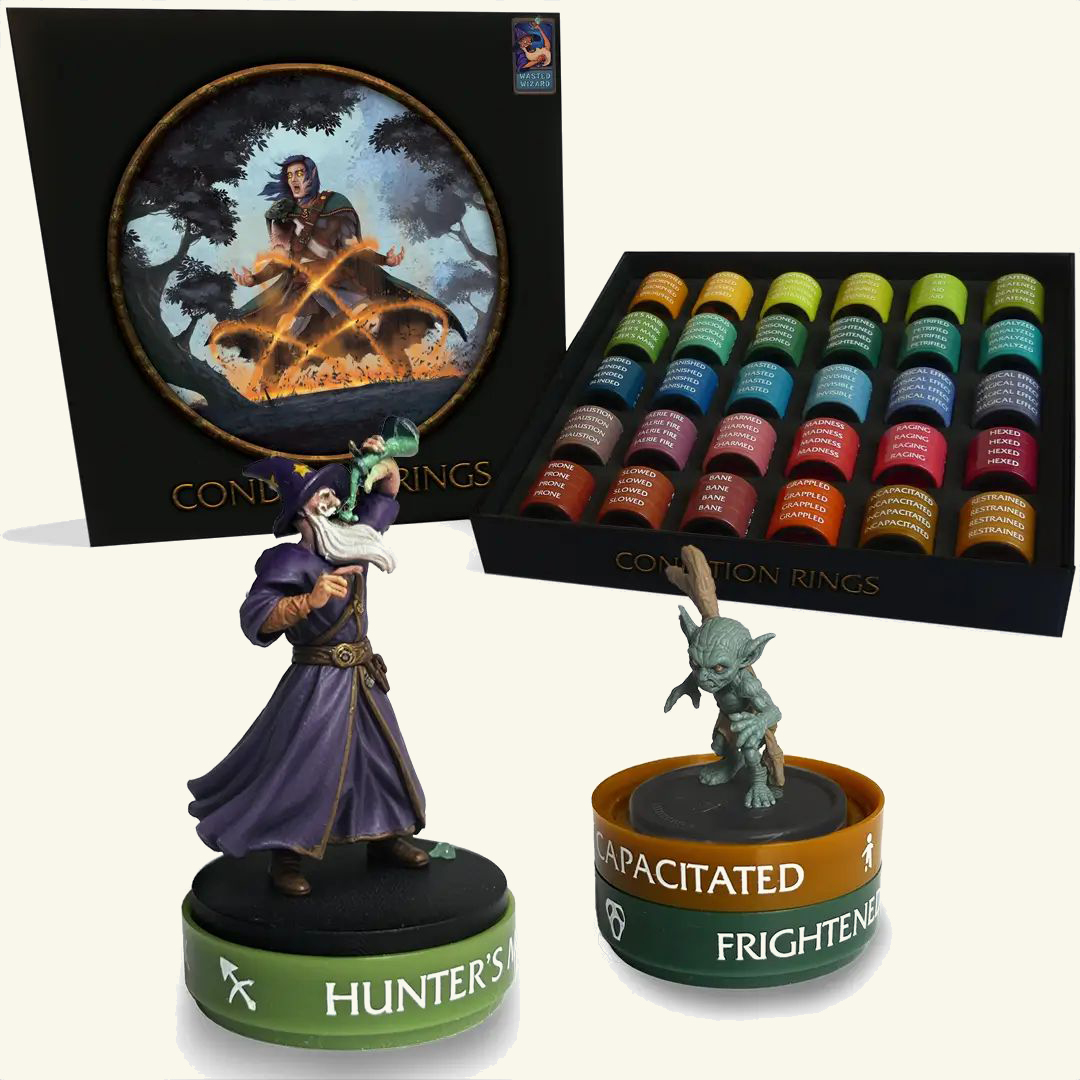
When playing D&D around the table, I typically play with miniature figures on a 1” square grid. In 2019 I bought a set of 64 “condition rings” to make it easier to track which character and monster currently has which condition. They are 1 1/2” dia. clear plastic rings, about 1/16” thick with a 1” hole in the center. Printed in different colors around the ring are the names of each of the 15 D&D conditions plus “concentrating” (4 rings of each condition). For most miniatures I can place the ring around its base, and for larger ones I can hang them on the mini. The problem is that my eyesight isn’t all that good and it has become harder for me to read the name of the condition printed on the ring, so last year I spent some time on Amazon seeing if there were any that would work better at my table. After looking at all the different options, I found “WASTED WIZARD Stackable DND Condition Rings.” For several reasons that I will describe later I decided that I would get me a set of these. But, because I wasn’t currently playing a game at my table, instead of ordering it I added it to my Amazon shopping list. Then, a couple of weeks ago, the Wasted Wizard contacted me and asked if I was open to doing a review of their stackable condition rings on my blog. In return they would send me a set free of charge. I agreed and was pleased to receive their produce a couple of days ago. The following is my review.
The main difference in these and the other condition markers for use in your D&D game (or most other RPGs) is that rather than sitting around the base of the miniature, the mini sits in the recession on the top of the ring that is only a little bigger than the base of the mini. Multiple condition rings can stack on top of each other, under the mini. The name of the condition is printed on the side of the ring.
The Box The product is well packaged. The box is good looking and well-made of heavy cardboard and the lid fits snugly. I will be able to keep all of the condition rings in the box they came in. The box contains a foam rubber insert with cut-outs for each set of 4 condition rings, each a different color.
The Conditions There are 4 identical rings for each condition. Each set of 4 is a different color. There are rings for each of the D&D fifth edition conditions: Blinded, Charmed, Deafened, Exhaustion, Frightened, Grappled, Incapacitated, Invisible, Paralyzed, Petrified, Poisoned, Prone, Restrained, Stunned, and Unconscious. In addition to these standard conditions, it also includes: Aid, Bane, Banished, Blessed, Concentration, Fairy Fire, Hasted, Hexed, Hunter’s Mark, Madness, Polymorphed, Raging, Slowed, and two more for anything else you might be need labeled; Magical Effect, and Physical Effect. For a total of 120 pieces. The addition of the magical and other effects is a welcome inclusion.
The Rings – Color and Text The rings are of hard plastic in dark colors with the conditions printed in white so they show up quite well. The condition is printed in all caps on both front and back with a symbol, unique to each condition on the two spaces between the condition names. It won’t take long to remember the most common conditions by the color of the ring.
The Rings – Fit I measure the overall diameter if each ring to be 1 1/16”. The top has two precisely made recesses. The bigger one is scaled to accept a standers D&D mini (25mm or 1 inch). The smaller, just below the upper one, is scaled to accept a standard Pathfinder mini (20mm). Every mini I tried with a 1” or smaller base set securely in the recess on the top of the ring. Unlike condition rings that set around the mini, these won’t get in the way when the PCs and/or monsters are standing next to each other. The base of each ring is slightly recessed to allow the rings to securely stack. You can stack 10 or more rungs with a mini on top without worry of it easily typing over. They don’t work as well for larger minis. You will have to hang them on the larger mini. On some there may be room on the base, between their legs, or a place to sit them on top, like a hat.
The Felt Pads At my table I typically use 1/8” clear Plexiglas over a 1” square grid. I have never felt the need to put felt pads on the bottom of my minis. I have never experienced scratching of the Plexiglas or any battlemat. So I don’t think I will be adding the felt pads to the bottom of the rings. But, for the purpose of this review I added the felt pads to 4 of the rings. Following the clear instructions, I did have a little difficulty in getting the pad to line up exactly with the bottom of the ring. I don’t think it would take much practice to improve, but I only felted 4 minis. I found the rings didn’t stack as securely with the added felt pads. Even with a stack of only 4 rings, the top ring tended to tilt awkwardly, and would shift whenever I moved the stack. Again, this may have been because I hadn’t properly centered the pads. This won’t be a problem for me. I never intended to felt them in the first place.
Visibility Here is the only real problem I have, and it is because of a situation particular to my specific gaming table. The table is in the center of a rather small room. The only light source is directly above the center of the table. This causes the sides of the condition rings, either singular or stacked, to be in shadow and thus be difficult to read. This was upsetting at first, before I realized that I always have an ink pin within reach that is also a laser pointer and a small flashlight. Pointing the flashlight at the ring makes the words easy to read.
Conclusion Even with the unexpected shadow problem, the fact that they don’t take up any additional table space is a plus. Another plus is that when you have multiple condition on a single character, they stack! And when stacked, you can still read them. Speaking of stacking, even though I have clear plastic stands to use for flying characters, rather than taking the time to dig them out, I can pull out a stack of 4 rings of a condition that I’m not currently using, and place a mini on the stack to indicate a flying character. I could then use a stack of 8 under a mini to indicate flying at a greater height. The minis are surprisingly stable on a tall stack of rings. Unless you feel that you need them, I would recommend just not using the felt pads. The only problem I found with them is when stacking the rings, and frankly 90% of the time I only use a single ring on a character. But it is good that they are provided for you should you prefer to use them. I like them. I will be using them on my games played IRL.
Let me know what you think in the comments below. Here is a link too the Wasted Wizard website.
I also updated the weapon cards that I posted HERE.
When playing Dungeons and Dragons, I have always thought that there should be some reason to choose one weapon over anther other than the amount of damage it does, or the damage type. This is something that I was hoping D&D 5.5 would fix. They tried to fix it with Weapon Mastery. I think that Tales of the Valiant did a better job with their Weapon Options, but why couldn’t each different weapon have its own unique feature? That is what I did for my Bold Against Monsters (BAM). If you are playing D&D and are disappointed with Weapon Mastery, you can replace it with my BAM weapon rules.
I am proud to announce that I am now a DriveThruRPG affiliate, anyone going to DriveThruRPG.com by clicking to a link here on my site will be tagged as visiting via my link. If they make a purchase anywhere on that site within 15 days of coming to DriveThruRPG via my link, I’ll receive a small percent of that purchase (excluding gift certificates) credited to my account.
If you sometimes purchase things from DriveThruRPG and would like to help me out, it will cost you nothing to use this link to go to that site.
Mike Mearls, one of the lead designers of D&D 5E and later its Creative Director, was laid off from WotC in 2023. He is now Executive Producer of roleplaying games at Chaosium, the publisher of Call of Chulhu. He is calling the 2024 version “D&D 5.5” and that’s good enough for me.
Continuing My Focus on D&D: A Personal Perspective
Introduction
As many of my readers know, I’ve been vocal in the past about my concerns regarding Hasbro and Wizards of the Coast (WotC), the companies behind Dungeons and Dragons. I’ve even contemplated moving away from D&D to other systems like Tales of the Valiant. Despite these criticisms, I’ve decided to continue focusing on D&D in my content. Today, I want to explain why.
The Enduring Magic of D&D
Dungeons and Dragons is more than just a product; it’s a gateway to imagination, creativity, and community. The game’s core essence – collaborative storytelling and adventure – remains unchanged, regardless of corporate decisions.
Separating the Art from the Artist (or Corporation)
While I stand by my past criticisms of Hasbro and WotC, I’ve come to realize that D&D has grown beyond its corporate owners. The game now belongs to its players, dungeon masters, and the vibrant community that has formed around it.
The Power of the Community
One of the most compelling reasons to stay engaged with D&D is the incredible community surrounding it. From homebrew content creators to passionate players, this community continues to innovate and expand the game in ways that often transcend official releases.
A Platform for Creativity
D&D provides an unparalleled platform for creative expression. By continuing to focus on the game, I can explore and share new ideas, homebrew content, and unique perspectives that contribute to the broader D&D ecosystem.
Advocating for Positive Change
By remaining engaged with D&D, I maintain a voice in the community. This allows me to continue advocating for positive changes, both in the game itself and in the practices of the companies behind it.
The Evolving Landscape of TTRPGs
While my focus remains on D&D, I’m also excited to explore how it fits into the broader world of tabletop RPGs. This includes looking at alternative systems and how they influence and are influenced by D&D.
Conclusion
In the end, my decision to continue focusing on D&D comes from a place of love for the game and its community. While I remain critical of certain corporate practices, I believe that the heart of D&D lies with its players. By continuing to engage with and create content around D&D, I hope to contribute positively to its ongoing evolution and the joy it brings to so many people around the world.
What are your thoughts on this decision? I’d love to hear from you in the comments below.
“A generic trademark, also known as a generalized trademark or proprietary eponym, is a trademark or brand name that, because of its popularity or significance, has become the generic term for, or synonymous with, a general class of products or services, usually against the intentions of the trademark’s owner.” (from Wikipedia) I am not a lawyer. This is simply my observation and is not intended as legal advice.
I believe that “Dungeons and Dragons” and “D&D” have become generic trademarks. Just like people may ask for a “Kleenex” when asking for a facial tissue, they often refer to all role playing games as “Dungeons and Dragons“.
Not long ago, when talking to most people, if I said that I played Dungeons and Dragons, they wouldn’t know what I was talking about. In the last five or so years D&D has exploded in popularity and most people know the name Dungeons and Dragons, even if they still don’t know much about it. However, this is the only role playing game they have heard of and may know very little about it. If you play a different TTRPG (table top role playing game) chances are the average person will have never heard of it.
A conversation may go something like this: “I play _______ every Friday evening.” [Fill in the blank with any TTRPG other than D&D.] “What is that?” “It’s a tabletop role playing game”. “What is that?” “It’s like Dungeons and Dragons.” “Oh, I’ve heard of that. Isn’t that where you sit around a table, roll dice and pretend to fight monsters?” “Yeah, kinda.”
To most people, any game where you sit around a table, roll dice, move little miniature people around and pretend that your character is fighting monsters, is Dungeons and Dragons. And, to tell the honest truth, that isn’t necessarily a bad definition. If you tried to tell your friend what the difference is between D&D and your preferred game it would boil down to your preferred rules. But, the rules aren’t necessary to understand what the game is about, and why we love it.
If you, like me, love fifth edition Dungeons and Dragons, there are most likely some rules that you think need to be changed. You may have some house rules that you use to improve the game. You are probably looking forward to the release of the updated rules that are scheduled to be released this year. You trust that WoTC (Wizards of the Coast) will make changes to improve on the existing rules. When they are released, you will probably switch to playing with the new rules, but you will still be playing Dungeons and Dragons. The same happened when third edition and v3.5 was released. It was all still Dungeons and Dragons.
So what is it when another company takes the Dungeon and Dragons rules (as are available to anyone in the SRD for fifth edition) and makes changes to improve on the existing rules? There is an argument to be made that these versions are still Dungeons and Dragons. Several different companies have done this. Some made major changes and some only added to the basic rules and made minor changes. I say that if you are plying any of these games you are still playing Dungeons and Dragons.
Why does any of this matter?
Many people, myself included, are unhappy with Hasbro, WoTC included, for many things they have done over the last 12 months. So much so that we are uncomfortable giving them any of our money. But we love the current version of Dungeons and Dragons. Of course, we could just continue playing the same game we have been playing for the last 10 years, but the idea of a new improved version is very appealing. So all I am saying is that if this describes you, don’t worry. You can upgrade your version of Dungeons and Dragons to a new and improved version without supporting WoTC. Just switch to one created by a different company. It will still be the same game, but will have changes that the authors think are an improvement. That is the same thing that WoTC is going to be doing with their new release.
I think that the easiest new version to switch to, the one that will be the most like the new version of D&D from WoTC but perhaps even better, is the one that is coming soon from Kobold Press that they are calling Tales of the Valiant. But I am tempted to call D&D 6E.
Wizards of the Coast (WoTC), the Hasbro subsidiary that owns D&D, had a bad year. 2022 was a banner year for Hasbro and WotC – 2023 not so much. Here are the highlights from this year.
January: The OGL Controversy – A leaked agreement drafted by WoTC threatened to “tighten” the OGL that has been in place since the early 2000s. It would grant WoTC the ability to “make money off of these products without paying the person who made it” and companies that make over $750,000 will have to start paying Hasbro a 25% cut of their earnings. In response to massive negative response from the D&D community, WoTC later announced that it would keep the current OGL intact. In addition, they released the Systems Reference Document (SRD) for the current edition under a Creative Commons license.
Also in January: Hasbro announced it was laying off 800 employees.
February: WoTC published Keys From the Golden Vault. This was originally scheduled for a Winter 2022,
March: The movie Dungeons & Dragons: Honor Among Thieves was released. The movie is said to have lost around $100 million.
April: WoTC sent the Pinkertons to recover Magic: The Gathering cards. YouTuber Oldschoolmtg uploaded an unboxing video featuring a collection of March of the Machine: The Aftermath booster packs. Evidently somebody sent out the wrong cases, and these were not supposed to be released yet. Pinkerton agents showed up at his home on Saturday morning and began demanding he hand over the “stolen” product.
Also in April: WoTC held its Creator Summit. One of the biggest announcements from the summit was that the 2024 core rulebooks will be a continuation of fifth edition and not a new edition. They referred to it as “One D&D”.
EDIT: I mistakenly stated that Hasbro purchased D&D Beyond in May 2023 – It actually acquired D&D Beyond on April 13, 2022 for $146.3 million.
June: WoTC dropped the term “One D&D” and began referring to the current version of the Player’s Handbook as the 2014 Player’s Handbook and the one scheduled for release next year as the 2024 Player’s Handbook. After it is published, it will just be the Player’s Handbook. The same goes for the other core rule books.
July: WoTC announced that they were translating the Systems Reference Document (SRD) into French, Italian, German, and Spanish to be released into Creative Commons.
August: WoTC published Bigby Presents: Glory of Giants. This was originally scheduled for a release in the Spring of 2023.
Also in August: WoTC released Baldur’s Gate 3. The deal that Hasbro made with Larian Studios 6 years earlier resulted in this video game that became the “Game of the Year” and a major money maker for Hasbro.
Also in August: Hasbro announced the sale of its eOne film and TV business, that it bought in 2019 for $4.0 billion, for $500 million (a $3.5 billion loss).
September: WoTC published Phandelver and Below: The Shattered Obelisk. This was originally scheduled for release in the late summer as The Phandelver campaign.
October: WoTC published Planescape: Adventures in the Multiverse which more or less hit its target released date.
November: WoTC launched three official DnD TV programs, but it was mired in confusion, with fans not sure how to access the content and there were many broken links.
December: Hasbro announced a new round of layoffs due to weak toy sales. They are projected to impact 1,100 workers across its global operations. Many WoTC employees have lost their jobs.
One final note: Don’t worry about Chris Cox, the CEO of Hasbro, he is doing just fine. He earns an annual salary of $1.5 million and received total compensation last year of $9.4 million.
To mark the 50th anniversary of Dungeons & Dragons, the U.S. Postal Service will be issuing a set of 10 official Dungeons & Dragons stamps next year. Just thought you might like to know.






 Dungeon Master Assistance