There are a lot of things that I like about the new 2024 rules for Dungeons and Dragons (D&D 5.5) but there are several things that I don’t care for. Before I run a D&D 5.5 game, here are the house rules I will be using to address some of these issues. I am sure that I will be updating this list from time to time as I run across other problems. These are in addition to, and in some cases may replace, my existing 5E house rules that I posted here: D&D 5E – My House Rules.
House rules I will use when running a D&D 5.5 campaign
1) I will be using the new (2024) rules exclusively. Players may not use spells, races, classes, subclasses, etc. from any earlier publications. 2) I will be using the house rules I posted here: The Old DM’s House Rules on Hiding and; 3) You cannot attack an ally. This includes opportunity attacks. 4) You can swap weapons (sheath one weapon and draw another one) once, and only once, on your turn. 5) I will have to nerf many spells, Conjure Minor Elementals for example. (I may provide details in a future post.) 6) Most on-going spells end when their caster dies and you can end any spell you have cast (no action required) if you aren’t incapacitated. 7) No crafting of magic items. 8) Background. Create your own. Just make up any background you want. Then, based on that background;
Ability Scores. Increase three ability scores by 1, or one by 2 and one by 1, to a maximum score of 20.
Skill Proficiencies. Select any two skills to be proficient in.
Tool Proficiency. Select one tool to be proficient in.
Equipment. Select any equipment pack, or 50 GP.
9) House rules to prevent weapon mastery abuse.
You can’t use the weapon mastery feature of a weapon if you use it as an improvised weapon. An example would be throwing a melee weapon that doesn’t have the thrown property or making a melee attack with a ranged weapon.
Save: For mastery features that allow a save to avoid the effect, it will be either a DEX or STR saving throw and the DC is 8 plus the ability modifier used to make the attack roll and your Proficiency Bonus. You should always have that number calculated and ready to give to the DM when needed.
Cleave: A single attack roll is used against both targets. The two targets must be within 5 feet of each other, within your weapons reach, and positioned so that they could be hit with a single swing of your weapon.
Graze: A poison weapon does no poison damage on a miss. A roll of a natural 1 does not graze.
Nick: Reword this to “When you make an attack action with this weapon you can make a second attack with it. You can make this extra attack only once per turn.”
Push: Must be horizontally (not up into the air). The target can save to resist being pushed. If the creature is hit more than once by weapons that have this property, the distance they are pushed doesn’t exceed 10 feet.
Sap: The target can save to resist the Sap.
Slow: If the creature is hit more than once by weapons that have this property, or they are (or have been) affected by the use of the Slasher Feat, their total Speed reduction never exceeds 10 feet.
Topple: If the creature is hit more than once by weapons that have this property, they automatically save.
Vex: Reword this to “If you hit a creature with this weapon and deal damage to the creature, you have Advantage with the same weapon on your next attack roll against that creature before the end of your next turn.”
Additional house rules I may implement, depending on the adventure
1) No flying characters. 2) Player characters may not have an evil alignment. 3) No Multiclassing. (Multiclassing is no longer listed as an optional rule as it was in 5E.) 4) No Firearms. 5) No bastions. 6) I LIKE opposed checks. 7) My “rule of cool”: If I think it is cool I MAY allow it ONCE.
Call to action.
I’m always looking to improve my resources for the D&D community! I would love to hear your feedback on these house rules. Let me know what you think in the comments below.
Continuing My Focus on D&D: A Personal Perspective
Introduction
As many of my readers know, I’ve been vocal in the past about my concerns regarding Hasbro and Wizards of the Coast (WotC), the companies behind Dungeons and Dragons. I’ve even contemplated moving away from D&D to other systems like Tales of the Valiant. Despite these criticisms, I’ve decided to continue focusing on D&D in my content. Today, I want to explain why.
The Enduring Magic of D&D
Dungeons and Dragons is more than just a product; it’s a gateway to imagination, creativity, and community. The game’s core essence – collaborative storytelling and adventure – remains unchanged, regardless of corporate decisions.
Separating the Art from the Artist (or Corporation)
While I stand by my past criticisms of Hasbro and WotC, I’ve come to realize that D&D has grown beyond its corporate owners. The game now belongs to its players, dungeon masters, and the vibrant community that has formed around it.
The Power of the Community
One of the most compelling reasons to stay engaged with D&D is the incredible community surrounding it. From homebrew content creators to passionate players, this community continues to innovate and expand the game in ways that often transcend official releases.
A Platform for Creativity
D&D provides an unparalleled platform for creative expression. By continuing to focus on the game, I can explore and share new ideas, homebrew content, and unique perspectives that contribute to the broader D&D ecosystem.
Advocating for Positive Change
By remaining engaged with D&D, I maintain a voice in the community. This allows me to continue advocating for positive changes, both in the game itself and in the practices of the companies behind it.
The Evolving Landscape of TTRPGs
While my focus remains on D&D, I’m also excited to explore how it fits into the broader world of tabletop RPGs. This includes looking at alternative systems and how they influence and are influenced by D&D.
Conclusion
In the end, my decision to continue focusing on D&D comes from a place of love for the game and its community. While I remain critical of certain corporate practices, I believe that the heart of D&D lies with its players. By continuing to engage with and create content around D&D, I hope to contribute positively to its ongoing evolution and the joy it brings to so many people around the world.
What are your thoughts on this decision? I’d love to hear from you in the comments below.
“A generic trademark, also known as a generalized trademark or proprietary eponym, is a trademark or brand name that, because of its popularity or significance, has become the generic term for, or synonymous with, a general class of products or services, usually against the intentions of the trademark’s owner.” (from Wikipedia) I am not a lawyer. This is simply my observation and is not intended as legal advice.
I believe that “Dungeons and Dragons” and “D&D” have become generic trademarks. Just like people may ask for a “Kleenex” when asking for a facial tissue, they often refer to all role playing games as “Dungeons and Dragons“.
Not long ago, when talking to most people, if I said that I played Dungeons and Dragons, they wouldn’t know what I was talking about. In the last five or so years D&D has exploded in popularity and most people know the name Dungeons and Dragons, even if they still don’t know much about it. However, this is the only role playing game they have heard of and may know very little about it. If you play a different TTRPG (table top role playing game) chances are the average person will have never heard of it.
A conversation may go something like this: “I play _______ every Friday evening.” [Fill in the blank with any TTRPG other than D&D.] “What is that?” “It’s a tabletop role playing game”. “What is that?” “It’s like Dungeons and Dragons.” “Oh, I’ve heard of that. Isn’t that where you sit around a table, roll dice and pretend to fight monsters?” “Yeah, kinda.”
To most people, any game where you sit around a table, roll dice, move little miniature people around and pretend that your character is fighting monsters, is Dungeons and Dragons. And, to tell the honest truth, that isn’t necessarily a bad definition. If you tried to tell your friend what the difference is between D&D and your preferred game it would boil down to your preferred rules. But, the rules aren’t necessary to understand what the game is about, and why we love it.
If you, like me, love fifth edition Dungeons and Dragons, there are most likely some rules that you think need to be changed. You may have some house rules that you use to improve the game. You are probably looking forward to the release of the updated rules that are scheduled to be released this year. You trust that WoTC (Wizards of the Coast) will make changes to improve on the existing rules. When they are released, you will probably switch to playing with the new rules, but you will still be playing Dungeons and Dragons. The same happened when third edition and v3.5 was released. It was all still Dungeons and Dragons.
So what is it when another company takes the Dungeon and Dragons rules (as are available to anyone in the SRD for fifth edition) and makes changes to improve on the existing rules? There is an argument to be made that these versions are still Dungeons and Dragons. Several different companies have done this. Some made major changes and some only added to the basic rules and made minor changes. I say that if you are plying any of these games you are still playing Dungeons and Dragons.
Why does any of this matter?
Many people, myself included, are unhappy with Hasbro, WoTC included, for many things they have done over the last 12 months. So much so that we are uncomfortable giving them any of our money. But we love the current version of Dungeons and Dragons. Of course, we could just continue playing the same game we have been playing for the last 10 years, but the idea of a new improved version is very appealing. So all I am saying is that if this describes you, don’t worry. You can upgrade your version of Dungeons and Dragons to a new and improved version without supporting WoTC. Just switch to one created by a different company. It will still be the same game, but will have changes that the authors think are an improvement. That is the same thing that WoTC is going to be doing with their new release.
I think that the easiest new version to switch to, the one that will be the most like the new version of D&D from WoTC but perhaps even better, is the one that is coming soon from Kobold Press that they are calling Tales of the Valiant. But I am tempted to call D&D 6E.
How do I know if I have the first printing on the Monster Manual or a later printing?
If I go to my local game store to buy a new copy of the Monster Manual (or the Player’s Hand book or …) because my copy is worn out, I want to make sure that I get the latest printing so it will contain all of the latest updates and reversions. But when I get there how do I know which printing of the book is on the shelf?
One way that usually works on D&D books, and most others, is to look for the printer’s key, also known as the number line. You can typically find it on the second or third page just under the ISBN number.
The example shown above on the left is a first edition. The printer’s key is:
9 8 7 6 5 4 3 2 1
Numbers are removed with subsequent printings, so if “1” is seen then the book is the first printing of that edition. If it is the second printing then the “1” is removed, meaning that the lowest number seen will be “2”.
In the example images above the one on the right is the 11th printing.
This is a complete re-write of the rules I posted in 2012 for version 3.5 (here). In keeping with the feel of 5E, these rules focus on the PCs.
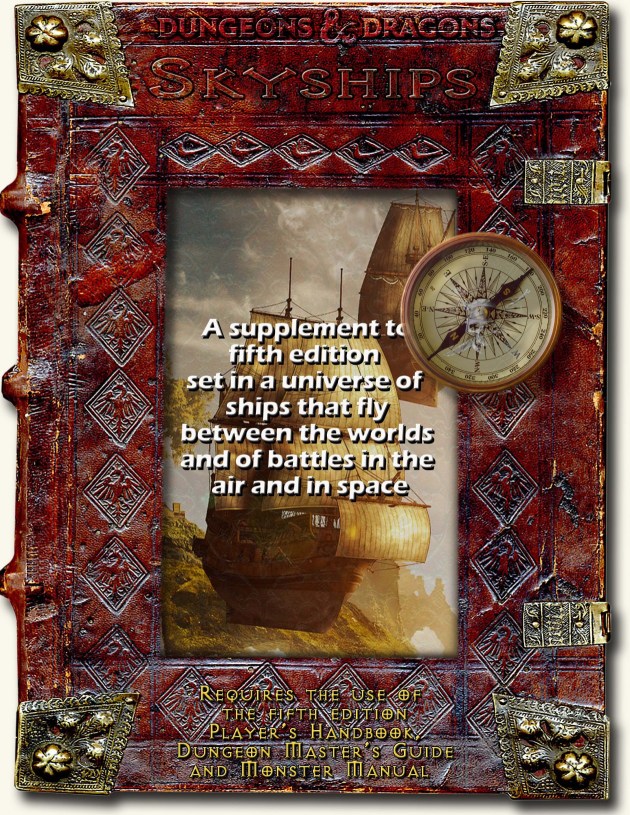
D&D Skyships is a supplement to fifth edition Dungeons & Dragons set in a universe of ships that fly between the worlds and of battles in the air and in space. This is a basic set of rules compatible with Dungeons & Dragons 5E that provide a foundation for taking your D&D adventures into space.




 Dungeon Master Assistance