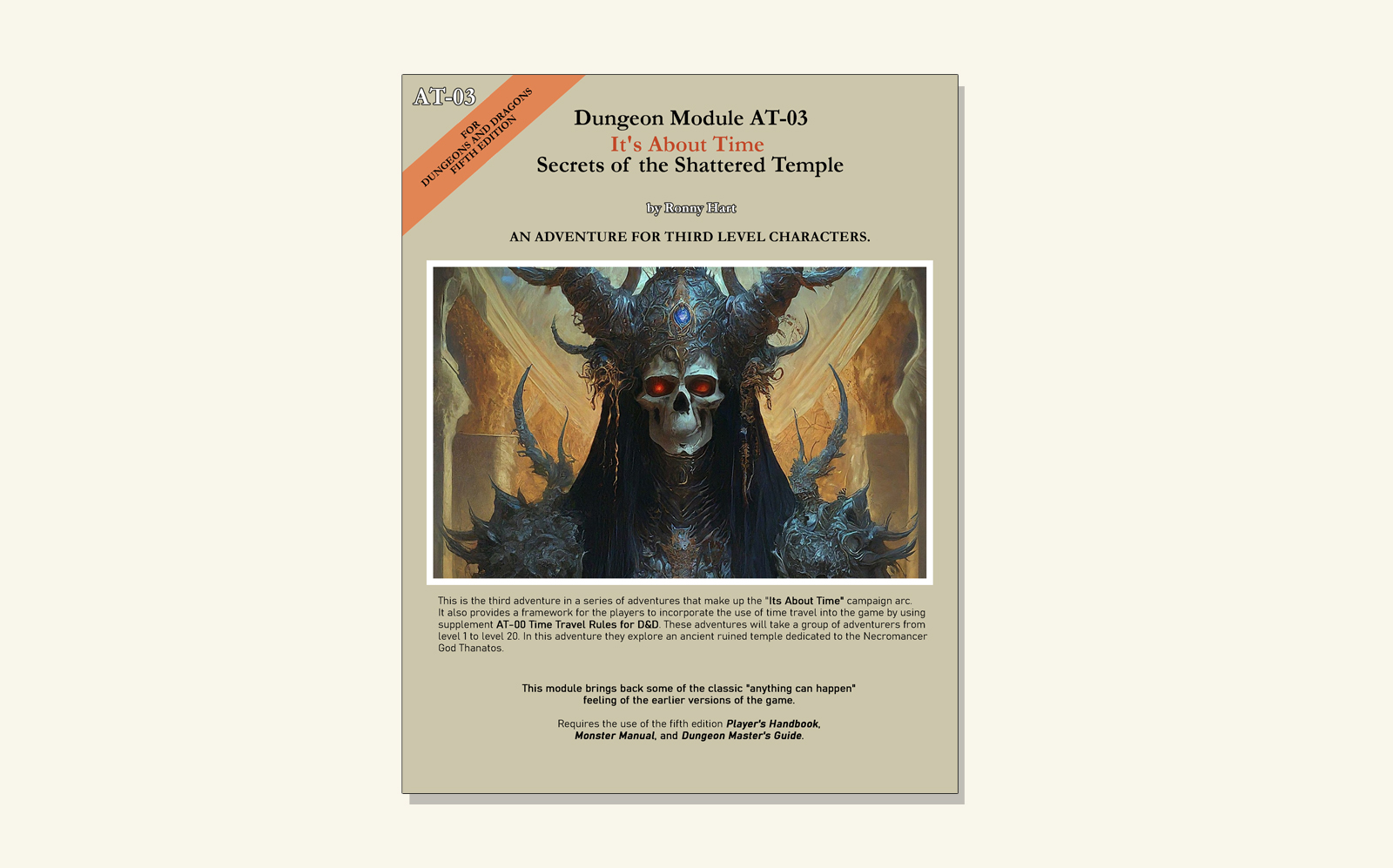
This is the third adventure in a series of adventures that I will be posting here, that will make up the “Its About Time” campaign arc. These adventures will take a group of adventurers from level 1 to level 20.
This is the third adventure in the series. It is a D&D 5E adventure for Dungeon Master’s (DMs) to take a group of 3rd level Player Characters (PCs) on an old fashion dungeon crawl where they explore an ancient underground ruined temple, filled with monsters, traps, puzzles and lots of secret doors. Even if you have no intention of running this adventure, it provides tools you may find useful in your campaign.
There are tips on tracking time and resources in a dungeon
I talk about my house rule for finding secret doors and my thoughts regarding random encounters.
The digital accessories pack includes maps for each dungeon floor. There are both color and black and white versions, A DM version with with room numbers, secret door, and trap locations.
There are 3 new monsters, complete with stat blocks, images and tokens for use on virtual table tops (VTT).
For each encountered monster, it lists the page number where that monster can be found in the Monster Manuel or, for new monsters, in the adventure. It then has an abbreviated version of the monster’s stat block on the page with the encounter.
Check it out and let me know what you think about it in the comments section below.
The next adventure will be “AT-04 The Cogs of Lost Time,” where the party lands in Chronopolis, a lost city on the lawful plane of Mechanus. Here, they encounter temporal anomalies, puzzles guarded by Modrons, and the long-dead ancestor of their friend Lander, all while searching for a fabled artifact: the Chronometer of Harmony.
This is the second adventure in a series of adventures that I will be posting here, that will make up the “Its About Time” campaign arc. These adventures will take a group of adventurers from level 1 to level 20.
This is the second adventure in the series. It is a D&D 5E adventure for Dungeon Master’s (DMs) to take a group of 2nd level Player Characters (PCs) on an exploration of an island that has way too many undead creatures. Even if you have no intention of running this adventure, it provides tools you may find useful in your campaign.
This introduces a simplified calendar that I have used in several campaigns.
This a micro-hex crawl. Where hex crawls typically use a scale of 6-10 miles per hex, or 20-70 miles per hex for larger regions, this adventure uses a map where each hex is only one mile across. This micro-hex crawl packs a lot of interesting features and encounters into a relatively small area.
This introduces a system for using a single random encounter table for encounters of different difficulties, depending on which die you roll.
It has 12 new monsters, complete with stat blocks, images and tokens you can use if you are playing on a virtual table top (VTT).
For each encountered monster, it lists the page number where that monster can be found in the Monster Manuel or, for new monsters, in the adventure. It then has an abbreviated version of the monster’s stat block on the page with the encounter.
Check it out and let me know what you think about it in the comments section below.
The next adventure will be a dungeon crawl, “AT-03 Secrets of the Shattered Temple.”
Revision 1 (June 11, 2024): On page 1, I changed “The PCs start this adventure with 1 Time Point.” to “The PCs start this adventure with 2 Time Points.”
I want to give a shout to to Jan Veenendaal. He has a web site that I used to create the stat blocks I used in this adventure. Here is how he describes it:
I created a website where you can create statblocks really easy: you enter the texts, the site does all the formatting. It will allow you to create PNG files, and a few other formats.
The site is free, does not collect data (everything stays on your computer), and is completely open source. Also, it is fine to publish whatever you create using it under Wizards’ Fan Content policy.
These new house rules are more streamlined and easier to implement into your game. One problem with the older version is that it contained very little for players who characters weren’t spellcasters, and spellcasters didn’t get very many useful time related spells. So this version includes Time Points, Time Checks, and 71 Chronology spells.
Time Points: A character’s Time Points represent his ability to detect and interact with the timeline. All PCs get Time Points as they advance in level. They can spend them for things like rewinding time to re-roll a d20 (even a death save), or take a different action. Or have some other creature re-roll his attack. You get a chance to regain a lost or spent Time Point after a long rest. Also, as you accumulate more Time Points you gain bonuses to certain ability checks.
Time Checks: These are tied to your Time Points. When the DM has you make a Time Check you roll a d20 and add your Wisdom ability modifier and Time Points to the D20 roll. Several spells require you to succeed on a Time Check or the spell fails.
Chronology Spells: There is no Chronomancy class. If your character is attuned to the flow of time (as represented by your Time Points) and has one or more levels in a class that can cast magic spells, you can add all of the chronology spells to the spell list for that class. Otherwise, none of the spell casting rules for your class are changed. Player characters can add these to their list of spells available to their spellcasting class.
Another problem with any time travelling campaign is that the most useful time travel spells are necessarily high level spells that lower level PCs won’t have access to. This would appear to limit you to high level adventures. To address this I have included many low level spells and I am also working on a series of Time Travelling adventures (an adventure arc) that will take your group from level 1 up through level 20. I am calling it “It’s About Time“. I will be posting these here as they become available. As always, these will be free for you to download and use in your campaigns.
“A generic trademark, also known as a generalized trademark or proprietary eponym, is a trademark or brand name that, because of its popularity or significance, has become the generic term for, or synonymous with, a general class of products or services, usually against the intentions of the trademark’s owner.” (from Wikipedia) I am not a lawyer. This is simply my observation and is not intended as legal advice.
I believe that “Dungeons and Dragons” and “D&D” have become generic trademarks. Just like people may ask for a “Kleenex” when asking for a facial tissue, they often refer to all role playing games as “Dungeons and Dragons“.
Not long ago, when talking to most people, if I said that I played Dungeons and Dragons, they wouldn’t know what I was talking about. In the last five or so years D&D has exploded in popularity and most people know the name Dungeons and Dragons, even if they still don’t know much about it. However, this is the only role playing game they have heard of and may know very little about it. If you play a different TTRPG (table top role playing game) chances are the average person will have never heard of it.
A conversation may go something like this: “I play _______ every Friday evening.” [Fill in the blank with any TTRPG other than D&D.] “What is that?” “It’s a tabletop role playing game”. “What is that?” “It’s like Dungeons and Dragons.” “Oh, I’ve heard of that. Isn’t that where you sit around a table, roll dice and pretend to fight monsters?” “Yeah, kinda.”
To most people, any game where you sit around a table, roll dice, move little miniature people around and pretend that your character is fighting monsters, is Dungeons and Dragons. And, to tell the honest truth, that isn’t necessarily a bad definition. If you tried to tell your friend what the difference is between D&D and your preferred game it would boil down to your preferred rules. But, the rules aren’t necessary to understand what the game is about, and why we love it.
If you, like me, love fifth edition Dungeons and Dragons, there are most likely some rules that you think need to be changed. You may have some house rules that you use to improve the game. You are probably looking forward to the release of the updated rules that are scheduled to be released this year. You trust that WoTC (Wizards of the Coast) will make changes to improve on the existing rules. When they are released, you will probably switch to playing with the new rules, but you will still be playing Dungeons and Dragons. The same happened when third edition and v3.5 was released. It was all still Dungeons and Dragons.
So what is it when another company takes the Dungeon and Dragons rules (as are available to anyone in the SRD for fifth edition) and makes changes to improve on the existing rules? There is an argument to be made that these versions are still Dungeons and Dragons. Several different companies have done this. Some made major changes and some only added to the basic rules and made minor changes. I say that if you are plying any of these games you are still playing Dungeons and Dragons.
Why does any of this matter?
Many people, myself included, are unhappy with Hasbro, WoTC included, for many things they have done over the last 12 months. So much so that we are uncomfortable giving them any of our money. But we love the current version of Dungeons and Dragons. Of course, we could just continue playing the same game we have been playing for the last 10 years, but the idea of a new improved version is very appealing. So all I am saying is that if this describes you, don’t worry. You can upgrade your version of Dungeons and Dragons to a new and improved version without supporting WoTC. Just switch to one created by a different company. It will still be the same game, but will have changes that the authors think are an improvement. That is the same thing that WoTC is going to be doing with their new release.
I think that the easiest new version to switch to, the one that will be the most like the new version of D&D from WoTC but perhaps even better, is the one that is coming soon from Kobold Press that they are calling Tales of the Valiant. But I am tempted to call D&D 6E.
Dungeons and Dragons is by far the most popular TTRPG (Table Top Role Playing Game) in the world today but they are not the only one. 2024 is shaping up to be a banner year for TTRPGs. Here some you may not have heard of.
Here are some of the most popular TTRPGs going into 2024
13th Age, 2nd Edition (Pelgrane Press) Cy_Borg (Free League Publishing) Dragonbane / Drakar och Demoner (Free League) Dread (The Impossible Dream) Household (Two Little Mice) King Arthur Pendragon, 6th Edition (Chaosium) Legend of The Five Rings (John Wick) Mörk Borg (Free League Publishing) Mothership 1e (Tuesday Knight Games) Warhammer 40,000 Roleplay: Wrath & Glory (Cubicle Seven)
Here are some new TTRPGs that are coming out in 2024
Adventurer, Conqueror, King System II (Autarch LLC) Aether Nexus (Absolute Tabletop) Alien – Building Better Worlds (Free League Publishing) Amboria (Strange Owl Games) Break!! (Grey Wizard) Broken Weave (Cubicle 7) Cairn 2E (Space Penguin) Cohors Cthulhu (Modiphius) Crown & Skull (physical) (Rune Hammer) Daggerheart (Darrington Press) Deathmatch Island (Old Dog Games/Evil Hat Productions) Diablo RPG (Glass Cannon Unplugged & Blizzard Entertainment) Dragon’s Dogma 2 (Capcom) Eat the Reich (Rowan, Rook and Deckard) Final Fantasy XIV TTRPG (Square Enix) Gubat Banwa (makapatag) Heroes of Cerulea (Bläckfisk Publishing) His Majesty the Worm (Rise Up Comus) Inevitable (SoulMuppet Publishing) Into the Mother Lands (Green Ronin/Tanya DePass) Knave RPG 2E (Ben Milton) Lords of the Middle Sea (Chaosium) Monty Python’s Cocurricular Mediaeval Reenactment Programme (Exalted Funeral) Mutant – Ad Astra (Free League Publishing) Mythic Bastionland (Chris McDowall) Mythic Iceland 2E (Chaosium) Outgunned – Cinematic Action RPG (Two Little Mice) Pendragon 6e (Chaosium) Pioneer (Mongoose Publishing) QuestWorlds (Chaosium) Ronin (Slightly Reckless Games) Savage HeXXen (Ulisses Spiele) Shadow of the Weird Wizard (Schwalb Entertainment) Shadow Scar (R. Talsorian) Sinless (Courtney) Starfinder 2e (Paizo) Stonetop (penny lantern) Stormlight RPG (Brotherwise Games) Subversion (Fragging Unicorns Games) Tales from the Gods (Alastor Guzman) Tales of the Valiant (Kobold Press) Talislanta 6th Edition (Everything Epic)\ Teenage Mutant Ninja Turtles TTRPG (Palladium Books) The Electric State Roleplaying Game (Free League) The Hidden Isle (Cult of the Lizard King) The Laundry 2nd Edition (Cubicle 7) The MCDM RPG (MCDM Productions) The One Ring – Moria (Free League) The Secret World (Star Anvil Studios) The World Below (onyx Path) Tiny Cyberpunk (Gallant Knight Games) Triangle Agency (Haunted Table Games) Urban Shadows 2E (Magpie Games)\ Yazeba’s Bed & Breakfast (Possum Creek Games)
Google a few of these. You may be surprised at what you find. You may even find one (or more) that you want to play.





 Dungeon Master Assistance