Dungeon Master Assistance

Where anyone over 18 can share thoughts and ideas on RPGs.

Tag Archives: D&D

D&D 5E – General Purpose Cards

Generic-Cards

Cards for All Occasions

Download your free copy here.

I have previously posted Initiative Cards, Monster Cards and Spell Cards. Burt requested that I  also make Class Ability cards. I thought about it and made these general purpose cards instead.

All of the text on these cars can be edited to say whatever you want. I filled them in with some examples of how they could be used. You can fill them out, print them on your printer and cut them out to use at your gaming table. They could be used for any game and aren’t specifically intended for 5th edition Dungeons and Dragons.

Some ideas –

Class Abilities and Traits: The character sheet doesn’t have enough space to fully describe all of your character’s  abilities. You can print them on these easy to use cards instead.

Magical Items: I would print two copies of each magic item that I was going to place in a dungeon. The first would simply have it’s physical description. and perhaps I would draw a sketch of it on the back. I would give that one to the player that obtained it. The other one, I would keep and it would contain all of the magical abilities and curses it has.

Conditions: I will print out one of these for each condition for quick reference.

House Rules: I will print out most of my house rules so the players can refer to them as needed.

NPC’s: Cards with several different NPC’s with a sketch on the back. Keep them handy for random encounters, or for when you need one quickly.

I am sure you can devise a lot of other uses for these. Let me know what you come up with.

Dragon Hunt – Chapter 2, Part 10 – The Paladin

It was nearing noon. The large pendant on its silver chain rattled against the paladin’s polished breastplate as his warhorse reared to a stop. The pendant was in the form of a silver hand holding a silver lightning bolt, the holy symbol of Heironeous, the deity to whom Sir Olorry Gleamheart had dedicated his life and sacred honor. It flashed brightly in the sun as the he dismounted at the gate to the governor’s residence.
As he removed his helmet and gantlets he addressed the guards, “I must see the Governor at once!”
The guards looked at each other. The first one said, “Of course, Sir Gleamheart, sir. But, you see, he wasn’t expecting you and, well, perhaps if I have someone announce you he will grant you an audience when he is free.” It was not surprising that he knew who this knight in shining armor was. Everyone in town knew of this man.
A young man, a squire from his clothing and demeanor, ran up from the stables to take the paladin’s horse and see to any of his other needs. Gleamheart handed him this helmet and gauntlets and turned for him to assist in removing his cape. “Tell Governor Patrick that his godson seeks his counsel in regard to this dragon business.”
Just then there arose a commotion in the street. A man in a torn and battered city guard uniform and a crazed expression on his face was running toward them. “You must die!” he exclaimed as he ran directly toward Sir Gleamheart and raised his sword to attack. With a swiftness born from years of practice, the paladin drew his sword and in that same motion swung it into his attackers weapon with a force that nearly knocked it from his hand and, ducking and spinning, he pivoted on one sabaton covered foot, turned a full circle and struck the man in his chest with the other, sending the attacker to the ground. The two guards were just now drawing their swords. Before they could approach, Sir Gleamheart stopped them with a raised hand saying, “This man is obviously under some kind of spell.” Reaching the man before he could get back to his feet, the paladin spoke some ancient and mysterious words as he placed a hand on the man’s forehead. Almost instantly, the man dropped his sword and looked around as if seeing his surroundings clearly for the first time.
Seeing the sword still in the paladin’s hand, the man dropped onto both knees and said, “Sir Gleamheart, please spare me! It wasn’t I who meant you harm, it was Abraxas! The dragon! He hexed me! I swear it!”
“Of course,” Gleamheart said as he sheathed his sword. “You are injured,” he said as he offered him his hand. “Can you stand?” With Gleamheart’s help he stood uneasily. “Let me heal you.” Then, with a magical incantation he had recited many times before, he invoked Heironeous’ divine mercy to heal the man’s wounds. The man acted as many before him when first receiving magical healing. First disbelief in the sudden and compete healing of all his wounds and restoration of his health and vigor. Then extreme happiness at his good fortune. “How do you feel?” Gleamheart asked.
“I feel great!” he answered as he turned himself around with outstretched arms, examining his arms and chest where seconds before there had been multiple scratches and bruising. “Thank you! Thank you so much!”
“Thank Heironeous,” Gleamheart replied. “I am only his servant.” Then, turning to the squire he said “Bring this man some water. He looks thirsty.”
“Yes, now that you mention it. I guess that I haven’t had anything to eat or drink for nearly two days. Ever since the dragon snatched me from the ballista tower.”
“It is important that you tell me of your ordeal. All of it, in so far as you can remember.”
“Yes, of course. And I can remember it all clearly.”
“But wait, you must tell it all in front the governor, so it won’t lose anything in its retailing.” He grabbed the man by the arm and took him quickly to the large doors of the white granite building. Ignoring the startled guards at the door he cast a spell which pushed the doors open with a slam that could be heard in the street. Without breaking stride he continued into the large foyer. He turned and started to toward the assembly hall when a guard stepped in front of him. Before the paladin could push him aside, the guard pointed to the descending staircase to his left. “He is in the dining hall,” he said with a grin. Sir Gleamheart smiled in return and turned to proceed down the wide stairs and then along a short corridor with doors to either side to arrive in front of another pair of ornately carved doors. He had ran and played in the corridors of this mansion as a child and knew every alcove and secret passageway. From beyond the doors to the dining hall he could hear music playing. It was a song he remembered from his youth. He stopped and waited for the song to end. The sweet sound of a child singing to the strings of a high strung lute.
He opened the doors to see that the lute player was a young boy astride a pure white buck which was being led by a fair hared girl. She led the buck out a near side door as all eyes turned to the intruders.
As soon as he recognized who it was, the Governor called out to him from the far end of the room, “Olorry!” Then with a wave for him to come on in he corrected himself, “Sir Gleamheart! You and your guest come join us. We were just finishing our meal, but I’ll have them return with soup and mead.”
Governor Tamas Patrick had bright turquoise eyes that could be seen clearly from across the large room. His complexion seemed somewhat paler than the paladin remembered but his wavy brown hair was pinned back as was his custom from as far back as Olorry Gleamheart could remember. He was a tall man, but was now somewhat stoop shouldered. His was wearing a suit of leather armor in gray and copper. The great hall was lit only by clusters of candle chandeliers rendering it rather dark. All of the main rooms of the mansion were built underground for fear of dragon attacks. This was a rectangular room three times as long as it was wide. The governor sat at the head table. There were tables to the left and to the right. With the central area for entertainment and for the servants to access the tables. Although the room could easily seat 50 or more guests, there were less than 20 seated here now. There were various land owners, money lenders, high ranking military men, guild masters, the harbor master, and other nobles and knights. Many of the faces were familiar to Glemheart, but none more familiar than Gauwalt Byne, the old wizard sitting to the mayor’s right.
Pushing the suddenly timid guard forward, Gleamheart said, “Governor Patrick, I came to discuss the dragon hunt, but first this man has some valuable information to share.”
The room grew quiet and the guard looked nervously around. He then stood tall and straight. “My name is Quaintus Northant, second paviser, third armored company, blue division of the city watch. On the night of the dragon attack I was stationed on the ballista tower on the corner of Rosemont Street and the Warfe Road.” Looking back at the paladin seamed to give him courage to continue. “The fog was so thick we couldn’t see even as far as the next tower over. The first notion we had that the city was under attack was the screaming. And then we saw a flash of fire in the distance. We manned the ballista but couldn’t see no target. Then there was a dark shape coming down and the dragon grabbed me up. His scaly foot, it was like a crow’s claw, only big, you know? It was near as big as me and it crushed the breath out of me. It flew away with me. I tell you, I have never been so scared. I don’t know if I was more scared of being crushed to death, or of being dropped. I had no way of knowing where we were, or how high we were flying because of the fog.”
Looking around at all the eyes watching him, he swallowed hard and continued, “Finally he flew far enough away that he was out of the fog and I could see how high in the air we were. I held on tight and closed my eyes. A couple of minutes later he landed. I could see that we were near the coast, many miles north of here. He must have cast some kind of spell on me because all of a sudden I wasn’t afraid any more. It was like he was the greatest creature in the world and I was his best friend. I mean, he isn’t really my friend. I was under a spell and I just thought he was. You have to understand that I wouldn’t do anything to help Abraxas. I swore an oath to defend Rockport from dragon attack and I take that oath seriously.”
Governor Patrick assured him, “I understand, my boy. You are not in trouble. Please continue.”
“Well. He asked me a lot of questions about the expedition that was being organized to come after him.” Turning to Sir Gleamheart he said, “I am sorry, but I told him everything that I knew. After I told him where the wagons were being kept, he instructed me to return to town and slay you. Failing that I was to give you a message. Then he flew back towards Rockport. That was the last time I saw him. I started walking. I didn’t stop until I found you. You know the rest.”
Gleamheart asked, “The message, what was it?”
“Please don’t hold this against me. These are not my words, they are his …
“Abraxas, the largest, most fearsome, most deadly, and greatest dragon since Tiamat, supreme lord of all land over which he flies, issues this command to Sir Gleamheart. You shall abandon your ill-conceived expedition. You shall obtain the gem that I seek, and you shall return it to me personally. Do this and I will stop my assault on your towns and villages. Defy me and not only will your entire expedition be utterly destroyed, but I shall start a campaign of fire and destruction such as has never before been seen.”
Gleamheart said, “Did he say what the gem was that he wants me to bring him?”
Quaintus shook his head and said, “No. I got the impression that he thought you knew what gem he was talking about.”
Gleamheart said, “I only wish that I did, and that I had it. Perhaps I could end this whole bloody mess.” Then he pointed to the nearest table and said, “Sit. Eat. Thank you.”
Quaintus went around to the table and quickly set at the nearest spot. Halflings hurried to the table to bring him food and drink. Gleamheart walked up to the head table. “Governor,” he began, “the expedition is in dire need of volunteers.”
Tamas Patrick answered, “I have already encourage all city guards that wished to volunteer. I granted them leave and told them they could keep their share of the treasure. As I recall, you seemed pleased with the response.”
“The attack has changed all of that. Yesterday many of the volunteers withdrew their pledge and returned their shares. More left this morning. It has been reported that some were seen leaving the city and taking their shares with them. Taking into account those that were killed or wounded that we were not able to restore, we are left now with less than one in five of the original number of fighters.”
“I can order more men to volunteer,” the governor replied.
“No,” snapped Gleamheart. “I will not lead men who are forced to fight!”
From the governor’s right Gauwalt Byne spoke up, “Tamas, Olorry, have either of you asked King Veray for help?”
They both turned and stared at the old wizard. This small man in the black cloak and pointed hat that he always wore had been sitting and listening calmly until now.
“King Veray?” asked the governor. “He is sitting on his throne in the Golden City of Wheathorp, a thousand leagues and two mountain ranges away. He wouldn’t be able to get any troops here even if he could be persuaded to part with them.”
The wizard tapped his bony finger on the table, then turned to the governor, “You are always overlooking the power of magic. No, I don’t have the power to move large numbers of people a thousand leagues or more, but the King has more powerful wizards than me at his command, and may have other magical means of transport we are unaware of. All I am saying is that it could do no harm to ask.”
Governor Patrick looked at Sir Glramheart, then turned back to the wizard and said, “I don’t suppose it would do any harm to ask. Can you send him a missive?”
“I took the liberty of preparing this earlier. It needs only your seal,” the wizard said as he handed him a parchment.
The governor looked it over. It eloquently but briefly, described the entire situation. It ended in a formal request for any help in the form of willing fighters that the king could provide. After reading it, he held a stick of red wax in a candle flame to drip the wax onto the document and then pressed his signet ring into the hot wax. While he was doing this, his wizard was clearing the table in front of him and setting a small silver tray there. When the governor handed the document back to him, he placed it on the tray and cast his spell. The document disappeared with a sparkling flicker. “We must now wait for his reply.”
Gleamheart and the governor continued discussing the upcoming quest. Gleamheart said that he had been informed that the wagon makers and ballista maker are requiring coins on the barrelhead and will no longer accept the golden coins for a share of the treasure in payment, and furthermore that it will take at least a week to equip and provision even the small band of volunteers he now had available. The governor gave the paladin an account of the destruction from the attack and what emergency measures are now in place. While they talked the wizard noticed a small transparent globe appear near the center of the room. It floated just above head height and was as elusive as a whiff of pale smoke. No one else saw this magical apparition which the wizard recognized as the receiving eye of a scrying device. As he watched, it winked out of existence and a heartbeat later a black robed man with a long grey beard appeared.
//

D&D 5E – Bounded Accuracy

This is my attempt to explain the term “bounded accuracy”.

bounded accuracy

Bounded accuracy is the term that WotC uses to represent a role playing game design concept. It is not a “rule” and you won’t find it in the Player’s Handbook, but it is the foundational design philosophy behind the core of 5 Edition D&D.

The “accuracy” part of the term refers to how hard it is to do something. For combat, this relates directly to armor class and bonuses to your attack roll.

The “bounded” part of the term refers to establishing upper limits.

 What are the limits?

There is a maximum Ability Score of 20, a maximum Difficulty Class of 30, and a maximum Armor Class of 30. There is a maximum Ability bonus of +5 and a maximum Proficiency Bonus of +6 making a maximum total bonus of +11 (resulting in a maximum score of 30 on a roll of 19.)

Also, there is typically no more than +1 on magic items, with +3 being the cap and representing things of artifact power. The game makes no assumption that you have magical enhancement bonuses on your weapons and armor.

This is all about the Core Mechanic: To resolve an action roll a 20-sided die and add modifiers. If the result is greater than or equal to a target number then the action succeeds.

Regardless if this target number is a Difficulty Class (DC) or an Armor Class (AC), the concept is the same.

DC-or-AC Difficulty To Break Armor To Hit
5 Very Easy a glass bottle an inanimate object
10 Easy a wooden chair No Armor a badger
15 Medium a simple door Leather Armor* a troll
20 Hard a small chest Plate Armor** a dragon***
25 Very Hard a treasure chest a tarrasque
30 Nearly Impossible a masonry wall(1 ft. thick) a deity
*with shield and +2 Dex modifier **with shield ***Adult Red Dragon is AC 19

To explain the effects of bounded accuracy on the game, it can be illustrative to compare its effect on three different characters.

Let’s start with a typical commoner. We’ll call him Fred. Fred is average in every respect. All of his ability scores are average (10) and Fred has no proficiencies or special skills. The table above was designed with Fred in mind. If any task is hard for Fred, it has a DC of 20. Fred adds no modifiers to his d20 roll when he attempts a task.

Our second character is Norman. Norman is a first level Fighter. The highest modifier Norman could add to his d20 roll would be about +5 (Ability +3, Proficiency +2).

Our third character is Conan. Conan is a 20th level Fighter. The highest modifier Conan could add to his d20 roll would be about +11 (Ability +5, Proficiency +6).

All three characters attempt to do something “hard”. They all need a 20. Fred rolls a 20 and succeeds. Norman’s roll is only 15, but with his +5 modifier he also succeeds. Conan only rolls a 9, but with his +11 modifier, he succeeds. So this “hard” thing is hard for Fred, not so hard for Norman and it is easy for Conan. Being normal PCs, Norman and Conan are better at some things than they are at others. They do not have maximum ability scores in all of their abilities, and they are not proficient at everything. At some tasks, they may not have a better chance of success than Fred does. Conversely, not all Non-Player Characters (NPCs) are as “average” as Fred. At some tasks, a NPC may have an ability score that is higher than a PC and a larger proficiency bonus. So most tasks within reach of specialist also fall within the ability of a lucky novice.

Higher level characters and tougher monsters are that way because they can do more damage, more often, in more ways than lower level characters.

If you are new to D&D, this may all seem obvious, and hardly worth more than a passing glance. However, this is a break from some earlier versions of the game. In some earlier versions, your PC’s “to hit” bonuses and Armor Class increased with each level and thus forced monster attacks/defenses to also increase with level. This resulted in lower level creatures being unable to have any possibility of hitting higher level PCs and visa-versa. This was done in the very reasonable goal of allowing higher level PCs to combat tougher monsters. D&D 5e accomplishes this goal, not by making tougher monsters harder to hit but by making them harder to defeat by giving them more hit points. So as PCs increase in level they do improve in their ability to hit higher armor classes (although at a much slower rate) but their ability to defeat tougher opponents comes mainly from their increased ability to inflict more damage when they do hit, and their increased capacity to survive stronger attacks due to their own increased number of hit points. So in this edition, characters can meaningfully interact with the same threats for most of their career, if they so choose. Lower level monsters will still be a threat at higher levels if they are encountered in larger numbers.

 This was described by Rodney Thompson in Legends & Lore (June 4th, 2012) on the Wizards of the Coast website. This is no longer available on their web site, so I quote from it here:

The basic premise behind the bounded accuracy system is simple: we make no assumptions on the DM’s side of the game that the player’s attack and spell accuracy, or their defenses, increase as a result of gaining levels. Instead, we represent the difference in characters of various levels primarily through their hit points, the amount of damage they deal, and the various new abilities they have gained. Characters can fight tougher monsters not because they can finally hit them, but because their damage is sufficient to take a significant chunk out of the monster’s hit points; likewise, the character can now stand up to a few hits from that monster without being killed easily, thanks to the character’s increased hit points. Furthermore, gaining levels grants the characters new capabilities, which go much farther toward making your character feel different than simple numerical increases.

Now, note that I said that we make no assumptions on the DM’s side of the game about increased accuracy and defenses. This does not mean that the players do not gain bonuses to accuracy and defenses. It does mean, however, that we do not need to make sure that characters advance on a set schedule, and we can let each class advance at its own appropriate pace. Thus, wizards don’t have to gain a +10 bonus to weapon attack rolls just for reaching a higher level in order to keep participating; if wizards never gain an accuracy bonus, they can still contribute just fine to the ongoing play experience.

This extends beyond simple attacks and damage. We also make the same assumptions about character ability modifiers and skill bonuses. Thus, our expected DCs do not scale automatically with level, and instead a DC is left to represent the fixed value of the difficulty of some task, not the difficulty of the task relative to level.


The link is back up on the Wizard’s site if you want to read Rodney Thompson’s comments in their entirety :  Legends & Lore Archive | 6/4/2012

D&D 5E – Chase rules

Optional House Rules for D&D 5e

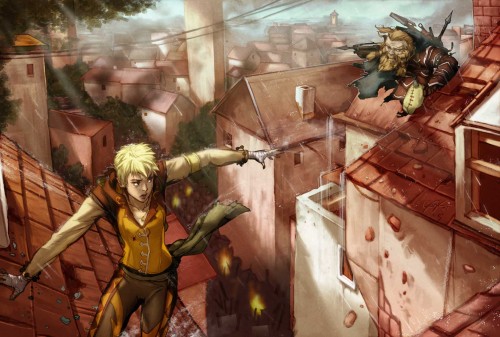
rooftop_chase-500x337

[Check out this newer post on this subject: D&D 5E – Quick Reference – Chase Rules.]

A couple of years ago I published chase rules for D&D v3.5. You can download them here.
With the release of the fifth edition of Dungeons and Dragons, those rules seem rather heavy. You can still use them if your campaign will have a lot of chases. However, in keeping with the slimmed down rules of 5e, I am proposing a simple house rule for chases. The description below is in terms of a PC character chasing a fleeing foe. Keep in mind that the same rules apply when the PC is the one fleeing.

What if your opponent tries to run away?

Most of the time the standard rules for combat work just fine. A chase may occur when one or more opponent turns and runs away. In game terms, he uses the Dash action to spend his entire turn moving away from combat as quickly as possible. If he starts his turn within 5 feet of you, or passes within 5 feet of you, you can use your Reaction to make an opportunity attack.

What if you want to chase him?

It all depends on how far away you are from him at the beginning of your turn. Compare this distance to your characters speed. There are three possible results.

1) You can use your Move to get within 5 feet of him.

  • You can attack him and combat continues.

2) You can catch up to him by using your Dash action.

[If you have enough speed to pass him you may do that, but if you come within 5 feet of him as you pass, he gets to use his Reaction to make an opportunity attack against you, so you will typically want to stop when you get within 5 feet.]
  • You stop within 5 feet of him.
  • If he continues to run away you can use your Reaction to attack him. [If you speed is the same or greater than his, this can repeat each round. This is not a good strategy for your opponent, unless he can reach shelter or he is leading you into an ambush.]
  • Or he may choose to turn and fight on his turn.

3) You cannot get to within 5 feet of him using your Dash action.

  • If your speed is greater than his, you should catch up with him in a few rounds.
  • If your speed is less than his, and you have no way to increase your speed, he will get farther away each round. You may as well attempt to shoot him with ranged weapons until he is out of range.
  • If your speed is the same as his, he will stay the same distance away from you forever. You move closer on your turn, he moves away on his. This is where a house rule is needed.

House Rule #1

A chase is not a race. There are multiple factors that could enable a creature to catch up to another one that has the same speed. Even a lucky slower creature should have a chance. Here is my house rule:

At the end of a turn where you have used a Dash action to advance toward an opponent that is fleeing, you may call for a Strength (Athletics) contest between the two characters. If you win the contest, you move an additional 5 feet toward your opponent. If you lose the contest, you move back 5 feet.

House Rule #2

Characters can’t continue running at top speed forever.  For extended chases:

After 5 rounds of continuous running, a character must make a [DC 15] Constitution save or suffer one level of exhaustion. Each additional round of continuous running requires another save at an additional +2 to the DC.

The DM may rule that certain creatures are immune to this exhaustion effect, or that they can run for longer periods before requiring this check.

D&D 5E – Quick Reference – Combat

Combat-main_FullThe combat rules for 5th Edition Dungeons and Dragons are much simpler than previous editions. This is a quick reference guide to the new rules. Refer to the complete rules (which can be downloaded for free here) for more detailed information. This is my own interpretation of those rules. Refer to the DM notes at the end for my house rules.

Each round represents 6 seconds in the game world. Anything a person could reasonably do in 6 seconds, your character can do in 1 round.

Each round, during your turn, you can move and take one action.

• You don’t have to move, but if you choose to, you can move a distance up to your speed. You can move before or after you take an action, or you can move first, take an action, and then move again, as long as the total distance moved doesn’t exceed your speed.
• You don’t have to take an action during your turn, but if you choose to, you can attempt to do anything that could be accomplished in 6 seconds or less. The most common action taken in combat is the attack action. See below for a list of actions that can be performed in combat.
• If your action permits multiple attacks, you can move between attacks so long as you haven’t used all of your move distance based on your speed.
• Your move can include jumping onto or off of things, jumping over things, climbing walls or ropes, swinging on ropes or chandeliers, or moving in any way that your character is capable of such as swimming or flying for example.

You can interact with one object as part of either your move or your action.

You can manipulate the object in an uncomplicated way. Some examples include:
•    Draw or sheath a weapon
•    Draw Two One-Handed Weapons [You can normally draw only 1 weapon for free on your turn. Dual Wielder lets you draw 2.]
•    Transfer an item from one hand to the other
•    Load a crossbow
•    Retrieve or put away a stored item*
•    Pick up an item
•    Move an object
•    Open a chest
•    Open a door
* You may only retrieve an item if it was stowed for easy access. If you must dig through your backpack to find something inside, it may require use of an action to retrieve it.
Doing more than one of these things requires the use of an action.

As part of your move or your action, you can do things that take little or no time and don’t interfere with your movement.

These activities take very little time, though there may be limits to the number you can perform in a turn. Examples include:
•    Drawing ammunition for use with a ranged weapon (such as arrows, bolts, sling bullets, or shuriken).
•    Dropping an item to your feet or within 5 feet of your current location.
•    Dropping to a prone position. (Standing up from prone, however, takes half of your movement for the turn.)
•    Speaking (you can always speak, even when it isn’t your turn – within reason.)

You may be able to take an additional, bonus action.

• A special ability, spell, or other feature of the game may allow you to do something as a bonus action. You are only allowed one bonus action in a round.
•    Example: If you have a short sword in one hand and dagger in the other, after using your action to attack with the sword, you can use a bonus action to attack with the dagger (refer to the rules on two-weapon fighting.)

You are allowed one reaction each round.

A reaction is an action that is triggered by an external event.

• A special ability, spell, or other feature of the game may allow you to react to a specific triggering event.
• If an opponent attempts to move past you or attacks you and then attempts to move away, you get a free swing at him. This is called an opportunity attack, and it is the most common reaction.
• Another example would be a wizard’s feather fall spell that is triggered when the wizard is pushed over a cliff, or steps into a pit trap.
• Your reaction does not have to occur during your turn, but can occur at any time during the round. If it occurs during another’s turn, his turn is suspended until your reaction is resolved.

Surprise

If surprised, you lose your turn for the first round of combat. After your turn, you are no longer surprised so you can use a reaction after your turn has passed, even during the remainder of the first round.

Actions in Combat

During your turn in a combat round, you can perform any one of the following actions.

Attack

You can make one melee or ranged attack. Some features may allow you to make more than one attack with this action.

Cast a Spell

You can cast any spell that you are capable of casting that has a listed casting time of one action.

Note regarding components: Retrieving the required material (M) component from a pocket or pouch is included in the “Cast a Spell” action. If the spell also has a somatic (S) component, you can perform the required hand gestures while holding the material component in that same hand. Therefore, if you are holding two weapons, or a weapon and a shield, at the beginning of your turn, you can sheath one weapon (refer to “interact with one object” above) and then draw the material component and cast the spell all in the same round. [A material component is not consumed with the casting of the spell, unless the spell description specifically says that it is.]

Dash

Rather than performing any other action, you spend the entire round moving. This allows you to move twice as far this round. It is effectively a double move action. [You use your dash action to move your speed then use your move to go that distance again.]

Disengage

If you start the round within 5 feet of an opponent that can see you, you can use this action to move away from him without provoking an opportunity attack. [The disengage action does not include a move. You use the disengage action to avoid an opportunity attack while you use your move to travel up to your speed.]

Dodge

This is a total defense action. You spend the round trying to avoid being hit. Until the start of your next turn, any attack roll made against you has disadvantage if you can see the attacker, and you make Dexterity saving throws with advantage.

Help

You can use your action to help an ally attack an opponent within 5 feet of you. You don’t make an attack yourself, but when your friend attacks, his first attack roll is made with advantage.
Or you can help him with any other task. If you are in position to do so, and your assistance could reasonably be seen to be of help, he will gain advantage on his ability check to accomplish the task.

Hide

The act of hiding requires an action to attempt. You must make a Dexterity (Stealth) check to see if you successfully hide from your opponents.
Additional information regarding the hide action here: Stealth and Hiding

Ready

Rather than taking and action during your turn, you wait for some specific event and then take your action as a reaction. You can still move up to the distance indicated by your move rate, but you can take no other action this round. You must specify two things –
1) What the triggering event will be.
This can be anything you think might happen that you can observe. If the event occurs before the start of your turn on the next round you can perform your readied action at that time. Some examples could be: If the sniper sticks his head up, If more Orcs come around the corner, If the rope brakes, If the water level rises, If the evil magic user starts to cast a spell, If the guard spots the thief, If the prisoner attempts to escape.
2) What action you will take.
This can be any of the combat actions.
Note that this action will be a reaction and you can only have one reaction per round. This means that if you take another reaction, you lose your readied action. Conversely, if you use your readied action you can have no other reactions this round.
• If the triggering event occurs, you can choose to not take your readied action.
• If you choose Dash as a readied action, you can move up to your move rate.
• If you choose Cast a Spell as a readied action, you cast the spell during your turn but hold off on releasing the energy of the spell until the triggering event occurs. You must concentrate to hold the spell’s energy. Anything that breaks your concentration before the final release of the spell’s energy results in the loss of the spell. If the triggering event doesn’t occur this round, you can continue to hold the spell with continued concentration into the following round, or you can cast it as an action on your next turn, or you can lose it.

Search

You can use your action to attempt to find something. The DM might require you to make a Wisdom (Perception) check or an Intelligence (Investigation) check.

Use an Object

An object may require an action for you to use it, or you may need to use this action to interact with more than one object in a round.

Improvised Action

There are many more things that a combatant could do during a round than can be accounted for in the above actions. When you want to attempt something that is not covered by any of the above actions, you can use an improvised action.

Examples of an improvised action:

“I want to pull the rug out from under that guy.”
“I want to jump on the monster and attack him with my sword while I ride on to his back.”
“I want to talk them into surrendering.”
“I want to break that flask the bad guy is holding.” (attack an object)
“I want to slide down the stairs on my shield while I fire arrows at the enemy.”
“I want to intimidate then into running away.”
“I want to grab that piece of folded parchment that is sticking out of his vest pocket.”
“I want to slide under the table and stab that guy in his ankle with my dagger.”
“I want to sheath my sword and walk up to that guy and tweak his nose.”
“I want to hit that rope with my arrow in such a way as to cut the rope and let the body that is hanging from it fall to the ground.”
“I want to disarm my opponent.” (This could be a called shot to the hand, shattering an opponent’s weapon, severing a spear shaft, entangling a sword arm, or using the flat of a blade to smack a weapon from an enemy’s hand.)
“I want to push him into the pit.” (Use the rules for “Shoving a Creature” – this could include shield bashes, tackles, bull rushes, overruns, tables hurled into enemies, doors smashed into opponents on the other side, and so on. Generally speaking, this could be any attempt to use brute strength to move an opponent. Any attempt to shove creatures off a nearby cliff, through a railing, out a chapel’s stained-glass window, and so on will allow the creature a dexterity save.)
“I want to trip that guy.” (This could be any attempt to knock an enemy off its feet. Whether it’s hooking an enemy’s leg, stabbing a kneecap, knocking an opponent off-balance, hurling an enemy away, sweeping an enemy’s legs, or some other maneuver, this improvised action would allow the warrior to knock an enemy prone.)

The following rules apply to improvised actions:
1. You must explain the improvised action to the DM. The DM may rule that what you want to do will require more than one round, or that it is simply impossible (you can’t fire an arrow into the sky and hit the moon). He may ask you to be more specific regarding the action you want to take and how the action will achieve the results you want.
2. The improvised action can also include all or part of your move. Successfully jumping on – or diving into a creature will give you advantage on the attack roll. A failed attempt results in your move stopping at the point there the attack takes place and may grant your opponent an advantage on his next attack against you.
3. To perform the improvised action the DM will normally have you make an ability check. The DM will assign an appropriate difficulty class and will explain possible consequences if the attempted action fails. For example, if you attempt to jump off of the balcony onto the monster in the center of the room and miss you may end up prone.

Most improvised actions can be resolved as simple contests.
Player: “I want to try to [describes some form of physical contest other than an attack roll].”
DM: “Okay, make a Strength (Athletics) check.”
DM compares result to opponent’s Strength (Athletics) or Dexterity (Acrobatics) check, perhaps giving someone advantage or disadvantage.

DM Notes: Some of the information above deviates somewhat from the official rules. You can consider these to be my House Rules.
Retrieving a stored Item – This should only be allowed as part of your move or action if you don’t have to dig through your backpack to find it.
Speaking – Should be allowed at any time
Disengage – I will only allow this action if you are currently engaged in combat and want to withdraw without provoking an opportunity attack.
Help – It only makes logical sense to be able to help another if there is some action that you could take that might possibly be of help to him.
Improvised action – I got rather wordy here, but I think these should be encouraged.

D&D 5E – Character Sheet

Sheets

Download this Autofill PDF file HERE

UPDATE: The character sheets on this page are an older version. For the most recent auto-calculate Character Sheets click HERE.

Here are some ready-to-play first level character sheets: D&D 5E – Quick Play Character Sheets

I really like the new fifth edition rules, but I am not a big fan of the character sheet provided by Wizards of the Coasts in The Basic Rules for Dungeons and Dragons, so I created my own. I found several others that fans have created, but I don’t care for them much either.

This has everything the player needs for combat on the front or first page and everything else on the back or second page. There is a third sheet for spell casters.

Revision:

I revised the file somewhat. I added lifestyle expenses to the second page and made a few other minor changes. It fills in the current date and calculates ability modifiers. You can click on the date and change it. If you delete the date it fills in with the current date. If you don’t want any date printed, you can delete the date and add a space. I also added a “Clear” button on the first page. It doesn’t print, but be careful with it because it clears all of the information you have added to all three pages. I purposefully did not calculate any skill or saving throw bonuses. Typically, your skill bonuses will be your ability modifier. Put a check mark in the little box next to a skill if you are proficient in that skill and add your proficiency bonus to your ability modifier. I didn’t calculate this, because there are situations where some characters have a larger bonus than this.
Many thanks to George Karas for his help and suggestions. He felt that the spell list needed more room for more lengthy spell descriptions. For simplicity sake, I decided not to do that. My feeling is that if you want a more complete spell description you could copy the descriptions onto cards (that is what I would do) or add another sheet.
The border is wider on the left on page 1 and on the right on page 2. The reason for this is for those of you that want to print your character sheet on two sides of a single sheet of paper. There should be a wide enough border that you can punch holes on the side to put it into a three ring binder.

D&D 5E – Weight of Standard Equipment Packs

Nodwick

The Basic Rules for Dungeons and Dragons are available as a free pdf download from Wizards of the Coasts. If you don’t have yours yet they are available here. I am very excited about these and will post a full review later. For now, here is something I hope you will find helpful.

The rules for encumbrance is a variant. However, if you choose to use them it would help if the weight of the various equipment packs were listed in the D&D Basic Rules. I have added up the weight of each of the individual items in each pack and have listed them here. These weights assume a full waterskin, for the packs that contain one. You can subtract 5 lb. for an empty waterskin.

Just out of curiosity, I also added up the cost of the packs if the items were purchased separately. It turns out that most of them really are a bargain, so if you like most of the items they contain, you may as well go with a pack.

Burglar’s Pack (16 gp): Total Weight 46.5 lb (Over 21 gp. if purchased separately.)

Diplomat’s Pack (39 gp): Total Weight 46 lb (Slightly over 39 gp. if purchased separately.)

Dungeoneer’s Pack (12 gp): Total Weight 61.5 lb (Over 17 gp. if purchased separately.)

Entertainer’s Pack (40 gp): Total Weight 38 lb (Over 63 gp. if purchased separately.)

Explorer’s Pack (10 gp): Total Weight 59 lb (Same cost of 10 gp. if purchased separately.)

Priest’s Pack (19 gp): Total Weight 25 lb (Over 27 gp. if purchased separately.)
The Priest’s Pack contains items that are not listed for purchase separately. Here are the values I used.
alms box, [a well-made small wooden box about 1 gp and 1 lb.]
2 blocks of incense, [2 smaller blocks of cheap incense should cost about 1 gp, the weight is negligible]
censer, [a light weight brass censer and chain should be about the same as a holy symbol 5 gp 1 lb]
vestments, [Fine clothes cost 15 gp and weigh 6 lb. so we can use that]

Scholar’s Pack (40 gp): Total Weight 11 lb (Cost of a little over 40 gp. if purchased separately.)
This assumes a small knife cost 2 gold pieces and a little bag of sand is 1 lb.

//

D&D 5E – Rules for Free

Dragon_5th

I am very pleased, and presently surprised, at Wizards of the Coast releasing the core rules for 5th edition Dungeons and Dragons as a free PDF download. They are calling this “Basic Rules for D&D” and it is scheduled for release on July 3, the same day as the release of the Starter Set.

Mike Mearls said on “Legends & Lore” today, “For the D&D basic rules, our initial release will include character creation. It features the human, elf, dwarf, and halfling for races, along with the cleric, fighter, rogue, and wizard classes, all from 1st level to 20th level. As the Monster Manual and Dungeon Master’s Guide near completion, we’ll add to the basic rules with more material to grow it into a complete game. Our goal is to continue to make updates to the basic rules for D&D until the end of the year, at which point it will be feature complete.” (Read “A Bit More on the Basic Rules for D&D” here.)

So we will have to wait until the end of the year for the full version that will include more monsters and more information on running your own campaign.  I can hardly wait to download this.

//

D&D Next – Time Travel Rules

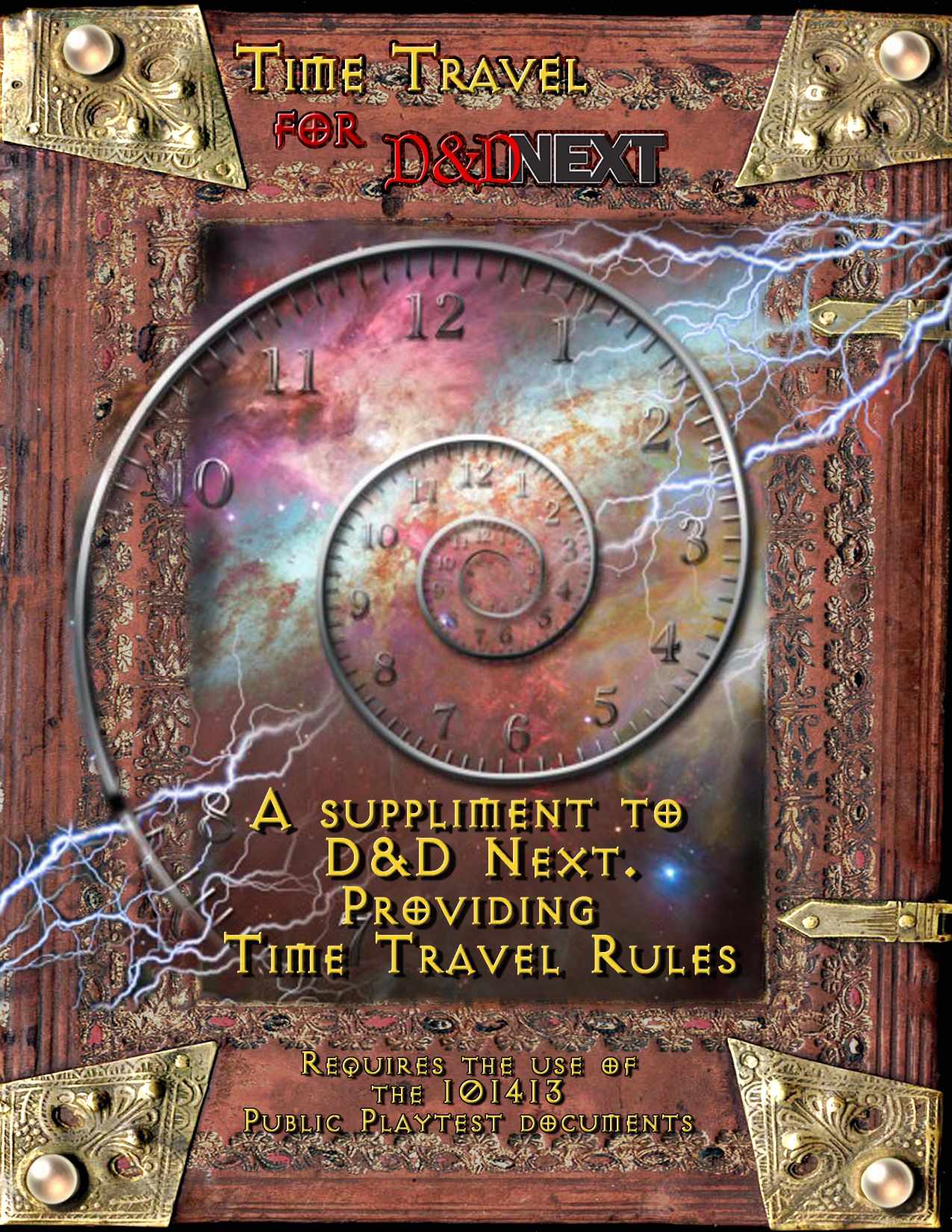
Download a free copy of Time Travel for D&D [ here].

This is a complete re-write of the Time Travel supplement to third edition Dungeons & Dragons that I published [here] in 2012. This completely abandons those rules in preference to these new simplified rules and brings them in line with D&D Next (the current playtest version of v5.0). You can use these rules with v3.5 with a little adjustment.

Consider this an interim version of these rules. I will make any needed tweaks to them and re-publish them when the official v5.0 rules are published.

I got a lot of good information from “Chronomancer” published by TSR in 1995. I am using it’s concept of Temporal Prime as a tool for time travel. I also used some of the spells presented there, with a little modification.

As always, all comments are welcome.

Enjoy!

D&D Next – Time Travel Re-visited

Time-Travel

“Time flies like an arrow. Fruit flies like a banana.”

Time travel is easy, explaining it is hard.

I was looking over my time travel rules (posted here). I was thinking that I hadn’t explained them very well and that I also needed to re-work them for the next version of D&D. The more I thought about it, the more I realized that they needed a complete overhaul. Before posting a new set of time travel rules I wanted to post this. Below is a summary of my current thinking on how time travel should work for D&D.

First a little thought experiment

Consider this. Your friend the wizard travels 24 hours into the past. While there, he sneaks into your room and shaves your head while you sleep. The question is this: If you are watching him when he cast the spell and he disappears into the past, what do you experience? Are you now bald? There are problems with every answer.

1) You can’t still have your hair. If you do it would mean that the wizard was unsuccessful in changing the past.

2) You couldn’t just suddenly become bald. What if the wizard doesn’t cast another spell to “return” to the present, but simply hangs out with you all day?

3) Okay, then perhaps your head is shaved, and it has been since you woke up this morning. This is a paradox, because if you have been bald all day it would mean that you were that way before the wizard cast the spell that resulted in your current condition.

There must be another answer, and I believe that I have found it. Think about this a little. I will give you the answer a little later.

This is how I think time travel should work in the D&D game.

Timelines

There is only one timeline. Everyone is in it. The “river of time”. It is easy to travel forward in time. Everyone does it. You are doing it now. It takes only one second to move forward one second into the future. If you were to sleep for 17 years, you would wake up 17 years in the future.

All time travel is along this one timeline. Although there is only one timeline, this doesn’t mean that it can’t be changed.

Rule #1 – “Everything that you do changes the future.”

This may seem so obvious that it is hardly worth mentioning. However remember that we are talking about time travel. If you travel along the timeline to a point in the past anything you do there will change everything on the timeline from that point forward.

Rule #2 – “You can’t change the past.”

Well, I suppose you could travel to the past and then change it, but nothing that you do now can change anything that was done before. Again, this seems obvious but it is worth remembering that you can’t travel into the future and do anything that will change what is happening in the present.

There are two types of time travel, tactical and strategic.

Tactical Time Travel

Similar to time travel in the movie “Groundhog Day”.

Tactical time travel is free from most time travel paradoxes. It moves the timeline forward or back to the appointed time. It is not normally used to travel farther than a single day and cannot be used to travel back to a time before the time traveler was fully grown. Tactical time travel has no “return” spell that allows the traveler to go back to his original time, but he can use strategic time travel to go back should he choose to.

Tactical Time Travel to the Future

In its simplest form, this is how everyone travels through time, one second at a time. For a time traveler that uses tactical time travel to go into the future the time passes so quickly that he seems to instantly appear at the appointed time in the future. To those around him, he disappears and later re-appears. The timeline has moved on and he has moved with it as if he had been in a type of suspended animation during the time that passed. This is often used to “hide” from an otherwise unavoidable encounter or to disappear until the storm passes.

Tactical Time Travel to the Past

This is often used to correct some mistake in the recent past, or to re-fight a recent battle. The timeline is erased back to the time traveled to. It is like pressing the “rewind” button. Everyone and everything reverts to the way it was then. The time traveler finds himself in the body he had then, where it was then, doing what he was doing then, and everything is as it was then with the exception that the time traveler, and he alone, recalls future events as they happened before. He is free to repeat his previous actions or change them as he sees fit. Everyone else will do what they did before unless the time traveler intervenes. Purely random events may have different outcomes. All dice will be re-rolled for any battle or game of chance that the time traveler participates in.

The time traveler cannot magically “return” to the time he left because that timeline has been completely erased. If he does use a strategic time travel spell to travel forward again, he disappears and doesn’t re-appear until he reaches the time he is traveling to. No time will have passed for him but to everyone else, time will have passed normally until he re-appears. This effectively erases him form the timeline for that period of time. The time traveler that travels into the past using tactical time travel will typically continue through time at the normal pace making whatever changes to his previous actions as he chooses. When he arrives at the point in time where he originally chose to travel into the past, he is free to do so if he wishes. The reason for him to travel back in time may no longer exist, so he may choose to not repeat his trip to the past.

Strategic Time Travel

Similar to the time travel in the movie “Back to the Future”.

Unlike tactical time travel, strategic time travel is susceptible to time travel paradoxes so care should be taken to prevent them. Refer to the section below on time travel paradoxes.

Strategic time travel allows travel both forward and back in time to any point in the past or future.

With strategic time travel, the traveler appears at the appointed time in the past or future, and his original body disappears – usually to return in a few seconds when the traveler returns from his journey. The time traveler arrives at the prescribed time with a duplicate of his body and everything he was wearing or carrying. Any time while on his journey, he can cast a spell to “return” to the time he left. When he returns his body is in the condition it was in at the end of his journey and he will bring back with him whatever he is wearing and carrying.

If, at any time during his journey, he is knocked unconscious or killed he will return to his original timeline and his body will re-appear and collapse to the floor still wearing and carrying only what he had when he left. Everyone at the time that he traveled to will see him collapse. His body and everything that he was wearing or carrying when he began his journey will disappear, leaving behind anything he may have picked up while he was there.

Strategic Travel to the Future

The time traveler appears at the appointed time in the future, and at the same location as when the spell was cast. The future that he finds is the most likely future based on how events were progressing when he left. The time traveler himself disappeared when the spell was cast and has not been there to effect changes. If he travels to the same time in the future more than once, each time he will find the future somewhat different. He cannot meet with himself in the future because each trip forward is to a different future that did not have him in it.

Strategic Travel to the Past

The time traveler appears in the past but he has not moved from where he was standing when the spell was cast. Using strategic time travel, it is possible for the time traveler to encounter himself. It should be fairly easy to avoid such encounters and avoiding them should be encouraged. Strategic time travel spells can be used to travel to times before the time traveler was born.

When the traveler cast the “return” spell to go back to the time he had left, things may not be as they were when he left. If he traveled far into the past, before he was born, things that he did then will affect the way things are now. For example, if he killed someone in the past, not only will that person no longer exist, but everything that that person did after he killed him will never have happened. This includes any children that that person may have had after that point, they were never born.

Back to the thought experiment

The problem with the thought experiment I presented above is in the question. It assumes that you will still be there after the spell is cast.

The answer depends on whether the wizard used a tactical or strategic time travel spell (as described above).

If it was a tactical spell, not only would the wizard disappear, but you and everyone else would also. The timeline will have been erased back to a point in time that existed 24 hours earlier. You will have no memory of anything that happened in the last 24 hours, which is now in your future. Everything will progress from there and when you wake in the morning you will be bald. When it comes around to the time where he originally cast the spell, he will have no reason to cast it this time.

If the spell that the wizard cast was a strategic spell you would see him disappear and would notice nothing else unusual until he re-appears a few seconds later. When he re-appears you will at that instant be bald. You still won’t notice anything else unusual because you won’t feel that you suddenly become bald. When you woke up this morning someone had shaved your head while you slept.

Time Travel Paradoxes

The Grandfather paradox

So… You may ask, “What if I were to accidently kill my Father or Grandfather?”

To answer this we must first examine the role of the soul in D&D.

When a player character travels in time, his is moving with his soul to a different point on the time line.

All sentient beings, including all player characters, have a soul. In earlier versions of D&D elves did not have souls, but that was changed in more recent versions of the game. Each soul experiences time in an uninterrupted string of events, starting when the soul is created and ending when, or if, it is destroyed.

In Dungeons and Dragons, all souls in the multiverse originate from fonts on the positive energy plain. When a sentient being is born, his soul enters his body with his first breath. How long that soul existed before it occupied the newborn and how the choice of host is made is not known. A PC’s soul then continues throughout his life and beyond. A PC’s soul isn’t typically destroyed when he dies and if he is brought back to life, his soul re-joins his body. It is possible for his soul to be moved into an object or another body or travel to other planes. In a very real sense, a player’s character is his soul. Everything about him can change, but his soul remains and it existed before his body did. If his newborn body wasn’t available for his soul to inhabit because he was prevented from being born for any reason, his soul would have gone into another body. This body would have been as close to the same as possible. In order of preference the chosen newborn would have the; same Mother, same Father, same family or close relative, same neighborhood and similar family.

This means that you can’t really prevent yourself (meaning your soul) from being born. At the worst you will have been raised in a different family. Regardless of which newborn your soul first inhabited you would now still be the same sex and race. Your physical appearance would be nearly identical and all of your abilities would not change.

The Butterfly Effect

“What if I do something like, say, accidentally stepping on a bug in the past? Couldn’t that possible cause great changes in the future?”

Well, that is one theory. Just like the way that a butterfly flapping its wings in Brazil can affect a weather system in Texas, one tiny change in the past can lead to all kinds of Rube Goldbergian complications that can subtly — or seriously — affect the present. However, that would put a serious damper on the fun of doing things in the past. Time travel in D&D must be more forgiving that that. So let’s say this; “The river of time is hard to change.”

Time flows forward as a viscous, syrupy thick river that is quiet difficult to change in any meaningful way. Although small day-to-day changes are easy to make, the course of history is such a wide and powerful force that actions taken by individuals have little effect on future history. As this relates to time travel, you can forget about the “butterfly effect”. Minor changes in the past have no effect on the present. Even large changes have only a small chance of affecting the present. The farther you travel into the past, the less likely it is that anything you do will have any effect on the present.

All major events in the past would have still happened even if the person (or creature) that caused that event was killed. Another would have done almost the same thing. Perhaps it would have been done at a slightly later date, or in a different way, but it would have still happened. The existing opportunity and situations will result in someone else filling the void left when the original perpetrator was not there.

This doesn’t mean that you can’t effect the present by changing the past. Otherwise why bother with time travel? It is just that the changes you make must be deliberate and specific to have much effect on the present.

All Other Paradoxes

“Are you trying to tell me that there is no danger of creating a time paradox? What If I caused my past self to be killed? What if something travels from the future to the past, and becomes the item that was sent back in time in the first place, thus, having no discernible origin, creating an infinite loop? I can think of a dozen other potential ‘impossible’ situations that could be caused by time travel. What about those?”

The potential for creating paradoxes is quite high. Part of the fun for players and DMs alike is how the PCs handle this potential danger. What I am attempting to do here is help the players by providing a consistent set of rules and to help the DM by providing a logical overview of how time travel works so he can apply his understanding of the concepts involved when dealing with all of the unexpected things that the PCs may do. Rather than saying that there can be no paradoxes it is my opinion that the DM should make accidental paradoxes unlikely by handling the Grandfather paradox and any Butterfly Effect paradoxes as indicated above. The DM can also provide the players with an easy way to avoid paradoxes. He should remind the players that there is no reason for you to interact with your previous self if you choose not to. This simple precaution should avoid most potential paradoxes.

How to Handle a Paradox

Regardless of precautions the PCs may end up creating a paradox. The best way to handle this is to assume that the timeline is self-correcting. Any paradox will cause the destruction of the part of the time and space affected by the paradox.

So, if a PC travels back and kills his former self, then it will cause himself to disappear. History will erase all traces of the person’s existence, and the death of the PC will have been caused by another reason. Thus, the paradox will have never have occurred from the historical viewpoint.

So now what?

I intend to create a set of rules compatible with D&D Next using the ideas presented above. If you have any questions or comments please let me know. As I said, explaining time travel is hard.