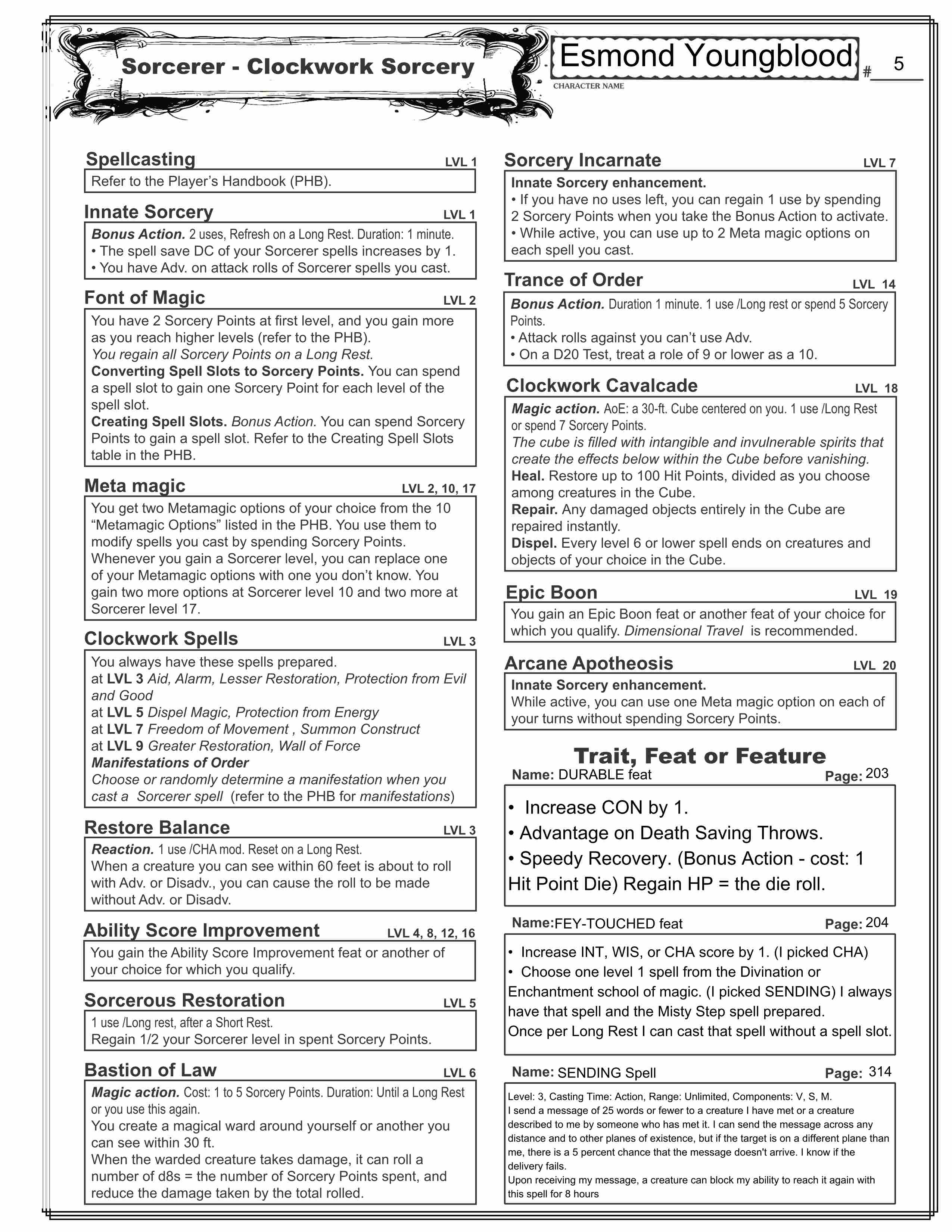
These “D&D 5.5 – Class Reference Sheets” were created to supplement my “D&D 5.5 Character Sheet” (You can find it on the “D&D 5.5 Character Sheet – Fillable and Auto-Calculating” post HERE.) but you may find them useful regardless of the Character Sheet you are using.
These are intend to be used at the table as a reference to all of the features your character has, based on character level, for each class and sub-class by character level. These are abbreviated descriptions of the features so please refer to the full descriptions that are in the Players Handbook, especially if any of these are unclear. Where the features don’t fill the sheet, I filled the unused space with a place to list one or more Traits, Feats or Features for handy reference. Unlike the ones I posted for 5E (HERE), these don’t calculate spell slots, etc. That is because my 5.5 character sheet does all of that.
It is not my intention to make Class Reference Sheets for any unofficial D&D content or for anything that is not in the Players Handbook. But if I get a lot of requests for any official published D&D 5.5 class or subclass I may be persuaded to make an exception. So please let me know what you want. Comments are always appreciated.
In their travels, the PCs often find themselves in a settlement that is unfamiliar to them. While there they want to buy supplies. I have spent countless hours in the past deciding on what shops are in the town. What each shop has for sell. How many of each item, and its cost. Not to mention shop names and the names and stats for the shop owner and others who work there. How about a description of what the shop looks like and what patrons may be there. This is what is expected of the DM. Right? Well … most of the time, the PCs only want to replenish their ammunition, upgrade their armor and maybe buy a couple of healing potions. They just want to know if what they want is available in this settlement, and how many can they buy. So here is what I have come up with. I don’t enjoy role-playing a haggling session, and my players have never been much into that aspect of the game either. So I simply use the prices that are in the Players Handbook. When running a game where buying magic items is allowed, I typically use the prices found in Sane_Magical_Prices.pdf and I often don’t allow the purchase of certain items. Of course you can modify these however you think is appropriate for your campaign, but I have found that that is an unnecessary complication. I thought there could be a simple table to find how many of any particular item (if any) are available in a settlement based on how large a settlement it is. The result of my attempt to create that table is what I am presenting here.
There are two tables. One for mundane (non-magical) items, and another for magical items. There are also Spellcasting Services and Spell Scrolls at the end.
How to use the tables. 1) Find the cost of the item you are seeking to purchase. This should be the cost of a single item unless it is commonly sold in a bundle consisting of several identical items, such as arrows for example.
2) Refer to the Mundane Item Availability table for anything other than a magic item, magic scroll, or potion. For those refer instead to the Magic Item Availability table.
3) Find the row on the table that corresponds to the settlement size.
4) If the cost of the item is higher than the value in the MAX Value column, there are none of these items available for purchase here. Otherwise, continue to step 5.
5) Refer to the value in the # Available column (for magic items refer to the die roll indicated under the items rarity: Common, Uncommon, Rare or Very Rare). This indicates the roll needed to determine how many of this particular type of item is available in this settlement.
A note regarding the Availability Roll. This is expressed in the standard format for making modified die rolls. Treat any negative result as zero. If you are unfamiliar with this: Dice rolls are described with expressions such as “1d4-2,” which means “roll one four-sided dice and subtract 2” (resulting in either -1, 0, 1, or 2). The first number tells you how many dice to roll (adding the results together). The number immediately after the “d” tells you the type of die to use (a 4 sided die in our example). Any number after that indicates a quantity that is added or subtracted from the result.
Mundane Item Availability
Type
Population
Max Value
# Available
Purchase Limit
Thorp
< 20
50 gp
1d4-3
500 gp
Hamlet
21–60
200 gp
1d4-2
1,000 gp
Village
61–200
500 gp
1d4-1
2,500 gp
Small town
201–2,000
1,000 gp
1d4
5,000 gp
Large town
2,001–5,000
2,000 gp
1d6
10,000 gp
Small city
5,001–10,000
4,000 gp
1d8
25,000 gp
Large city
10,001–25,000
8,000 gp
2d8
50,000 gp
Metropolis
25,001 >
*16,000 gp
2d10
100,000 gp
* In a metropolis, single items valued over 16,000 gp may be available for purchase on a case by case basis subject to the DM’s discretion. The item may need to be created/built/fabricated and may require that the PC furnish some needed components. All of this and how long it takes to create the item is also to be determined by the DM.
Max Value: There is no single item for sale with a value higher than this.
# Available: For any specific type of item (other than a magic item), if the value of the item is the Max Value or less, the modified die roll indicated determines how many (if any) are available for purchase.
Purchase Limit: This maximum total that the entire party can spend on items, including magic items.
Magic Item Availability
Type
Population
Max Value
# Available
Common
Uncommon
Rare
Very Rare
Thorp
< 20
50 gp
1d4-3
—
—
—
Hamlet
21–60
200 gp
1d4-2
1d4-3
—
—
Village
61–200
500 gp
1d4-1
1d4-2
1d4-3
—
Small town
201–2,000
1,000 gp
1d4
1d4-1
1d4-2
1d4-3
Large town
2,001–5,000
2,000 gp
1d6
1d4
1d4-1
1d4-2
Small city
5,001–10,000
4,000 gp
1d8
1d6
1d4
1d4-1
Large city
10,001–25,000
8,000 gp
2d8
1d8
1d6
1d4
Metropolis
25,001 >
16,000 gp
2d10
2d8
1d8
1d6
Legendary magic items are not commonly for sale.
Max Value: There is no single magic item for sale with a value higher than this.
# Available: For any specific magic item, if the value of the item is the Max Value or less, the modified die roll indicated in the column for the items rarity determines how many (if any) are available for purchase.
Spellcasting Services The following is a rough pricing guide to have someone cast a spell for you and the smallest settlement in which you might find a spellcaster to cast a spell of that level. It also requires you to find someone that is capable and willing casting it for you. To these prices you must add the cost of material components (if any). Cantrip (Thorp) – 15 gp; 1st Level (Hamlet) – 25 gp; 2nd Level (Village)- 100 gp; 3rd Level (Small town) – 150 gp; 4th Level (Large town) – 1,000 gp; 5th Level (Small city) – 1,500 gp. It is not typically possible to hire someone to cast a spell that is higher than 5th Level, but they may be persuaded to cast it in exchange for some item or service that the PCs could provide.
Spell Scrolls The cost of a spell scroll is double the cost of having the spell cast for you.
Disclaimer: This post is sponsored by Wasted Wizard, who sent me their product free in exchange for an honest, unbiased review. All opinions are my own. If you make a purchase using my Amazon affiliate links, I may make a small commission at no extra cost to you.
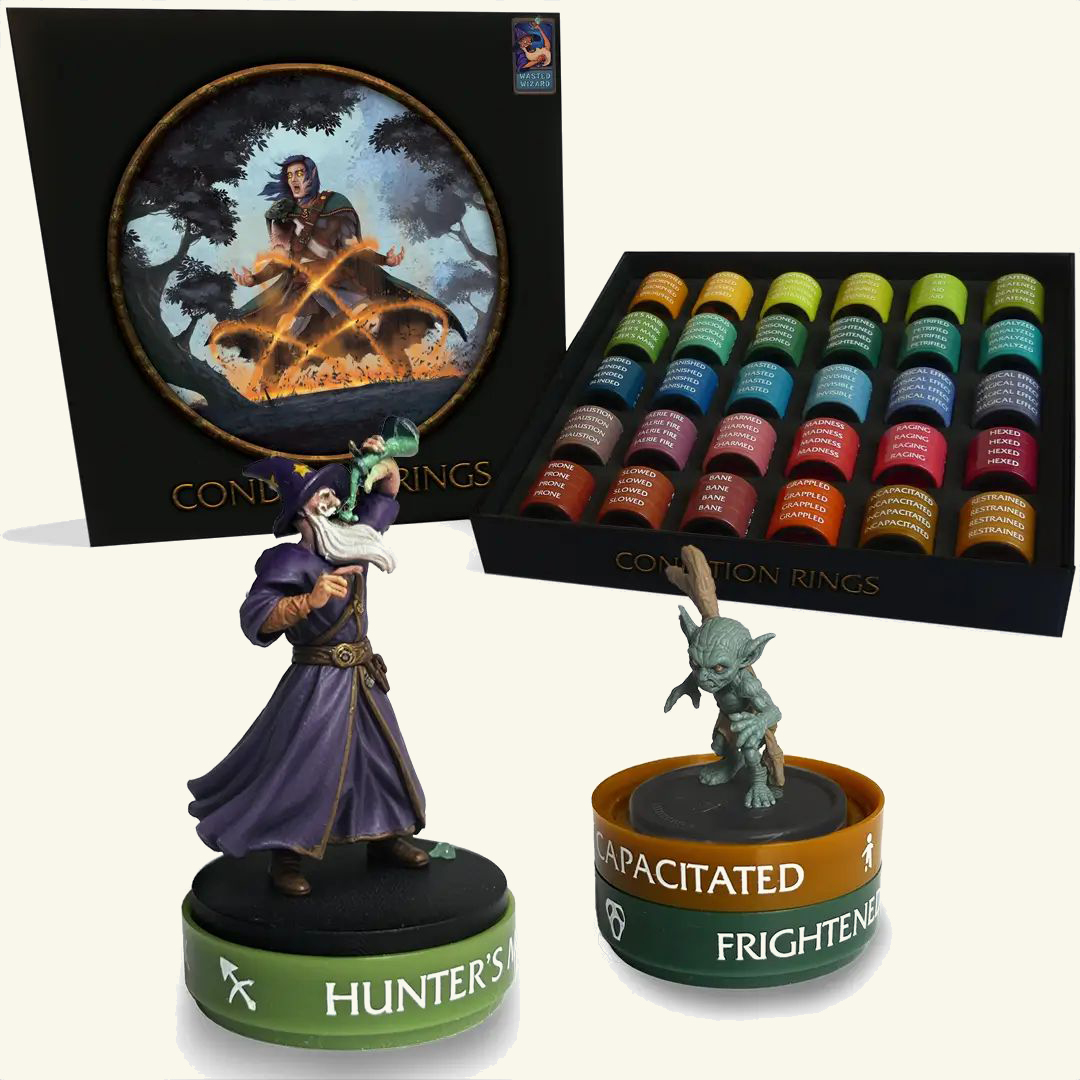
When playing D&D around the table, I typically play with miniature figures on a 1” square grid. In 2019 I bought a set of 64 “condition rings” to make it easier to track which character and monster currently has which condition. They are 1 1/2” dia. clear plastic rings, about 1/16” thick with a 1” hole in the center. Printed in different colors around the ring are the names of each of the 15 D&D conditions plus “concentrating” (4 rings of each condition). For most miniatures I can place the ring around its base, and for larger ones I can hang them on the mini. The problem is that my eyesight isn’t all that good and it has become harder for me to read the name of the condition printed on the ring, so last year I spent some time on Amazon seeing if there were any that would work better at my table. After looking at all the different options, I found “WASTED WIZARD Stackable DND Condition Rings.” For several reasons that I will describe later I decided that I would get me a set of these. But, because I wasn’t currently playing a game at my table, instead of ordering it I added it to my Amazon shopping list. Then, a couple of weeks ago, the Wasted Wizard contacted me and asked if I was open to doing a review of their stackable condition rings on my blog. In return they would send me a set free of charge. I agreed and was pleased to receive their produce a couple of days ago. The following is my review.
The main difference in these and the other condition markers for use in your D&D game (or most other RPGs) is that rather than sitting around the base of the miniature, the mini sits in the recession on the top of the ring that is only a little bigger than the base of the mini. Multiple condition rings can stack on top of each other, under the mini. The name of the condition is printed on the side of the ring.
The Box The product is well packaged. The box is good looking and well-made of heavy cardboard and the lid fits snugly. I will be able to keep all of the condition rings in the box they came in. The box contains a foam rubber insert with cut-outs for each set of 4 condition rings, each a different color.
The Conditions There are 4 identical rings for each condition. Each set of 4 is a different color. There are rings for each of the D&D fifth edition conditions: Blinded, Charmed, Deafened, Exhaustion, Frightened, Grappled, Incapacitated, Invisible, Paralyzed, Petrified, Poisoned, Prone, Restrained, Stunned, and Unconscious. In addition to these standard conditions, it also includes: Aid, Bane, Banished, Blessed, Concentration, Fairy Fire, Hasted, Hexed, Hunter’s Mark, Madness, Polymorphed, Raging, Slowed, and two more for anything else you might be need labeled; Magical Effect, and Physical Effect. For a total of 120 pieces. The addition of the magical and other effects is a welcome inclusion.
The Rings – Color and Text The rings are of hard plastic in dark colors with the conditions printed in white so they show up quite well. The condition is printed in all caps on both front and back with a symbol, unique to each condition on the two spaces between the condition names. It won’t take long to remember the most common conditions by the color of the ring.
The Rings – Fit I measure the overall diameter if each ring to be 1 1/16”. The top has two precisely made recesses. The bigger one is scaled to accept a standers D&D mini (25mm or 1 inch). The smaller, just below the upper one, is scaled to accept a standard Pathfinder mini (20mm). Every mini I tried with a 1” or smaller base set securely in the recess on the top of the ring. Unlike condition rings that set around the mini, these won’t get in the way when the PCs and/or monsters are standing next to each other. The base of each ring is slightly recessed to allow the rings to securely stack. You can stack 10 or more rungs with a mini on top without worry of it easily typing over. They don’t work as well for larger minis. You will have to hang them on the larger mini. On some there may be room on the base, between their legs, or a place to sit them on top, like a hat.
The Felt Pads At my table I typically use 1/8” clear Plexiglas over a 1” square grid. I have never felt the need to put felt pads on the bottom of my minis. I have never experienced scratching of the Plexiglas or any battlemat. So I don’t think I will be adding the felt pads to the bottom of the rings. But, for the purpose of this review I added the felt pads to 4 of the rings. Following the clear instructions, I did have a little difficulty in getting the pad to line up exactly with the bottom of the ring. I don’t think it would take much practice to improve, but I only felted 4 minis. I found the rings didn’t stack as securely with the added felt pads. Even with a stack of only 4 rings, the top ring tended to tilt awkwardly, and would shift whenever I moved the stack. Again, this may have been because I hadn’t properly centered the pads. This won’t be a problem for me. I never intended to felt them in the first place.
Visibility Here is the only real problem I have, and it is because of a situation particular to my specific gaming table. The table is in the center of a rather small room. The only light source is directly above the center of the table. This causes the sides of the condition rings, either singular or stacked, to be in shadow and thus be difficult to read. This was upsetting at first, before I realized that I always have an ink pin within reach that is also a laser pointer and a small flashlight. Pointing the flashlight at the ring makes the words easy to read.
Conclusion Even with the unexpected shadow problem, the fact that they don’t take up any additional table space is a plus. Another plus is that when you have multiple condition on a single character, they stack! And when stacked, you can still read them. Speaking of stacking, even though I have clear plastic stands to use for flying characters, rather than taking the time to dig them out, I can pull out a stack of 4 rings of a condition that I’m not currently using, and place a mini on the stack to indicate a flying character. I could then use a stack of 8 under a mini to indicate flying at a greater height. The minis are surprisingly stable on a tall stack of rings. Unless you feel that you need them, I would recommend just not using the felt pads. The only problem I found with them is when stacking the rings, and frankly 90% of the time I only use a single ring on a character. But it is good that they are provided for you should you prefer to use them. I like them. I will be using them on my games played IRL.
Let me know what you think in the comments below. Here is a link too the Wasted Wizard website.
These weapons are intended as a replacement for the weapons in the official rules. They have been modified somewhat to work with Bold Against Monsters (BAM) and ShadowDark, but could be used with Tails of the Valiant (ToV), Dungeons and Dragons 2014 (D&D 5e) or Dungeons and Dragons 2024 (D&D 5.5). This free PDF file contains all the weapons that are in D&D 5.5 (except for the Musket and the Pistol). There is a card for each weapon containing the features for the weapon and a box at the top for calculating the Attack modifier and Damage for each weapon. For ranged weapons, there is a space at the bottom of the card for tracking used ammunition.
Update #1: 8/2/2025 Removed “Long” feature and added special features to most of the weapons.
This a black and white 22 page (8.5″x11″) PDF file. There are four 3″x5″ cards on each page that you will have to cut out (except on page 1). If printed 2 sided by long edge you will have 36 two sided weapon cards with a drawing of the weapon on the back of each card. Page 1 contains a card with information regarding Ability Modifiers and Character Sizes. It also has an example card with information on how to fill in the blanks that are on the weapon cards. There are also cards for Unarmed attack, Improvised weapons (both melee and thrown), and blank cards.
What I changed and why.
First I was just going to make a set of printable cards so each player could have a card for each of the weapons their PC had that would contain the basic information and the calculations used to arrive at that weapon’s damage and attack bonus. After working on this for a while, I realized that the old categories and properties needed to be re-organized and simplified.
Weapon Properties: I added a “medium” weight property and changed the weight property on a few weapons. I added the “light” property to the dagger, dart, spear, sling, flail, rapier, whip, blowgun, and hand crossbow. Then I added a “medium” weight property to the other weapons that weren’t listed as having the “light” or “heavy” property.
I got rid of the Simple and Martial categories so, for D&D, you will need to adjust Weapon Proficiencies for the Classes.
Barbarian, Fighter, Paladin, and Ranger – “Simple and Martial weapons” changes to “All weapons.”
Bard, Cleric, Druid, Sorcerer, Warlock, and Wizard – “Simple weapons” changes to “Light and medium weapons.” [Note: To exactly match D&D 5.5 this will have to change to “No heavy weapons. No medium weapons other than the greatclub, javelin, mace, quarterstaff, light crossbow, or shortbow. All light weapons except for the flail, rapier, scimitar, shortsword, or whip.“]
Monk and Rogue – “Simple weapons and Martial weapons that have the Light property” changes to “Light weapons.” [Note: To exactly match D&D 5.5 this will have to change to “All light and medium weapons except for the Battleaxe, Longsword, Morningstar, Trident, Warhammer, or War Pick.“]
Added the “Thrown” weapon type and replaced “Reach” with “Long“.
Some melee weapons could be throne and some had to be thrown, making them more like ranged weapons. To clarify, I added the “Throne” weapon type.
ABILITY Which ability modifier to use for attack and damage.(For D&D, I removed the “finesse” property and added the DEX or STR option to the cards where it applies.)
Melee and Thrown weapons
Light: use your DEX modifier
Medium: use your STR modifier
Ranged weapons
Light: use your DEX modifier
Medium: use your DEX modifier
Heavy: use your STR modifier
ONE or TWO HANDED Which weapons can your character use one handed, based on your size, unless noted otherwise.
Large (or larger) character:
You can weld any weapon one handed.
Medium character:
Light weapons – You can weld them one handed.
Medium weapons – You can weld them one handed.
Heavy weapons – You must use 2 hands to weld them.
Small character:
Light weapons – You can weld them one handed.
Medium weapons – You must use 2 hands to weld them.
Heavy weapons – You must use 2 hands to weld them, and you have disadvantage on attacks.
Tiny character:
Light weapons – You must use 2 hands to weld these.
Medium weapons – You must use 2 hands to weld them, and you have disadvantage on attacks.
Heavy weapons – You can’t use these weapons
ADDITIONAL FEATURES Many of the weapons have a feature that is specific to that specific weapon type. For example, The greataxe has a feature called Second Target: “On a hit that drops the target, your swing can continue to also hit a target next to the first that is within range. If your attack could hit its AC, any remaining damage will be applied to the second target.”
When reading through these, keep in mind that in both BAM and ShadowDark your character only gets a single attack each round, making things like not adding your DEX modifier to your second attack made with a weapon in your other hand doesn’t apply.
I would love to hear your feedback on these weapon cards. Let me know what you think in the comments below.
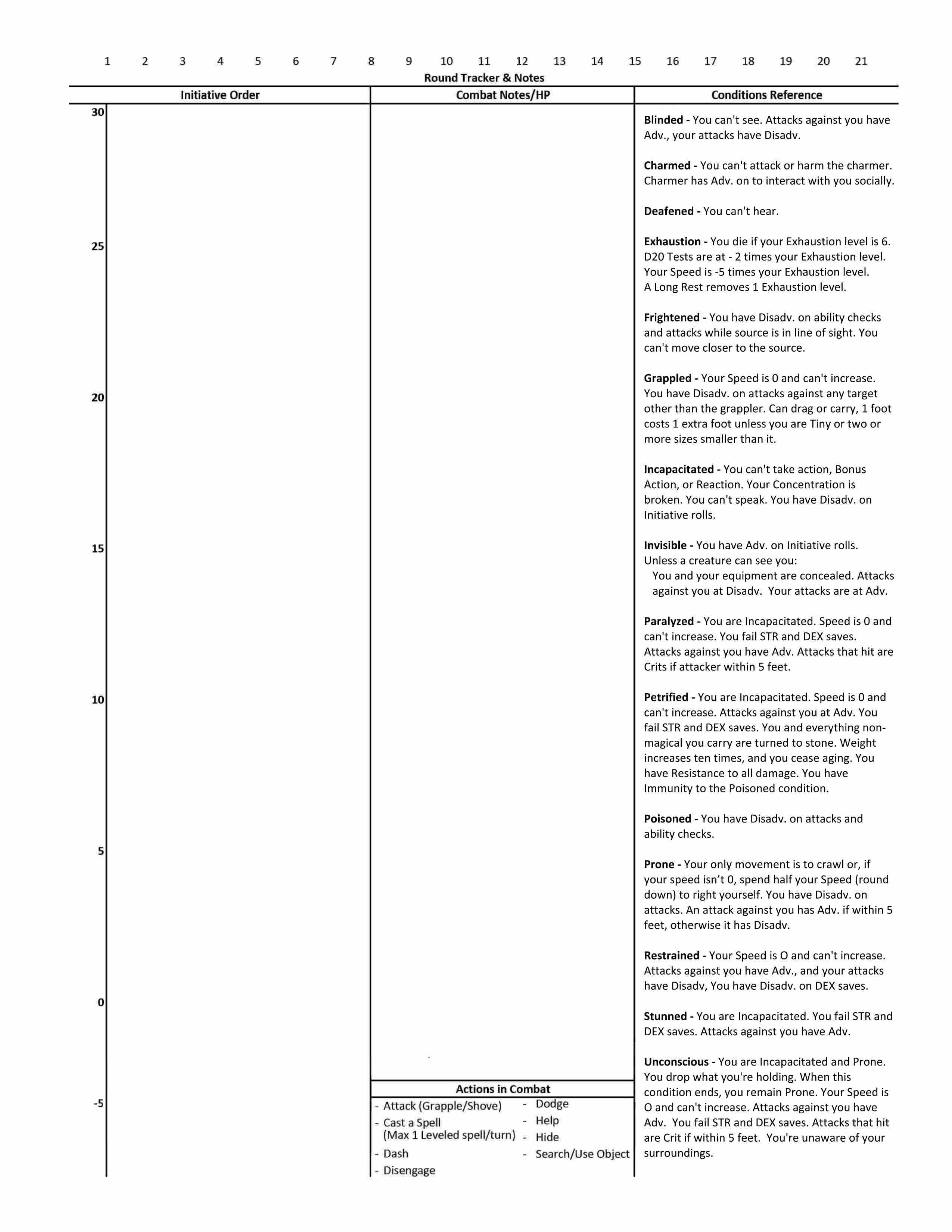
I posted a 5E version of this some time back. (My friend Nicholas sent me this excellent combat tracker. If anyone knows who created it, please let me know so I can give credit to him or her.) Erichthegree commented on that post today that it needs to be updated to the new D&D 5.5 conditions, so that is what this is. One complaint I have with the new Player’s Handbook is that the conditions are not presented all together in one place. This can be used for that, but I did have to abbreviate them a lot in order to get them to all fit in a single column.
If you are one of us who are adapting to the 2024 version of D&D (D&D 5.5), Tales of the Valiant, or some other RPG you are finding that your old spell cards need to be updated. I made these without any symbols so you can use different colored cards for different classes, or school of magic, or any way that makes sense for the game you are playing.
These cards are 2 1/2″ x 3 1/2″, 10 cards on an 8 1/2″ x 11″ sheet. Each PDF file has 2 pages. The first page has 10 cards you can fill in with the spell info, and the second page has the 10 colored backs.
They are 8 1/2″ x 11″ so they are easy to print and to find backings or plastic sleeves to fit them in.
I oriented them with the long dimension horizontally to make it easier for the DM to see over.
I only listed information that might be needed during play – so no player creation or dungeon creation information.
Update #1: 4/27/2025 Enlarged the text size in “Weapon Options.”
Let me know what you think about this new ToV DM Screen in the comments below.
I’m preparing to run a ShadowDark adventure for a group and some of the players are new to Table Top Role Playing Games. Since my copy of the rule book will be the only one at the table, I thought a combat reference sheet for each of the players would be handy, so I created this one.
You can download your own free copy of the PDF file HERE.
There are a lot of things that I like about the new 2024 rules for Dungeons and Dragons (D&D 5.5) but there are several things that I don’t care for. Before I run a D&D 5.5 game, here are the house rules I will be using to address some of these issues. I am sure that I will be updating this list from time to time as I run across other problems. These are in addition to, and in some cases may replace, my existing 5E house rules that I posted here: D&D 5E – My House Rules.
House rules I will use when running a D&D 5.5 campaign
1) I will be using the new (2024) rules exclusively. Players may not use spells, races, classes, subclasses, etc. from any earlier publications. 2) I will be using the house rules I posted here: The Old DM’s House Rules on Hiding and; 3) You cannot attack an ally. This includes opportunity attacks. 4) You can swap weapons (sheath one weapon and draw another one) once, and only once, on your turn. 5) I will have to nerf many spells, Conjure Minor Elementals for example. (I may provide details in a future post.) 6) Most on-going spells end when their caster dies and you can end any spell you have cast (no action required) if you aren’t incapacitated. 7) No crafting of magic items. 8) Background. Create your own. Just make up any background you want. Then, based on that background;
Ability Scores. Increase three ability scores by 1, or one by 2 and one by 1, to a maximum score of 20.
Skill Proficiencies. Select any two skills to be proficient in.
Tool Proficiency. Select one tool to be proficient in.
Equipment. Select any equipment pack, or 50 GP.
9) House rules to prevent weapon mastery abuse.
You can’t use the weapon mastery feature of a weapon if you use it as an improvised weapon. An example would be throwing a melee weapon that doesn’t have the thrown property or making a melee attack with a ranged weapon.
Save: For mastery features that allow a save to avoid the effect, it will be either a DEX or STR saving throw and the DC is 8 plus the ability modifier used to make the attack roll and your Proficiency Bonus. You should always have that number calculated and ready to give to the DM when needed.
Cleave: A single attack roll is used against both targets. The two targets must be within 5 feet of each other, within your weapons reach, and positioned so that they could be hit with a single swing of your weapon.
Graze: A poison weapon does no poison damage on a miss. A roll of a natural 1 does not graze.
Nick: Reword this to “When you make an attack action with this weapon you can make a second attack with it. You can make this extra attack only once per turn.”
Push: Must be horizontally (not up into the air). The target can save to resist being pushed. If the creature is hit more than once by weapons that have this property, the distance they are pushed doesn’t exceed 10 feet.
Sap: The target can save to resist the Sap.
Slow: If the creature is hit more than once by weapons that have this property, or they are (or have been) affected by the use of the Slasher Feat, their total Speed reduction never exceeds 10 feet.
Topple: If the creature is hit more than once by weapons that have this property, they automatically save.
Vex: Reword this to “If you hit a creature with this weapon and deal damage to the creature, you have Advantage with the same weapon on your next attack roll against that creature before the end of your next turn.”
Additional house rules I may implement, depending on the adventure
1) No flying characters. 2) Player characters may not have an evil alignment. 3) No Multiclassing. (Multiclassing is no longer listed as an optional rule as it was in 5E.) 4) No Firearms. 5) No bastions. 6) I LIKE opposed checks. 7) My “rule of cool”: If I think it is cool I MAY allow it ONCE.
Call to action.
I’m always looking to improve my resources for the D&D community! I would love to hear your feedback on these house rules. Let me know what you think in the comments below.
D&D 5E’s rules for hiding are a mess. I previously posted my thoughts on this in my post D&D 5E – Stealth and Hiding. In a similar vein I posted D&D 5E – House Rule – Pop-up Archer. I was hoping that the 2014 update would improve on the hiding rules, but I was disappointed. Also, I am a fan of Tales of the Valiant, but they left the hiding rules pretty much unchanged. So I decided to replace the rules on hiding in 5E with my own house rules and here they are.
This replaces everything I said on those previous posts.
In the house rules below, every rule applies equally to PCs and other creatures.
The first thing I did was create a new condition called “Hidden.”
The Hidden Condition
Hidden: The creature or creatures that you are hiding from are unaware of your location.
Clarification:
The terms “you are hiding” and “you are hidden” or “you have the Hidden condition” are synonymous.
Being “stealthy” is trying to remain undetected which is the same as trying to hide.
You are hidden if the creature you are hiding from is unable to determine your location by sight, hearing, smell or any other sense it possesses.
This is the most common situation. The Creature is trying to determine where you are.
It may be wanting to attack you, but it can’t see or hear you.
An example could be when you are invisible (it can’t see you) and you are being very quiet (it can’t hear you).
Another example would be when you move to a position behind total cover, such as behind a tree or a barrel and try to remain unseen and unheard.
You are hidden if the creature you are hiding from doesn’t notice you.
This is typically when a creature you are trying to sneak up on is currently unaware of your presence. They may be distracted or simply looking the other way. You attempt to both quickly and silently sneak up from behind.
Another example might be if you are attending a royal party and attempt to pick the pocket of a noble. You try to avoid attracting his attention while you get close enough to pick his pocket without being noticed.
A third example would be if you transformed into a small spider and are simply there to gather information while observing from the ceiling in the corner of the room.
You are hidden if the creature you are hiding from can’t distinguish you from others.
In this case they can see you and they may know that you are near and a possible threat, but you are among others and it doesn’t know which one you are.
You may be trying to blend in with the crowd, or you might be attempting to hide while disguised as (or transformed into) a sheep in a flock of sheep.
Benefits to Being Hidden
If you are hidden from all your opponents before the first round of combat you will surprise them and get a free round to attack them before they can react. (You are no longer hidden after you attack.)
On all targeted attacks against you, the attacker must first identify where he thinks you are located. The attack will automatically miss if you are not in that 5 foot area. The attack is made with disadvantage, even if you are not in the targeted area, and the DM simply tells the attacker if his attack missed.
If you are hidden you make attacks with advantage if you can see the target. However, you will no longer be hidden if the attack hits or misses.
When can you hide?
During combat, hiding is an action.
In combat or not, you can’t hide from a creature that can perceive your location.
Clarification:
The DM determines when conditions are right for making a hide check, including in the following examples.
You can attempt to hide from one or more creatures if they do not currently see you clearly or perceive your location by any special senses they might have such as darkvision, blindsight, tremorsense, or truesight.
Another situation where you can attempt to hide is when the creature you are trying to hide from is distracted or looking away from your location.
How do you hide?
You make a Hide check [a Dexterity (Stealth) check].
Make a note of the results of that check to be used later.
Unless you indicate one or more specific creatures that you are attempting to hide from, it will be assumed that you are attempting to hide from your foes and not from your allies.
When are you no longer hidden?
Until you are discovered or you stop hiding, the hide check you made is contested by the Wisdom (Perception) check of any creature that might notice you or that actively searches for signs of your presence. You are discovered and no longer hidden from creatures that win the contest. The DM may choose to use the creature’s Passive Perception score rather than making a Perception check.
You are no longer hidden from a creature that can hear you if you make noise.
You are no longer hidden from a creature that can hear you if you speak louder than a whisper or cast a spell with a verbal component.
You are no longer hidden if you make an attack of any kind if it hits or misses.
Difference between hidden and invisible
Invisible: Being invisible means you can’t be seen by normal sight or darkvision but creatures might still locate you by sounds you make, tracks you leave, your smell, the way the air or plants move around you, or some other way. Hidden: If a creature can’t perceive your location by seeing you, or by any special senses, you can attempt to hide from it. So if a creature is dependent on sight alone to perceive your location, you can attempt to hide from it if you are invisible.
Clarification:
If you are invisible and hidden, when a creature locates you, you will no longer be hidden from it but you will still be invisible.
If a creature can’t be detected by using any of your senses then you can only guess at its location.
If you can notice some clue as to its location you must succeed in a Perception check to locate it.
You can make this check with advantage if you use the Search action.
If it has attempted to hide, your Perception check will be against its hide check.
Advantage and Disadvantage
Here is a summary of situations where your character might have advantage or disadvantage based on hidden or invisible conditions.
Attacks you make against a creature you can’t see are made with disadvantage.
If you are hidden or invisible, attacks you make against a creature you can see are made with advantage.
If you attack a creature that is hidden from you, you must guess at its location (identify the square you think it is in) before you make the attack and the attack is made with disadvantage. The DM will tell you if the attack hit or missed. If it missed you will not know if the creature was in that square or not.
If you attack a creature that is invisible but not hidden, you may first make a perception check to see if you can notice some indication of where it is located. If you determine the creature’s location, your attack is made with disadvantage. Failing the perception check, proceed as you would if it were hidden.
Handling Total Cover
Have you ever had a player that wanted to stay behind total cover during combat and just step out and fire his arrow on his turn and then step back? I don’t like this. It doesn’t make for cinematic, or heroic combat. Here are a couple of house rules I have implemented to address this and other similar situations.
If you are behind total cover and hidden, if you move out from behind that cover, you are no longer hidden to creatures who can see you. However, the first attack you make the round you come out from cover is made with advantage.
This is to reward you for being stealthy.
If you are behind total cover but are not hidden and cannot see your target, if you move out from behind total cover and attack, the first attack you make that round is made with disadvantage.
This is because you will have to locate your target visually and do not have time to take careful aim.
If, during your turn, you move from an exposed location to a location behind total cover, one creature that can see you can take a reaction to make an attack with disadvantage against you with a ranged weapon it is holding.
This assumes of course that the attacker hasn’t used its reaction this round and meets any other requirements for making the attack. For example, if it has a longbow in hand, it must have the other hand free and access to an arrow it can draw and fire.
The attack will necessarily be rushed. That is why it is made with disadvantage.
The attack is made when you are in the last exposed 5 foot space that the creature can see before you enter total cover.
The limit of one creature taking the reaction is imposed to prevent a deluge of arrow attacks against a character seeking refuge.
Remember that you can now only attempt to hide this round by taking the hide action. If you have already taken an action (to attack for example) you might not have another action available.
If, during combat, you move from an exposed location to a location behind total cover it is assumed that your opponents are taking note of where you are hiding. Therefore, if you then take the hide action, unless you move at least 15 feet while remaining behind total cover before moving out into the open, the Wisdom (Perception) check of any creature that might notice you is made with advantage.
Note that this will typically mean that they will have advantage on noticing when you re-appear if you have stepped behind a tree or barrel for example and can’t move 15 feet or more before leaving an area of total cover.
If they succeed in their perception check, you are not hidden from them so your first attack after revealing yourself is made with disadvantage instead of with advantage (refer to the Advantage Disadvantage section above).






 Dungeon Master Assistance