This is the second adventure in a series of adventures that I will be posting here, that will make up the “Its About Time” campaign arc. These adventures will take a group of adventurers from level 1 to level 20.
This is the second adventure in the series. It is a D&D 5E adventure for Dungeon Master’s (DMs) to take a group of 2nd level Player Characters (PCs) on an exploration of an island that has way too many undead creatures. Even if you have no intention of running this adventure, it provides tools you may find useful in your campaign.
This introduces a simplified calendar that I have used in several campaigns.
This a micro-hex crawl. Where hex crawls typically use a scale of 6-10 miles per hex, or 20-70 miles per hex for larger regions, this adventure uses a map where each hex is only one mile across. This micro-hex crawl packs a lot of interesting features and encounters into a relatively small area.
This introduces a system for using a single random encounter table for encounters of different difficulties, depending on which die you roll.
It has 12 new monsters, complete with stat blocks, images and tokens you can use if you are playing on a virtual table top (VTT).
For each encountered monster, it lists the page number where that monster can be found in the Monster Manuel or, for new monsters, in the adventure. It then has an abbreviated version of the monster’s stat block on the page with the encounter.
Check it out and let me know what you think about it in the comments section below.
The next adventure will be a dungeon crawl, “AT-03 Secrets of the Shattered Temple.”
Revision 1 (June 11, 2024): On page 1, I changed “The PCs start this adventure with 1 Time Point.” to “The PCs start this adventure with 2 Time Points.”
I want to give a shout to to Jan Veenendaal. He has a web site that I used to create the stat blocks I used in this adventure. Here is how he describes it:
I created a website where you can create statblocks really easy: you enter the texts, the site does all the formatting. It will allow you to create PNG files, and a few other formats.
The site is free, does not collect data (everything stays on your computer), and is completely open source. Also, it is fine to publish whatever you create using it under Wizards’ Fan Content policy.
After posting my NEW Time Travel Rules, I realized that an adventure where these new rules were used might be helpful. So here is what I came up with. This also gave me a chance to create an adventure containing what I like for adventures that I run to contain. Let me know what you think about it.
AT-00 Time Travel Rules is basically a re-post of the time travel rules I posted last month. I re-formatted it and made a couple of minor additions.
AT-01 An Ancient Evil is the first adventure in a series of adventures that I intend to publish here, that will make up the “Its About Time” campaign arc. It also provides a framework for the players to incorporate the use of time travel into the game by using supplement AT-00 Time Travel Rules. These adventures will take a group of adventurers from level 1 to level 20. It starts with our adventures arriving in the small fishing village of Saltport Cove.
These new house rules are more streamlined and easier to implement into your game. One problem with the older version is that it contained very little for players who characters weren’t spellcasters, and spellcasters didn’t get very many useful time related spells. So this version includes Time Points, Time Checks, and 71 Chronology spells.
Time Points: A character’s Time Points represent his ability to detect and interact with the timeline. All PCs get Time Points as they advance in level. They can spend them for things like rewinding time to re-roll a d20 (even a death save), or take a different action. Or have some other creature re-roll his attack. You get a chance to regain a lost or spent Time Point after a long rest. Also, as you accumulate more Time Points you gain bonuses to certain ability checks.
Time Checks: These are tied to your Time Points. When the DM has you make a Time Check you roll a d20 and add your Wisdom ability modifier and Time Points to the D20 roll. Several spells require you to succeed on a Time Check or the spell fails.
Chronology Spells: There is no Chronomancy class. If your character is attuned to the flow of time (as represented by your Time Points) and has one or more levels in a class that can cast magic spells, you can add all of the chronology spells to the spell list for that class. Otherwise, none of the spell casting rules for your class are changed. Player characters can add these to their list of spells available to their spellcasting class.
Another problem with any time travelling campaign is that the most useful time travel spells are necessarily high level spells that lower level PCs won’t have access to. This would appear to limit you to high level adventures. To address this I have included many low level spells and I am also working on a series of Time Travelling adventures (an adventure arc) that will take your group from level 1 up through level 20. I am calling it “It’s About Time“. I will be posting these here as they become available. As always, these will be free for you to download and use in your campaigns.
In an earlier post (HERE) I praised this adventure. After a recent, more careful, reading I have changed my mind. As written, I would only recommend it for children that are too young to accept character death.
Below I am quoting some DM tips that I take issue with, followed by my comments. I will start with one of the last presented DM Tips.
“A character that reaches 0 hit points falls unconscious and remains unconscious until they regain hit points through healing. At the end of the encounter, any unconscious player characters regain 1 hit point automatically.”
This adventure is presented as “an introductory Dungeons & Dragons (also known as D&D) adventure designed for younger players, but it can be enjoyed by players of all ages!” I understand leaving out a lot of unnecessary rules but this is a new rule that eliminates character death. If you are using this to learn (or teach) a little about D&D I would change this to the D&D rule used in D&D 5e. It can be simply explained like this:
PC (Player Character) Death A PC reduced to 0 or fewer Hit Points is dying. A PC reduced to as many Hit Points below 0 as the PC’s Hit Point maximum dies outright. A dying PC makes a death saving throw on its turn; no other action, movement, or activity. There are no modifiers to this roll.
d20 Roll
Death Saving Throw Result
20
PC regains 1 hit point and is no longer unconscious.
10-19
Mark 1 success.
2-9
Mark 1 failure.
1
Mark 2 failures.
On the 3rd failure, the PC dies. On the 3rd success, the PC stabilizes. A stabilized PC is unconscious, has 0 Hit Points, and does not roll death saving throws. Successes and failures reset as soon as a dying PC stabilizes. A stable PC that is not healed regains 1 hit point and becomes conscious after 1d4 hours.
“Advantage and disadvantage are powerful game tools. They make d20 rolls more likely to succeed or fail, so use them wisely. They are best used as a reward for clever play by the players, or to represent good or bad luck affecting the story. …”
The examples that follow this DM tip give good examples of how they should be used, but they are not, and should not be, used to “reward clever play” or to “affect the story”.
“You can intervene if the characters seem to be losing the battle. For instance, you can give the characters advantage on attack rolls or give the monsters disadvantage on attack rolls. … Changing probabilities like this can improve the characters’ odds in defeating the monsters.”
I think this is bad advice. I have never done this and would advise DMs to never do this. If a player is too young to accept that their character can die, play a different game. Otherwise, try to not pit them against a monster that they have almost no chance of defeating, and let the dice fall where they may. Or, rather, never let them know if you cheat in their favor. If you give the PCs Advantage and/or give the monsters Disadvantage then that would be obvious. I have, very rarely, lowered the hit points of a monster during combat if it was going very badly for the PCs. Part of the fun is the excitement of not knowing if your character will survive.
“If a character carries the baby dragon and falls during the climb, the dragon doesn’t take damage. You can reward a character protecting the baby dragon by giving them advantage on certain rolls.”
I have no problem with the baby dragon not taking damage if the PC that is carrying it falls. However, there is no reason to give a PC Advantage on rolls just because they are carrying it. I might not go so far as giving that PC Disadvantage on certain rolls, but I would with experienced players. There needs to be a good ‘in game’ reason for giving a PC Advantage or Disadvantage. To just award it to help then is not a good reason. Because carrying a baby dragon might make it harder to climb a wall would be a good reason to make them role with Disadvantage.
“Rule 0 of D&D is simple: Have fun. It’s fine if everyone agrees to change the rules as long as doing so means the game is more fun for everyone.”
This is the DM tip that prompted me to make this post. This new definition more than implies that any rule change must be agreed to by all the players. This is a change to the official definition and I don’t like it. To me, Rule 0 has always been “The DM is always right” or “The DM can change or add any rule.” What do you think?
Even if nobody around your table knows how to play, someone to be the DM and 4 more players, one 20 sided die, one 6 sided die, and this 20 page book is all you need to play D&D!
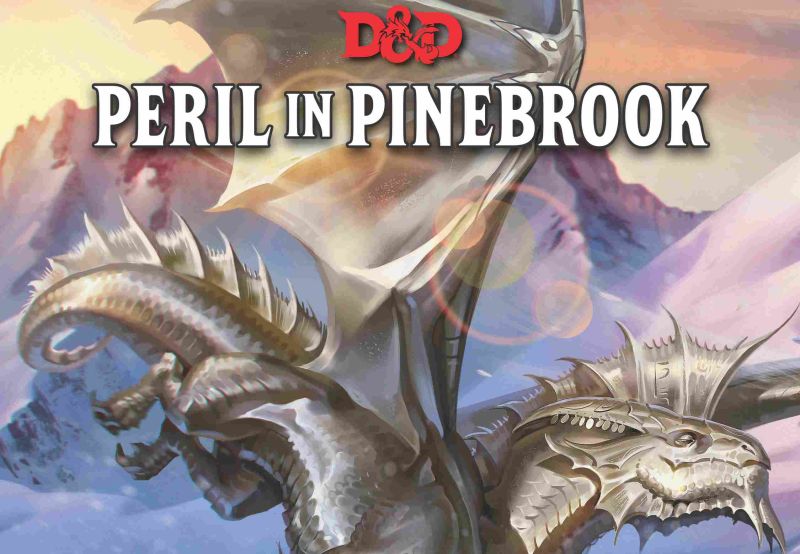
Wizards of the Coast recently posted this free introductory adventure. You can get your free copy HERE.
This is an excellent short first level adventure, written as a tutorial for new DMs and players. For someone wanting to learn about D&D for the first time, this is all they need. It does NOT require the Players Hand Book (or even the free game rules, or the SRD). There is also no need for minis or a battle mat (there are no maps). It includes 4 pre-generated character sheets. These are super simple but contain all the information you need for this adventure and has options for you to modify your character’s description and draw a sketch. You will learn a little more about how to play with each encounter.
I haven’t yet run this adventure, but am quite impressed. I would encourage anyone who wants to dip their toes into this game for the first time to start with “Peril in Pinebrook”.




 Dungeon Master Assistance