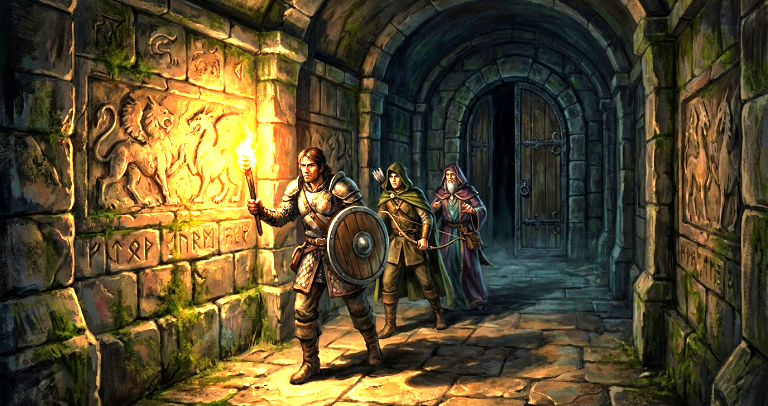
When Dungeon Masters run a subterranean adventure, they step into one of tabletop roleplaying’s most iconic styles of play: the classic dungeon crawl. While wilderness hex crawls focus on wide-open exploration, a dungeon crawl traps the party in a confined pressure cooker where every closed door, dim torch, and creaking corridor presents a choice between risk and reward.
Whether you are running a published module like my AT-03 Secrets of the Shattered Temple or dropping an ancient ruined complex into your own homebrew world, running a dungeon crawl smoothly requires a specific set of DM tools. Here is how you can manage time, resources, exploration, and encounters to keep tension high without grinding play to a halt.
What Exactly Is a Dungeon Crawl?
At its core, a dungeon crawl is an adventure structure focused on navigating a self-contained, enclosed environment—whether an ancient burial crypt, a sunken fortress, or ruined temple vaults.
Unlike open-ended urban investigations or wilderness travel, a dungeon crawl relies on tight spatial logistics. The dungeon itself acts as an active adversary. Success isn’t just about winning combat encounters; it requires careful mapping, smart resource management, keen observation for traps and secret doors, and tactical decision-making regarding when to push forward and when to fall back.
Time & Resource Management: The Dungeon Clock
In a dungeon crawl, time isn’t measured in days or hours—it’s measured in Exploration Turns. If the players don’t feel time passing, resource management becomes meaningless.
Track Time in 10-Minute Intervals: Over the years as a DM I have tried several different ways of tracking time in the game. I’ve found that the way I track the time the PCs spend in game varies with the type of adventure. In a dungeon crawl, I find that tracking time is best done by implementing a simple “Dungeon Time Track.” Every major action takes one 10-minute turn. Searching a room for loot or secret doors costs 10 minutes. Cleaning up after combat, dressing wounds, and recovering arrows costs 10 minutes. Deciphering an ancient inscription or inspecting a complex statue costs 10 minutes. Normal movement down empty corridors doesn’t cost time, but anything non-trivial ticks the clock forward.
Light Source Management: Dark environments make light a critical survival resource. A standard torch lasts 1 hour (6 ten minute exploration turns). As torches burn down to dim light and flicker out, the party faces tough choices: do they burn through their remaining fuel, cast precious spells for light, or risk navigating pitch-black corridors where enemies hold darkvision advantages?
Rations and Water: Deep subterranean crawls strain party logistics. Tracking daily ration consumption and clean water usage adds weight to prolonged delves, especially when underground chambers contain stagnant or contaminated water rather than drinkable streams.
Resting Dynamics: Strategic Safety vs. Lurking Danger
Resting inside a dungeon should never feel like checking into a cozy inn. Every rest is a gamble against the denizens of the deep.
Short Rests (1 Hour / 6 Turns): Short rests are essential for PCs to partial heal and recover short-rest abilities, but they require a secure location. Remind your players to rest strategically – spiking doors shut, hiding in secret alcoves, or barricading cleared rooms. A short rest in an open corridor is an invitation for a wandering patrol.
Long Rests (8 Hours / 48 Turns): Taking an 8-hour long rest deep within an active dungeon should be nearly impossible without major preparation. The dungeon ecosystem reacts to the party’s presence. If characters attempt an 8-hour sleep in the middle of a monster-infested complex, enemies will organize, set ambushes, or you will simply roll for a random encounter. Encourage players to retreat to a secured entrance chamber or return to a safe nearby base town for long rests.
Dungeon Exploration: Secret Doors, Mapping, and Traps
Exploration is the heartbeat of a dungeon crawl, but clunky search mechanics can slow the game to a crawl.
Streamlined Secret Door Searches: Instead of requiring constant passive checks or blind rolls in every empty room, consider using an active search rule. If a player explicitly states where and how their character is searching (e.g., “I’m checking behind the moldy tapestry on the west wall”), and a secret door is present, they automatically discover it! Saying “I’m always searching everywhere” isn’t allowed. However, searching interactive features carries risk: if the secret door or alcove is trapped, active searching might trigger the mechanism unless they inspect it carefully first.
Tabletop Mapping: If you play at a physical table, encourage one player to act as the party cartographer, drawing a rough map based on your descriptions. This builds immersion, prevents needless backtracking, and gives players a tangible sense of accomplishment as the dungeon layout unfolds. On Virtual Tabletops (VTTs), dynamic line-of-sight handles this visually, but keeping track of unexplored corridors remains the player’s responsibility.
Telegraphing Traps and Hazards: Traps are most engaging when players can deduce their presence through environmental cues. Describe subtle details: pressure plates flanked by scorched stone walls, the faint smell of embalming fluid and buzzing flies near an old tomb, or crumbling floorboards over a hidden pit.
Random Encounters: The Dungeon’s Immune System
A dungeon isn’t a static collection of disconnected rooms; it is a living, hostile environment.
Themed Encounter Tables: If the party spends extra turns searching rooms, arguing over puzzles, or making excessive noise, roll on a custom random encounter table. Tailor encounters strictly to the dungeon’s theme – for an ancient crypt, populate your d6 table with wandering skeletal archers, roaming ghouls, or haunting specters.
Escalating Threat: Random encounters shouldn’t just be random combat; they should signal that the dungeon is responding. Hearing heavy footsteps in adjacent corridors or finding fresh tracks reinforces the feeling that time is ticking.
Puzzles, Keys, and Teased Backtracking
Great dungeon design incorporates interconnected loops rather than linear hallways:
Key-and-Lock Links: Place keys for locked vaults in distant, distinct chambers (such as finding an iron key inside a flooded storeroom to unlock a crypt elsewhere). This gives players clear goals and reasons to explore every wing of the complex.
Interactive Environmental Puzzles: Incorporate atmospheric puzzles tied to the dungeon’s lore – like an altar inscription where placing a specific ceremonial offering onto the stone causes a hidden doorway or key to manifest. Puzzles that require interacting with the physical environment make dungeon rooms memorable.
How do you handle time-tracking and light sources during dungeon crawls at your table? Do you use strict 10-minute turns or a more abstract pacing system? Don’t hesitate to let me know in the comments below!