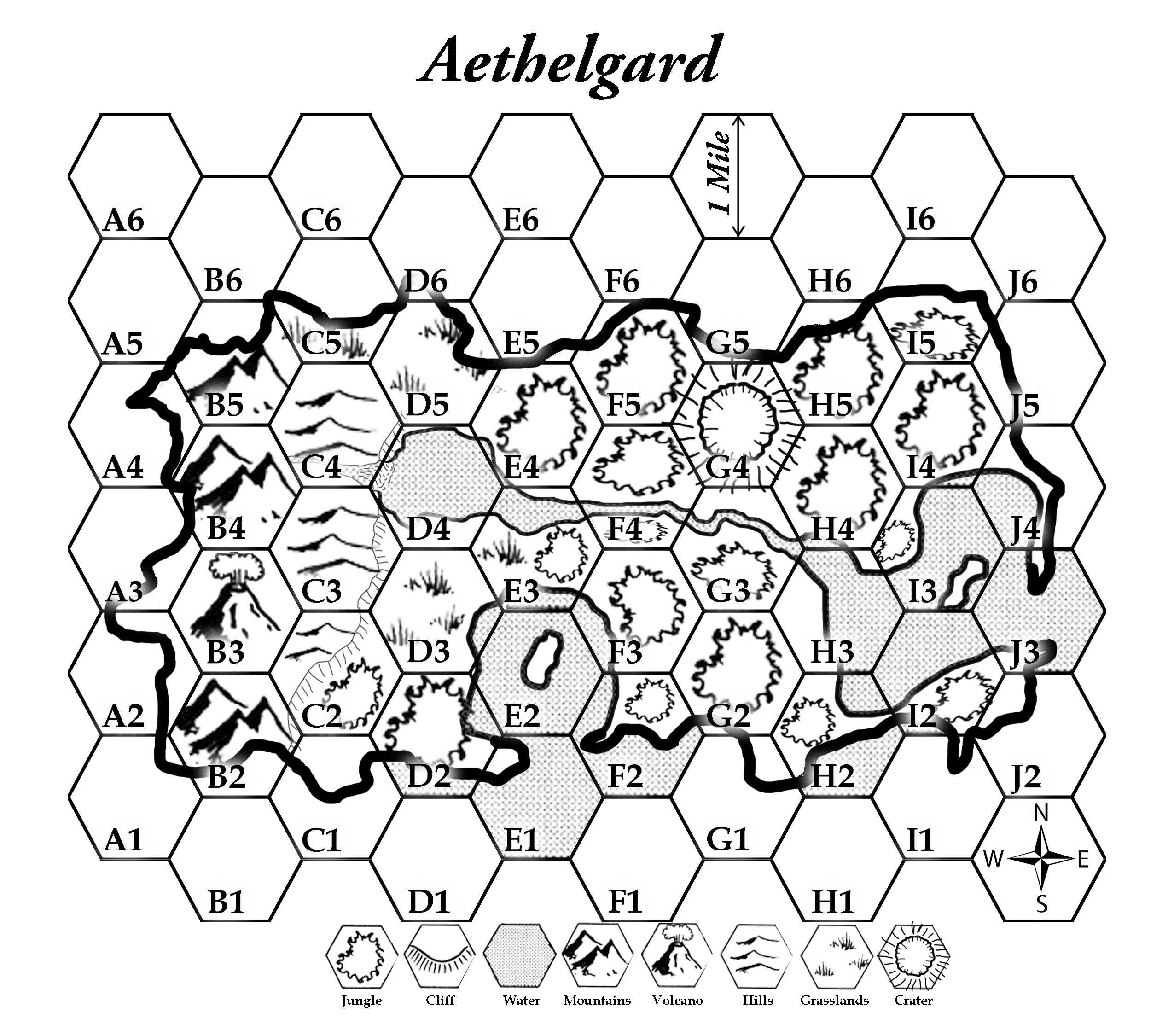
Exploration is one of the three core pillars of tabletop roleplaying, yet it is often the hardest for a Dungeon Master to run smoothly at the table. Traditional regional hex crawls typically operate on a grand wilderness scale – using hexes that span 6 to 10 miles, or even 20 to 70 miles across for vast continent-spanning journeys. While wide-scale mapping works great for long marches across an empire, it can make localized wilderness exploration feel empty, repetitive, or bogged down by abstract travel math.
If you want to give your players a rich, tactical exploration sandbox where every mile matters, it is time to shrink the scope. Enter the Micro-Hex Crawl.
In modules designed around localized wilderness discovery, such as Quest for the Mithral Sphere, the map shifts to a tight 1-mile per hex scale. By zooming in on a specific region—like an uncharted island, an isolated valley, or a dense forest ruin – a DM can pack environmental variety, terrain choices, and survival choices into a manageable geographical footprint.
Here is a practical guide on how to design and run a micro-hex crawl for your table, complete with streamlined rules for timekeeping, rations, terrain movement, and dynamic random encounters.
Why Run a Micro-Hex Crawl?
When players explore a standard 10-mile hex, crossing a single tile takes almost an entire day of travel. Minor landmarks, local wildlife, and small environmental hazards get swallowed up by the scale.
A 1-mile micro-hex crawl flips that balance:
Fast-Paced Discovery: Characters cover noticeable ground and discover multiple features within a single session. Exploration stays active because every hex entry presents a distinct choice or clue.
Dense Environmental Diversity: You can fit varied biomes – volcanoes, coastal cliffs, overgrown jungles, inland lakes, and ancient craters – onto a single island or regional map without stretching plausibility.
Focus on Local Lore and Ecology: Instead of spending hours calculating multi-day marches, the party focuses on piecing together the history, ecology, and hidden secrets of a localized area through smaller, granular discoveries.
Tracking Time, Rations, and Exhaustion Without the Headache
Survival mechanics often get hand-waved because DMs worry about tedious tracking. In a micro-hex crawl, however, resource management creates real tension – provided your tracking system is clean and predictable.
Timekeeping in 10-Minute Increments
Rather than counting hours or abstract turns, track party activities on the hex map in 10-minute increments. This makes tracking travel, searches, and rests seamless:
Exploration & Movement: Base movement across a standard 1-mile hex takes 20 minutes (modified by terrain).
Encounters & Searching: Add a minimum of 10 minutes for every combat encounter or quick investigation. Searching a full hex for hidden features takes additional dedicated time.
Routine Rests & Meals: Account for a 20-minute breather every couple of hours, plus at least 30 minutes for meals. You can tell your players that routine short breaks are baked into your overall time tracking so they don’t need to stop and announce every lunch break.
The 8-Hour Travel Cap and Exhaustion
Adventurers cannot march through dense wilderness indefinitely. Limit standard daily exploration and rowing to 8 hours per day.
If the party insists on pushing past 8 hours of travel or exploration in a single day, enforce forced march rules: for every hour of travel beyond 8 hours, each PC must make a Constitution saving throw (DC 10 + 1 for each hour beyond 8). On a failure, the character suffers one level of exhaustion. This simple check keeps players from trivializing time limits and forces them to pick safe campsites before nightfall.
Managing Rations and Foraging
When players are isolated on an expedition, tracking food keeps pressure on the party:
Daily Need: Each character requires 1 pound of food per day to stay fully nourished.
Foraging in the Wild: If the party runs low on packed rations, foraging characters can spend time harvesting local food. Once per day, a foraging character can make a (DC 10) Wisdom check. On a success, they gather 1d6 + Wisdom modifier pounds of food. In regions with plentiful fresh water, no check is needed to find water, allowing characters to focus purely on gathering food.
Dynamic Terrain: Implementing Speed Factors
In a micro-hex crawl, moving through a jungle shouldn’t take the same effort as walking across open grassland. To reflect this mechanically without complex math, assign a Speed Factor multiplier to each terrain type.
A standard open hex has a baseline Speed Factor of x1, taking 20 minutes to walk straight across (one mile). To determine travel and search times for tougher terrain, multiply 20 minutes by the terrain’s Speed Factor.
Terrain Type
Speed Factor
Time to Cross Hex (1 Mile)
Time to Search Hex
Environmental Features & Examples
Grassland
x1
20 min
1 hour
Rolling plains, tall grass, clear visibility.
Hills / Water / Crater
x2
40 min
2 hours
Steep inclines, rowing across bays or lakes, craggy ash craters.
Precarious slopes, vertical rock faces, shear climbing.
Handling Hexes with Multiple Terrains
When a hex contains two distinct terrain types (such as half jungle and half hills), cut the time for each speed factor in half and apply the appropriate duration for each half the party traverses. If the party skirts along a beach or shoreline, you can ignore the extra travel time for the sandy coast.
Dynamic Danger: The Dice Chain Random Encounter System
In addition to fixed encounters in specific hexes, a great exploration adventure needs random encounters, but traditional single-die tables (like a flat d20 roll) can feel disconnected from party actions. A Dice Chain system adjusts danger dynamically based on what the party is doing and where they are resting.
The Dice Chain
The Dice Chain uses five standard polyhedral dice arranged by size: d4 → d6 → d8 → d10 → d12.
Instead of rolling the same die every time, a DM rolls a specific die from the chain based on the scenario’s inherent risk:
Start of a Long Rest (Roll 1d4): Low probability check while the party is fresh and settling down.
Moving Between Terrains in the Same Hex (Roll 1d6): Low-to-moderate risk when navigating internal terrain shifts.
Moving to a New Hex or Spending 12 Hours in Place (Roll 1d8): Standard exploration check for moving across the map or staying stationary in the wild.
End of a Long Rest / Daily Check (Roll 1d12): The primary daily check. Rolling on a d12 introduces the highest chance of triggering serious or deadly encounters.
Master Random Encounter Table Structure
When you roll on the encounter table, map the die result to difficulty tiers. Notice how smaller dice (like a d4) cap out at lower difficulty tiers, while larger dice (like a d12) unlock deadlier threats:
Die Roll
Encounter Difficulty Tier
Typical Terrain Encounter (Jungle Example)
1
Escalation: On a d12, no encounter. On any smaller die, step up to the next die in the chain and roll again!
The environment grows tenser as threat level escalates.
2–3
No Combat Encounter
Local flavor: Playful monkeys, brightly colored birds, or a swarm of annoying mosquitoes.
4–5
Easy
2 Skeletons lurking in the foliage.
6–9
Medium
1 Giant Spider dropping from the jungle canopy.
10–11
Hard
6 Skeletons ambushing from the undergrowth.
12
Deadly
1 Beach Hag stalking the party near the shore.
Tuning Difficulty on the Fly
One of the best features of the Dice Chain is how effortlessly a DM can scale difficulty for their specific group:
Stronger or Larger Party: Shift the baseline roll up one die step in the chain (e.g., roll a d10 instead of a d8 when entering a new hex).
Smaller or Level 1 Party: Shift the baseline roll down one die step (e.g., roll a d6 instead of a d8).
This lets you preserve your encounter tables while scaling challenge levels on the fly!
Final Thoughts
A micro-hex crawl offers Dungeon Masters the perfect balance between open sandbox exploration and tight narrative pacing. By giving your terrain distinct Speed Factors, keeping simple 10-minute time records, enforcing ration and exhaustion limits, and running a flexible Dice Chain encounter table, you create a living wilderness where player decisions really matter.
Have you ever run a micro-scale hex crawl at your table? How do you handle travel pacing and random encounters in your campaign? Let me know in the comments below!