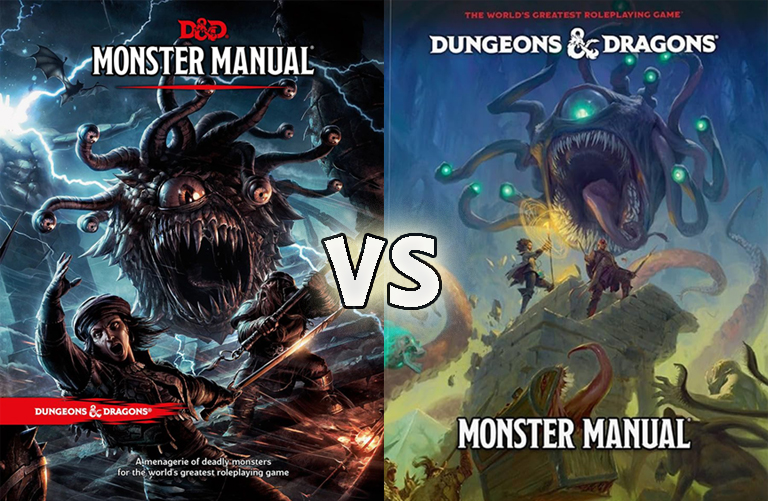
Comparing the new (2025) Monster Manual to the old (2014) one.
How many Monster and NPC stat blocks does it have and how are they organized?
NOTE: the following counts are my own. I apologize in advance for any inaccuracies.
2014 Monster Manual. (I’ll be referring to this as the 5E MM.) The 5E MM contains 392 stat blocks. They are divided up like this: The main section of the 5E MM contains 276 creature stat blocks. Appendix A: Miscellaneous Creatures contains 95 stat blocks for animals and fantastic variants of animals. Appendix B: Nonplayer Characters contains 21 stat blocks for humanoid opponents.
2024 Monster Manual. (I’ll be referring to this as the 5.5 MM.) The 5.5 MM contains 504 stat blocks. That’s 112 moremonsters than in the 5E MM. They are divided up like this: The main section of the 5.5 MM contains 408 creature stat blocks. Appendix A: Animals contains 96 stat blocks for animals including and fantastic variants of animals. Note that dinosaurs have been moved out of the main section of the book and into this appendix where they are listed alphabetically, mixed in with the other animals. Appendix B: Nonplayer Characters– Has been removed. Each NPC is now listed, grouped by type and those groups sorted alphabetically, in the main section of the book. For example, all the Cultists are grouped together and found with the monster names that start with “C”. These NPC groups (although they aren’t called NPCs in this MM) contain every Humanoid that is in the 5,5 MM other than the “Vampire Familiar.”
If Appendix B still existed it might look something like this:
Missing Appendix B: Nonplayer Characters
Berserkers
Guards
Performers
Scouts
Berserker Commander
Guard
Performer
Scout
Berserker
Guard Captain
Performer Maestro
Scout Captain
Cultists
Knights
Performer Legend
Spies
Cultist
Knight
Pirates
Spy
Cultist Fanatic
Questing Knight
Pirate
Spy Master
Cultist Hierophant
Mages
Pirate Captain
Toughs
Aberrant Cultist
Mage Apprentice
Pirate Admiral
Tough
Death Cultist
Mage
Priests
Tough Boss
Elemental Cultist
Archmage
Priest Acolyte
Warriors
Fiend Cultist
Nobles
Priest
Warrior Infantry
Noble
Archpriest
Warrior Veteran
Noble Prodigy
Warrior Commander
This is a welcome expansion. There are 54 NPC stat blocks, 33 more than in the 5E MM. By the way, none of these are required to be humanoid. They could easily be any other creature type, but there isn’t any guidance in that regard.
What happened to all the other Humanoids?
There were 29 other humanoid stat blocks in the 5E MM. Most of them are still there but their creature type has been changed! The 5E MM Humanoid Description: includes this: “The most common humanoid races are the ones most suitable as player characters: humans, dwarves, elves, and halflings. Almost as numerous but far more savage and brutal, and almost uniformly evil, are the races of goblinoids (goblins, hobgoblins, and bugbears), orcs, gnolls, lizardfolk, and kobolds.” The 5.5 MM Humanoid Description: in total is: “Humanoids are people defined by their roles and professions, such as mages, pirates, and warriors. They include members of varied species.”
So the monsters that are no longer a humanoid creature type are: Aarakocra are all Elementals. All Goblinoids (Goblins, Hobgoblins, and Bugbears) and Bullywugs are Fey. Githyanki, Githzerai, Grimlocks, and Kuo-toa are Aberrations. Gnolls and Jackalwere are Fiends. Kenku are Monstrosities. Kobolds are Dragons. Lizardfolk are Elementals.
Note that this change means that the spells Charm Person, Dominate Person, and Hold Person will no longer work on these creatures. They can only be effected by the higher level spells Charm Monster, Dominate Monster, and Hold Monster. But there may be other magical effects than can affect these other creature types.
Removed from the 5.5 MM: Orcs are still Huminoid and Drow are still Elves but neither of them have stat blocks in the 5.5 MM. Duergar are still, presumably, Dwarves although they are not mentioned in the 5.5 MM. Half-Elves and Half-Dragons are not mentioned. Evidently, they no longer exist.
How easy is it to find the monster you are looking for?
For a comparison, let’s say I am looking for a Dinosaur, specifically an Allosaurus. The 5E MM contains stat blocks for 6 Dinosaurs and the 5.5 MM contains 7.
Finding an Allosaurus in the 5E Monster Manuel: The Allosaurus is not listed in the Contents (in the front of the book). It is listed in the Index of Stat Blocks (in the back of the book). Just thumbing through the book, I eventually find it under “D”, in the Dinosaur section. Description: “Thick armor plating covers the body of the plant-eating ankylosaurus, which defends itself against predators with a knobbed tail that delivers a devastating strike. Some varieties of ankylosaurus have spiked tails that deal piercing damage instead of bludgeoning damage.” The 5E MM groups several different creature types into their own separate sections such as Animated Objects, Beholders, Demons, Devils, Dragons, and many others. It has been criticized for making it hard to find a monster if you don’t know what creature type it belongs to. You could be forgiven if you didn’t know to look for Black Pudding in the Oozes section. But many who are familiar with the book like having all of the different creatures of the same type in the same section of the book. This makes it more convenient if you are looking to find just the right Dinosaur or Devil for tonight’s adventure, for instance.
Finding the Allosaurus in the 5.5 Monster Manuel: In the back of the book there is a Monsters by Creature Type table where it can be found in the “Beast” section (it doesn’t have a “Dinosaur” section) but there are no page numbers. There is also a Monsters by Group table that also has a “Dinosaur” section. The Allosaurus is also listed there, but there are still no page numbers. There is also a Monsters by Challenge Rating table which is great to have, but it also doesn’t have page numbers. Going to the front of the book, the Allosaurus is listed in the Index of Stat Blocks just under the very short Contents. Finally, a page number! Just thumbing through the book, I don’t find it with the “A” creatures, and there is no “Dinosaur” section. I eventually found it in Appendix A, Animals. All the dinosaurs are found here, listed alphabetically mixed in with all other animals of the Beast type. Description: In the introduction of Appendix A: Animals it says: “You can find descriptions of these creatures in dictionaries or other educational sources, or you can create new roles for them in your D&D worlds.” In the 5.5 MM all of the other monsters are in the main portion of the book listed alphabetically by creature name, but there are several exceptions. The good thing is that “Black Pudding” is in with the other monsters whose names start with “B” and no longer in the “Oozes” section. But let’s say you are looking for an Adult Blue Dragon. You may have noticed when you were earlier thumbing through the book that in the Index of Stat Blocks all “Adult” dragons were listed together, and there was no listing for simply “Blue Dragons”. So you start looking through the book, flipping through pages that contain creatures whose names start with “A” but you don’t find the Adult dragons. You turn a few more pages and you do find “Blue Dragons” where it has the stat blocks for “Blue Dragon Wormling,” “Young Blue Dragon”, ”Adult Blue Dragon,” and “Ancient Blue Dragon.” Each dragon type has a septate entry that contains all of that dragon’s stat blocks. Other monsters are listed together and I started making a list: Animated Objects, Awakened Plants, Azers, Blights, Bugbears, Buletts, Bullywugs, … then I realized that most of these are where new monsters of existing monster types have been added with different CRs. This is a good thing. You will just have to remember that to find a “Twig Blight” you need to look under “B” for Blights.
What is missing from the 5.5 MM?
Other than what I have already mentioned, there is quite a bit of lore in the 5E MM that is missing from the 5.5 MM.
What’s new in the 5.5 MM?
There is a lot new and different. Here are some of the major changes (in my opinion). 1) It’s bigger. The page count has increased from 352 to 384 and the font is larger. 2) There is more and better artwork. By better I mean that almost all of them show the monster in a typical combat situation, which can inspire the DM. 3) Many of the monsters include a table for inspiration on why the creature might be there or what it may be doing. 4) There is a new Appendix B: Monster lists. These are great. I was surprised to realize that the 5E MM doesn’t include any of these. My dig disappointment is that none of them include page numbers. Stat Block Conversions: Lists every monster that was in the 5E MM that isn’t in the 5.5 MM. Even if it was just a name change, this list tells you the name of the monster in this book you can substitute for the old one. Monster by Habitat: Contains 13 tables of different habitats with a list of monsters that might be found there. Monsters by Creature Type: List each creature type and all of the different monsters that belong to that type. Monsters by Group: Lists each monster group and each of the monsters that belong to that group. Monsters by Challenge Rating: List each CR from CR 0 to CR 30 and every monster of that CR.
The stat block format has improved.
This “New DnD Stat Block Unveiled in 2025 Monster Manual” post on the “DUNGEONS & DRAGONS FANATICS” site does an excellent job of describing everything new about the stat blocks. Although it may take some time to get used to the way that ability score modifiers and saving throws are now shown, I think the new 5.5 stat block format is a major improvement over the 5E stat blocks.
What I would have done differently.
My biggest criticism has to do with the many changes that, it seems to me, were made to avoid any accusation of racism. Of course they are no longer using the word “race” and are instead using the word “species,” but with the monster manual they have gone out of their way to attempt to remove any suggestion that any species or any creature type that could possibly be used by someone to represent a race in the real world be removed from the list of “monsters.” To accomplish this they removed all “Humanoid” creatures from the monster manual, with the exception of the “Vampire Familiar.” And they simultaneously reclassified many monsters that they wanted to keep as monsters to something other than “Humanoid.” In the 4th edition of D&D, the playable character races were included with their own separate monster statistics. This included the Dwarf, Eladrin (a playable Fey Humanoid character race in 4th edition), Elf, Halfling, Human, Dragonborn (not a playable character race in 4th edition), and Tiefling. This was every playable character race at that time other than the Half-Elf. For each of these races there were several different stat blocks representing different difficult levels (XP values). For instance, for Humans there was a Human Rabble, Human Lackey, Human Bandit, Human Guard, Human Berserker, and a Human Mage. I think that doing this again in the 5.5 MM, rather than going through all the gymnastics that they did would have worked perfectly well. On page 6 it says that the Alignment listed on the stat block is a “default suggestion” inspired by its “traditional role in the game.” Therefor no monster is necessarily always evil.
My overall opinion. I like it!
If you have read this so far, after all my criticisms you may be surprised at my overall opinion. I disagree with many of the decisions they made in creating this book but I will be using it. The revisions to existing monsters are an overall improvement. The DCs are more consistent. The monsters, especially at higher CRs, are more deadly. They were not difficult enough previously. The way they are presented make them easier to run. Many have new features which may surprise your party. In many instances, even if I am not using the 5.5 PHB, I will be switching out the old monsters and using these instead. The addition of different CR versions of old monsters a very useful. And the completely new monsters are all excellent. In my opinion, this is the best of the three new core rule books.


 Dungeon Master Assistance
Pingback: ToV Monster Vault Review | Dungeon Master Assistance
Pingback: ToV Monster Vault Review – SMOOSH