Abbreviations: In the following I am referring to Wizards of the Coast as WotC, Dungeons and Dragons as D&D, the Players Handbook as the PHB, the 2014 version as 5E and to the 2024 version as 5.5.
The D&D 5.5 PHB: Review of “Chapter 2, Creating a Character”
I am assuming that the reader is familiar with the 5E PHB, so I am only commenting on things that are new or different from the 5E version.
Chapter 2, Creating a Character
Note: This chapter includes a sample Character Sheet with a big numbered dot in each of the spaces that corresponds to the step where you get that information. This can be useful, but there is NO blank Character Sheet in the book that you can photocopy like there is in the 5E PHB. You can download a blank PDF of the Character Sheet that it has in the book on D&D Beyond, but it doesn’t mention that in this book. It does say you can use a “printed character sheet (like the one shown on the following pages), a digital character sheet like the one on D&D Beyond, or plain paper.” For those of you who don’t know, D&D Beyond didn’t exist when D&D 5E was published in 2014. It was founded in 2018 and, in partnership with WotC, developed a character generator for D&D 5E. It later added an encounter builder and a combat tracker. WotC bought D&D Beyond in 2022 so it should be of no surprise that it is mentioned several times in this book.
Step 1: Choose a Class
In 5E you selected your race (now called species) first. In 5.5 you select your class first.
CLASSES: D&D 5.5 has the same 12 classes that are in the D&D 5E PHB. It refers you to Chapter 3 for the class details. A BALANCED PARTY: It recommends the party contain a Cleric (can substitute a Bard or Druid), Fighter (can substitute a Barbarian, Monk, Paladin, or Ranger), Rogue (can substitute a Bard or Ranger) and Wizard (can substitute a Bard, Sorcerer, or Warlock). WRITE YOUR LEVEL: Level 1, 0 XP.
Step 2: Determine Origin
BACKGROUND: It refers you to Chapter 4 for the backgrounds. STARTING EQUIPMENT: You get some starting equipment from your background and some from your class. SPECIES: The word “race” has been replaced with the word “species”. It refers you to Chapter 4 for the species. IMAGINE YOUR PAST: It has some questions to help you come up with a backstory. There are no Ideals, Bonds, or Flaws. LANGUAGES: You get Common and two other languages. You don’t get any languages from your Species or your Background. The list of standard languages has expanded to include Common Sign Language and Draconic. Thieves’ Cant has been added to the rare languages list. A note regarding Primordial reads “Primordial includes the Aquan, Auran, Ignan, and Terran dialects. Creatures that know one of these dialects can communicate with those that know a different one.” The language tables no longer list Typical Speakers or Script, instead it has a column listing the languages origin.
Step 3: Ability Scores
GENERATE YOUR SCORES: The methods are the same. The Point Cost system (often referred to as the Point Buy system) is just one of the standard ways to determine your scores, it is no longer called a variant. ASSIGN ABILITY SCORES: There is a “Standard Array by Class” table that recommends which score to assign to which ability, based on your class. ADJUST ABILITY SCORES: Your background lists three abilities; add one point to each of these or add 2 to one and 1 to another one. DESCRIBE APPEARANCE AND PERSONALITY: For each ability there is a table with 4 potential descriptions of your character depending on whether he has a high or low score in that ability. Write it on your sheet.
Step 4: Alignment
The NINE ALIGNMENTS: Same as always. There has been speculation as to whether or not alignments would be dropped from D&D altogether. I’m glad they kept them. Of note is that there are no alignment tendencies for Species (previously Races). It says “D&D assumes that player characters aren’t of an evil alignment. Check with your DM before making an evil character.” This agrees with what I have always done. I have never allowed evil player characters in my games.
Step 5: Fill in the Details
CLASS FEATURES: From class’s feature table in chapter 3. FILL IN NUMBERS: Enter onto your Character sheet; Saving Throws, Skills, Passive Perception, Hit Points, Hit Point Dice, Initiative (your Dexterity modifier), Armor Class, Attacks, Spellcasting, Spell Slots, Cantrips, and Prepared Spells. NAME YOUR CHARACTER: Same as always.
Starting at Higher Levels
This is a much needed section that includes a table of Starting Equipment at Higher Levels.
Multiclassing
Multiclassing was an optional set of rules in D&D 5E. It is no longer an option, it is a part of the core rules. None of the rules for multiclassing change, but in the new book, in several places you will have to look up specific information in other places in the book.
For example; PREREQUISITS: These rules don’t change, but you have to have a minimum score of 13 in the primary ability of your current class and your new class. The difference here is that in 5E there is a table that makes it clear that for classes with more than one prime ability you must have a 13 in all of them. The primary ability for each class is the first thing listed on the Core Traits table for that character in its section in Chapter 3, Character Classes; and in the Class Overview table in Chapter 2, Creating a Character, Step 1: Choose a Class. Another minor change in wording is that, for all classes except for the wizard, it uses “spells you have prepared” in place of “spells you know.”
I’ll be making a separate post for each class. Please share your thoughts in the comments below.
Abbreviations: In the following I am referring to Dungeons and Dragons as D&D, the Players Handbook as the PHB, the 2014 version as 5E and to the 2024 version as 5.5.
The D&D 5.5 PHB: Review of “Chapter 1, Playing the Game” and of “Appendix C, Rules Glossary”
I finally got my copy of the new Players Handbook. I thought I would share my thoughts as I read through it and point out the differences in the 5.5 version and the 5E version. I am assuming that the reader is familiar with the 5E PHB, so I am only commenting on things that are new or different from the 5E version. I won’t be commenting on entries that were just re-worded for clarification (there are a lot of those).
I will make a post after I finish reviewing this book with any House Rules I will be using with this 5.5 version of the PHB.
Note: On page 11, it clarifies that “The rules provide DCs for certain checks, but the DM ultimately sets them.” You will need to keep that in mind where, in other places in the book, it gives a specific DC for a task, such as hide or pick a lock, for example.
Chapter 1, Playing the Game
EXAMPLES: This chapter contains several examples of game play. These are an excellent way to introduce new players to the game.
Here are the things that are new or have changed.
SAVING THROWS: It spells out that you can choose to fail a saving throw if you choose to. I have always played it this way but I am glad to see it codified in the rule book.
HEROIC INSPIRATION (formerly just called Inspiration): Renaming it is a good move. That differentiates it clearly from Bardic Inspiration. The only change I see is that it no longer says that you can give it to another player unless you receive it when you already have it and the other player doesn’t.
I fond 3 places where in the 5.5 rules where PCs can get Heroic Inspiration other than when the DM gives it to them.
Fighter, Champion, HEROIC WARRIOR: “During combat, you can give yourself Heroic Inspiration whenever you start your turn without it.”
Human trait, RESOURCEFUL: “You gain Heroic Inspiration whenever you finish a Long Rest.”
Origin Feat, MUSICIAN: After each Short or Long Rest, you can give Heroic Inspiration to all your allies. It doesn’t make it clear, but I would assume this would also include yourself.
ACTIONS: One change that I noticed is that these actions are not called “combat actions” like they were in the 5E PHB. It leaves me with the feeling that if it’s not on this list you can’t do it, if you are in combat or not. It does call the table a list of the “game’s main actions” and that “you can improvise other actions” but doesn’t make it clear that your character can do, or attempt to do, anything he chooses to do. The actions from 5.5 are not changed.
INFLUENCE: (This is a new action.) You decide what you want to convince a monster to do. If the monster is neither willing nor unwilling but is hesitant, you make a CHA check (either Deception, Intimidation, Performance, or Animal Handling). The DC = the higher of 15 or the monsters INT score. “On a successful check, the monster does as urged”.
MAGIC: This was the “Cast a Spell” action in 5E. It now also includes “use a magic item, or use a magical feature”.
STUDY: (This is a new action.) You make an INT check to recall an important bit of information. What I like best here is the PC can use this to “remember” something about the monster they are facing. The skill they use depends on the monster type; Arcana (Aberrations, Constructs, Elementals, Fey, and Monstrosities), History (Giants and Humanoids), Nature (Beasts, Dragons, Oozes, and Plants), Religion (Celestials, Fiends, and Undead).
UTILIZE: This is a renaming of the old “Use an Object” action.
CARRYING OBJECTS: It says “You can usually carry your gear and treasure without worrying about the weight of those objects.” and that the DM may require you to abide by the carrying capacity rules if you try to carry something especially large or heavy. Although this is covered in the 5E PHB by saying the calculated weight “is high enough that most characters don’t usually have to worry about it,” the new PHB makes it very clear.
ENCUMBRANCE: (variant rule) has been removed from the rules. I very seldom used this anyway.
HAZARDS: This is a new category of environmental dangers. They are all defined in the rules glossary. They are:
Burning: How much fire damage you take each turn and how to put out the fire.
Dehydration: How much water you need each day, based on your size. You gain 1 level of exhaustion each day without it. Can’t be removed until you drink full amount for one day.
Falling: Same a falling damage in 5E. Adds STR (Athletics) check to reduce damage by half if falling into water.
Malnutrition: Same as Dehydration, but pounds of food required each day, except you get a CON save each of the first 4 days day to avoid getting an Exhaustion level.
Suffocation: How long you can hold your breath hasn’t changed. But, at the end of that time instead of dropping to 0 HP you gain 1 Exhaustion level each turn. You recover from all Exhaustion gained that way once you can breathe again.
TRAVEL PACE: Basically the same but presented in a clearer, easier to understand way, and it omits Forced March [which is OK with me.]
COMBAT:
Here are the things that are new or have changed.
SURPRISE: If you are surprised, you roll for initiative with Disadvantage. This is so much simpler and easier to understand than the old rules. It is a little less “realistic” but the old way sometimes gave the monsters two rounds of combat before a PC could act which always felt like a major penalty. MOVING AROUND OTHER CREATURES: Moving through the space of an ally is no longer Difficult Terrain. COVER: No change, but it includes a table that makes finding the information you are looking for much easier to find. OPPORTUNITY ATTACKS: Added “Bonus Action” to the list of actions you can use to move that do not provoke an opportunity attack. [This is a minor change. I always allowed this anyway, but it’s good that it is now in the official rules.]
It now says “… when a creature that you can see leaves your reach.” In 5E it said “… when a hostile creature that you can see moves out of your reach.” By leaving out the word “hostile” you can now make an opportunity attack against an ally. [I may be adding a new house rule that says that you cannot make an opportunity attack against an ally.]
UNDERWATER COMBAT: This has been greatly simplified. If you don’t have a swim speed you have disadvantage on melee attacks with weapons that don’t do piercing damage. [In the 5E PHB it had to be a shortsword, spear, or trident.] And, all range weapon attacks miss at long range and have disadvantage at normal range. [The 5E PHB excluded ranged piercing weapons from disadvantage.] KNOCKING OUT A CREATURE: In addition to the creature falling unconscious, the new PHB adds “It then starts a Short Rest, at the end of which that condition ends on it. The condition ends early if the creature regains any Hit Points or if someone takes an action to administer first aid to it, making a successful DC 10 Wisdom (Medicine) check.” CONDITIONS: Because it added “can’t speak” to the Incapacitated condition, it removed “can’t speak” from the descriptions of the conditions that include having the Incapacitated condition. Any condition that had “can’t move”, was changed to “Your Speed is 0 and can’t increase.” Other than those 2 changes, these conditions are unchanged; Blinded, Charmed, Deafened, Frightened, Grappled, Paralyzed, Poisoned, Restrained, Stunned, and Unconscious.
These conditions have changed;
Exhaustion: (This wasn’t a condition in 5E.) For each level of exhaustion you receive an additional -2 on ability checks, attack rolls, and saving throws (now called D20 Tests), and your speed is reduced by an additional 5 ft. You die when your Exhaustion level is 6. Each long rest removes 1 level of exhaustion.
Incapacitated: You still can’t take any action, Bonus Action, or Reaction and it adds that your Concentration is broken, you can’t speak, and you have Disadvantage on initiative.
Invisible: It adds; you have advantage on initiative, and are not affected by any effect that requires you to be seen, “unless the effect’s creator can see you”. [This means when the creator has something like the See Invisibility]
Petrified: Same as before but it removed “is unaware of its surroundings.” and “a poison or disease already in its system is suspended, not neutralized.”
Prone: The only change is “A prone creature’s only movement option is to crawl, unless it stands up and thereby ends the condition.” is changed to “Your only movement options are to crawl or to spend an amount of movement equal to half your Speed (round down) to right yourself and thereby end the condition. If your Speed is 0, you can’t right yourself.”
Appendix C, Rules Glossary
Here are the things that are new or have changed.
ATTACK [Action], Equipping and Unequipping Weapons: “You can either equip or unequip one weapon when you make an attack as part of this action. You do so either before or after the attack.” I have seen several people on YouYube saying that this new rule allows unlimited swapping between different weapons. It does not. You can either equip or unequip a weapon as part of the attack. Therefore, with any one hand, you can only switch between 2 different weapons regardless of how many attacks you are allowed to make with the attack action. Also, in the new rules, dropping a weapon counts as unequipping. Bloodied: “A creature is Bloodied while it has half its Hit Points or fewer remaining.” Burning [Hazard]: Rules for how much damage you take if you are on fire and how you can put out the fire. (Hazard is a new category.) CARRYING CAPACITY: There is a nice table showing how the amount you can carry depends on your size and your strength. In the 5E PHB that fact is easily overlooked and not very clear. D20 TEST: This is a simple new definition that they have added. It refers to ability checks, attack rolls, and saving throws. HELP [Action]: Clarifies that you must have proficiency in the help skill or tool you are helping with. HEROIC INSPIRATION: This was just called inspiration in 5E. Also, it changes it to a re-roll of ANY DIE. HIDE [Action]: Requires a Dexterity (Stealth) check to hide. [Refer to the “How to Hide” section below.] ILLUSIONS: I like it that it spells out that illusions cast shadows and reflections. JUMPS: Distance calculations are simplified, making them are easier to remember. LONG REST: It now requires 16 hours between each 8 hour long rest.
How to Open a Lock (or Disarm a Trap)
Here is my interpretation of how a PC can pick a lock in D&D 5.5.
You can’t pick a lock unless you have thieves tools, although you are not required to have proficiency with them.
If you have thieves’ tools, to pick the lock you must succeed in a (DC 15) Dexterity check. [The DC can be changed by the DM.]
If you have proficiency with thieves’ tools you can add your Proficiency Bonus (PB) to the check.
The book says “If you have proficiency in a skill that’s used with that check, you have Advantage on the check too.” But, none of the tool descriptions list any skills that are used with that check. So, because using thieves’ tools doesn’t use any skills (such as Sleight of Hand), and you can’t have proficiency in an ability (such as Dexterity), you can’t get Advantage on the check.
How to Hide
Here is my interpretation of how a PC can hide in D&D 5.5.
The Dungeon Master decides if the circumstances are appropriate for hiding.
You must be Heavily Obscured or behind Three-Quarters Cover or Total Cover, and out of the line of sight of all enemies.
You make a Hide check. This is a DC 15 Dexterity (Stealth) check. [The DM may assign a different DC.]
If you succeed you now have the invisible condition.
A creature you are hiding from can find you on a Wisdom (Perception) check. The DC is the same as what you rolled on your Hide check.
You give away your location (no longer have the hidden condition) when you make a sound louder than a whisper, an enemy finds you, you make an attack roll, or you cast a spell with a verbal component.
As written, the rules could be interpreted to imply that even though you have the invisible condition you are not, in fact, invisible. You are only hidden. Your invisible condition only applies to your enemies, your allies may be able to see you. I would have liked to have seen this clarified a bit more. For one thing, it now implies that a See Invisibility spell would allow you to see any creature that was successfully hiding from you. I strongly feel that they should have added a Hidden condition, that you get when you are hiding, that would be similar to the Invisible condition.
The current rules for invisibility and hiding in D&D 5.5 can lead to some counterintuitive situations. Let’s consider this scenario:
You’re hiding behind a barrel in an Old West-style street confrontation.
You step out from behind a barrel you are hiding behind and fire at an opponent across the street. Do you still have advantage from being hidden?
What if you walk across the street and attack an enemy up close? Are you still considered hidden?
The rules don’t explicitly address these situations, which can lead to confusion. While common sense suggests you’d lose your hidden status when moving in plain sight, there’s no clear rule stating this. How would you handle this as a DM? Would you implement a house rule? If so, what would it be? Share your thoughts in the comments below.
Continuing My Focus on D&D: A Personal Perspective
Introduction
As many of my readers know, I’ve been vocal in the past about my concerns regarding Hasbro and Wizards of the Coast (WotC), the companies behind Dungeons and Dragons. I’ve even contemplated moving away from D&D to other systems like Tales of the Valiant. Despite these criticisms, I’ve decided to continue focusing on D&D in my content. Today, I want to explain why.
The Enduring Magic of D&D
Dungeons and Dragons is more than just a product; it’s a gateway to imagination, creativity, and community. The game’s core essence – collaborative storytelling and adventure – remains unchanged, regardless of corporate decisions.
Separating the Art from the Artist (or Corporation)
While I stand by my past criticisms of Hasbro and WotC, I’ve come to realize that D&D has grown beyond its corporate owners. The game now belongs to its players, dungeon masters, and the vibrant community that has formed around it.
The Power of the Community
One of the most compelling reasons to stay engaged with D&D is the incredible community surrounding it. From homebrew content creators to passionate players, this community continues to innovate and expand the game in ways that often transcend official releases.
A Platform for Creativity
D&D provides an unparalleled platform for creative expression. By continuing to focus on the game, I can explore and share new ideas, homebrew content, and unique perspectives that contribute to the broader D&D ecosystem.
Advocating for Positive Change
By remaining engaged with D&D, I maintain a voice in the community. This allows me to continue advocating for positive changes, both in the game itself and in the practices of the companies behind it.
The Evolving Landscape of TTRPGs
While my focus remains on D&D, I’m also excited to explore how it fits into the broader world of tabletop RPGs. This includes looking at alternative systems and how they influence and are influenced by D&D.
Conclusion
In the end, my decision to continue focusing on D&D comes from a place of love for the game and its community. While I remain critical of certain corporate practices, I believe that the heart of D&D lies with its players. By continuing to engage with and create content around D&D, I hope to contribute positively to its ongoing evolution and the joy it brings to so many people around the world.
What are your thoughts on this decision? I’d love to hear from you in the comments below.
This is the sixth adventure in a series of adventures that I will be posting here, that will make up the “Its About Time” campaign arc. These adventures will take a group of adventurers from level 1 to level 20.
This is the sixth adventure in the series. This 48 page PDF file is a D&D 5E adventure for Dungeon Master’s (DMs) to take a group of 6th level Player Characters (PCs) to a chaotic dimension where time magic runs rampant. They must navigate through warped landscapes and encounter bizarre creatures to retrieve another fragment of the shattered Clock of Aeons. Even if you have no intention of running this adventure, it provides tools you may find useful in your campaign.
It introduces the Temporal Winds, a chaotic and unpredictable dimension that exists outside of linear time. The Temporal Wilds is filled with temporal anomalies, which can cause time to flow at different rates or even reverse, and is home to a variety of creatures that have been displaced from different time periods.
It has 4 new magic items.
It has 25 New monsters.
The Digital Accessories Pack includes images of Items and Monsters along with maps and monster tokens you can use in in your virtual table top game.
Check it out and let me know what you think about it in the comments section below.
The next adventure will be “AT-07 Echoes of the Future,” where PCs will travel to a possible future ravaged by Thanatos’ influence. They will encounter monstrous versions of familiar creatures and glimpse the potential consequences of failing.
This is the fifth adventure in a series of adventures that I will be posting here, that will make up the “Its About Time” campaign arc. These adventures will take a group of adventurers from level 1 to level 20.
This is the fifth adventure in the series. This 50 page PDF file is a D&D 5E adventure for Dungeon Master’s (DMs) to take a group of 5th level Player Characters (PCs) to the city of Eldoria, where they purchase magical supplies before venturing into the Whispering Wood where they uncover forgotten lore about Thantos’ dark influence, and secure another artifact needed to prevent him destroying the world. Even if you have no intention of running this adventure, it provides tools you may find useful in your campaign.
It includes a new walled port city to explore that includes 17 keyed locations with descriptions of individuals, points of interest, and potential encounters, including a ruined temple to explore complete with monsters, traps and treasure.
It presents a trek through an enchanted forest searching for the next corrupted artifact used by the malevolent Thanatos to spread chaos.
It has 4 new magic items..
It has 12 New monsters including a Spectral Nymph and a Skeletal Dragon.
It includes a magic item price and availability system with a simple table where you can roll to determine how many (if any) of any particular magic item is available for purchase depending on its rarity and the size of the town.
Check it out and let me know what you think about it in the comments section below.
The next adventure will be “AT-06 The Temporal Wilds.” It starts as the heroes (now 6th level) stroll through the bustling Eldoria marketplace. A growing murmur among the crowd catches their attention. Suddenly, a deafening roar echoes through the city. A gaping tear in reality materializes, its edges shimmering with an otherworldly light. Before their eyes, unsuspecting citizens vanish into the abyss, their screams echoing through the panicked crowd. Monstrous creatures, their forms distorted and alien, begin to emerge from the rift. The heroes, their instincts honed by previous adventures, find themselves drawn to the heart of the chaos. The fate of the city, perhaps even the world, hangs in the balance. A new adventure unfolds, testing their courage, skill, and resolve.
This is the fourth adventure in a series of adventures that I will be posting here, that will make up the “Its About Time” campaign arc. These adventures will take a group of adventurers from level 1 to level 20.
This is the fourth adventure in the series. It is a D&D 5E adventure for Dungeon Master’s (DMs) to take a group of 4th level Player Characters (PCs) to Chronopolis, a lost city on the lawful plane of Mechanus. Here, they encounter temporal anomalies, puzzles guarded by Corrupted Modrons, and the long-dead ancestor of their friend Lander, all while searching for a fabled artifact: the Chronometer of Harmony. Even if you have no intention of running this adventure, it provides tools you may find useful in your campaign.
There are tips on using “Theater of the Mind”.
The digital accessories pack includes images for Items, Locations, Monsters and Tokens.
There are 12 new monsters, complete with stat blocks, images and tokens for use on virtual table tops (VTT).
For each encountered monster, it lists the page number where that monster can be found in the Monster Manuel or, for new monsters, in the adventure. It then has an abbreviated version of the monster’s stat block on the page with the encounter.
Check it out and let me know what you think about it in the comments section below.
The next adventure will be “AT-05 The Whispering Wood,” where the heroes, guided by Lander the flump and Puck the sprite, embark on a journey to retrieve a fragment of the Clock of Aeons hidden within the Whispering Wood, a remote enchanted forest in Manoria. Their path leads from a small fishing village of Saltport Cove to the bustling city of Eldoria, where they can seek magical supplies before venturing into the perilous woods. Within the Whispering Wood, they face guardians, solve time-based puzzles, and uncover forgotten lore about the Sundering and Thanatos’ dark influence. A climactic battle awaits them as they confront a creature twisted by Thanatos’ power, forcing them to utilize all their skills and resources to secure the Clock fragment and ensure the flow of time remains stable.
This is the third adventure in a series of adventures that I will be posting here, that will make up the “Its About Time” campaign arc. These adventures will take a group of adventurers from level 1 to level 20.
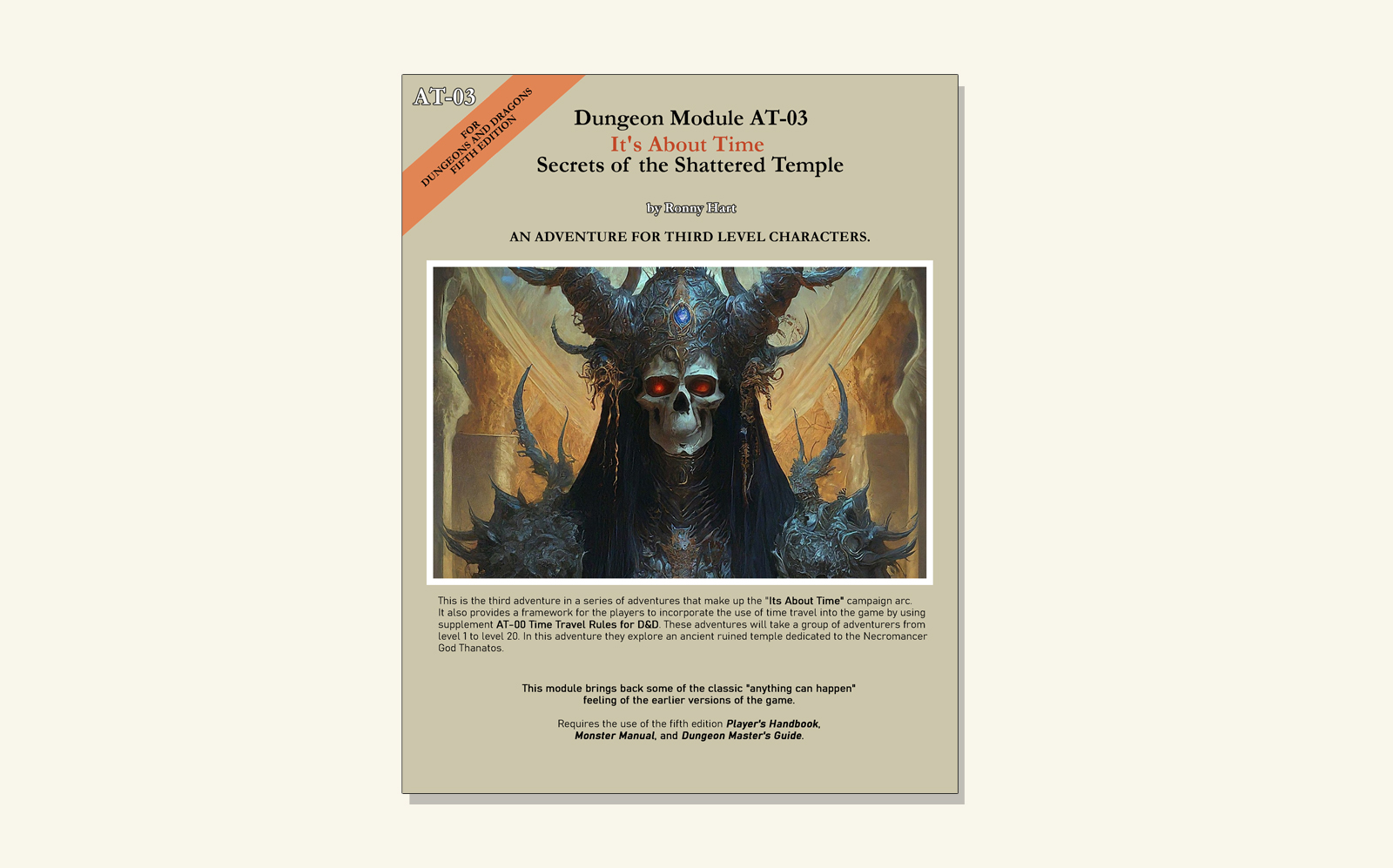
This is the third adventure in the series. It is a D&D 5E adventure for Dungeon Master’s (DMs) to take a group of 3rd level Player Characters (PCs) on an old fashion dungeon crawl where they explore an ancient underground ruined temple, filled with monsters, traps, puzzles and lots of secret doors. Even if you have no intention of running this adventure, it provides tools you may find useful in your campaign.
There are tips on tracking time and resources in a dungeon
I talk about my house rule for finding secret doors and my thoughts regarding random encounters.
The digital accessories pack includes maps for each dungeon floor. There are both color and black and white versions, A DM version with with room numbers, secret door, and trap locations.
There are 3 new monsters, complete with stat blocks, images and tokens for use on virtual table tops (VTT).
For each encountered monster, it lists the page number where that monster can be found in the Monster Manuel or, for new monsters, in the adventure. It then has an abbreviated version of the monster’s stat block on the page with the encounter.
Check it out and let me know what you think about it in the comments section below.
The next adventure will be “AT-04 The Cogs of Lost Time,” where the party lands in Chronopolis, a lost city on the lawful plane of Mechanus. Here, they encounter temporal anomalies, puzzles guarded by Modrons, and the long-dead ancestor of their friend Lander, all while searching for a fabled artifact: the Chronometer of Harmony.
This is the second adventure in a series of adventures that I will be posting here, that will make up the “Its About Time” campaign arc. These adventures will take a group of adventurers from level 1 to level 20.
This is the second adventure in the series. It is a D&D 5E adventure for Dungeon Master’s (DMs) to take a group of 2nd level Player Characters (PCs) on an exploration of an island that has way too many undead creatures. Even if you have no intention of running this adventure, it provides tools you may find useful in your campaign.
This introduces a simplified calendar that I have used in several campaigns.
This a micro-hex crawl. Where hex crawls typically use a scale of 6-10 miles per hex, or 20-70 miles per hex for larger regions, this adventure uses a map where each hex is only one mile across. This micro-hex crawl packs a lot of interesting features and encounters into a relatively small area.
This introduces a system for using a single random encounter table for encounters of different difficulties, depending on which die you roll.
It has 12 new monsters, complete with stat blocks, images and tokens you can use if you are playing on a virtual table top (VTT).
For each encountered monster, it lists the page number where that monster can be found in the Monster Manuel or, for new monsters, in the adventure. It then has an abbreviated version of the monster’s stat block on the page with the encounter.
Check it out and let me know what you think about it in the comments section below.
The next adventure will be a dungeon crawl, “AT-03 Secrets of the Shattered Temple.”
Revision 1 (June 11, 2024): On page 1, I changed “The PCs start this adventure with 1 Time Point.” to “The PCs start this adventure with 2 Time Points.”
I want to give a shout to to Jan Veenendaal. He has a web site that I used to create the stat blocks I used in this adventure. Here is how he describes it:
I created a website where you can create statblocks really easy: you enter the texts, the site does all the formatting. It will allow you to create PNG files, and a few other formats.
The site is free, does not collect data (everything stays on your computer), and is completely open source. Also, it is fine to publish whatever you create using it under Wizards’ Fan Content policy.
Dungeons and Dragons is by far the most popular TTRPG (Table Top Role Playing Game) in the world today but they are not the only one. 2024 is shaping up to be a banner year for TTRPGs. Here some you may not have heard of.
Here are some of the most popular TTRPGs going into 2024
13th Age, 2nd Edition (Pelgrane Press) Cy_Borg (Free League Publishing) Dragonbane / Drakar och Demoner (Free League) Dread (The Impossible Dream) Household (Two Little Mice) King Arthur Pendragon, 6th Edition (Chaosium) Legend of The Five Rings (John Wick) Mörk Borg (Free League Publishing) Mothership 1e (Tuesday Knight Games) Warhammer 40,000 Roleplay: Wrath & Glory (Cubicle Seven)
Here are some new TTRPGs that are coming out in 2024
Adventurer, Conqueror, King System II (Autarch LLC) Aether Nexus (Absolute Tabletop) Alien – Building Better Worlds (Free League Publishing) Amboria (Strange Owl Games) Break!! (Grey Wizard) Broken Weave (Cubicle 7) Cairn 2E (Space Penguin) Cohors Cthulhu (Modiphius) Crown & Skull (physical) (Rune Hammer) Daggerheart (Darrington Press) Deathmatch Island (Old Dog Games/Evil Hat Productions) Diablo RPG (Glass Cannon Unplugged & Blizzard Entertainment) Dragon’s Dogma 2 (Capcom) Eat the Reich (Rowan, Rook and Deckard) Final Fantasy XIV TTRPG (Square Enix) Gubat Banwa (makapatag) Heroes of Cerulea (Bläckfisk Publishing) His Majesty the Worm (Rise Up Comus) Inevitable (SoulMuppet Publishing) Into the Mother Lands (Green Ronin/Tanya DePass) Knave RPG 2E (Ben Milton) Lords of the Middle Sea (Chaosium) Monty Python’s Cocurricular Mediaeval Reenactment Programme (Exalted Funeral) Mutant – Ad Astra (Free League Publishing) Mythic Bastionland (Chris McDowall) Mythic Iceland 2E (Chaosium) Outgunned – Cinematic Action RPG (Two Little Mice) Pendragon 6e (Chaosium) Pioneer (Mongoose Publishing) QuestWorlds (Chaosium) Ronin (Slightly Reckless Games) Savage HeXXen (Ulisses Spiele) Shadow of the Weird Wizard (Schwalb Entertainment) Shadow Scar (R. Talsorian) Sinless (Courtney) Starfinder 2e (Paizo) Stonetop (penny lantern) Stormlight RPG (Brotherwise Games) Subversion (Fragging Unicorns Games) Tales from the Gods (Alastor Guzman) Tales of the Valiant (Kobold Press) Talislanta 6th Edition (Everything Epic)\ Teenage Mutant Ninja Turtles TTRPG (Palladium Books) The Electric State Roleplaying Game (Free League) The Hidden Isle (Cult of the Lizard King) The Laundry 2nd Edition (Cubicle 7) The MCDM RPG (MCDM Productions) The One Ring – Moria (Free League) The Secret World (Star Anvil Studios) The World Below (onyx Path) Tiny Cyberpunk (Gallant Knight Games) Triangle Agency (Haunted Table Games) Urban Shadows 2E (Magpie Games)\ Yazeba’s Bed & Breakfast (Possum Creek Games)
Google a few of these. You may be surprised at what you find. You may even find one (or more) that you want to play.
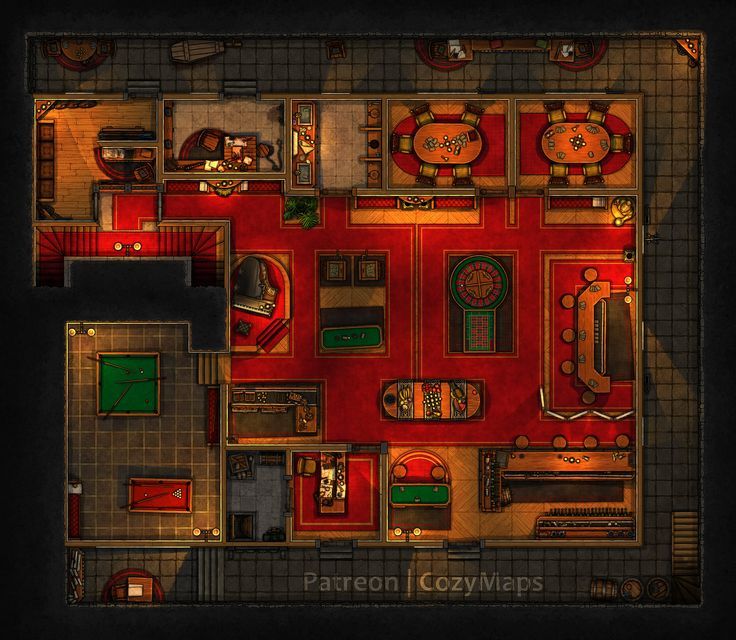
You are running a FRPG (Fantasy Role Playing Game) and the player’s characters have come to the big city. They want to check out the local gambling house. Perhaps try their luck at the tables. But you don’t want to run a whole complicated sub-game. This is for you.
Here is a simple way to determine who wins and who looses and how many gold pieces are won or lost.
The simple method:
The player tells you how much his character is going to bet. Have him flip a coin. [You could have him do this once for the entire day of gambling, or for each bet he makes while there.]
Heads – PC looses all he bet. Tails – PC wins – Roll 1d4 and check this list: 1) PC wins 1.25 X what he bet 2) PC wins 1.5 X what he bet 3) PC wins 1.75 X what he bet 4) PC wins 2 X what he bet
A more complex method:
Player rolls 1d20 and adds his character’s ability bonus. [STR for games like arm wrestling. DEX for games like darts. CON for drinking games. INT for games like dragon chess. WIS for games like poker. CHA for games where the patrons vote to determine the winner.] The house (opponent) also makes a check [add an appropriate bonus determined by the DM. +5 is a good place to start]. Ties go to the house.
Maximum Bets:
Each house will has their own max bet and max payout. An example: Maximum bet 10 gp. Maximum payout on a single bet: 20 gp. Maximum total daily payout: 200 gp.





 Dungeon Master Assistance