To mark the 50th anniversary of Dungeons & Dragons, the U.S. Postal Service will be issuing a set of 10 official Dungeons & Dragons stamps next year. Just thought you might like to know.
Even if nobody around your table knows how to play, someone to be the DM and 4 more players, one 20 sided die, one 6 sided die, and this 20 page book is all you need to play D&D!
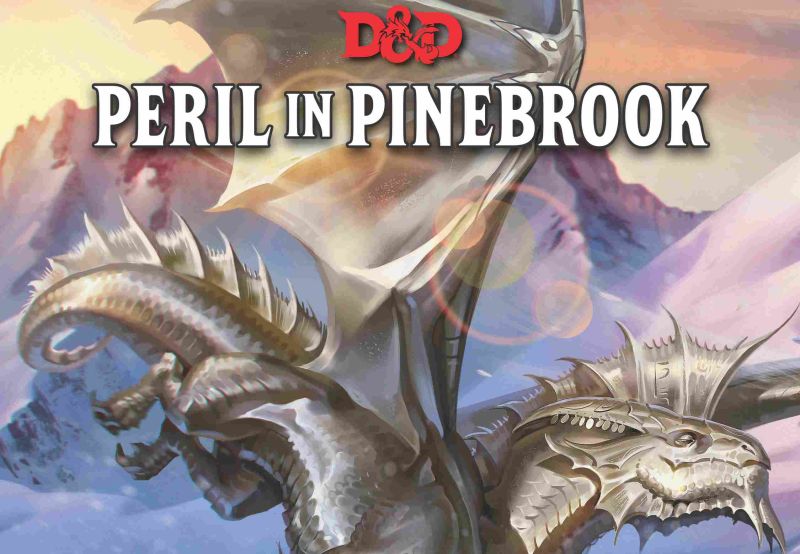
Wizards of the Coast recently posted this free introductory adventure. You can get your free copy HERE.
This is an excellent short first level adventure, written as a tutorial for new DMs and players. For someone wanting to learn about D&D for the first time, this is all they need. It does NOT require the Players Hand Book (or even the free game rules, or the SRD). There is also no need for minis or a battle mat (there are no maps). It includes 4 pre-generated character sheets. These are super simple but contain all the information you need for this adventure and has options for you to modify your character’s description and draw a sketch. You will learn a little more about how to play with each encounter.
I haven’t yet run this adventure, but am quite impressed. I would encourage anyone who wants to dip their toes into this game for the first time to start with “Peril in Pinebrook”.
In case you are interested, I edited your provided sheet a little to suit my preferences as a DM. I primarily replaced the whole player actions part with DM focused material, including the stuff that was present in WotC original screens regarding encounter visibility and suffocating. I also adjusted some graphic elements (such as table rows not following proper background order) as well as fixed some minor typos. I also changed/standardized some uppercasing to my preference.
Note to the one who sent this to me anonymously. If you would like me to include your name or a link to your web site here, just let me know.
This is only available (for now) as a $30.00 PDF on Dungeon Masters Guild. It is not being advertised, or even mentioned, by Wizards of the Coast. I can only assume that this is because they are not making any money from it. However, it is excellent!
Chains of Asmodeus is a massive release. It is a 268 page source book and high level adventure through the Nine Hells. WotC hasn’t published many adventures for high level parties, but this adventure takes your character’s from 11th through 20th level.
As per it’s page on Dungeon Masters Guild, the book contains:
50+ High Challenge Monsters
Stat Blocks for Asmodeus, Lord of the Nine, and all major Archdevils
20+ Infernal Magic Items
New Item Corruption Mechanic
Details on all Layers of the Nine Hells, with Beautifully Illustrated Maps created by John Stevenson
A Fiendish Adventure for Levels 11-20
Thanks to Nerd Immersion‘s YouTube review for turning me onto this.
And, for those of you that are interested in even more background information; back in 1984 Ed Greenwood wrote some excellent articles on the Nine Hells which were printed in issues #75, #76 and #91 of DRAGON Magazine.
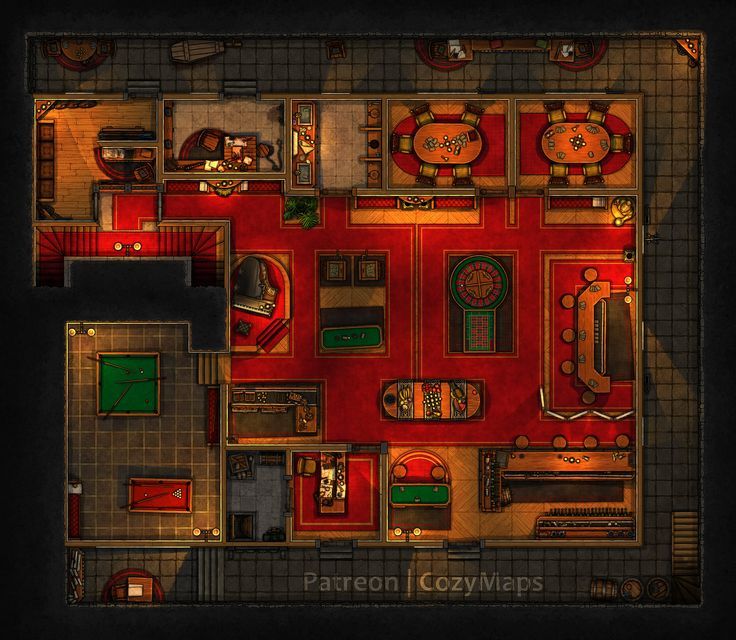
You are running a FRPG (Fantasy Role Playing Game) and the player’s characters have come to the big city. They want to check out the local gambling house. Perhaps try their luck at the tables. But you don’t want to run a whole complicated sub-game. This is for you.
Here is a simple way to determine who wins and who looses and how many gold pieces are won or lost.
The simple method:
The player tells you how much his character is going to bet. Have him flip a coin. [You could have him do this once for the entire day of gambling, or for each bet he makes while there.]
Heads – PC looses all he bet. Tails – PC wins – Roll 1d4 and check this list: 1) PC wins 1.25 X what he bet 2) PC wins 1.5 X what he bet 3) PC wins 1.75 X what he bet 4) PC wins 2 X what he bet
A more complex method:
Player rolls 1d20 and adds his character’s ability bonus. [STR for games like arm wrestling. DEX for games like darts. CON for drinking games. INT for games like dragon chess. WIS for games like poker. CHA for games where the patrons vote to determine the winner.] The house (opponent) also makes a check [add an appropriate bonus determined by the DM. +5 is a good place to start]. Ties go to the house.
Maximum Bets:
Each house will has their own max bet and max payout. An example: Maximum bet 10 gp. Maximum payout on a single bet: 20 gp. Maximum total daily payout: 200 gp.
I haven’t posted much on D&D lately. If you follow this blog you know that after the OGL mess this January I have said that, depending on the Wizards of the Coast’s (WotC) behaviour between now and the time the next version of D&D is released in 2024, and my opinion of that version, I will not be buying any Wizard’s of the Coast products. Here are my latest thoughts regarding this.
I’m still not giving Hasbro [WotC is a subsidiary or Hasbro] any of my money at least until after they release the 2024 version of D&D, if then.
As a side note – they have said that they will not be calling it a new edition but will be referring to the current edition as the 2014 edition of Dungeons & Dragons and the new version as the 2024 edition of Dungeons & Dragons. I agree that, based on the most current play-test, it does look more like a rules update than a new game. For now, I will be referring to it as D&D v5.5
At the current time I like the proposed changes to 5e, but I also like the new game rules that Kobold Press is proposing for their Tales of the Valiant (ToV). The two games will be different from each other, but they will both be based on the current version of D&D with revisions, changes, updates, and new content. They both insist that they will be backward comparable with existing 5e content. So, when the new books come out next year, I have several options. 1) I could ignore both and continue playing 5e. 2) I could believe WotC was censer when they apologized for the Dungeons & Dragons Open Gaming License fiasco, and start using the new v5.5 rule books. 3) I could switch from D&D to ToV or some other RPG (I am leaning toward ToV over the alternatives).
Here are my thoughts:
I am a long time supporter of WotC and I would hate to give up on them by switching to a different gaming company. Hashro’s purchase of them in 1999 didn’t seam to have much effect on WotC until after Chris Cocks became CEO of Hasbro on February 25, 2022. The changes were subtle at first, but they came to a head January this year with the OGL thing.
Hasbro has made it clear that their goal is to get more money from D&D players. They realize that DMs spend much more on WotC products than the players do and they want to get more of the players money. Their plan appears to make D&D primarily an on-line game with the v5.5 Virtual Tabletop (VTT) that they are developing, coupled with D&D Beyond. That way they can charge a monthly fee for each player and offer a lot of customizing options, each of which you can get for a small fee. Even if they make it free for the players to join a game, WotC will still make a lot of money on the micro transactions. And they can offer even more things for the DM to buy, such as 3D objects and tools to create custom 3D dungeons along with animations, special effects, furniture, commoners and monsters.
When I first saw their VTT preview I was excited. It looked great. I thought it would be wonderful to play. But now I am not sure how well that will work for me as a Dungeon Master. First of all I may have to upgrade my PC or get a new one to handle the real time 3D at a decent rate. Perhaps if I stick to playing on-line with adventures that are published by WotC that include all of the 3D maps and monsters, that would work. Especially if it were something like a dungeon crawl where the PCs couldn’t go anywhere off the map. But for me to use it for a home grown campaign or to play one of the many 5e adventures I currently have as a PDF or in a print, the VTT would need to have a 2D ability to draw the encounter map and to import 2D JPG files, something like Fantasy Grounds or Roll20. But if I use their new VTT it will need to be a lot better than the Fantasy Grounds, that I am currently using.
For one thing, I bought a copy of Fantasy Grounds including a copy of the 5e version of the Player’s Handbook, the Dungeon Masters Guide and the Monster Manuel a couple of years ago. This was a one-time purchase which they say will allow me to continue playing with it as long as I want to. With it, for example, I am currently running the “The Age of Worms” adventure path that was published over twelve instalments from July 2005 through June 2006 in Dungeon magazine. I am importing 2D maps that others have drawn and made available on the internet. If the WotC new VTT won’t allow me to do that, I won’t be interested. Also, if there is a monthly fee along with a requirement to link to D&D Beyond with a requirement for another monthly fee for that, those will be strikes against it.
If I decide to not use the new VTT and continue using Fantasy Grounds, I will be surprised if WotC makes a Fantasy Grounds version of the new PHB and MM available for purchase. They seem to be intent on forcing everyone onto their platform.
And, what if I just buy the new D&D 5.5 books, and don’t play on-line or take the time to revise all the rules on my copy of Fantasy Grounds? Up until now, WotC has published Errata for the PHB and others from time to time with corrections and revisions, and include those in the next release of the book. Will they continue to do this? I think that the temptation will to be to make those changes to the on-line versions of those books that you access through the VTT or D&D Beyond and forget about the errata updates. It appears that they are looking at the physical books as only something that collectors will purchase. If they do that, you will only know if you are using the latest rules if you are using Wizards’ VTT, or at least D&D Beyond. I also wouldn’t be surprised if they combine their new VTT with D&D Beyond at some point.
Another thing – when you “buy” a book on D&D Beyond you are not actually buying anything. What you are doing is paying for a “license” to access a copy of that book when you log onto their web platform. If the site goes down, or the company goes out of business, or they simply decide to change the wording of the conditions that you accepted when you clicked on at the bottom of the pages of text that you never read when you “bought” the book, then you will no longer have access to it. If you think that could never happen, look at what they tried to do with the OGL. There is no reason to think that everything that you “buy” on their VTT will be any different. As an example of what they could do instead: A copy of the Fantasy Grounds program exists on my hard drive. When I run it, it links to their on-line site, but it would run even if I were disconnected from the internet. When I purchased Fantasy Ground versions of the D&D books, I downloaded copies of them onto my hard drive. These are similar to PDF files, except they can only be opened with the Fantasy Grounds program, and all the rules, monsters, NPCs, etc. that they contain are available for me to use in Fantasy Grounds. I regularly backup the folder that they are in. Whenever I update Fantasy Grounds, it checks to see if anything else that I have purchased has been updated and will replace them with the newer versions. If Fantasy Grounds were to disappear from the internet, for any reason, I could still link to others site-to-site and continue to play with everything I have purchased. WotC could do something similar if they chose to.
So what am I going to do?
Well, it depends. ⚫ If either v5.5 or ToV becomes obviously head and solders better than the other, I will probably use that one. (I will post a side-by-side comparison once they are both published.) ⚫ If the v5.5 books are not available for Fantasy Grounds, I will probably switch to ToV. I have already supported their Kickstarter and included purchase of the Fantasy Grounds versions of the books.
Comparing D&D 5e to Level Up: Advanced 5th Edition
This is one of several reviews I am doing this year of various table top role playing games. I am specifically comparing them to D&D 5e. I am doing this with the assumption that my readers are already familiar with D&D 5e. The following review is based only upon my reading of the rulebook. I haven’t played this yet, but I will be posting my opinion after I get a chance to play test it.
I am referring here to the fifth edition of Dungeons and Dragons as 5E and to Level Up: Advanced 5th Edition as A5E. This information is for evaluation purposes, it should not be considered official rules of the game. You can assume things that I don’t list here are basically like 5E with only minor differences.
In A5E the Dungeon Master is called the Narrator.
Summary of the game system
Level Up: Advanced 5th Edition is the name of a game by EN Publishing, a UK-based tabletop roleplaying game company. A5E is an ‘advanced’ version of 5E with an extra layer of crunch and depth. It’s fully stand-alone with no need for the original 5E core rulebooks. This review is based on my reading of A5E’s Adventurers Guide, a 656 page replacement for 5E’s Player’s Handbook. It is what you would get if you started with 5E’s SRD, then added everything else that is in the Player’s Handbook, re-writing everything and changing everything that is copyrighted. And then you added a whole lot more of almost everything. If you know how to play 5E, you pretty much know how to play A5E, the rules have only been added to or modified in a few places.
Primary differences between A5E and 5E
Character Creation
Hit Points, Abilities, Ability Modifiers, Proficiency Bonus
All the same as in 5E.
Origins
Heritage: Who were your parents? (Race in 5E)
Your heritage determines your age, size, and speed. Some heritages include multiple gifts for you to choose from to further diversify your character. At a higher level, each heritage grants an additional paragon feature (called a paragon gift).
Select Dragonborn, Dwarf, Elf, Gnome, Halfling, Human, Orc, Planetouched (Tiefiing and Aasimar in 5E), or Mixed Heritage (with parents of two different heritages)
Cluture: Where did you grow up? (Subclass in 5E)
Your culture contains a range of traits and the languages you know.
Your destiny provides your character with motivation, roleplaying hooks, and special features, including a bonus feature when your character eventually fulfills their destiny.
Select Chaos, Coming of Age, Devotion, Dominion, Excellence, Knowledge, Metamorphosis, Revenge, Underdog, or Wealth.
Class
Choose Adept (Monk in 5E), Bard, Berserker (Barbarian in 5E), Cleric, Druid, Fighter, Herald (Paladin in 5E), Marshal, Ranger, Rogue, Sorcerer, Warlock, or Wizard.
Weapon Properties: In addition to its specific features, each weapon type may have one or more of these properties: Breaker, Compounding, Defensive, Dual-Wielding, Finesse, Hand-Mounted, Heavy, Loading, Mounted, Parrying, Parrying Immunity, Range, Reach, Simple, Thrown, Trip, Two-Handed, Versatile, Vicious
Shields
There are 4 shield types: Light, Medium, Heavy, and Tower
Heavy Armor: Hauberk (steel), Splint (steel), Full Plate (steel), Elven Plate mithral, Dwarven plate (stone)
Helms: Helm, Visored Helm
Materials:
Your gear may be made from these materials, each with different price, weight and other properties: Adamantine, Bone, Bronze, Cloth, Cold iron, Hide, Iron, Leather, Mithral, Silver, Steel, Stone, Wood
Material Properties: the material your armor or weapon is made of may have one or more of these properties: Comfortable, Feybane, Flaw, Fortified, Hardy, High-Quality, Lightweight, Low-Maintenance, Rust, Silvered, Underarmor, Weighty
Adventuring Gear
There are a lot of things listed with their cost, weight and descriptions. I’ll not list them all here. I’ll just indicate the number of items of each type.
Multiclassing: Basically the same as in 5E, but the Prerequisites are an optional rule.
Feats: They are not listed as an optional rule. Getting them instead of an ability score increase is the same as 5E. The list of feats has been expanded and modified.
The available feats are: Ace Driver, Athletic, Attentive, Battle Caster, Bladechanter (Whirling Incantor, Eldritch Whirlwind Master) Brutal Attack, Bull Rush, Combat Thievery, Covert Training, Crafting Expert, Crossbow Expertise, Deadeye, Deflector, Destiny’s Call, Dual-Wielding Expert, Dungeoneer, Eldritch Archer (Arrow Enchanter, Eldritch Volley Master), Empathic, Fear Breaker, Fortunate, Grappler, Guarded Warrior, Hardy Adventurer, Heavily Outfitted, Heavy Armor Expertise, Heraldic Training, Idealistic Leader, Intuitive, Keen Intellect, Lightly Outfitted, Linguistics Expert, Martial Scholar, Medium Armor Expert, Moderately Outfitted, Monster Hunter, Mounted Warrior, Mystical Talent, Mystic Arcanist (Pure Arcanist, Arcanum Master), Natural Warrior, Newblood (Vampire Spawn, Vampire Lord), Nightstalker (Subtly Skilled, Night Master), Physician, Polearm Savant, Power Caster, Powerful Attacker, Proclaimer (Divine Orator, Harbinger of Things to Come), Primordial Caster, Rallying Speaker, Resonant Bond, Rite Master, Shadowdancer (Shadowmancer, Shadow Assassin), Shield Focus, Skillful, Skirmisher, Spellbreaker, Stalwart, Stealth Expert, Street Fighter, Surgical Combatant, Survivor, Swift Combatant, Tactical Support, Tenacious, Thespian, Untamed (Living Stampede, Wild Rioter), Vendetta (Revenant, True Revenant), Vengeful Protector, Vigilante (Equipped for Justice, A Symbol That Strikes Fear), Weapons Specialist, Well-Heeled, Woodcraft Training
Skills: the same as 5E with the addition of Culture and Engineering.
Advantage, Disadvantage, and Expertise
Advantage and Disadvantage are the same as in 5E.
Some class features of the game may grant you an expertise die on a d20 roll. In that case you add another die (usually a d4) to the roll. If you get another expertise die that applies to the same roll, the size of the largest expertise die increases by one step for that check, from 1d4 to 1d6, or 1d6 to 1d8.
Combat
Initiative: Same as in 5E – except you roll a Dexterity check to set the order (sometimes a WIS, STR or CHA check depending on the situation).
Flanking: When you and an ally are on direct opposite sides of a target, you gain an expertise die on your actions against that target.
Actions in Combat
On your turn in combat you perform actions exactly as in 5E, with a few additional actions available to choose from. They are:
Press the Attack (bonus action): Before you attack, designate one creature within your reach. Your melee attacks against that creature gain an expertise die this round unless they are made with disadvantage, and attacks against you have advantage.
Fall Back (reaction): Whenever a creature takes the Press the Attack action against you, you can use your reaction to move backwards 5 feet, and your attacker does not gain an expertise die against you. As part of its action, your attacker can move 5 feet towards you. This doesn’t provoke opportunity attacks.
Sprint (action): You can move in a straight line up to quadrupled your speed, or triple your speed if you are encumbered or wearing heavy armor. You may not take any other actions, bonus actions, or reactions this turn. You may Sprint for a number of turns equal to your CON mod. Attacks against you are made with advantage.
Tumble (action or bonus action): Make a DEX save vs. creatures combat maneuver DC, on a success, you can move through the hostile creature’s space.
Use a Basic Maneuver (action): Disarm, Grapple, Knock-down, Overrun, or Shove.
Use a Combat Maneuver (action or reaction):
Exertion Pool: To use a combat maneuver, you must expend exertion points. You have a maximum number of exertion points equal to double your proficiency bonus. You regain any spent exertion points at the end of a short or long rest.
How many Combat Maneuvers do you get? You know a number of combat maneuvers determined by your class and class level. Your known combat maneuvers are chosen from the combat traditions you are proficient with.
There are 165 combat maneuvers. Here is an example:
Hear the Wind: (3 points)5th degree Biting Zephyr bonus action “You can literally hear the sound of incoming missiles and react to them easily. Until the end of your next turn, you gain blindsight to a range of 20 feet. When you are hit by a ranged attack, you make a Perception check against a DC equal to the attack roll. On a success the attack misses you, and on a critical success you redirect it back at the attacker.”
Spellcasting
Everything regarding Knowing and Preparing Spells, Casting Spells, Spell Slots, Casting Spells With a Higher Slot, Cantrips, Rituals and Casting Spells in Armor is the same as in 5E and the spell descriptions have the same basic formatting and components as in 5E. The spell descriptions have been re-written and more spells have been added.
Example 5E spell description:
ACID SPLASHConjuration cantripCasting Time: 1 action Range: 60 feet Components: V, S Duration: Instantaneous Description: “You hurl a bubble of acid. Choose one or two creatures you can see within range. If you choose two, they must be within 5 feet of each other. A target must succeed on a Dexterity saving throw or take ld6 acid damage. This spell’s damage increases by ld6 when you reach 5th level (2d6), 11th level (3d6), and 17th level (4d6).
Example A5E spell description:
Acid SplashCantrip (conjuration; acid, arcane)Classes: Sorcerer, wizard Casting Time: 1 action Range: Medium (60 feet) Target: Up to two creatures within 5 feet of each other Components: V, S Duration: Instantaneous Saving Throw: Dexterity negates Description: “A stinking bubble of acid is conjured out of thin air to fly at the targets, dealing 1d6 acid damage. This spell’s damage increases by 1d6 when you reach 5th level (2d6), 11th level (3d6), and 17th level (4d6).”
Conditions: The same as in 5E, but A5E has added Confused, Doomed, Encumbered, Rattled, and Slowed.
What you need to get started
5E’s Player’s Handbook,Dungeon Master’s Guide, and Monster Manual can be replaced with A5E’s Adventurers Guide, Trials & Treasures, and Monstrous Menagerie. You have free access the rules on-line HERE: You can buy hardcover and PDF versions of their books at the EN Publishing web site “https://enpublishingrpg.com/“, or “https://www.levelup5e.com/“.
Final Thoughts
If you are thinking (like I was at first) that, “A5E is just like 5E so I can skip over reading what it says about ____ (fill in the blank with a class, race, feat, spell, or anything else you know by heart in 5E),” that would be a mistake. The Adventurer’s Guide is a big book, with 656 pages compared to D&D’s Player’s Handbook with 320 pages. You don’t have to read everything, for instance, there is no need to read all of the equipment, feat or spell descriptions. But Level Up: Advanced 5th Edition is notDungeons and Dragons. It is a stand-alone complete role playing game that is based on Fifth Edition Dungeons and Dragons. Even where the topic or rule is basically the same as the one in 5E, A5E has re-written it and often made small changes. They would call these improvements or clarifications and, for the most part, I would agree.
Even if you never play A5E, there are a lot things here that could easily be used in your 5E game. For instance the entire section of weapons and armor could be lifted from this book and used with only minor changes in any 5E game. There are a lot of other things that a DM could find handy, such as costs for buying magic items or crafting them. Or if you need to look up the cost of an iron pot and how much does it hold? And there is a whole section on building a stronghold.
In general, I prefer lower crunch games to higher crunch games. A5E definently has more crunch than 5E. However, the reason I have for preferring lower crunch games are largely avoided in A5E. The reasons I don’t normally care for games with a lot of crunch are: 1) They are overly complicated and bogged down with too many rules. This makes them harder to learn and to teach new players. 2) The game is slowed because it is too complicated. 3) Combat in particular is too slow because you have too many decisions to make and/or you must always be looking things up in the book.
1) Because Level Up is looking at this game as an enhancement to 5E, if you already know 5E you will only need to learn the few things that are different, and that makes it no harder than learning a DMs house rules.
2) The large majority of what has been added to the game only effects characters during character creation and advancement. Yes, this takes time, but it isn’t time spent “adventuring”. Also, there are a lot of additional feats, but these too are only selected during character level advancement.
3) The main difference in combat – that could make it take longer – is the addition of special attack actions they call “Maneuvers.” There are only 4 Basic Maneuvers that everybody can use, which isn’t too bad. There are, however, a large number of Combat Maneuvers. Only 7 of the 13 classes have access to Combat Maneuvers. The Fighter gets 3 at first level and the others start at second level with 2, and they each add one more every couple of levels on average. What slows down combat is having to look up the rule. With this slow progression and the few number of new Combat Maneuvers introduced on advancing to higher levels, I don’t see this as having a big effect on the speed of play during combat.
The bottom line is, I like it! It would be easy to switch a group of 5E players over to this. You could even start out a group of players new to role playing with this game. It would be no harder to learn or teach than 5E. And you could easily play any published 5E adventure using these rules.
This is one of several reviews I am doing this year of various table top roll playing games. I am specifically comparing them to D&D 5e. I am doing this with the assumption that my readers are already familiar with D&D 5e. The following review is based only upon my reading of the rulebook. I haven’t played this yet, but I will be posting my opinion after I get a chance to play test it.
It has been pointed out to me that I didn’t give Pathfinder Second Edition a fair review in my post on March 8, 2023. Looking back, I must agree that I was a little harsh. This is my attempt to rectify that. I will be basing this review on the Pathfinder Second Edition Core Rulebook.
I am referring here to the fifth edition of Dungeons and Dragons as 5E and to Pathfinder Second Edition as PF2. This information is for evaluation purposes, it should not be considered official rules of the game. You can assume things that I don’t list here are basically like 5E with only minor differences.
In PF2 the Dungeon Master is called the Game Master.
Summary of the game system
Dungeons & Dragons has the largest market share in table top role playing games by far. Pathfinder is D&D’s closest competitor. In 2008 Wizards of the Coast published the 4th edition of D&D. Many (including myself) didn’t like care for the new version. Paizo Publishing came to the rescue in 2009 by publishing Pathfinder. This was basically a revised D&D 3.5 rule set with changes that proved popular with many fans. They published the Second Edition in 2019 which further improved the game’s reputation.
Primary differences between PF2 and 5E
Character Creation (the 10 steps as per the Pathfinder Second Edition Core Rulebook)
Step 1: Create a Concept
Step 2: Start Building Ability Scores: (The 6 abilities are the same as 5E)
Each ability score starts at 10.
Step 3: Select an Ancestry (Race in 5E):
Select from: Dwarf, Elf, Gnome, Goblin, Halfling, and Human
Assign any free ability boosts and decide if you are taking any voluntary flaws.
Select aHeritage (Subrace in 5E)
Each Ancestry has 5 Heritages to pick from.
Half-Elf and Half-Orc are human Heritages.
Choose an Ancestry Feat.
You gain one ancestry feat at first level and another one at levels 5, 9, and 13.
The feats that you can select from varies with your Ancestry.
Step 4: Pick a Background
Choose one from these backgrounds: Acolyte, Acrobat, Animal Whisperer, Artisan, Artist, Barkeep, Barrister, Bounty Hunter, Charlatan, Criminal, Detective, Emissary, Entertainer, Farmhand, Field Medic, Fortune Teller, Gambler, Gladiator, Guard, Herbalist, Hermit, Hunter, Laborer, Martial Disciple, Merchant, Miner, Noble, Nomad, Prisoner, Sailor, Scholar, Scout, Street Urchin, Tinker, Warrior
Your background gives you two ability boosts.
And training in two skills.
And a skill feat.
NOTES Regarding Skills and Proficiency Bonus
Skill checks are like in 5E, but your Proficiency Bonus is not a static number that increases with your character’s level.
Your Proficiency Bonus in any skill is broken into five different ranks depending on the level of expertise you have in the use of that particular skill: Untrained +0, Trained +2, Expert +4, Master +6, Legendary +8.
Select from Alchemist (somewhat like the Artificer in 5E), Barbarian, Bard, Champion (Paladin in 5E), Cleric, Druid, Fighter, Monk, Ranger, Rogue, Sorcerer, or Wizard. (No Warlock class in the PF2 core rulebook.)
Feats
Class Feats are abilities granted to you by your class.
Class feats are special feats that only members of that class can access.
You receive one at levels 1, 2, 4, 6, 8, 10, 12, 14, 16, 18, and 20.
Skill Feats are tied directly to your skills.
Your character must be trained in the corresponding skill to take a skill feat.
You receive one at levels 2, 4, 6, 8, 10, 12, 14, 16, 18, and 20
General Feats improve your statistics or give you new actions.
You select any general feat (including skill feats) if your character qualifies for it.
You receive one at levels 3, 7, 11, 15, and 19
Bonus Feats could be any of the above feat types
Certain features of your class may grant these.
NOTES Regarding Feats
PF2 has 17 General Non-Skill Feats, 9 General Skill Feats, and 91 Skill Feats.
The feats have a level and often have one or more prerequisites. As an example:
Titan Wrestler is a level 1 “General Skill” Feat with the prerequisite of being trained in Athletics. It reads, “You can attempt to Disarm, Grapple, Shove, or Trip creatures up to two sizes larger than you, or up to three sizes larger than you if you’re legendary in Athletics.”
By contrast, Feats in 5E is an optional rule. 5E has 42 feats, some that have a prerequisite. In 5E, at levels 4, 8, 12, 16, and 19 (Also at levels 6 and 14 for Fighters) you can increase 1 ability score by 2, or 2 scores by 1, or take a feat.
Skill increases
At 3rd level and every 2 levels thereafter, most classes grant a skill increase, though rogues gain them earlier and more often.
You can use a skill increase to either become trained in a skill or become an expert in one in which you’re already trained.
Ability Boosts
At 5th level and every 5 levels thereafter, your character boosts four different ability scores.
Boosting an ability score increases it by 1 if it’s already 18 or above, or by 2 if it starts out below 18.
Step 6: Determine Ability Scores
Your Ancestry, Background, and Class will each increase a score by 2, and may decrease a score by 2.
Apply 2 more points to 4 abilities of your choice.
You should have no ability score lower than 8 or higher than 18.
Determine your ability modifiers (same as 5E)
Step 7: Record Class Details
Record all the benefits and class features that you get from your class.
Step 8: Buy Equipment
At 1st level, your character has 15 gold pieces to spend on armor, weapons, and other basic equipment. All equipment has the following properties.
Item Level: Each item has an item level. Characters can use items of any level but GMs are cautioned against allowing items that are far above the PCs current level.
Bulk: Items can have a number to indicate their Bulk value. For instance, full plate armor is 4 Bulk, a longsword is 1 Bulk.
Hands: This lists how many hands it takes to use the item effectively.
HP: The number of hit points it can lose before being destroyed.
Hardness value: Reduce any damage a item takes by its Hardness before applying the rest of the damage to reduce its Hit Points.
Armor
Light Armor is: Padded armor, Leather, Studded leather, Chain shirt
Medium Armor is: Hide, Scale mail, Chain mail, Breastplate
Heavy Armor is: Splint mail (level 1), Half plate (level 1), Full plate (level 2)
Each type of armor is listed with the following.
Price: (similar to 5E)
AC Bonus: added to your Armor Class
Dex Cap: the max. amount of your DEX modifier that can apply to your AC.
Check Penalty: penalty to STR and DEX based skill checks, except for those that have the attack trait.
Speed Penalty: penalty to your Speed, to a minimum Speed of 5 feet.
Strength: If your Strength is equal to or greater than this, you don’t take the armor’s Check Penalty, and you decrease the Speed Penalty by 5 feet.
Bulk: A suit of armor that’s carried or worn has 1 more Bulk than what’s listed. An armor’s Bulk is increased or decreased if it’s sized for creatures that aren’t Small or Medium in size.
Group: Some abilities reference armor groups.
Armor Traits: Armor can have the following traits.
Bulwark: add +3 instead of your DEX modifier to Reflex saves.
Comfort: can rest normally while wearing it.
Flexible: no penalty to Acrobatics or Athletics checks.
Noisy: likely to alert others to your presence.
Shields
PF2 has 4 shield types: Buckler, Wooden shield, Steel shield, and Tower shield
Each type of shield is listed with the following.
Price: (as in 5E)
HP (BT): the shields Hit Points and Broken Threshold. These measure how much damage the shield can take before it’s destroyed and how much it can take before being broken and unusable (its BT).
Attacks that damage you don’t normally damage your armor unless you use the “Shield Block” reaction.
Shield Block [reaction]: (Trigger: While you have your shield raised, you take damage from a physical attack.) You place your shield to ward off a blow. Your shield prevents you from taking an amount of damage up to the shield’s Hardness. You and the shield each take any remaining damage, possibly breaking or destroying the shield.
Hardness: Whenever a shield takes damage, the amount of damage it takes is reduced by this amount. This number is particularly relevant for shields because of the Shield Block feat.
Range: A single number of feet (short range in 5E). Attacks beyond this take a –2 penalty for each additional multiple of that increment up to a maximum penalty of -12.
Reload: how many actions it takes to reload the weapon.
Bulk: A weapon’s Bulk is increased or decreased if it’s sized for creatures that aren’t Small or Medium size.
Hands: the number of hands required to wield. Some one-handed weapons deal a different size of weapon damage die when used in two hands. Some abilities require you to wield a weapon in two hands.
Group: affects some abilities and what the weapon does on a critical hit if you have access to that weapon’s critical specialization effects.
Weapon Traits: Most weapons have one or more of the following traits: Agile, Attached, Backstabber, Backswing, Deadly, Disarm, Dwarf, Elf, Fatal, Finesse, Forceful, Free-Hand, Gnome, Goblin, Grapple, Halfling, Jousting, Monk, Nonlethal, Orc, Parry, Propulsive, Reach, Shove, Sweep, Thrown, Trip, Twin, Two-Hand, Unarmed, Versatile, Volley.
Step 9: Calculate Modifiers
Perception: This is equal to your proficiency bonus in Perception plus your WIS modifier.
Saving Throws: PF2 uses Fortitude, Reflex and Will saving throws.
Fortitude saving throw bonus = Fortitude proficiency bonus + CON modifier + any bonuses or penalties from abilities, feats, or items.
Reflex saving throw bonus = Reflex proficiency bonus + DEX modifier + any bonuses or penalties from abilities, feats, or items.
Will saving throw bonus = Will proficiency bonus + WIS modifier + any bonuses or penalties from abilities, feats, or items.
Melee Strikes and Ranged Strikes: Calculate the modifier to Strike with each of your weapons weapon and how much damage that Strike deals.
Strike bonus = proficiency bonus with the weapon + (STR mod for melee or DEX mod for ranged weapons) + any item bonus from the weapon and any other permanent bonuses or penalties.
Melee weapon damage = Weapons damage + STR mod
Ranged weapon damage = Weapons damage + some or all of your STR mod, depending on the weapon’s traits.
Skills: Modifier for each skill = ability mod for that skill + your proficiency bonus for that skill + any other applicable bonuses and penalties.
Step 10: Finishing Details
Alignment: Select your character’s alignment (same as 5E)
Deity: Select the deity your character worships, if any.
Age: Decide your character’s age.
Gender and Pronouns: Record your character’s gender and pronouns.
Class DC: A class DC sets the difficulty for certain abilities granted by your character’s class.
Class DC = 10 + proficiency bonus for your class + the class’s key ability score modifier
Hero Points: Your character usually begins each game session with 1 Hero Point, and your GM can give you additional Hero Points during sessions. Your character can use Hero Points to gain certain benefits, such as staving off death or rerolling a d20. (Similar to Inspiration in 5E)
Armor Class: AC = 10 + DEX mod + proficiency bonus with your armor + your armor’s bonus to AC + any other permanent bonuses and penalties.
Bulk: Bulk = sum bulk of all of your items. (10 light items make up 1 Bulk)
If you’re carrying a total amount of Bulk that exceeds 5 plus your STR mod, you are encumbered. You can’t carry a total amount of Bulk that exceeds 10 plus your STR modifier.
Spells
Spells in PF2 are handled very much the same as in 5E. There are cantrips, spell focus, spell lists, spell slots, spell attacks, spell saving throws, etc.
Spell Lists: There are Arcane, Divine, Occult, and Primal spell lists. (Different than in 5E.)
Ritual Spells: Rituals do not require spell slots to cast.
5E has 14 In addition to the 11 highlighted above, 5E also has Charmed, Incapacitated, and Poisoned.
Here an example of how they are defined.
Prone (5E definition): “A prone creature’s only movement option is to crawl, unless it stands up and thereby ends the condition. The creature has disadvantage on attack rolls. An attack roll against the creature has advantage if the attacker is within 5 feet of the creature. Otherwise, the attack roll has disadvantage.”
Prone (PF2 definition): “You’re lying on the ground. You are flat-footed and take a -2 circumstance penalty to attack rolls. The only move actions you can use while you’re prone are Crawl and Stand. Standing up ends the prone condition. You can Take Cover while prone to hunker down and gain cover against ranged attacks, even if you don’t have an object to get behind, gaining a +4 circumstance bonus to AC against ranged attacks (but you remain flat-footed). If you would be knocked prone while you’re Climbing or Flying, you fall (see pages 463–464 for the rules on falling). You can’t be knocked prone when Swimming.”
Encounter Mode (Combat in 5E)
Initiative
Roll a Perception check to determine your initiative. Or a Stealth or Deception or Diplomacy check depending on the situation.
Your Turn
In PF2 your turn is divided into three steps, each step takes an action.
Everything you can do is either a free action, a reaction, or it takes one, two, or three actions to perform.
Movement is an action, like Crawl, Leap, Step or Stride. Unlike 5E, you cannot interrupt a move action to do something else, but you can take multiple (a maximum of three) move actions on your turn.
You have to complete one action or activity before beginning another.
If you begin a 2-action or 3-action activity on your turn, you must be able to complete it on your turn.
Multiple Attacks: Most attacks take 1 action, so there is nothing preventing you from making up to three attacks a round. However, you get a penalty to your attack roll of -5 on the second attack and -10 on the third.
Actions
Every action is defined as being a free action, a reaction, or taking 1, 2, or 3 actions.
Most actions have a type, such as move, attack, concentrate, or manipulate.
Some actions have requirements.
Reactions must have a trigger.
Critical Success/Failure
In 5E, when making an attack, rolling a natural 20 always hits and you roll double the damage dice. Rolling a natural 1 is always a miss.
In PF2, when making an attack, rolling a natural 20, or rolling 10 over your opponents AC, hits and does double damage. Rolling a natural 1 is always a miss.
Basic Actions
Aid [reaction] (Help in 5E)
Crawl [1 action] You crawl 5 ft.
Delay [reaction] Change your initiative to a later position in the initiative order.
Drop Prone [1 action]
Escape [1 action] Attempt to escape from being grabbed, immobilized, or restrained.
Interact [1 action] Manipulate an object or the terrain.
Leap [1 action] You can Leap horizontally 10 feet if your Speed is at least 15 feet, or 15 feet if your Speed is at least 30 feet.
Ready [2 actions] (like the ready action in 5E)
Release [free action] Let go of something.
Seek [1 action] Look for something
Sense Motive [1 action]
Stand [1 action]
Step [1 action] Move 5 feet, if your speed is at least 10 feet.
Stride [1 action] Move up to your speed
Strike [1 action] Attack
Take Cover [1 action]
Spell Actions
Cast a spell: Cast a 1 action, 2 action, 3 action, reaction, or free action spell.
Sustain a Spell [1 action] A sustained spell continues until the end of your next turn.
Dismiss a Spell [1 action] End one spell effect or magic item effect.
Magic Item Actions
Activate an Item [1 action] Call forth the effect of an item by properly activating it.
Sustain an Activation [1 action] A magic item effect continues until the end of your next turn.
Dismiss an Activation [1 action] End one spell effect or magic item effect.
Specialty Basic Actions
Arrest A Fall [reaction] Attempt an Acrobatics check to slow your fall.
Avert Gaze [1 action]
Burrow [1 action] Move up to your burrow Speed.
Fly [1 action] Move up to your fly Speed.
Grab An Edge [reaction] Try to grab the edge when you fall.
Mount [1 action] Move onto a creature and ride it.
Point Out [1 action] Indicate a creature that you can see to one or more allies.
Raise A Shield [1 action] You position your shield to protect yourself.
Attack of Opportunity [reaction] (basically the same as in 5E)
Attack of Opportunity is a specific skill, and not everyone has it.
Movement in Encounters
Basically the same as in 5E with a few exceptions.
Flanking:
A creature has –2 to their AC to creatures that are flanking it. (PF2 calls that “flat footed”.)
To flank a foe, you and your ally must be on opposite sides or corners of the creature.
Cover: there are 3 types of cover:
Lesser cover gives you +1 to AC and you can’t hide.
Standard cover gives you +2 to AC, Reflex saves, and Stealth checks, and you can attempt to hide.
Greater cover gives you +4 to AC, Reflex saves, and Stealth checks, and you can attempt to hide.
Special Battles: PF2 has additional rules for Mounted Combat, Aerial Combat, and Aquatic Combat
Death and Dying
When you reach 0 Hit Points:
Your initiative position moves to directly before the creature or effect that reduced you to 0 HP.
You gain the Dying 1 Condition (see below).
If the effect that knocked you out was a critical success from the attacker or the result of your critical failure, you gain the Dying 2 Condition
If you have the Wounded Condition (see below), increase your dying value by an amount equal to your wounded value.
If the damage was dealt by a nonlethal attack or nonlethal effect, you don’t gain the dying condition; you are instead unconscious with 0 Hit Points.
The Dying Conditions:
Dying 1: You are unconscious and must make a recovery check each round.
Dying 2: You are unconscious and must make a recovery check each round.
Dying 3: You are unconscious and must make a recovery check each round.
Dying 4: You are dead (unless you have the Diehard feet)
Dying 5: Even if you have the Diehard feet, you are dead
Your dying condition increases by 1 (or by 2 if from a critical hit) if you take damage while dying.
You lose the dying condition automatically and wake up if you ever have 1 Hit Point or more.
When the dying condition ends, you gain the Wounded 1 Condition (see below), or increase your Wounded Condition value by 1 if you already have that condition.
Recovery Check:
When you’re dying, at the start of each of your turns, you must attempt a flat check with a DC equal to 10 + your current dying value
The effects of this check are as follows.
Critical Success: Your dying value is reduced by 2.
Success: Your dying value is reduced by 1.
Failure: Your dying value increases by 1.
Critical Failure: Your dying value increases by 2.
The Wounded Conditions:
Wounded 1: When you drop to 0HP you get the Dying 2 Condition
Wounded 2: When you drop to 0HP you get the Dying 3 Condition
Wounded 3: When you drop to 0HP you get the Dying 4 Condition (and die unless you have the Diehard feet)
Wounded 4: When you drop to 0HP you get the Dying 5 Condition (and die even if you have the Diehard feet)
You may gain the Wounded 1 Condition when you have been seriously injured in a fight, or increase your Wounded Condition value by 1 if you already have that condition.
The wounded condition ends if someone successfully restores Hit Points to you with Treat Wounds, or if you are restored to full Hit Points and rest for 10 minutes.
Other information in the Pathfinder Second Edition Core Rulebook: There are chapters on Exploration, Downtime, Game Mastering, and Crafting & Treasure.
What you need to get started
All you need to play the game is the Pathfinder Second Edition Core Rulebook. The Advanced Player’s Guide will give you some more options. The GM may also want The Gamemastery Guide, and The Pathfinder Bestiary.
Final Thoughts
This is definitely an improvement over Pathfinder’s original edition.
I like that it includes plenty of rules for activities other than combat, such as exploration and down time.
You get everything you need in the 640-page Pathfinder Second Edition Core Rulebook, eliminating the need for a GM Guide, however I haven’t read the Pathfinder Second Edition Gamemastery Guide. I am sure it is also excellent.
Paizo is great company and their books are top quality.
Now here is why I still don’t think I will be playing this game:
Too much crunch: In my opinion, it is too complicated, too many rules, too much crunch. Of course, this is only because I prefer a game with less crunch. Less crunch makes a game easier to learn, easier to teach new players, and faster to play. You spend less time at the table looking up rules, spells, conditions, feats and features. Too little crunch and you don’t have enough rules to cover the most common situations. I feel 5E hits a happy medium (although 5E could be improved.)
As an example: It took me quite a while to find and understand the PF2 Death and Dying rules. In 5E, whether or not you like the rules regarding death saving throws, everything you need to know is all on the same page and relatively straight forward. In PF2, I was trying to find what happens when you reach 0 HP. First I looked in the “Encounters” section, it wasn’t there. I found “Death and Dying” in the index, so I went to pages 459–461. There I found under “Knocked Out and Dying” what happens when you reach 0 HP. A quick summery is: you’re knocked out, your initiative position changes, and you gain the Dying 1 Condition. It goes on to explain how you might get the Dying 2, or higher, Condition depending on if you have the Wounded Condition. I had no idea at that point what the Dying 1 Condition, Dying 2 Condition, or the Wounded Conditions were. Then it tells you about what happens when you take damage while you have the dying condition. So before I read about “Recovery Checks”, I had to read the section on the “Dying” condition and the “Unconscious” condition, and the “Wounded” condition. Maybe that I am just a little slow, but it took me a few Google searches to read some discussions regarding it all before I was comfortable enough with how it all worked to I write that part of my review. I did read a couple of places that you die if you have the Wounded 4 Condition when you drop to 0 HP, but that isn’t how I read it. Please let me know if I got anything wrong. It was almost like the old joke, “You have to read everything before you read anything.”
Another problem with having so many rules: On your turn in combat, you can take 3 actions. There are a lot of actions to choose from (slowing combat) but it leaves the players with the feeling that you can only do something if it is on the list. The essence of role playing games should be that your character can attempt to do anything he can think of, and the rules are there to help the DM determine whether or not you succeed.
This is one of several reviews I am doing this year of various table top roll playing games. I am specifically comparing them to D&D 5e. I am doing this with the assumption that my readers are already familiar with D&D 5e. The following review is based only upon my reading of the rulebook. I haven’t played this yet, but I will be posting my opinion after I get a chance to play test it.
Tails of the Valiant is scheduled to release early in 2024. I am basing this comparison on the Tails of the ValiantPreview (that they have labeled final) that I downloaded from their site on July 7, 2023. I may update this when the final version is released. When the 2024 version of Dungeons and Dragons is available I will post a comparison of that with 5E.
I am referring here to the fifth edition of Dungeons and Dragons as 5E and to Tales of the Valiant as ToV. This information is for evaluation purposes, it should not be considered official rules of the game. You can assume things that I don’t list here are basically like 5E with only minor differences.
In ToV the Dungeon Master is called the Game Master.
Summary of the game system
Kobold Press is creating Tales of the Valiant to be compatible with 5E. From their Kickstarter page: “It combines the Creative Commons foundation of 5th Edition with new elements to create a powerful Kobold-style 5E with teeth.” If you know how to play 5E you know how to play ToV, with only a few differences – most of which I will try to summarize here.
Primary differences between Tails of the Valiant and D&D 5e
Character Creation
Choose a Class
Note your Hit Die size
If you have spellcasting, mark your available spell slots and spells known (if applicable)
Any skills you are proficient in
Any equipment and tools you are proficient with
Saves you are proficient with
Your Proficiency Bonus (PB)
Your starting equipment [you may also get additional equipment based on your background]
Determine Ability Scores and use them to calculate the following:
Your hit-point total
Your spell save DC and your spellcasting attack modifier (if applicable)
Choose your lineage and heritage, including:
Your size
Your senses
Your base movement speed (or speeds, if applicable)
Any additional proficiencies
Select or create a background, including:
Any skill or tool proficiencies
Your languages
Your talent
Any additional starting equipment
Your adventuring motivation
Set your Luck points to 0
Come up with a name and basic description
Classes
The rules preview includes the iconic Cleric, Fighter, Rogue, and Wizard. When released, ToV should include the 12 core 5e classes plus the Mechanist. It will also include more subclasses and all classes get their subclass at 3rd level. The preview only includes the class progression through 5th level. As an example, here are the major differences in the Rogue Class between ToV and 5E. These are still in beta testing and may change before the final version is published.
Rogue
Hit Points: Same as 5E, except 1d8 (or 4) + your CON modifier per fighter level after 1st [in 5E it is 1d8(or 5).]
Proficiencies, Weapons, Tools, Skills, Saves, and Starting Equipment: Same as 5E
1st Level Features
Expertise: Same as 5E
Sneak Attack: Same as 5E
Thieves’ Cant: Same as 5E
2nd Level Feature
Cunning Action: Same as 5E
3rd Level Feature
Roguish Specialty: called “Roguish Archetype” in 5E – select one form the following:
Enforcer: You get the following features if you choose “Enforcer”:
Ambush: During the first round of combat, you have advantage on the first attack roll you make against any creature involved in the combat. Additionally, whenever you make a successful attack roll against a creature with the surprised condition, that attack is automatically considered a critical hit.
Cold-Blooded: Once per turn when you reduce a creature to 0 hp with a weapon attack, you can use the same weapon to immediately make a weapon attack against a different creature you can see within your weapon’s range. You can’t add Sneak Attack damage to this additional attack.
Expanded Talent List: When you gain a new talent, you can select that talent from the Martial or Technical Talent list. (Refer to Talents)
Thief: You get the following features if you choose “Thief::
Fast Hands: You can use the bonus action granted by your Cunning Action to do any of the following:
Make a DEX (Sleight of Hand) check
Use thieves’ tools to attempt to disarm a trap or open a lock
Take the Use an Object action
Second-Story Work: gives you the following features
You gain a climb speed equal to your base movement speed. If you already have a climb speed when you gain this feature, it increases by 10 feet.
When you make a long jump, you cover a number of feet equal to your walking speed if you move at least 10 feet on foot immediately before the jump. When you make a standing long jump, you can leap half your walking speed. Either way, each foot you clear on the jump costs a foot of movement.
In the event a STR (Athletics) check is required to clear or extend a jump, you can choose to make a DEX (Acrobatics) check instead.
4th Level Feature
Improvement: Add 1 point to any ability and get a Talent. (Refer to Talents)
5th Level Feature
Uncanny Dodge: Same as 5E
Talents (Called Feats in 5E)
Talents are not an optional rule in ToV.
Talent Categories: Talents are divided into three categories: magic, martial, and technical.
At Level 1: Your background gives you one Talent.
At Class Ability Score Improvement: When your class level gives you an Ability Score Improvement you improve an ability by one point and choose a talent from a specified list.
Ability Scores
Abilities and Modifiers
Same 6 abilities, and the modifiers are the same as 5E.
Player Characters can’t have an ability score higher than 20.
Ability Scores start out slightly higher in ToV
The standard array numbers are 16, 15, 13, 12, 10, and 8. (They are 15, 14, 13, 12, 10, and 8 in 5E)
Point buy works the same as 5E but you start with 32 points rather than 27 and you can purchase a score of 16, 17, or 18 at the cost of 11, 13, or 16 points respectively.
Roll 4 d6’s and discard the lowest, is just like in 5E but when you have finished, add 2 to one score of your choice that is 16 or below and add 1 to one score of your choice that is 17 or below.
Lineage and Heritage (Race in 5E)
ToV splits what would be your Race in 5E into the traits you get from your biological parents (your Lineage) and those you get from upbringing (your Heritage). You select both your Lineage and your Heritage separately. You could have a dwarf who was raised by elves, for instance.
Lineage
Among other traits, your Lineage affects your age, size and speed.
The Lineages in the preview packet are Beastkin (like a half man/half beast of some kind), Dwarf, Elf, and Human. We know there will be all of the races that are in 5E plus Kobold and perhaps more.
If you want a character that reflects common fantasy archetypes, each Lineage has a couple of recommended Heritages.
Heritage
The languages you know are determined by your Heritage, not your Race as in 5E.
Many of the traits and features you get from your background in 5E – you get from your Heritage in ToV.
Your Heritage affects your cultural elements, such as folklore, traditions, and natural environment.
Background
Different from your Background in 5E, this is a backstory explaining why your character has chosen to become an adventurer.
They have omitted personality traits, ideals, bonds, and flaws.
You can select one of the provided Backgrounds, with advice on customizing it to better fit your character or campaign.
Each Background includes an Adventuring Motivation. You are encouraged to modify it, or create your own. Your Adventuring Motivation provides you with the following:
Proficiency in two skills
Proficiency with one or more tools or additional languages.
Starting equipment
One talent.
Luck (replaces 5E’s Inspiration)
You receive one luck point when you fail an attack roll or save and the GM can give you a luck point whenever he chooses.
You can have a maximum of 5 Luck points.
If you have 5 Luck points and would gain a sixth, you roll a d4 and reset your Luck points to that number.
Unless you have rolled a natural 1, you can spend one of more of your Luck points to add to any d20 roll you make. Or you can spend 3 Luck points to re-roll a d20.
Luck can’t create a natural 20.
Spells
Spell Circles: There is not a separate list of spells for each class. Instead the spells are divided into Circles (arcane, divine, primordial and wyrd). A few spells are included in two or more circles. Your classes will get spells from a specific circle.
Spell Rings: This is just a name change. ToV calls spell levels spell rings instead. [I can see where this will be less confusing to new players.]
Ritual Spells: In 5E certain spells can be cast as a ritual if your class allows you to cast rituals. In Tov they have been moved into a separate type of spell, a Ritual Spell.
For each spell circle, rituals are listed separately from the other spells.
Ritual spells take 1 minute or longer to cast.
Ritual spells don’t use spell slots and can’t be cast at higher rings.
When applicable, your class progression table will have columns for: cantrips known, spells known, rituals known, 1st ring spell slots, 2nd ring spells slots, etc.
Monsters
The Preview includes a few monsters that will be in the ToV Monster’s Vault. I am showing the ToV and 5E stat block for the Goblin side by side for you to see how they differ.
Challenge Rating and XP: ToV shows these at the top – to the right of the monster’s name.
Alignment: The Tov preview doesn’t mention alignment. It appears that they will not be using it for monsters or PCs.
Hit Points: ToV lists the monster’s hit points. 5E shows this as the average number and also shows the die expression used to generate a range of hit points.
Stealth: Tov lists a stealth number for all monsters (15 for the Goblin). Your character must make a Perception check of this or higher to notice the monster if it is trying to hide. 5E lists this as one of the monster’s skills (+6 for the Goblin).
Perception: Tov lists this for every monster (9 for the Goblin). Your character must make a Stealth check of this or higher to sneak past it. 5E lists this as passive Perception for one of the monster’s Senses. [Notice that this changes from the monster doing a perception check to the PC making a Stealth check. In my 5E games I have the player make a stealth check when his PC can hide and later have the monster make a perception check when it might possibly notice him. Doing it the ToV way simplifies and should speed up play.]
Proficiency Bonus: This is not included in the monster stat block in the 5E Monster Manual. [Wizards has started including this in their more recent publications.]
Ability Modifiers: ToV only lists the ability modifier and does not also include the ability score. [This may take a little getting used to but I understand simplifying the stat block. Also, ToV is using the stat modifier to do more.]
For any save or ability check, roll a d20 and add the relevant ability modifier.
Bonus Actions: ToV moves anything the Monster can do with a bonus action to this section. (Nimble Escape in the case of a Goblin.)
Reactions: ToV moves anything the Monster can do with a reaction to this section. (ToV has added Frantic Reflexes to their version of the Goblin.)
Immunities, Resistances, and Vulnerabilities: ToV doesn’t use multiple lines that separate out damage and conditions. For example if a creature is immune to fire damage and the charmed condition, both appear in the Immune line.
Immune
A monster that is immune to a kind of damage takes no damage from it.
A monster that is immune to a condition can’t be affected by it.
Resistant
A monster that is resistant to a kind of damage takes half the damage (rounded down) from it.
A monster that is resistant to a condition has advantage on saves to avoid it.
Vulnerable
A monster that is vulnerable to a kind of damage takes double damage from it.
A monster that is vulnerable to a condition has disadvantage on saves to avoid it.
What you need to get started
All you will need will be the Tales of the Valiant Player’s Guide. The Game Master may also want to have the Tales of the Valiant Monsters Vault. There will be no required Game Master’s Guide. Their CFR (Core Fantasy Roleplaying) rules will contain all the basic rules and will always be available as a free download.
Final Thoughts
Quoting from their web site: “ToV moves the independent 5th Edition community forward with a system that is open and available to all … Our goal is to keep 5E products vibrant, both in print and on VTT partner platforms, by keeping a set of rules available under an open, perpetual, and irrevocable license.” Where Wizards of the Coast has their SRD (System Reference Document), Kobold Press will have their CFR (Core Fantasy Roleplaying) rules, which will contain the basic ToV rules. They have also indicated that they intend to be publishing their CFR under the ORC (Open RPG Creative) license, rather than Wizards of the Coast’s OGL (Open Game License). The ORC and the OGL are both public copyright license systems. Where the OGL was created by Wizards of the Coast for publishers to use when using elements of their SRD, the ORC is an agnostic, perpetual, irrevocable open gaming license created and made available to all by Paizo. Wizard’s attempt to change their OGL (in a very bad way) earlier this year prompted Kobold Press to create Tales of the Valiant.
I am a big fan of Kobold Press. I have several of their books. I fully expect their Tales of the Valiant to be at least as good, and most likely better, than Wizards of the Coast’s new version of D&D (that they now say they will be calling D&D 2024). For one thing, Kobald Press isn’t hampered by WotC’s need to keep all the rules basically the same as the current version with “enhancements”, where Kobold Press is making a brand new RPG that will be compatible with 5E. This allows them to re-think the way “Races” work and come up with new ones. The same is true with Classes and sub-classes, the spells, and all of the rules. They don’t need to make theirs compatible with all of the sourcebooks that WotC has published. Their goal isn’t to keep all the rules the same, but to make them “better” where they can and try to make everything so that it can still be used with their published adventures and campaign settings. There are no game designers that I think are better up to this task than Kobold Press.
Kobold Press successfully ended their ToV Kickstarter (June 23, 2023) with over $1,000,000.00 pledged. Congratulations! I’m looking forward to receiving my stuff early in 2024.
As I mentioned previously, depending on the Wizard’s of the Coast’s behavior between now and the time the next version of D&D is released in 2024, and my opinion of that version, I will not be buying any Wizard’s of the Coast products.